
Results
-
 £54.99
St. James Drive (Concert Band - Score and Parts) - Evers, Harm
A visit to the United States inspired Harm Evers to write this march. It has thus become an "American style" march-a happy "Swing March." The Pithy rhythmical melody and the simple harmony come together in a merry whole. The melodic counterparts in the tenor register, the dynamic contrasts, and the varied instrumentation keep the march exciting from the beginning to the end, both for the listener and the musician.Duration: 3:00
Estimated dispatch 7-14 working days
-
 £24.95
ST. LOUIS BLUES (Military Band) - Handy, W. C. - Burgett & Gray
Marchcard-size
Estimated dispatch 7-14 working days
-
 £108.10
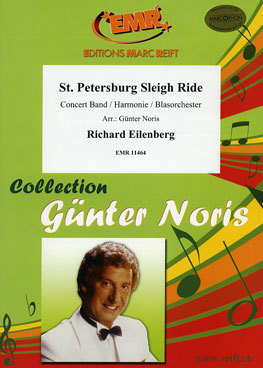
ST. PETERSBURG SLEIGH RIDE (Advanced Concert Band) - Eilenberg, Richard - Noris, Gunter
Duration: 3:10
Estimated dispatch 7-14 working days
-
 £57.50
ST. THOMAS (Young Band) - Brown, Michael
This Latin/jazz standard by jazz great Sonny Rollins provides a great way to spice up any occasion. Michael Brown's skilful concert setting includes solid ensemble writing and feature spots for the percussion section
Estimated dispatch 7-14 working days
-
£24.95
STANDARD OF ST GEORGE (Military Band) - Alford, Kenneth J.
Marchcard-size
Estimated dispatch 7-14 working days
-
 £109.50
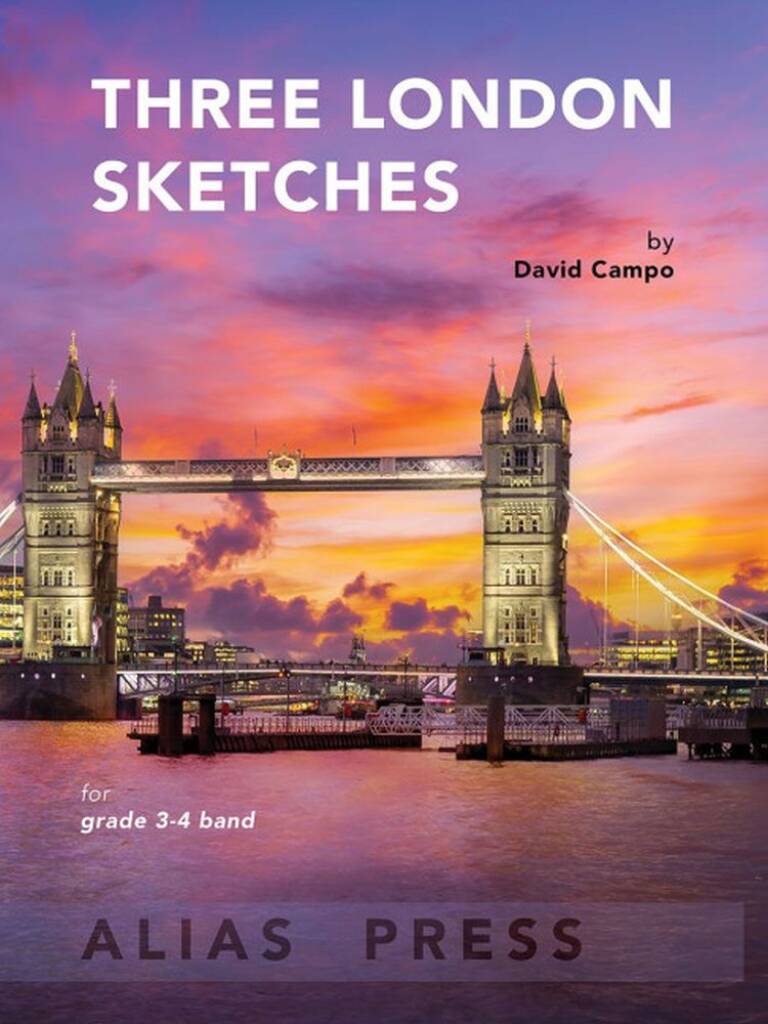
Three London Sketches - David Campo
London is one of my favorite cities in the world, and in 2016 I was invited there to serve as an adjudicator for the London New Year's Day Parade and Gala Concerts. While I was there, I was fortunate to meet and spend time with The Lord Mayor of Westminster Councillor Steve Summers. While his title sounds formidable and intimidating, I found Steve to one of the nicest, most easygoing people I've ever met. And boy, does he love London! He was fond of saying that he had "the best job in the greatest city in the world." He spoke passionately about London and his favorite places in the city, and his enthusiasm was contagious. Some of his favorite places became some of my favorite places, and the inspiration for this piece. I hope that this work not only conveys the beauty and history of these iconic places, but Steve's deep and abiding love for them as well. I. Tower Bridge - The Tower Bridge was built over 120 years ago to ease road traffic while maintaining river access to the busy Pool of London docks. Its giant moveable roadways lift up for passing ships, making it a true engineering marvel. It is also one of the most iconic sites in London, and was used to display the Olympic Rings during the 2012 Olympics. II. St. Paul's (The Whispering Gallery) - The history of St. Paul's Cathedral goes back well over a thousand years, but construction on the current St. Paul's began in 1669 after a fire destroyed the earlier structure. The dome of St. Paul's Cathedral is a whispering gallery; you can whisper against the wall on the inside of the dome and it can be clearly heard on the other side of the dome over 100 ft. away. Imagine the secrets that have passed there... III. Trafalgar Square - The name commemorates the 1805 naval Battle of Trafalgar and is marked by Nelson's Column, a monument to Admiral Horatio Nelson, the hero of the Battle of Trafalgar. It is the heart of London; full of life and constant energy and home to iconic buildings including the National Gallery, St. Martin-in-the-Fields, Canada House and South Africa House. Londoners say that all roads in London lead to Trafalgar Square.
Estimated dispatch 7-14 working days
-
 £104.99
Prelude and Polonaise - Nikolai Rimsky-Korsakov
Nikolai Rimsky-Korsakov (1844-1908) composed his opera The Night before Christmas in 1894-95. The premiere took place on December 10 1895 in St. Petersburg. The libretto to the opera came from Rimsky-Korsakov himself and is based on a tale by Nikolai Gogol, which some years earlier had already served as operatic material for Pjotr Tchaikovsky. The opera tells the story of Vakula, the blacksmith of a small Ukranian village. He is madly in love with Oxana who demands - as proof of his love - a most unusual Christmas present: the magnificent slippers of the Empress. Knowing full well that, in normal circumstances, he would never be able to fulfil Oxana's wish, Vakula seekssupernatural assistance and finds it in the shape of the devil, who comes up with a ploy to help him. The devil carries him on his back to St. Petersburg, where during a lavish reception at court Vakula finds an opportunity to present his request to the empress. The Empress actually agrees to Vakula's wish and hands over her slippers to him. Thereupon he returns to his own village. Here, in the meantime, he had been given up for dead, and Oxana had been plunged into great sorrow as she had come to realise that she also truly loved Vakula. In the end, however, all misunderstandings are resolved and all adversities overcome: Oxana receives her extravagant present, the lovers are united, and the church bells call the villagers to the Christmas service.The vibrant Polonaise is played in the 3rd act of the opera at the entrance of the Empress, whose appearance is anticipated in the prelude by the fanfare motives. The music paints a vivid picture of the party atmosphere and the marvellous dcor at the imperial court of St. Petersburg, which Rimsky-Korsakov conjures up in his opera and which can also be played outside of the Advent and Christmas season, for example as an opening piece to any festive concert.
Estimated dispatch 7-14 working days
-
£184.99
Il Cantico - Oliver Waespi
Commissioned by the Stadtharmonie Zurich Oerlikon-Seebach for the 2005 WASBE Conference in Singapore"Il Cantico" was inspired by the poem "Cantico di Frate Sole" (Canticle of Brother Sun) by St. Francis of Assisi. In this famous mystic poem, St. Francis expresses his gratitude to God for the creation of nature, the sun, the earth and the living beings."Il Cantico" is based on specific parts of St. Francis's poem. A slow, dreamlike song in the flute leads gradually to the appearance of the sun, the light energy of which is expressed by radiant, powerful music in the brass instruments. The next, slower part of the work is dedicated to the moon (sora luna), a sort of mirror of thesun, and to the stars (le stelle). The music becomes more thoughtful, leads to a calm sound field in the woodwinds and later to a mystic horn solo. Still during the slow part, several chord fragments flash up, thereby announcing the fast ultimate part of the work. This part is about the fire (frate focu) illuminating the night, some sort of representative of the sun on earth. Towards the end of the work, the sun theme is combined with the fire theme.Besides these images, a purely musical structure guides the development of Il Cantico. Almost the entire piece evolves from a basic four-tone cell which appears in the horns and flute at the beginning. Consequently, the work is mainly monothematic and structured in the form of a metamorphosis. The basic cell gradually leads to a rich melodic and harmonic development. This basic material is later completed by a new chord series belonging to the fire theme. In the conclusion both approaches are combined.
Estimated dispatch 7-14 working days
-
 £128.80
La Citt - Michael Geisler
Symphonic concert work, dedicated to the Bauernkapelle St. Georgen, conductor Johannes Biegler. The concert work "La Citt", which translates as "The City", is a tribute to the district of St. Georgen near Eisenstadt in Austria.The work begins with a majestic introduction in which the main theme is presented. The following Allegro con Spirito. Is intended to symbolize the occupation of the Romans after the birth of Christ. The "St. George's Song", a folk tune arranged in various registers, is heard. Another fast section reminds us once again of the Romans. After a reprise of the opening theme with various solos, the work ends in a grandiose finale with the whole orchestra.
Estimated dispatch 7-14 working days
-
 £138.00
The Saints And the Royal - Eric Swiggers
The Saints and the Royal was composed on behalf of Royal brass band St. Willibrord Heeswijk on the occasion of its 200th anniversary in 2023.When the marching band was founded in 1823, it was given the name "Harmonie Sint Cecilia," referring to Saint Cecilia, the patron saint of music. Around 1904, the name was changed to 'Kerkelijke fanfare Willibrord', strongly emphasizing the connection with the church in Heeswijk, of which Saint Willibrord is the patron saint. In 1973, at its 150th anniversary, the band received the predicate 'royal'. From that time on one speaks of the Royal brass band Saint Willibrord.The composition musically depicts both Saints Saint Cecilia and Saint Willibrord and the jubilee royal brass band. Although one of the oldest musical societies in the Netherlands, this fanfare is alive and kicking and will celebrate its 200th anniversary in 2023. The composition therefore opens festively and energetically. The alto saxophone plays a recitative, the Gregorian "Cantantibus organis Caecilia virgo in corde suo soli domino decantabat" from the vespers of the feast day of Saint Caecilia, the patron saint of music. This is taken over by the full wood and soft brass group. After a brief, playful interlude, this chant is played by the full orchestra, like an organ, larded with circumambulations.St. Willibord was born in England but made the crossing to the Netherlands in 690 to preach the gospel as a missionary. This was far from harmless and he faced frequent uprisings. After his death he was buried in Echternach in Luxembourg. In this place he is commemorated to this day with the annual "Spring Procession" or "Dance Procession". This procession of Echternach went as follows until 1947: 3 steps forward, 2 steps backward. Hence we hear this procession back in a 5/8 measure: 3 + 2.After this procession, the Gregorian vesper of Sint Caecilia sounds one more time, leading the composition to a reprise of the opening: The jubilee Royal Fanfare Sint Willibord Heeswijk.
Estimated dispatch 7-14 working days
 View Music