
Results
-
 £95.99
5 Tantum Ergo - Anton Bruckner
Anton Bruckner (b. 4.9.1824, Ansfelden, d. 11.10.1896, Vienna) didn't have it easy. Throughout his life, the Austrian composer was plagued by self-doubt. Anton Bruckner came from a simple, rural background. After the death of his father, he was accepted as a choirboy at the monastery of Sankt Florian in 1837. After several years as a school assistant and his own organ and piano studies, he first worked as organist in St. Florian, then from 1855 as cathedral organist in Linz. Introduced to music theory and instrumentation by Simon Sechter and Otto Kitzler, he discovered Richard Wagner as an artistic role model, whom he admired throughout his life and also visited several times in Bayreuth.In 1868 Anton Bruckner became professor of basso continuo, counterpoint and organ at the Vienna Conservatory; ten years later court organist; and in 1891 finally honorary doctor of the University of Vienna. He was considered an important organ virtuoso of his era, but had to wait a long time for recognition as a composer. It was not until Symphony No.7 in E major, composed between 1881 and 1883, with the famous Adagio written under the effects of Wagner's death, that he achieved the recognition he had hoped for, even if he was reluctant to accept it given his inclination towards scepticism and self-criticism.Anton Bruckner was a loner who did not want to follow a particular school or doctrine. He composed numerous sacred vocal works, such as his three masses, the Missa Solemnis in B flat minor (1854), the Te Deum (1881-84) and numerous motets. As a symphonic composer, he wrote a total of nine symphonies and many symphonic studies from 1863 onwards, tending to revise completed versions several times over. Bruckner's orchestral works were long considered unplayable, but in fact were merely exceptionally bold for the tonal language of their time, uniting traditions from Beethoven through Wagner to folk music, on the threshold between late Romanticism and Modernism.Hymns for four-part mixed choir a cappella (1846, St. Florian)No. 1 in E flat major (WAB 41/3): Quite SlowNo. 2 in C major (WAB 41/4): AndanteNo. 3 in B flat major (WAB 41/1): SlowNo. 4 in A flat major (WAB 41/2): SlowHymn for five-part (2 S, A, T, B) mixed choir and organNo. 5 in D major: SolemnlyThey are simple works, completely subordinate to their liturgical use, which nevertheless already show numerous characteristics of personal expression. These small pieces were able to stand up to the harsh scrutiny of the mature master: in 1888, Bruckner subjected them to a revision in which he made only minor corrections.
Estimated dispatch 7-14 working days
-
 £134.99
Compostela - Thierry Deleruyelle
"Four roads lead to Santiago", so begins the Book of the Pilgrim. Written in the 12th century, the Codex Calixtinus opened the way for pilgrimage from most cities in Europe and North Africa to Santiago de Compostela, in Spain. Compostela - The Way of St James describes the pilgrims' journey. After a slow introduction, a brilliant theme announces the start of the journey. The arrival in Spain is indicated by incantatory chants and majestic chords. Finally, the music softens as the pilgrims venerate St James.
Estimated dispatch 7-14 working days
-
 £109.99
Around a Village - Menno Haantjes
The idyllic village Beetsterzwaag, in the east of Friesland, and its surroundings are depicted in this suite. The first part describes the main street with its liveliness. The second part brings us to the nearby church of St. Hippolytus-Olterterp while the final section describes the children playing in the woods of Sparjebird. Het idyllisch in de Friese bossen gelegen dorp Beetsterzwaag en haar omgeving staat model in deze landelijke suite. Het eerste deel beschrijft de hoofdstraat met al haar levendigheid. Het tweede deel brengt ons in het naburige St. Hippolytus-kerkje van Olterterp terwijl het slotdeel de spelende kinderen beschrijft in het speelbosSparjebird.
Estimated dispatch 7-14 working days
-
 £57.50
Nonantum Bulgar - Hankus Netsky
Adding to the minuscule number of Klezmer pieces for concert band, Nonantum Bulgar is the 20th piece published in the BandQuest series. The title, Nonantum Bulgar, refers to Nonantum, a district in Newton which is home to the city's oldest synagogue (on the National Register of Historic Places), and bulgar (pronounced 'bull-ghar'), a type of Klezmer dance. When writing the piece, the composer imagined the dedication of the Adams St. Shul, which took place over one hundred years ago and featured a prominent Boston cantor and choir and a klezmer orchestra leading a Grand March down Adams St. This upbeat work is fun to play, features a trumpet solo, and gives every instrument the opportunity to play the melody. Learn more on YouTube! BandQuest, an exciting series of new music and accompanying curricula for band, is a program published by the American Composers Forum. The series was started as a response to feedback from music educators that there is a pressing need for new, fresh band music. The heart of this program is new works written by a diverse group of leading American composers who have created challenging pieces that are a true departure from standard middle school repertoire. Every BandQuest project includes a residency component in which the composer works collaboratively with a middle school as they create their new piece. Many BandQuest pieces are accompanied by an interdisciplinary curriculum designed to assist students as they learn the music and to integrate each piece with non-music studies. Visit www.bandquest.org to learn more about this innovative series, and email [email protected] to request a free downloadable audio catalog.
Estimated dispatch 7-14 working days
-
£69.99
Floriana - Henk Hogestein
The convent of St. Florian was the place of work of the Austrian composer Anton Bruckner. It was in the rural setting of this convent with its marvelloaus church that Bruckner composed many of his great symphonies. St. Florian Choral is Thomas Doss' modest tribute to this great master whose music has left its permanent mark on the composer's musical life.
Estimated dispatch 7-14 working days
-
 £84.99
Wachet Auf! - Felix Mendelssohn Bartholdy
This excellent arrangement by Robert van Beringen is of the well-known German chorale Wachet auf, ruft uns die Stimme, taken from the oratorio Paulus (St. Paul) by Felix Mendelssohn Bartholdy (1809-1847). Although accredited to Mendelssohn it is thought the melody was in fact written by the pastor and poet Philipp Nicolai in 1599. Robert van Beringen's arrangement perfectly captures the biblical story of St. Paul.
Estimated dispatch 7-14 working days
-
 £144.99
Ross Roy - Jacob de Haan
Jacob de Haan was commissioned to compose this concert piece by the "St. Peters Wind Symphony" from Brisbane, Australia. "Ross Roy" is the monumental late 19th century villa where St. Peters Lutheran College was founded in 1945. The villa has always remained the school symbol. In this composition, Jacob de Haan sees the "Ross Roy" as a metaphor for the years spent at school (a monument in time), where one's personality is formed. So, the opening theme the artist calls the Ross Roy theme initially has monumental characteristics.The rhythmic motion, which strides along in the lower register and percussion at the beginning of the next section is typical of "Tempo di Marcia". Thismovement, accompanied by repetitions of sound, is a metaphor for the structure and discipline in school. This is the introduction to a march theme, symbolic of "passing through" the classes up to the final examinations.Then, the Ross Roy theme is dealt with again, now in a playful, humorous variation. As if the composer is saying there should also be time for a smile in school. The same theme can be heard in major key and a slower tempo in the following section, expressing pride and self-confidence. This is also the introduction to the expressive middle section that represents love, friendship and understanding.We then return to the march theme in a slightly altered construction. The oriental sounds, constituting the modulation to the final theme, are symbols of the diversity of cultures in the school. The characteristic final theme first sounds solemn, but turns into a festive apotheosis. It is no coincidence that the final cadence is reminiscent of the close to a traditional overture, for the school years can be considered the "overture" to the rest of one's life. The premiere of "Ross Roy" was conducted by Jacob de Haan in Brisbane, on August 22, 1997.
Estimated dispatch 7-14 working days
-
 £84.99
Yellow Mountains - Jacob de Haan
In October 1997, Jacob de Haan visited the Swiss village of St. Moritz, where he worked as a conductor with a symphonic wind band. The Mountains around St. Moritz were covered in marvelous autumn colors. The Colors, the quietness and nature itself inspired Jacob de Haan to compose this lyrical composition.
Estimated dispatch 7-14 working days
-
 £50.50
The Last Gladiator - Timothy Loest
Experience the brutal energy of the Roman Colosseum in this larger-than-life work by Timothy Loest. Heart-pounding drums and sword-clashing sound effects tell the heroic story of St. Telemachus, a frail monk whose bravery brought the gladiatorial games to an end. Exhilarating and epic, The Last Gladiator will absolutely be a student and audience favorite!
Estimated dispatch 7-14 working days
-
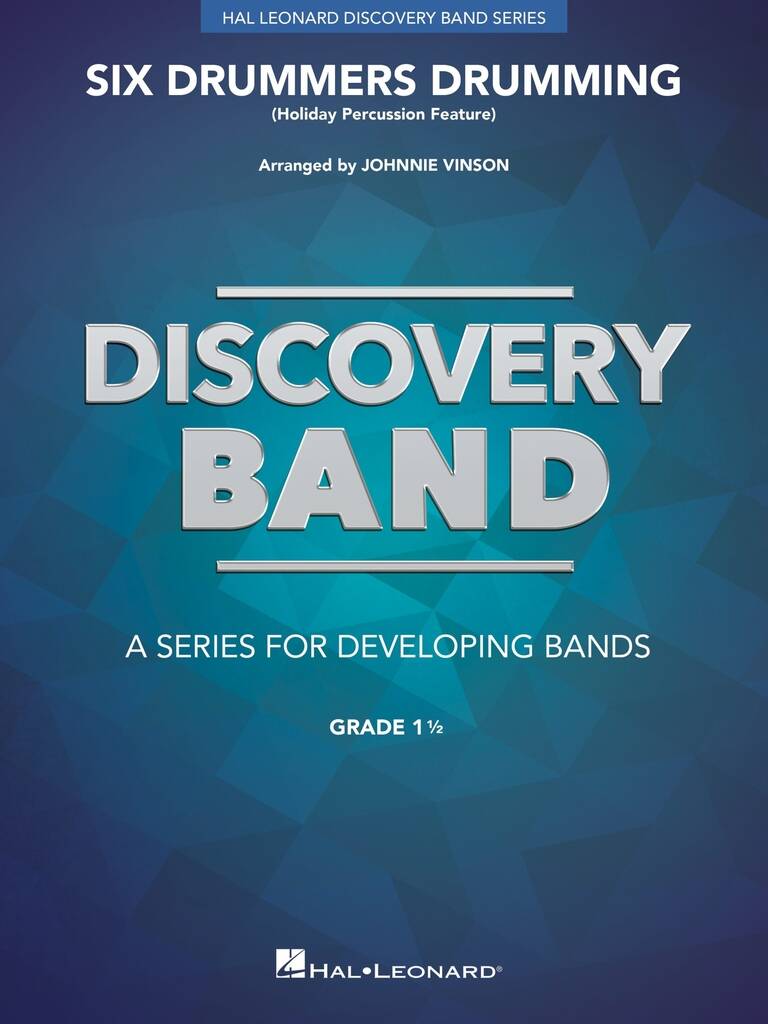 £53.50
Six Drummers Drumming
Using fragments from The Twelve Days of Christmas, Jolly Old St. Nicholas, and We Wish You a Merry Christmas, Johnnie has created a clever percussion feature sure to be a hit at your holiday concert and also fun for the entire band. The percussion parts can adjusted based on the number of players you have available, so just remember to change the title to fit your performance!
Estimated dispatch 7-14 working days
 View Music