
Results
-
£73.60
Live is Life - Opus One
Estimated dispatch 7-14 working days
-
£74.99
Live Is Life - Herwig Ruedisser, Kurt Rene Plisnier, Gunter Grasmuck, Ewald Pfleger & Niki Gruber - Johny Ocean
Estimated dispatch 10-14 working days
-
£87.00
-
£106.95
Dream, Imagine, Live - Larry Clark
The inspiration for this piece comes from one of Henry David Thoreau's most famous quotes - Go confidently in the direction of your dreams! Live the life you've imagined. It was Thoreau's vision that we contemplate a simpler life and be deep thinkers about what we want our lives to be. The piece is divided into three distinct sections based on the same three-note motive. The first section is intense and bold, the second is introspective and lyrical and the third is dance-like, almost reminiscent of a Celtic folk song, in lilting in 6/8. This perfect contest or festival selection will highlight your band's strengths.
Estimated dispatch 7-14 working days
-
 £75.50
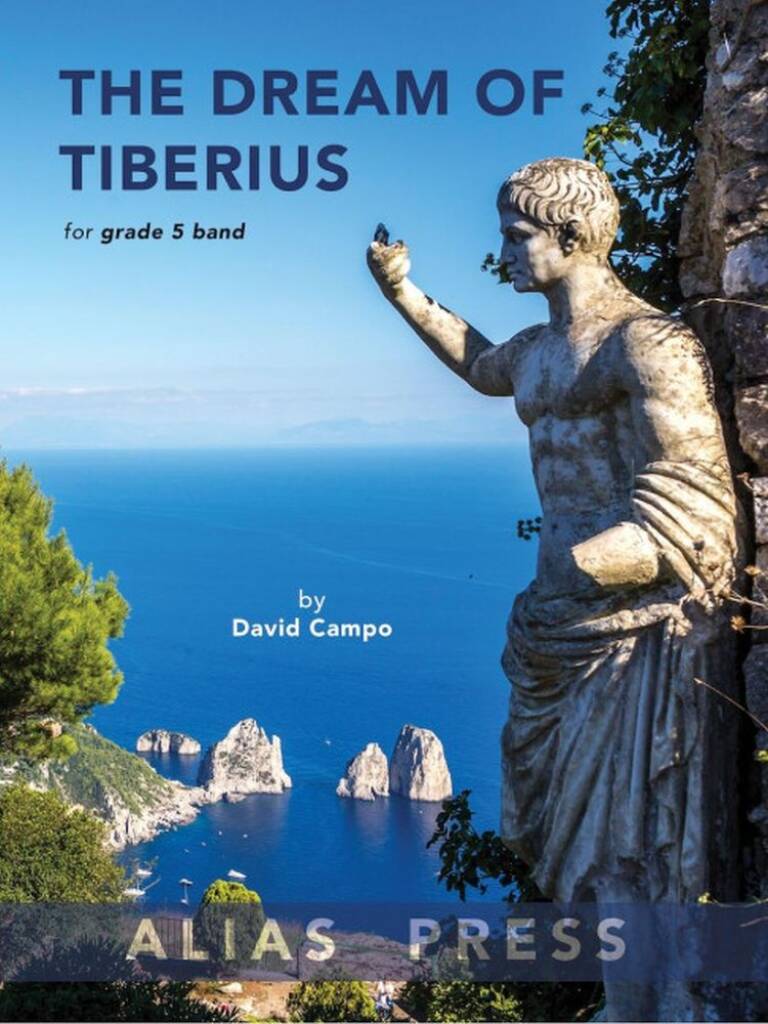
The Dream of Tiberius - David Campo
The Roman Emperor Tiberius was born in 42 BCE to Tiberius Claudius Nero and Livia Drusilla, both descendants of prestigious political families, at a time when Rome was undergoing significant political upheaval. Julius Caesar had begun a brutal civil war in 49 BCE to end Rome's rule as a Republic and consolidate his power as supreme ruler. Following Caeser's assassination in 44 BCE, Tiberius' father backed the forces wishing to return Rome to a Republic, but they were defeated by Caesarian loyalists led by Caeser's heir Octavian. As a result, Tiberius' early life was spent on the run and in political exile with his parents. In 27 BCE, Octavian would become the first Emporer of Rome and assume the name Augustus. Augustus forced Tiberius' parents to divorce and took Tiberius' mother as his new bride, separating the family and forcing Tiberius to live with his father. Upon his father's death, Tiberius went to live with his mother and Emporer Augustus, a situation Tiberius found extremely uncomfortable but one over which he had no control. Having been adopted by the Emperor, Tiberius assumed the military and political life thrust upon him. He proved to be an outstanding military and political leader, and with his marriage to Vipsania Agrippina his life took on a heretofore unknown stability. However, Augustus would intervene in Tiberius' life once more, forcing him to abandon his happy marriage and take Augustus' daughter Julia (Tiberius' step sister) as his new wife. This arrangement, while securing Tiberius' place as Augustus' heir and ensuring he would one day be Emperor of Rome, was disastrous. Julia's drunken licentiousness was a constant source of scandal and embarrassment for Tiberius (and her father, the Emperor) and she was eventually exiled by her father Augustus. Tiberius was named Emperor of Rome upon the death of Augustus in AD 14, assuming his position as the most powerful man on Earth. However, no matter how powerful he had become, Tiberius never felt as if he had ever had any control over his life, having been manipulated from childhood through adulthood by the whims of Augustus. As Emperor, he soon became disgusted with the political intrigue of the Roman Senate and by AD 26 left Rome and took up residence on the island of Capri, where he lived out the rest of his life. History does not regard Tiberius fondly and by all accounts towards the end of his reclusive life on Capri, he had become a miserable, sick and mentally unstable old man reveling in debauchery and cruelty. It is also informative to note that he was Emperor of Rome when Jesus of Nazareth was crucified, and while there is no indication that Tiberius was even aware of the existence of Jesus, as Emperor he was responsible for the appointment of Pontius Pilate as Governor of Judea. Even considering this, it is difficult to look on the life of the Emperor Tiberius and not feel some sympathy and pity. It's in this spirit that I composed "The Dream of Tiberius." I imagine the man sitting in thoughtful seclusion on the beautiful island of Capri imagining what his life might have happily been had not power been thrust upon him: husband, father and humble servant of the people.
Estimated dispatch 7-14 working days
-
 £119.60
Frankenstein - Kelly Bennette
This tone poem entitled Frankenstein is based on the original novel by Mary Shelley (1797-1851). Victor Frankenstein creates life from pieces of many dead bodies. Soon, his monster comes to life. Though very intelligent, the monster has the maturity of a child. In a fit of rage, the monster kills William, Victor's younger brother. The monster finds Victor in The Alps and asks him to make him a mate. Victor makes him a mate, but kills her. The enraged monster tells Victor, "I will be with you on your wedding night." The monster forces his way into the wedding and kills Victor's fiance, Elizabeth. Victor chases the monster all the way to the Arctis where he dies of exhaustion. The monster finds Victor's body and realizes he has nothing to live for and goes away to die.
Estimated dispatch 7-14 working days
-
 £139.99
Le Cortge du Roi Renaud - Franco Cesarini
Le cortge du roi Renaud is a suite in five parts. It is based on tales that originated in southern European folk songs, dating back as far as the 16th century. A large portion of these songs are of the genre "Complaintes" songs in which the text gives a detailed description of events having a generally criminal or macabre character. The most familiar song to feature the tales of Roi Renaud is "Fualdes", consisting of 48 verses.The first part of the suite is based on the song "La Porcheronne" (The Swineherd). It telis the story of a young woman forced by her mother-in-law to tend pigs while her husband is away fighting in the war. She is freed only when her husband returns sevenyears later.The next part tells the story of "La mrquise Empoisonne" (The Poisoned Marquise). A marquise is coerced by her king to become his mistress. The jealous queen poisons her by means of a bouquet of deadly scented fiowers.Despite having the character of a merry dance, the third part, "La maumarie vengee" (The Avenged Wedding), expresses the touching story of Queen Clotilde, persecuted for her refusal to live according to the Aryan beliefs."La belle engloutie" (The Swallowed Beauty) relates the tale of the young wife of King Renaud. She cannot imagine a life without her husband, who was mortally wounded in the war, and begs the earth to open and swallow her up so thst she may rejoin her love.The gruesome content of the final part,"Le tueur de femmes" (The Wife Killer), bears a strong resembiance to the tale of Bluebeard. The story is about a young wife in danger of being drowned in a pond by her husband, which is what happened to her 13 predecessors. Thanks to her cunning, she manages to turn the tables and contrive her husband's demise.
Estimated dispatch 7-14 working days
-
 £199.99
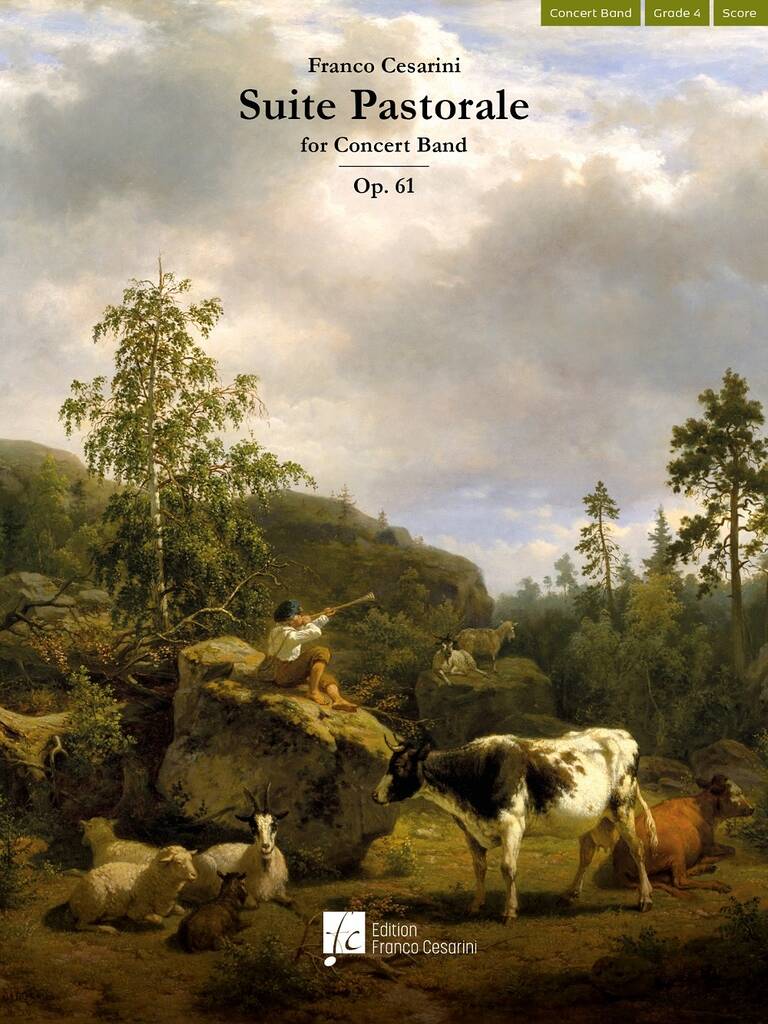
Suite Pastorale - Franco Cesarini
Suite Pastorale, made up of three movements - Idyll, Playful Shepherd Boys, Rain Upon the Fields - is characterized by an idealization of the simplicity of country life in close contact with nature. Suite Pastorale depicts the eternal and fascinating myth of Arcadia: a world in which man lives in harmony with nature, immersed in bucolic forest landscapes, one of the most important imaginary places to escape to for those who were, and still are, tired of culture and civilization. The evocative Arcadian world is made almost mythological by the attention dedicated to it by poets, writers, playwrights, painters, and composers who over the centuries have drawn lifeblood from it for their works. Full of metaphorical meanings, it is a place of shelter, a place to live and sing about love, even if it means disappointment, and it is the place of civilization opposed to barbarism. It is a symbol of happiness, a real and intact image of reality, motionless in space and time, where nothing changes. The myth of the "locus amoenus" has not disappeared but has kept all its charm intact over the centuries.Suite Pastorale was commissioned to Franco Cesarini by the concert band of Aldeno (Trento/Italy) for the 100th anniversary of its foundation (1923-2023.Suite Pastorale: an ideal concert piece that will delight your audience!
Estimated dispatch 7-14 working days
-
£74.00
Radetzky-Marsch, Op. 228 - Johann Strauss Sr.
Presented for the first time in August 1848 in Vienna, Johann Strauss Sr's Radetzky-Marsch is one of the most famous marches ever composed, dedicated to Field Marshal Joseph Radetzky von Radetz. Strauss was commissioned to write it to commemorate Radetzky's victory in the battle of Custoza.Next to the waltz An der schnen blauen Donau - On the beautiful blue Danube - by Johann Strauss Jr, the Radetzky-Marsch has assumed the role of 'unofficial' Austrian anthem over time. When it was performed for the first time in front of officers, these began to beat their hands and feet to the rhythm of the music, giving life to a tradition often seen in many concert halls when the march is performed live.The Vienna Philharmonic always performs the march as the final piece in the famous New Year's Concert.
Estimated dispatch 7-14 working days
-
 £56.50
Vermilion River Serenade - David Campo
The Vermilion River runs through the heart of my hometown of Lafayette, LA. It was created when the ancient course of the Mississippi River, which originally ran through the area that is now Lafayette, shifted from west to east and left a channel through the plains. While originally home to the Atakapa-Ishak and Canneci (Lipan Apache) Tribes and the competing Choctaw Tribes, between the years 1765 and 1785 the first great wave of immigration occurred in South Louisiana and Acadian exiles settled the area. They created a profitable fur and deerskin trading business along the Vermilion River, and the Old Spanish Trail reached the Vermilion right about where the village of Vermilionville (later Lafayette) was founded. Subsequently, the town grew and flourished on both sides of the Vermilion. The tranquil river and its scenic banks, adorned with live oaks draped in Spanish moss, provided the backdrop for early Cajun life as the river was a source of food, communication, travel and commerce. This piece is a "postcard;" an homage to my culture and to the river that brings me great peace every time I encounter its pastoral beauty and serenity.
Estimated dispatch 7-14 working days
 View Music