
Results
-
 £53.95
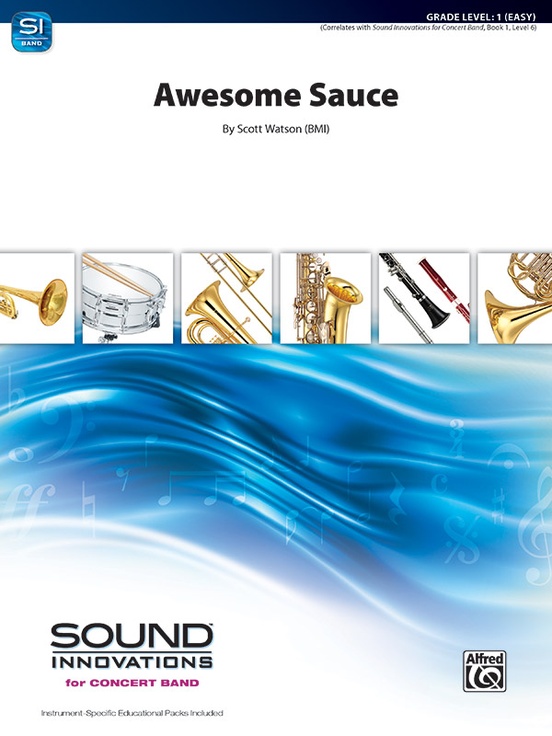
Awesome Sauce (Concert Band - Score and Parts) - Watson, Scott
You're cool, likeable, and confident. You don't walk, you strut. When you enter a party, a hush falls over the room and heads turn because you have a certain "je ne sais quoi!" People say you're "the bee's knees" and "the cat's meow." You're Awesome Sauce and this piece is the soundtrack of your life! With its fun, blues-like melody and cool rock beat, Awesome Sauce by Scott Watson is sure to be a player favorite. The limited chromaticism, accessible jazz-esque rhythms, and style-important articulations offer excellent teaching moments for the director. Duration: 3.00
Estimated dispatch 7-14 working days
-
 £84.99
Yakolo (Concert Band - Score and Parts) - Oswald, Gerald
Yakolo is originally a dance song from Africa. It reflects the people of Africa's zest for life, following the maxim Come and join us!. In this work, the call and response principle is featured as a trademark element of traditional African music. The rhythmic melodies invite listeners to sing and dance along and thus give shape to the African art of celebrating together. The repeating themes will be sure to put a smile on everyone's face!Duration: 3.30
Estimated dispatch 7-14 working days
-
 £184.99
Einstein (Concert Band - Score and Parts) - Doss, Thomas
Theoretical physicist and Nobel prize winner Albert Einstein (1879 - 1955) developed the theory of relativity, one of the basic tenets of modern physics: who doesn't know his formula E = mc2? This impressive, exciting work from Thomas Doss tells the life story of Einstein using spectacular effects to enforce the musical ideas. This is a daring and original choice for a contest and surely a guaranteed success as a main piece for your concerts.Duration: 13.00
Estimated dispatch 7-14 working days
-
 £76.95
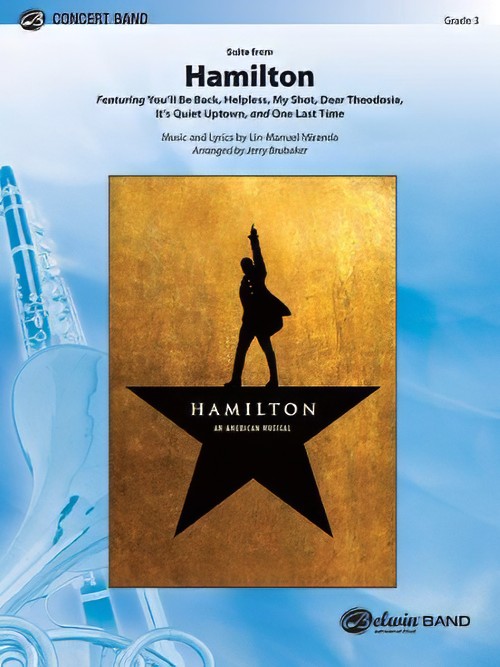
Hamilton, Suite from (Concert Band - Score and Parts) - Miranda, Lin-Manuel - Brubaker, Jerry
Hamilton is a musical about the life of American Founding Father Alexander Hamilton, with music, lyrics, and book by Lin-Manuel Miranda and others. In 2016, it was nominated for a record-setting 16 Tony Awards?, winning 11 (including Best Musical), and was also the recipient of the 2016 GRAMMY? Award for Best Musical Theater Album and the 2016 Pulitzer Prize for Drama. Jerry Brubaker has chosen six of the most musical selections from the Broadway show to use in this arrangement, including "You'll Be Back," "Helpless," "My Shot," "Dear Theodosia," "It's Quiet Uptown," and "One Last Time." Experience the beauty and excitement of this amazing musical! Duration: 6.00
Estimated dispatch 7-14 working days
-
 £76.99
Whispers from Beyond (Concert Band - Score and Parts) - Galante, Rossano
Composed as a tender tribute to a lost friend, this is meant not to be a mournful piece, but rather a joyous remembrance of a life ended too soon. The work features two primary themes that ebb and flow as the music progresses. Soaring melodic lines and rich orchestration help bring character and distinction to this effective and emotional piece. Duration: 4:00
Estimated dispatch 7-14 working days
-
 £74.99
Three Colonial Moments (Concert Band - Score and Parts) - Kirby, Rick
Depicting three contrasting and intriguing settings from early American lore, Rick Kirby masterfully brings these images to life in this suite for band. The first movement tells the legend of The Phantom Drummer with unique orchestrational effects. The second movement, The Lady's Lament, mourns the loss of loved ones in the Revolutionary War, and the suite concludes with the lively dance Virginia Two-Step. Rich in stylistic and tonal variety, this is an appealing work for concert or festival use.Duration: 8:00
Estimated dispatch 7-14 working days
-
 £62.95
Zombie Dreams (Concert Band - Score and Parts) - Barrett, Roland
Defined as a reanimated corpse by supernatural means, this original work explores life (or death) through a variety musical scenes both normal and abnormal... even waltzing! With a few special effects to set the mood, dynamic shifts and instantaneous style changes keep the zombies alive. Spooky and engaging, this is a real imagination enhanced by music.Duration: 4:45
Estimated dispatch 7-14 working days
-
 £58.50
It Had Better Be Tonight (Concert Band - Score and Parts) - Mancini, Henry - Phillippe, Roy
A classic pop tune from the pen of Henry Mancini has enjoyed new life with the energy infused by Michael Buble on his "Call Me Irresponsible" CD. Roy Phillippe has transferred this energy in his young band arrangement. Complete with salsa-style percussion, this is one hot chart. High energy!Duration: 1.45
Estimated dispatch 7-14 working days
-
 £139.99
Gayaneh, Four Excerpts from (Concert Band - Score and Parts) - Khachaturian, Aram - Van der Beek, Wil
In 1941, Khatchaturian composed a ballet soon to be known throughout the world - Gayaneh. In this piece the composer describes the landscape of his native country Armenia, and the people who tried to build the country to create a happy life there. Evil powers, however, try to destroy the peaceful work. Gayaneh is a young ordinary woman who cares greatly for her village. In addition to the fight for the village she also fights for her own happiness. Khatchaturian was a master at using elements of folk music in his compositions and these can be clearly heard in this arrangement for concert band by Wil van der Beek.Duration: 8:30
Estimated dispatch 7-14 working days
-
 £84.99
Holiday in Rio Wind Band Set (Score & Parts)
The party atmosphere of the beaches in Rio de Janeiro is famous worldwide. Holiday in Rio brings this party to life and, right from the first bar, conjures up a Brazilian spirit on the concert stage. No one will be able to resist the infectious rhythms of this exciting piece! 03:00
Estimated dispatch 7-14 working days
 View Music