
Results
-
 £279.99
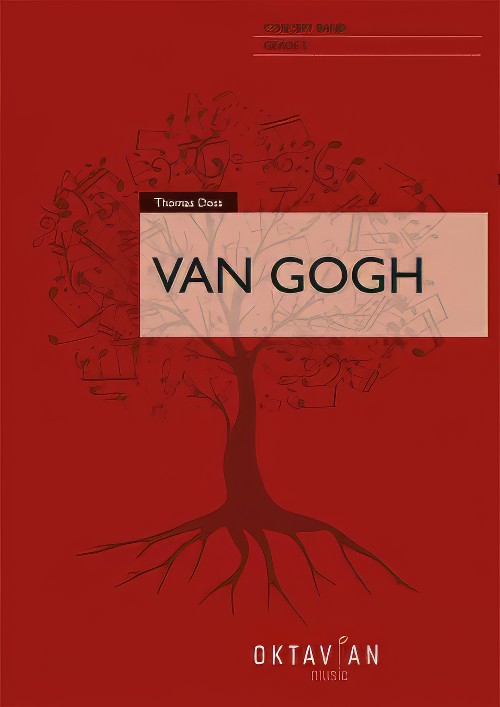
Van Gogh (Concert Band - Score and Parts) - Doss, Thomas
This composition is not a work inspired by the life of the famous painter, but rather an attempt at a pictorial immersion into his world. In addition to Van Gogh's character and tragic life, the technique he employed to create his works, the bright colours of his paintings and his view of nature served as inspiration for this musical work. Point by point, stroke by stroke, Van Gogh brought his own world to life on canvas.On the life of Van Gogh: The Dutch artist Vincent van Gogh was one of the most important pioneers of Modernism, despite being relatively unknown during his own lifetime. As an artist, he chose a life of poverty and seclusion. From today's perspective, his important woks were created from 1880 onwards, when he had already more or less succumbed to madness. While his earlier works could still be classed as contemporary, he matured into a pioneer of Expressionism with his later work indicating an increasing self-awareness. He was just 37 years old when he died but he created over 750 paintings and 1600 drawings in the last ten years of his life.The structure of the work:Start: Brushes and Paints: Van Gogh retired to Arles in southern France where he found his artistic home. The colours and flowering gardens of this landscape awakened in him an unbelievably great creative power.A: A Picture Comes into Being: Van Gogh's psychotic episodes and bouts of depression did not stop him from painting wonderful pictures. Hardly anyone recognised his genius during his lifetime, on the contrary, he often felt misunderstood.C: Paris - Arles: In Paris (from 1886), Van Gogh became inspired by the French art scene. His works found few takers, however. He met and befriended the painter Paul Gauguin, but the lack of success made Van Gogh short tempered, and he began to drink. Eventually, he moved from Paris to Arles in the south of France to establish an artists' collective with Gaugin. Within a few weeks, the two got into such a violent argument that Van Gogh attacked his friend with a knife. The friends parted ways and afterwards Van Gogh cut off his right ear. In 1889 he voluntarily admitted himself into a mental hospital at St. Remy, suffering from hallucinations and fearing that he would lose his mind.G: The Starry Night One of his most famous paintings, created in 1898.H: Death and Brotherly Love Vincent van Gogh accepted an invitation to Auver-sur-Oise in 1890. This was one of his most intensive creative periods. He also went there for treatment, but his mental state hardly improved. After an extended walk, he injured himself fatally with a pistol under mysterious circumstances. Not even to his beloved brother Theo, who had supported him all his life, did he reveal on his deathbed how the accident had occurred.J: Art Market Today, Van Gogh's paintings are among the most expensive paintings on the art market. How ironic, given that he could hardly sell a painting during his lifetime. "I put my heart and soul into my work and lost my mind in the process." (Vincent van Gogh)Duration: 13.15
Estimated dispatch 7-14 working days
-
 £209.99
La Terre Wind Band Set (Score & Parts)
In the composition 'La terre' several aspects of Earth have been translated into sounds in an associative manner. The first part depicts Nature, Mother Earth, stability, the soil which is the source of life. Earth symbolizes tradition, rituals, fertility. In the music of the composition this can be heard in tonic and ostinato passages. Furthermore, human emotions such as gladness, sorrow, wonder, resignation, hope and despair, indissolubly connected as they are to mankind's life on earth, are musically reflected in sudden gusts of expression. Earth for us human beings is the solid ground on which everything in life takes place. In the second part different moods are evoked in a sort of toccata. Now and then the music sounds fragmented, at other times as a solid whole. The robustness of the music in this part has its roots in the earth, originates from it. It reflects stability and strength, but love and nostalgia are also present in soft and fragile tones. 'La terre' is a musical narrative about Earth, in which music has been given ample room to show its many-sided beauty. 14:00
Estimated dispatch 7-14 working days
-
 £209.99
Codon (Concert Band - Score and Parts) - Houben, Kevin
Codon is a term used in the field of molecular genetics to describe the interaction between the three elements that are important for both the creation and the preservation of life. Kevin Houben uses this term as a metaphor for the interaction between the conductor, the musicians and the committee of a concert band. They all have the same goal, to preserve the life of the band. This work consists of three movements, symbolising birth, life and death - either of a human being or a band. From the foundation of a band over good and bad times up to the optimistic future, this work will appeal to the soul of every band member in the world!Duration: 17:00
Estimated dispatch 7-14 working days
-
£332.99
Cantica de Sancto Benedicto Wind Band Set (Score & Parts)
Cantica de Sancto Benedicto is a three-movement work for mixed choir, soprano solo, concert band and organ ad libitum - on Latin lyrics that relate to the life of Saint Benedict. It was commissioned by the city of Norcia in Italy, where Benedict was born. The holy Benedict (480-547) is considered the founder of monastic life within the Roman Catholic Church. His enormous influence is especially owing to his monastic rule, the Regula Benedicti.Jacob de Haan has named the movements of Cantica de Sancto Benedicto after the Holy Trinity: the Father (Gloria Patri), the Son (Gloria Filio) and the Holy Spirit (Gloria Spiritui Sancto). The lyrics of thehymn Gemma Caelestis, (which, like the other texts, were originally used in Gregorian chant) are voiced by the choir. To this purpose, Jacob de Haan composed new, choral-like, homophone music. The sequence Laeta Quies is rendered by the soprano; the verses (divided over the three movements) are alternated with those of Gemma Caelestis. The work closes with an impressive grand finale, in which texts are used from the proprium of the mass in honor of the saint's day of the holy Benedict (11 July). Notes to the conductor: For this cantata, there are various possibilities for the performance. The first involves a performance in which the choir and soprano parts are only accompanied by organ. Such a performance has several advantages: since the band never sounds together with the choir and the soprano, no balance problems occur, and even a performance with a large concert band and a small cantata choir is conceivable. A special layout is also possible - with which you can set up a three-dimensional performance in a church. For example, the choir can sing in the chancel, accompanied by the choir organ; the soprano can stand on the gallery, accompanied by the main organ; and the band can be seated in another part of the church. The choir could also sing from a gallery. With layouts like this, working with two conductors is advisable. Choral parts available separately. 0:28:30
Estimated dispatch 7-14 working days
-
 £149.99
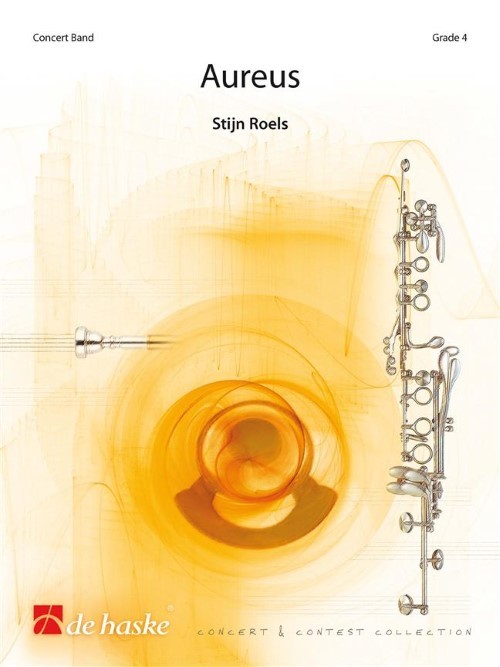
Aureus (Concert Band - Score and Parts) - Roels, Stijn
This composition was written on the occasion of the golden jubilee of the De Pinte wind band. This is also the derivation of Latin title Aureus (golden - from the word aurum, or gold). This work is comprised of three main sections. The first and last sections are predominantly a musical setting of the concepts of celebration and joy in keeping with the theme of jubilee. The music is therefore above all dynamic, energetic and extrovert. The middle section has a more introspective, melodic character, contemplating the subtle beauty of life. Aureus is a newly composed chorale that establishes the most important attributes in life and also within a club or association: love, friendship, health and happiness.Duration: 10:00
Estimated dispatch 7-14 working days
-
 £73.50
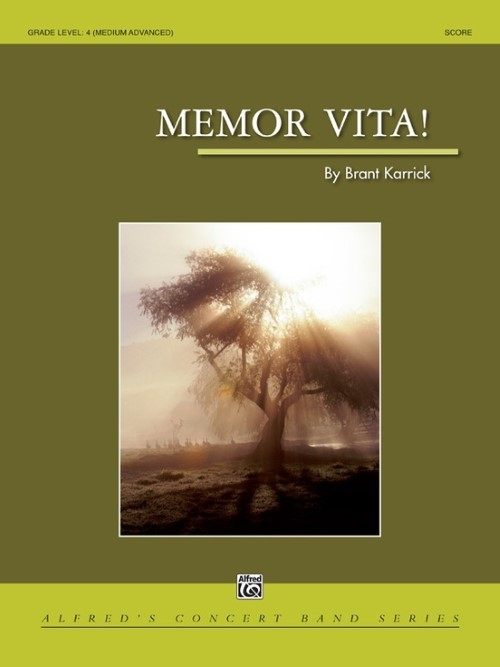
Memor Vita! (Concert Band - Score and Parts) - Karrick, Brant
There is nothing more precious on this Earth than human life, and every day we wake up to start a new day, we choose how to live our own. Memor Vita! is a musical celebration of life, particularly remembering the life of Zachary Joseph Heringer. Zach was diagnosed with cancer when he was 10 years old. He remained positive throughout the many months of treatments and had strong hopes of being cured. He was a vivacious boy who loved sports, the outdoors, and playing the trumpet in band. He was also an excellent student. He was looking forward to joining his high school band with his older sister, Beth, and his friends. However, the cancer continued to spread and at the age of 14, Zach passed away. He fought his cancer with faith, compassion, and an attitude to never give up, and his steadfast optimism left an indelible impression on all who knew him.Duration: 6.00
Estimated dispatch 7-14 working days
-
 £179.90
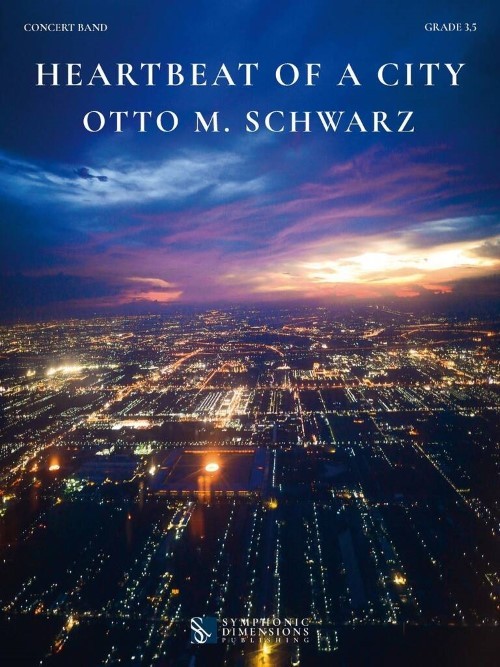
Heartbeat of a City (Concert Band - Score and Parts) - Schwarz, Otto M.
A city is founded, it has a heart that beats. But visible achievements such as buildings and infrastructure merely bear witness to what its true heart is made of, the people who have lived, and still live, in the city. The pulse of the city, brought to life by its heartbeat, changes over time. Who hasn't seen those time-lapse images showing twinkling lines of car lights as people make their way to work, while others stand at traffic lights, only moving as if at the push of a button? These are like life flowing in the veins, driven by a strong heart. Leonardo da Vinci had already imagined the rivers as the blood vessels of the Earth. In any city, though, it's not the rivers but the movement and activities of the people who live there. The heart doesn't always beat steadily, however, but its rhythm can be influenced by joy, fear, and many other things. Every city has its own pulse. This is also true of the university city of Marburg, where people from over 100 nations now live together in a cosmopolitan and tolerant community. This work describes the city from its founding in 1222, and the charity of Saint Elizabeth, all the way to the present day.Duration: 9.15
Estimated dispatch 7-14 working days
-
 £242.50
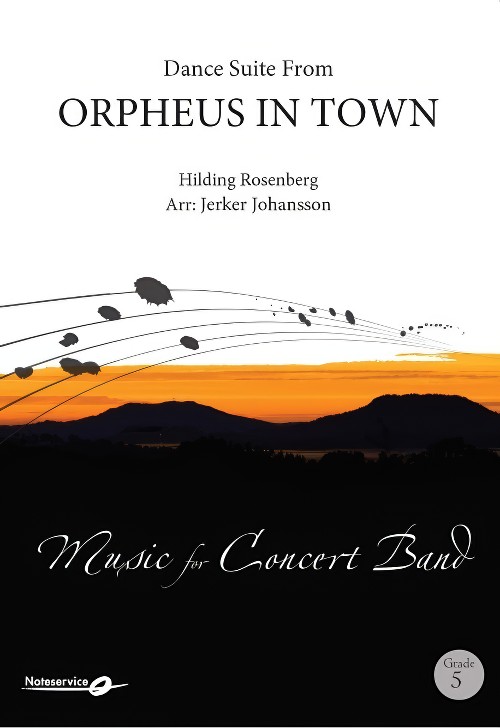
Orpheus in Town, Dance Suite from (Concert Band - Score and Parts) - Rosenberg, Hilding - Johansson, Jerker
Dance Suite in Seven Movements. Op.75. Orpheus In Town. In 1936 the Stockholm Concert Hall was given its most distinguished artistic adornment, Carl Milles' Orpheus fountain. A Greek god lets his voice and the sounds of his lyre float over the rush and bustle of the big city far up in Ultima Thule. Two choreographers at the Stockholm Opera, Julian Algo and Vera Sager, had a brainwave. Why should Orpheus merely be a statue, a symbol of the beauty and inspiring power of music, why not give the myth about him its special Stockholm chapter as well? This is what happened: On the stage we see the columned facade of the Concert Hall and in front of it the statue group with Orpheus and the eight enraptured listeners. Suddenly the figures come to life, jump down from their pedestal and dance into the crowd at the marketplace. Orpheus, who is consumed by longing for Eurydice, begins looking for his beloved, first among other well-known sculptures in town, then in restaurants and nightclubs. At last he thinks he recognises her in a fashionable society woman and brings her to the Concert Hall. However, faced with the threat of having to spend her life in bronze at Orpheus' side, she runs away. She wasn't Eurydice after all. Or was she? For this ballet, which had its first performance at the Stockholm Opera in 1938, Hilding Rosenberg wrote vital and entertaining music in a style which is unusually to the point, and with a bright and strong orchestration. The music in the Dance Suite from Orpheus in Town is taken from the dance scenes at the nightclub: guests and a bartender perform, finally also Orpheus and his entourage. The suite consists of: 1. Rhythm of the Times (2.00); 2. Bartender's Dance (1.30); 3. Girl's Dance (1.00); 4. Dance of the Negress (2.30); 5. Trio Dance (1.30); 6. Tango (2.00); 7. Finale (1.30). Total duration: 14.00.
Estimated dispatch 7-14 working days
-
 £139.99
Story of a Village (Concert Band - Score and Parts) - Waignein, Andre
This work relates the story of Maasbracht, a town on the banks of the Meuse River in the Dutch province of Limburg. Like all fairy tales, the story begins serenely with ?Once upon a time?? The music evokes the atmosphere of this very pleasant region, where the gentle way of life is the key to happiness. A lively and joyful passage depicts the cheerfulness of the people of Maasbracht. Maasbracht, like many other towns, suffered during World War II: sound colours darken and pictures of destruction run through our mind. In the midst of despair there is hope, from grief comes new life. The future looks promising. The work leaves Maasbracht, looking forward to the 21st century with confidence. A highly descriptive work that is suitable for any concert or contest situation.Duration: 10:00
Estimated dispatch 7-14 working days
-
 £149.99
St. Martin's Suite (Concert Band - Score and Parts) - Van der Roost, Jan
This suite was composed by Jan Van der Roost on the occasion of the 110th anniversary of the 'Koninklijke Sint Martinusfanfare' (Royal Saint Martinus Fanfare Band) from Halle (Belgium). The composer was required to create a suite in three movements based on three images associated with the 'Sint Martinusfanfare' from the small town of Halle in the province of Brabant. The first movement (Andante Pomposo) describes Martin, a soldier in the Roman army. In Andante Moderato we see the image of Martin, who become a Christian and chooses to devote his life to God. In this movement, the composer was inspired by the Brabantine gothic art of the Sint Martinus Basilica in Halle. The contrast between the dark Basilica and the statue of Our Lady between the soaring pillars will vividly come to life for audiences of this descriptive piece. The final movement, Allegro Molto Vivace', could have been an image for a frivolous peasant in the Halle carnival. In a triptych about St. Martin it is more fitting to refer to it as an apotheosis, the crown on the pastoral work of Martin, Bishop of Tours, Patron Saint of the Fanfare Band and the Basilica of Halle.Duration: 13:30
Estimated dispatch 7-14 working days
 View Music