
Results
-
 £74.99
Swords against the Sea - James L. Hosay
Blackbeard and his crew of ruffian freebooters, aboard the ship Queen Anne's Revenge, were the terrors of the Atlantic and the Caribbean in the early 18th century. Composer James L. Hosay captures those turbulent times in music with his vivid and exciting new tone poem, SWORDS AGAINST THE SEA. This presents an excellent opportunity for cross-curriculum teaching with history.SWORDS AGAINST THE SEA carves out new territory all its own. A rollicking sea chantey and the emotions of impending battle are described in the first two movements. Your audience will thrill to the sound and fury of battle in the final movement, as the most feared Pirate of his day finally meets his match. Go ahead! Raise your spyglass! Look ahead, look astern, look a'weather and a'lee!
Estimated dispatch 7-14 working days
-
 £104.50
In Storm and Sunshine - John Clifford Heed
John Clifford Heed (1862-1908) was known as the "March Wizard," and has more than 60 published marches to his credit. In Storm and Sunshine was one of his earliest works, and it remains his most popular work to this day. It has all the ingredients for a great march, and this new edition by the former director of the U.S. Marine Band provides a fresh new approach to the long time favorite.
Estimated dispatch 7-14 working days
-
 £84.99
Tempus Fugit - James Curnow
Commissioned by the Glenbard East High School Music Department of Lombard, Illinois in grateful appreciation for the 34 year teaching career of Ross Kellan and his tireless commitment to excellence in music education, where he led by example each and every day. A scintillating opener! The joyful spirit will light up your concert hall like fireworks as you set your next performance in motion with James Curnow's striking new piece titled Tempus Fugit. Brass fanfares, Woodwind flourishes, and Percussive flamboyance commence as the house lights go down and the curtains part. Artistic variation is the hallmark of this enthusiastic work and many delights are in store foryour group as you carefully rehearse this outstanding new piece.Carpe diem!
Estimated dispatch 7-14 working days
-
 £225.99
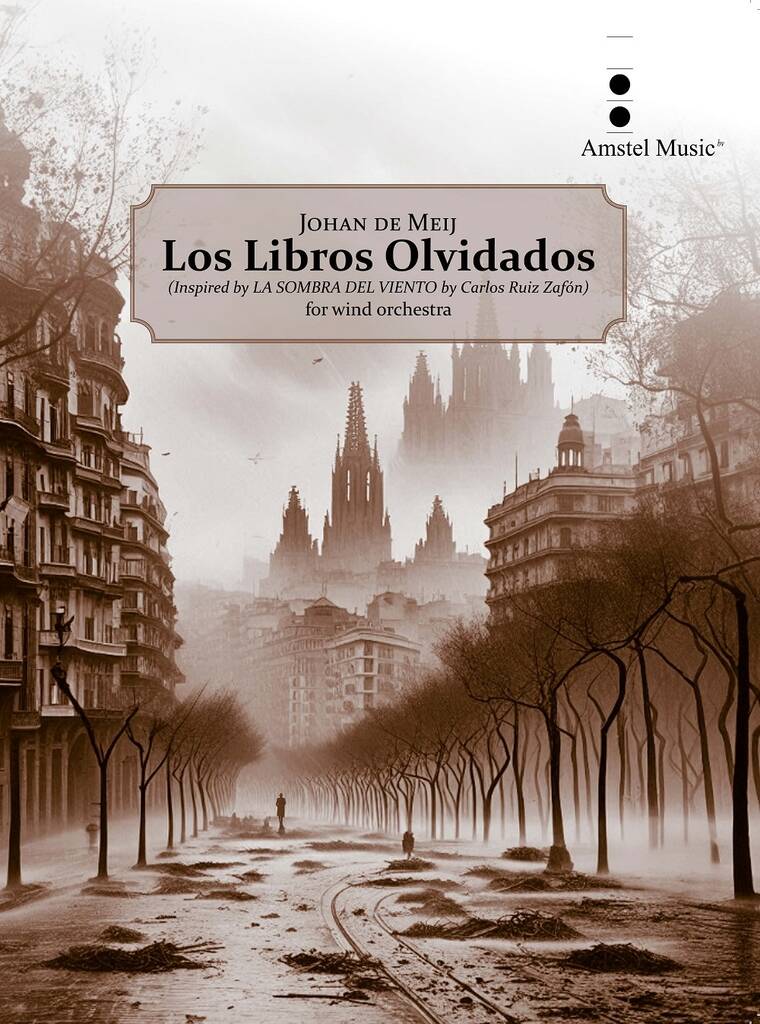
Los Libros Olvidados - Johan de Meij
1. Barcelona 19452. Los Libros Olvidados - El Cementerio3. Las Ramblas - Els Quatre Gats4. Coubert - El Hombre sin Rostro5. Bea (Beatriz)6. El Inspector Fumero7. La Ciudad de las SombrasThis is a story wrapped within a story that unfolds in Barcelona 1945, following World War II. The protagonist, Daniel Sempere, is the teenage son of an antiquarian book dealer, who one day takes him to the Cemetery of Forgotten Books, a mysterious place with labyrinthine corridors where rare and banned books are stacked in massive dusty piles. His father tells Daniel to select a book, but it will be his responsibility to protect it. Daniel picks La Sombra del Viento (The Shadow of the Wind), a novel by a forgotten author Julin Carax. Daniel immediately starts reading the book, and the story unwinds itself into a compelling and complicated plot. As he reads, Daniel finds himself and his own life merging into the story's plot. It transpires that there is a mysterious man named Lan Coubert ('the man without a face') who is determined to destroy all copies of Carax's books. Daniel is threatened by Coubert and is determined to find out what happened to Carax, who fled to Paris and subsequently disappeared. Daniel finds that his own life has much in common with the author's. The book mixes magic realism, page-turning mystery, and Daniel's own real life. Daniel's once ordinary teenage existence is now filled with larger-than-life colorful and at times, terrifying characters. Among them are Fermn Romero de Torres, a beggar who Daniel and his father befriend and employ in the family bookstore; the evil police inspector Javier Fumero, who could be compared to Scarpia in Puccini's opera Tosca or Javert in Les Misrables. The corrupt Fumero uses the war as an excuse to practice his sadism and is widely feared in Barcelona. He is represented in the music by a fascist military march. The city of Barcelona becomes a character in the book and in the music. The Ramblas, the boulevard running through Barcelona's Gothic Quarter and the famous caf Els Quatre Gats (the four cats) come alive in the score through a Cobla, the traditional wind ensemble playing a sardana, typical Catalan folk music. Two parallel love stories turn up the heat: Julin Carax's passionate, forbidden love for Penlope, and Daniel's equally passionate and forbidden love for Beatriz (Bea). Bea's sultry love theme is based on the first three letters of her name, with the ascending intervals B-E-A. Johan de Meij New York, October 17th, 2023
Estimated dispatch 7-14 working days
-
 £332.99
Cantica de Sancto Benedicto - Jacob de Haan
Cantica de Sancto Benedicto is a three-movement work for mixed choir, soprano solo, concert band and organ ad libitum - on Latin lyrics that relate to the life of Saint Benedict. It was commissioned by the city of Norcia in Italy, whereBenedict was born. The holy Benedict (480-547) is considered the founder of monastic life within the Roman Catholic Church. His enormous influence is especially owing to his monastic rule, the Regula Benedicti.Jacob de Haan has named the movements ofCantica de Sancto Benedicto after the Holy Trinity: the Father (Gloria Patri), the Son (Gloria Filio) and the Holy Spirit (Gloria Spiritui Sancto). The lyrics of thehymn Gemma Caelestis, (which, like the othertexts, were originally used in Gregorian chant) are voiced by the choir. To this purpose, Jacob de Haan composed new, choral-like, homophone music. The sequence Laeta Quies is rendered by the soprano; the verses (divided over the threemovements) are alternated with those of Gemma Caelestis. The work closes with an impressive grand finale, in which texts are used from the proprium of the mass in honor of the saint's day of the holy Benedict (11 July). Notes to the conductor:For this cantata, there are various possibilities for the performance. The first involves a performance in which the choir and soprano parts are only accompanied by organ. Such a performance has several advantages: since the band never soundstogether with the choir and the soprano, no balance problems occur, and even a performance with a large concert band and a small cantata choir is conceivable. A special layout is also possible - with which you can set up a three-dimensionalperformance in a church. For example, the choir can sing in the chancel, accompanied by the choir organ; the soprano can stand on the gallery, accompanied by the main organ; and the band can be seated in another part of the church. The choir couldalso sing from a gallery. With layouts like this, working with two conductors is advisable. Choral parts available separately.
Estimated dispatch 7-14 working days
-
 £169.99
Colossus - Thomas Doss
The giant Haymon was a peaceful knight who lived in Inntal (Austria). One day the bloodthirsty giant Thyrsos came and destroyed Haymon's castle. A horrible fight ensued and Haymon, being the better armed, was victorious and slew his adversary. But instead of rejoicing in his success, Haymon felt deep remorse. This remorse led him to seek out a monk and become a Christian, upon which he immediately started building a monastery. Once completed, Haymon joined the monastic order. Two statues at the monastery's entrance stand in remembrance of his victory. A colossal new work for concert band.
Estimated dispatch 7-14 working days
-
£202.99
Euterpe - Ferrer Ferran
Music is an indispensable element in the lives of human beings. In nature, we see the essence of this principle reflected. Plato imagined the cosmos as a live animal: all parts are connected in harmony. From this point of view, the universe forms a large pentagram in which all notes flow together perfectly. This is confirmed around us every day. The twittering of a canary, the sputtering of fire, the sparkle of a waterfall pattering and falling on stones, the rattle of a snake that takes on a threatening attitude, or even the silence of the desert are expressions of Euterpe (the muse of music). Why not let your flautist shine with this major new solo work.
Estimated dispatch 7-14 working days
-
£184.99
Rubicon - Bert Appermont
The Rubicon is a river in Northern Italy which Julius Caesar crossed with his army in 49 BC in defiance of the leaders of Rome, who feared his power. A civil war against rival Pompey ensued, which culminated in Caesar seizing power as the absoluteruler of Rome. The phrase "crossing the Rubicon" therefore refers to any person committing himself irrevocably to a risky, decisive and irrevocable of course of action.The work consists of three parts that deal with this important moment in history.Part 1 (Meditation) symbolises Caesars request to the Gods to assist him in his difficult choice. In a slow introduction we hear the melancholy and beseeching sounds of the duduk (alternatively, this part can be played by a soprano saxophone)and of the soprano solo singer over the bourdon accompaniment. The soprano solo singer then sings "dona tibi pacem" (give him rest) in a melodious and probing theme.In Part 2 (Battle of Pharsalus) trumpets and trombones resound alternately ina stately Roman fanfare, producing a stereophonic effect. This develops into a martial theme in which Caesars impressive army goes to battle against the army of rival Pompey. While the theme of Caesars army fades away, Pompeys theme emerges as anaive dance in six-eight time. His army is definitely in the majority and it believes it can easily defeat the enemy. Suddenly trumpets and trombones clash on two sides of the orchestra: Caesars army advances and attacks. A fierce battle ensues inwhich the two themes are played alternately as well as simultaneously. Thanks to his shrewd battle tactics, Caesar manages to win this legendary battle after all: his theme resounds ever louder in trumpets and horns until everything dies out andchanges into a kind of reconciliation between the soldiers of the two armies. The melancholy "dona tibi pacem" from part 1 now serves as a reconciliation theme.Caesar is now the sole ruler of the New Roman Empire, which would be destined to leave itsmark on our Western civilisation to this day. The third part is a sparkling succession of dance music (Dance) with many Greek and Roman elements in which Caesars victory is praised and celebrated. It is common knowledge that the culture(arts, gods, etc.) of the Romans drew heavily on Greek culture. I have therefore used an authentic Greek theme (the Seikolos song) several times in this part (bar 17 in the euphonium, bar 60 in the base section, bar 68 in the sopranosaxophone) to suggest the music of that era and to evoke the right atmosphere. After a gradual increase in tempo in the entire orchestra, the opening melody gloriously resounds once more, surrounded by virtuoso dance music. The work ends withbombastic brass fanfares in which Caesars theme triumphs once more.NOTE FOR THE CONDUCTOR:The Armenian duduk and the monochord that are used in the introduction give a special tone to the music, but could be substituted (soprano saxophone instead ofthe duduk) or left out (monochord). The soprano solo is also doubled within the orchestra and could therefore also be left out if necessary, although it does provide the work with an extra dimension. The male voices in the introduction and the finalecould possibly be replaced with a synthesizer with choral setting.As a visual and acoustic element in part 2, the trumpets, the e-flat cornet, the small drum and trombones can be stood up and placed at two sides of the orchestra (bar 80).Seen fromthe point of view of the conductor, put the trumpets, the e-flat cornet and the small drum in the left section and the trombones in the right section of the orchestra. This also helps to create a visual contrast between the two themes of the secondpart. The players can be seated again at bar 97 or bar 121. The soprano soloist can be placed in or in front of the orchestra, depending on what gives the best result. For the conclusion of the work the soprano solo can be sung from afar (from thewings) to create additional atmosphere.This work was composed especially for the "St Joseph" brass band from Pey/Echt (Belgium) with conductor Mark Prils.
Estimated dispatch 7-14 working days
-
 £64.99
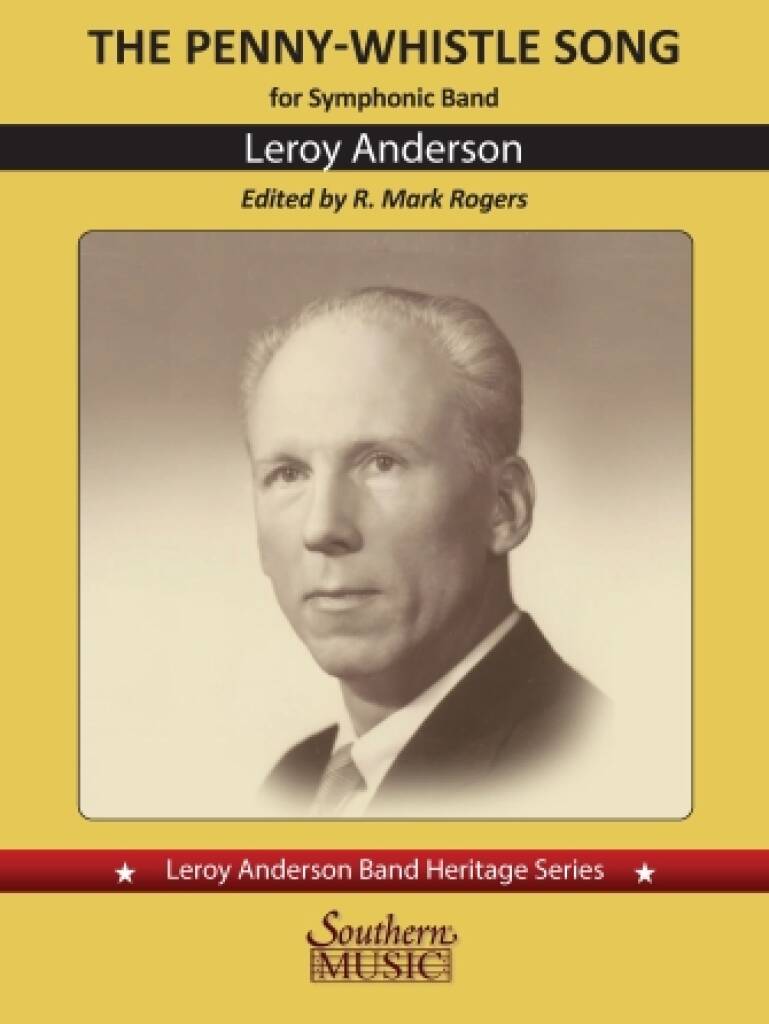
The Penny Whistle Song - Leroy Anderson
Imagine strolling along the trail through a bucolic countryside on a sunny spring day, whistling all the way. The Penny Whistle Song conjures that very mood, featuring a trio of flutes on the melody with a bouncy two-step accompaniment. This exclusive Southern band edition by Mark Rogers reintroduces Anderson's enchanting work to new generations of audiences.
Estimated dispatch 7-14 working days
-
£101.50
Arts du Cirque - Bill Calhoun
Arts du Cirque takes the listener on an exotic musical journey through a day at the circus. You hear the lion tamers, the trapeze artist--you even hear the clowns. It is a tapestry of sounds and marvelously orchestrated colors, not a tongue-in-cheek presentation. This new work for band will fit nicely as a contrasting piece on a concert, contest, or festival program.
Estimated dispatch 7-14 working days
 View Music