
Results
-
 £54.00
Prelude for Hampstead Heath (Concert Band - Score and Parts) - Ellerby, Martin
Almost a 'Paris Sketch' for London! Join in the jostling crowds for a summer day of enjoyment, romance, mischief, or just listen to the band. A long time favourite for brass; the masterly concert band version adds a new range of colour to this bustling holiday snapshot.Duration: 07:00
Estimated dispatch 7-14 working days
-
 £84.99
Seor Juancito (Concert Band - Score and Parts)
In Se?or Juancito, the Belgian composer Johan Nijs tells the unusual story of a rich, gruff nobleman who lives on a large estate and does not feel the slightest need to communicate with the outside world. However, one particular day, the people who live in the nearby village try to convince him to visit the annual village festival. At first he raises objections, but the village people insist, so finally, Se?or Juancito gives in and accepts the invitation. The people's friendliness makes an impact on him, and so, in the end, a new world opens up for him... 03:00
Estimated dispatch 7-14 working days
-
£60.99
They are Coming Wind Band Set (Score & Parts)
There are people who are capable of planning well. They live their lives in a well-structured manner and know exactly what they have to do. On the other hand, there are also people who are the exact opposite: they want to do too many things at once and are often somewhat absent-minded, which occasionally results in frantic situations. The outcome of one such situation is 'They are coming'. John Emerson Blackstone had been working on a new composition for some time when he received a telephone call from his editor, who told him that the deadline was approaching rapidly, even worse, that it would expire at the end of that same day and that he would drop by in person to fetch the composition! Blackstone set to work in a frenzy and completed the last details. When his editor arrived, the piece was finished ..... and got its definitive title: 'They are coming'. 02:30
Estimated dispatch 7-14 working days
-
 £118.99
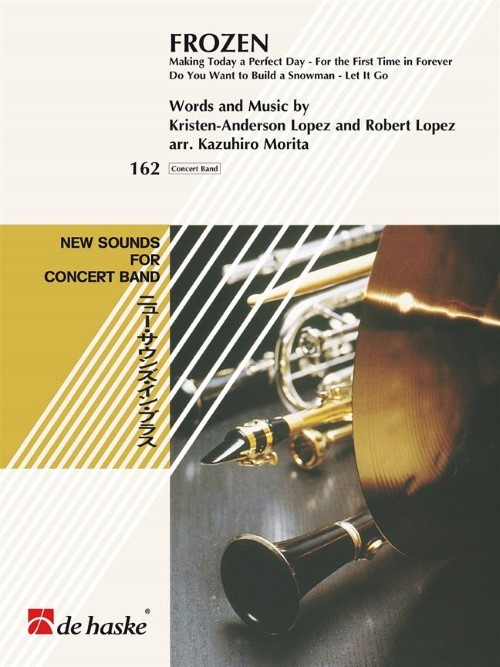
Frozen (Concert Band - Score and Parts) - Anderson-Lopez & Lopez - Morita, Kazuhiro
The movie 'Frozen' is one of the most popular Walt Disney Animation films of recent years. Kazuhiro Morita made an impressive medley for the famous series 'New Sounds for Concert Band' containing Do You Want To Build A Snowman, For the First time in Forever, Making Today A Perfect Day and Let It Go. Duration: 8.15
Estimated dispatch 7-14 working days
-
£144.99
Ante Lucem (Concert Band - Score and Parts)
This meditative work describes the final minutes before the night slips away and officially turns to day, the last few moments before a new dawn. The composition is based on the old Austrian folk tune Auf dem Berg bin i gern which has been used as the main theme in a wonderfully atmospheric way. Calm yet effective! 07:40
Estimated dispatch 7-14 working days
-
 £137.99
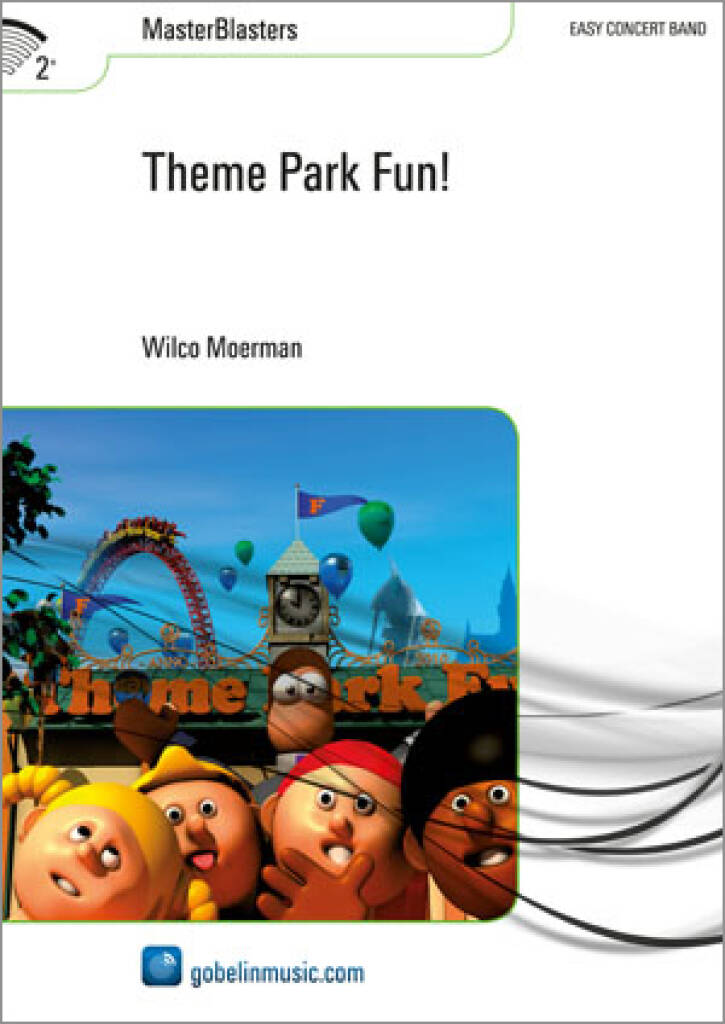
Theme Park Fun! - Wilco Moerman
In Theme Park Fun! your orchestra pays a visit to an amusement park. During your visit, you will experience some spectacular rides and attractions this theme park offers. The uniqueness of Theme Park Fun! is the interplay between music and(moving) images. Animations and illustrations support the visual composition.Part 1: The Entrance & Parade [with animation]The opening of the park is a fact. A day full of fun and pleasure awaits! You and the other visitors willbe confronted with all the rides, attractions and adventures the theme park has to offer. Which ride shall we do first?! There is so much to do and experience on this day in the park! A parade of colorful floats and park figures is passing by.Letthe fun begin!Part 2: The Haunted House [with animation]The only ride in the park that is not related to fun, is the Haunted House. Here visitors will be challenged to visit a house full of ghosts, creepy figures and otherominous things. The clock strikes twelve, there is no turning back. Ghosts are whispering, yelling, screaming... Fortunately it is almost one oclock, so we can leave this creepy place quickly.Part 3: The Swinging Galleon [withillustrations]What a huge pirate ship! Each time you swing back and forth, you will feel that weird feeling in your stomach. When you are thrown completely into the top you will have a fantastic view over the park, but you can not enjoy itfor long. Before you know the ship swings back the other way.Part 4: The Fairy Tale Ride [with illustrations]After all those exciting and spectacular rides and attractions, it is time for a peaceful tour in The Fairy Tale Ride.Surrounded by a fairytale setting, you will discover fable figures, talking animals and colorful designs. Such a beauty and tranquility. Having had this experience, we are ready again for the big rides in the park!Part 5: The Bumper Cars[with illustrations]Now its time to crawl behind the wheel of the Bumper Cars! Shall we all chase the conductor?! Before you know you are hit by another visitor or you will bump against someone else. In this tough ride you can prove yourselfas a real driver, or perhaps as a really bad one.Part 6: The Roller Coaster [with illustrations]The largest, fastest and scariest ride in the park ... we should definitely do the Roller Coaster! All together in the train, theover-the-shoulder restraints are lowering... be ready to ride. The train leaves the station and is heading for the big lift hill. It will be very scary when the train reaches the top and the train will be plunged down the first drop! Loops,corkscrews and other spectacular coaster elements will follow... Before you know it, the ride of your life is over. Shall we ride it again?!Part 7: Leaving the Park [with animation]Unfortunately everything comes to an end. Thisday in the theme park is over, but we have a lot new experiences to talk about! The memories of all the funny and spectacular rides will come up when we walk through the park to the exit. Just one look over the shoulder, the amusement park figuresare waving at us. Hopefully we will come back again soon!
Estimated dispatch 7-14 working days
-
 £144.99
Downtown Divertimento - Johan de Meij
The inspiration for Downtown Divertimento comes from Johan de Meijs daily wanderings in Chelsea, in lower Manhattan. The day begins with a leisurely walk to Madison Square Park with his dog Alice. They visit the dog run where she meets up withother city canines. On the way back they have a moment of reflection looking at the nearby Flatiron Building, the striking triangular city landmark. Johan goes for a run later in the day. His jogging shoes naturally head for The Highline, anabandoned railway viaduct that was transformed into a lushly landscaped National Park. He absorbs the spectacular views of the Hudson River and the majestic New York skyline as if seeing them for the first time.The movements are:1) Dog Play (at Madison Square Park)2) Flatiron Reverie3) Hitting the Highline
Estimated dispatch 7-14 working days
-
 £76.80
Eveil - Serge Lancen
The famous Paris composer Serge Lancen wrote a brand new overture which was commissioned by the A.D.D.M.44 (Departmental Organization for the Musical Development in the Loire Atlantique area) and its director Pierre Delamarre. This overture describes the awakening of nature when the day rises, giving birth to light. Lancen is fond of dawn, which he considers as a privileged moment because it brings the day, the sun, the light and the awakening of all activities that contribute to our happiness. In opposition to his ' Ouverture pour un Matin d'Automne' this overture has a definite taste of summer.
Estimated dispatch 7-14 working days
-
 £75.50
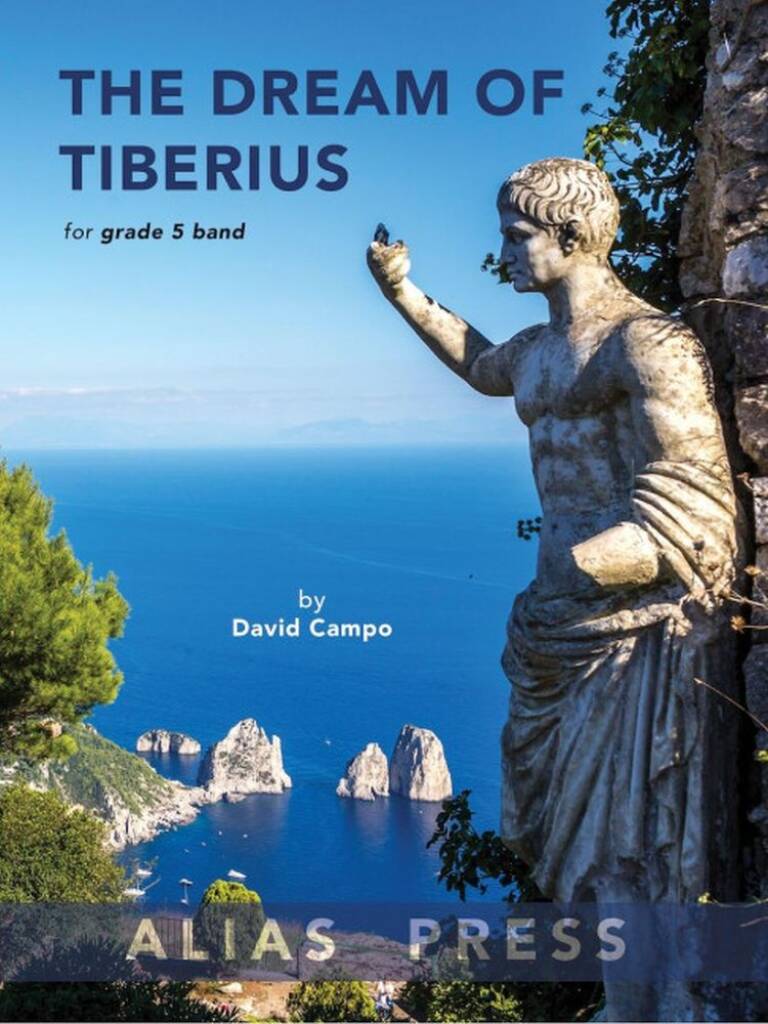
The Dream of Tiberius - David Campo
The Roman Emperor Tiberius was born in 42 BCE to Tiberius Claudius Nero and Livia Drusilla, both descendants of prestigious political families, at a time when Rome was undergoing significant political upheaval. Julius Caesar had begun a brutal civil war in 49 BCE to end Rome's rule as a Republic and consolidate his power as supreme ruler. Following Caeser's assassination in 44 BCE, Tiberius' father backed the forces wishing to return Rome to a Republic, but they were defeated by Caesarian loyalists led by Caeser's heir Octavian. As a result, Tiberius' early life was spent on the run and in political exile with his parents. In 27 BCE, Octavian would become the first Emporer of Rome and assume the name Augustus. Augustus forced Tiberius' parents to divorce and took Tiberius' mother as his new bride, separating the family and forcing Tiberius to live with his father. Upon his father's death, Tiberius went to live with his mother and Emporer Augustus, a situation Tiberius found extremely uncomfortable but one over which he had no control. Having been adopted by the Emperor, Tiberius assumed the military and political life thrust upon him. He proved to be an outstanding military and political leader, and with his marriage to Vipsania Agrippina his life took on a heretofore unknown stability. However, Augustus would intervene in Tiberius' life once more, forcing him to abandon his happy marriage and take Augustus' daughter Julia (Tiberius' step sister) as his new wife. This arrangement, while securing Tiberius' place as Augustus' heir and ensuring he would one day be Emperor of Rome, was disastrous. Julia's drunken licentiousness was a constant source of scandal and embarrassment for Tiberius (and her father, the Emperor) and she was eventually exiled by her father Augustus. Tiberius was named Emperor of Rome upon the death of Augustus in AD 14, assuming his position as the most powerful man on Earth. However, no matter how powerful he had become, Tiberius never felt as if he had ever had any control over his life, having been manipulated from childhood through adulthood by the whims of Augustus. As Emperor, he soon became disgusted with the political intrigue of the Roman Senate and by AD 26 left Rome and took up residence on the island of Capri, where he lived out the rest of his life. History does not regard Tiberius fondly and by all accounts towards the end of his reclusive life on Capri, he had become a miserable, sick and mentally unstable old man reveling in debauchery and cruelty. It is also informative to note that he was Emperor of Rome when Jesus of Nazareth was crucified, and while there is no indication that Tiberius was even aware of the existence of Jesus, as Emperor he was responsible for the appointment of Pontius Pilate as Governor of Judea. Even considering this, it is difficult to look on the life of the Emperor Tiberius and not feel some sympathy and pity. It's in this spirit that I composed "The Dream of Tiberius." I imagine the man sitting in thoughtful seclusion on the beautiful island of Capri imagining what his life might have happily been had not power been thrust upon him: husband, father and humble servant of the people.
Estimated dispatch 7-14 working days
-
 £119.99
Sea of Hope - Jacob de Haan
Sea of Hope is an optimistic work about new land arisen from the former Zuiderzee (the Netherlands). In the introduction, the sea is conveyed in all its glory and ferocity, through a melody that keeps you wondering whether it makes you happy or sad. Then, finally, there is a glimmer of hope, when the water is dammed up and the land partly reclaimed (by conversion into polder land). The town of Dronten, for instance, develops into a place where one day two people meet up and fall in love. This love is reflected in the slow, passionate middle movement. New life in the town is celebrated joyfully: the zest for life clearly shines through this part of the work, followed byoptimism and celebration in the closing bars.
Estimated dispatch 7-14 working days
 View Music