
Results
-
 £214.80
Skies - Oliver Waespi
Program notes by Oliver Waespi on his composition Skies:Skies is the plural of Sky. We may wonder are there several skies? Is the sky we all long for not the same for everybody? While travelling on foot and "in the open air" I have observed the firmament often in quite different shapes, so that I can say I have indeed experienced the sky in different ways. Years ago I already wanted to portray "my sky" in music; I finally have been able to realise this long-cherished dream.This composition deals with the sky, more precisely with my sensual and emotional experience of the sky in all its aspects. Two point of views are combined in this composition: one showing the sky as it presents itself to me, the other showing the sky as I observe it. The music was bom simultaneously by intemal and extemal inspiration: it describes nature but also the emotional and spiritual experience of nature. To me, the experience of nature is not abstract, but it is connected with concrete ages, places or people from my neighbourhood. This is why I have combined several parts of this composition with certain landscapes.The sky presents itself in different landscapes in the most varied ways: for the sensual experience, there is no sky as such. The indications of places spread all over the score, are primarily clues for myself; they represent certain atmospheres, which I have experienced especially in England and Scotland. They can however also be useful to the musicians and the audience, providing they know those landscapes and the celestial atmospheres linked to them.The music is independent from the atmospheres described in the subtitles, as those are rather connected to a tragic nature, and so the music is not based on any program. Musically spoken, the composition has a symphonic structure, which means that the complete musical material is derived from three contrasting main themes. In the first part, the description of a noctumal sky ("Night") two themes are developed in an organic way; the first, rather "dusky", is to be found with the horns, the second, "in bright daylight", with the oboe and flute, the third, "more quiet" , with the brass instruments. In the next part, we have clouds and rain over the Isle of Skye (one of the Hebrides islands in Scotland) and here several elements of the first theme are still more developed. Then we get an increasingly dark mood, which is released, in heavy chords. Then suddenly, the sun breaks through and the music gets a majestic character. We have a new shape of the initial theme, first with the French horns and then with the trombones. The music gets a quicker tempo and flows into a quick movement describing the winds and waves at sea ("Wind and Waves"). Three themes are gathering and some variations are developed. The music gets more and more energetic and, after a climax, calms down again. Then we have a kind of "summer pastoral" which suggests summer at the South coast of Cornwall ("South Coast of Penwith Peninsuia in Summer"). This is certainly not the hotte st summer in Europe, but still it is beautiful in this country that is blessed with so much rain. In the "pastoral" , the sea is already sketched in broad outlines in the French horn solo. The magnificence of an aftemoon at the seaside is developed at the end of the composition ("Noon at Treen Cliff', a rock protruding in the sea next to Porthcumo at the South Coast of Cornwall); here the music gets stronger and stronger and after a majestic climax it vanishes completely.
Estimated dispatch 7-14 working days
-
£37.50
Sentimentale - Satoshi Yagisawa
Premiered by Funabashi Hiagshi High School under the direction of Shinichiro Tagawa in March, 2015, Sentimentale is an excerpt from Yagisawa's Trumpet Concerto. That work, commissioned by the Japan Air Self-Defense Force Central Band with trumpet soloist Kenichi Kurishu, premiered in 2003 with many subsequent performances. In 2013, the Concerto had its U.S. debut with Kagoshima Joho HS and Robert Sullivan, principal trumpet of the Cincinnati Symphony. I received many warm regards and compliments on the work, especially for the second movement. However, I also heard regrets that the interlude required a trumpet soloist. I remembered the words of Mr. Tagawa, who had collaborated with me on works such as"And Then the Ocean Glows" and"Hymn to the Infinite Sky". Ten years earlier he suggested that I arrange that movement for full band so that it could be more widely enjoyed. Though I agreed then, only now have I had the chance to realize this idea, as Mr. Tagawa presented me with the opportunity of this musical creation and world premier.This new arrangement was entitled "Sentimentale" by Mr. Tagawa. I composed the piece with his constant consultation, discussing grade level and instrumentation, and how the work should be a chorale etude for both concert and daily training. I would like to express my sincere gratitude to both Mr. Tagawa and Funabashi Higashi High School.(Satoshi Yagisawa)
Estimated dispatch 7-14 working days
-
 £164.99
Trumpet Concerto - Satoshi Yagisawa
Commissioned by Japan's Central Air Self Defense Force BandWhen I received this commission, I thought of a regular piece for wind band, but as my preparations continued I heard so much about the band's outstanding trumpeter Kenichi Kurisu that I ended up writing a concerto for him. The Self Defense Force audience includes those without much chance to otherwise hear live music. With that in mind I realized I also had the challenge of creating a melody that was compelling.Using the classical sonata as a model I made this song with simple movements and included a signature chorus in the middle section. Although this piece is performed with band, a version for piano accompaniment was created by pianist Orimo Manabu for the 20th Anniversary of "The Trumpet Concert."This edition of Trumpet Concerto was offered for an American Premier at the 2013 Midwest International Band and Orchestra Clinic, Robert Sullivan soloist with the Kagoshima Joho High School Wind Orchestra.(Satoshi Yagisawa)
Estimated dispatch 7-14 working days
-
 £109.50
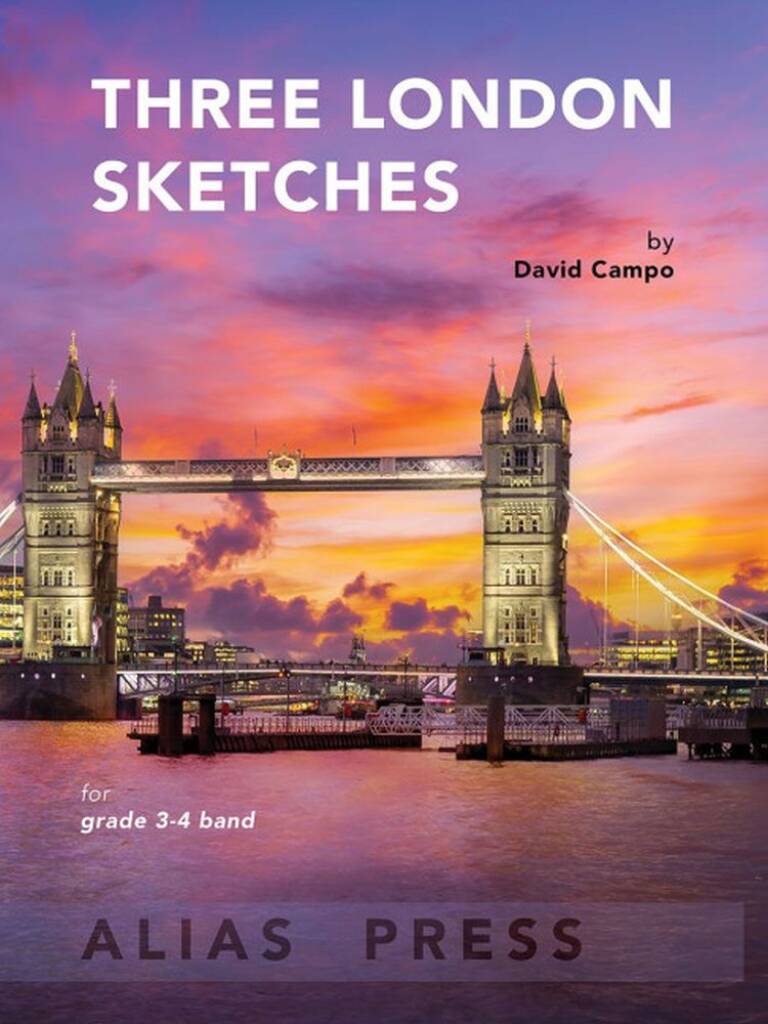
Three London Sketches - David Campo
London is one of my favorite cities in the world, and in 2016 I was invited there to serve as an adjudicator for the London New Year's Day Parade and Gala Concerts. While I was there, I was fortunate to meet and spend time with The Lord Mayor of Westminster Councillor Steve Summers. While his title sounds formidable and intimidating, I found Steve to one of the nicest, most easygoing people I've ever met. And boy, does he love London! He was fond of saying that he had "the best job in the greatest city in the world." He spoke passionately about London and his favorite places in the city, and his enthusiasm was contagious. Some of his favorite places became some of my favorite places, and the inspiration for this piece. I hope that this work not only conveys the beauty and history of these iconic places, but Steve's deep and abiding love for them as well. I. Tower Bridge - The Tower Bridge was built over 120 years ago to ease road traffic while maintaining river access to the busy Pool of London docks. Its giant moveable roadways lift up for passing ships, making it a true engineering marvel. It is also one of the most iconic sites in London, and was used to display the Olympic Rings during the 2012 Olympics. II. St. Paul's (The Whispering Gallery) - The history of St. Paul's Cathedral goes back well over a thousand years, but construction on the current St. Paul's began in 1669 after a fire destroyed the earlier structure. The dome of St. Paul's Cathedral is a whispering gallery; you can whisper against the wall on the inside of the dome and it can be clearly heard on the other side of the dome over 100 ft. away. Imagine the secrets that have passed there... III. Trafalgar Square - The name commemorates the 1805 naval Battle of Trafalgar and is marked by Nelson's Column, a monument to Admiral Horatio Nelson, the hero of the Battle of Trafalgar. It is the heart of London; full of life and constant energy and home to iconic buildings including the National Gallery, St. Martin-in-the-Fields, Canada House and South Africa House. Londoners say that all roads in London lead to Trafalgar Square.
Estimated dispatch 7-14 working days
-
£202.99
The Wind Rises - Joe Hisaishi
This beautiful, lyrical melody is so colorful in the film, without having an imposing image. "The Wind Rises" (2013) does not dominate the visual, and perhaps is an ideal form of film music considering this is director Miyazaki's final production. Chamber ensembles with solos and strings are frequently used in the soundtrack, so the sound is mellow and soft. As you listen more and more, you still recognize the tradition of Ghibli music.When I arrange, I try not to visualize the image of a film. I may think of characters and story line but is it important to write music that alone is appealing and fascinating. Trying not to "overstate" the film is not needed here. If you can bring out the most appealing parts of the soundtrack, excess can be forgiven. Of course, I have not changed the musical elements of the original.I asked Mr. Tomoki Ubata (band director at Ina Gakuen Sr. High School) whom I have worked with numerous times to assist with layout. He came up with a heartwarming medley with two main parts; leading boy Jiro's gift for aeronautical design and his romance with the heroine, Natsuko.The following themes are contained in the arrangement:1. Nahoko (A Rainbow) Beginning2. Caproni (An Aeronautical Designer's Dream) C3. A Journey (An Encounter at Karuizawa) H4. The Falcon I5. Prototype 8 N6. A Journey (A Parting) & A Journey (A Dream of Flight) PIt is quite remarkable, looking back on 30 years of Studio Ghibli's achievements.(Kazuhiro Morita)
Estimated dispatch 7-14 working days
-
 £154.99
Swaying in the West Wind - Satoshi Yagisawa
This piece was commissioned by Japan Ground Self Defense Force Western Army Band. In the programme note for the premire the composer wrote: "I am always impressed by the expansive earth and sparkling ocean scenery when I come to Kyushu. I have met many local people here and they are all expressive and energetic. I wrote this dramatic piece to convey to the whole of Japan the memory of my experience here, swaying in the west wind. I wrote this, hoping that the Self Defense Force will forge closer ties with the community through this piece." Eastern drama felt in the west wind!
Estimated dispatch 7-14 working days
-
 £53.50
Palladio - Karl Jenkins
Although this composition sounds like it came straight out of the Baroque period, it is actually the first movement of a suite written in 1996 by Karl Jenkins. Instantly recognized as the 'diamond commercial' theme, its relentless pulse and dramatic nature make it a natural for bands. Robert Longfield's skilled arrangement puts it within reach of most groups.score and parts - 4 Flute I, 4 Flute II, 2 Oboe, 4 Bb Clarinet I, 4 Bb Clarinet II, 4 Bb Clarinet III, 2 Bb Bass Clarinet, 2 Bassoon, 2 Eb Alto Saxophone I, 2 Eb Alto Saxophone II, 2 Bb Tenor Saxophone, 2 Eb Baritone Saxophone, 2 F Horn I, 2 F Horn II, 3 Bb Trumpet I, 3 Bb Trumpet II, 3 Bb Trumpet III, , 3 Trombone I,3 Trombone II, 2 Baritone B.C., 2 Baritone T.C., 4 Tuba, I String Bass, I Timpani, 2 Percussion I, 2 Percussion II - wind/concert band
Estimated dispatch 7-14 working days
-
 £108.40
Three Brass Cats - Chris Hazell
This is what Chris Hazell, the composer, had to say about 'Three Brass Cats': 'Some years ago I had four cats in the house - all were strays and decided that I was a soft touch when it came to free board and lodgings, so instead of moving on, they all decided to stay. Sadly they have all now gone to the great cattery in the sky. However, at the time they were around I was asked to write some pieces for a brass group (The Philip Jones Brass Ensemble). What should I write about? Well, I've always liked writing about the people and places around me (they appear in a lot of my music) so I thought.. I know, my cats. These days I don't have any cats as I travel around a lot with my work, but it's nice to think that they're still with me in the music.'
Estimated dispatch 7-14 working days
-
 £205.30
Mitt hjerte alltid vanker - Fantasi - Hans Adolph Brorson
This arrangement was commissioned by B3 (The Bergen Woodwind Ensemble). B3 is a large woodwind ensemble located in Bergen with a mix of professional and amateur players. My Heart Remains in Wonder is a well-known Christmas hymn in Scandinavia. I wanted my version to be different to the traditional hymn tune style in which it is normally performed. One day I was outside walking and this idea came to me: an ostinato-like, mechanical skeleton of arpeggio semiquavers on which I could 'hang' the melody. However, I also wanted to do the melody line a bit different. The inspiration for this comes from folk music and the way fiddlers hardly ever lift their bow off the strings when they play. Because of this, it is important that the melody is played in a very sostenuto style in this arrangement. The harmonies lie somewhere between jazz and folk music with a little nod towards Grieg (himself heavily influenced by folk music) in the slow middle section.
Estimated dispatch 7-14 working days
-
 £164.99
Early Hungarian Dances - Ferenc Farkas
The composer wrote of his work as follows: In the music of Hungary, folk songs are manifestly of great importance, on the other hand our ancient airs and dances play a modest role. For this work I have been influenced by dances of the 17th century, written by unknown amateurs in a relatively simple style. Most of these dances were recorded between the 14th and 18th centuries under the usual form of tablature notation. My interest in this music was first captured in the 1940s. I was so fascinated that I decided to give these melodies new life. I fitted the little eight-bar dances together into ternary and rondo forms, and leaning on early Baroque harmony and counterpoint, I attempted a reminiscence of that atmosphere of the provincial Hungarian Baroque.
Estimated dispatch 7-14 working days
 View Music