
Results
-
 £205.30
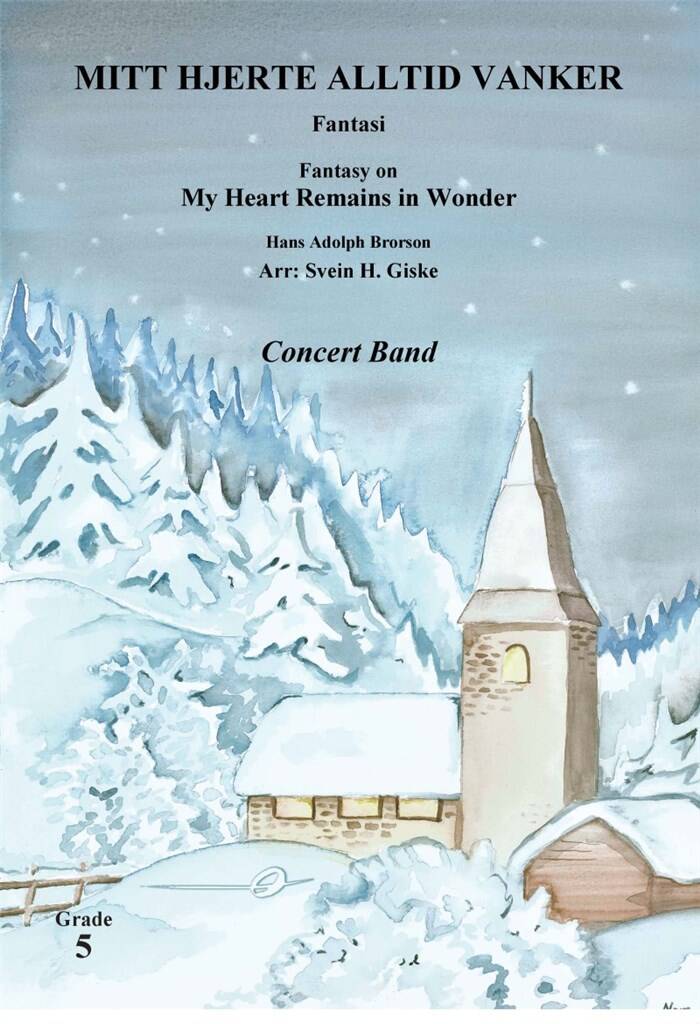
Mitt hjerte alltid vanker - Fantasi - Hans Adolph Brorson
This arrangement was commissioned by B3 (The Bergen Woodwind Ensemble). B3 is a large woodwind ensemble located in Bergen with a mix of professional and amateur players. My Heart Remains in Wonder is a well-known Christmas hymn in Scandinavia. I wanted my version to be different to the traditional hymn tune style in which it is normally performed. One day I was outside walking and this idea came to me: an ostinato-like, mechanical skeleton of arpeggio semiquavers on which I could 'hang' the melody. However, I also wanted to do the melody line a bit different. The inspiration for this comes from folk music and the way fiddlers hardly ever lift their bow off the strings when they play. Because of this, it is important that the melody is played in a very sostenuto style in this arrangement. The harmonies lie somewhere between jazz and folk music with a little nod towards Grieg (himself heavily influenced by folk music) in the slow middle section.
Estimated dispatch 7-14 working days
-
 £218.30
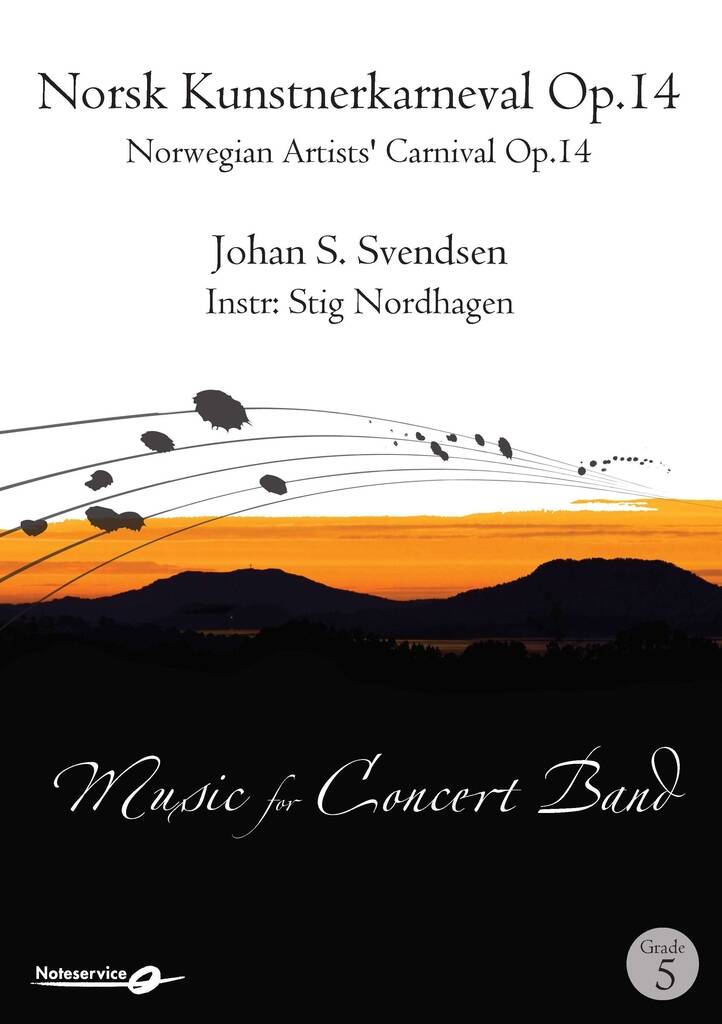
Norsk Kunstnerkarneval Op.14 - Johan S. Svendsen
This well-known work was composed in Christiania in 1874 for a burlesque Carnival in "Kunstnerforeningen".An early title for the work was "Bryllup paa Dovre". The manuscript score and parts at The National Library in Oslo of the early version with this title have much more music than the version printed by C.F. Peters, Leipzig in 1881. The form in this first version was ABA with an additional trio part that later were discarded. In the trio Svendsen used the melody Sterreisen (Os har gjort kva gjeras skulle) from Lindeman's collection of Norwegian Folk Tunes. (Vol. I/115). In the A-part a wedding tune (Bruraslaatten) from Sogn is used (Lindeman Vol. I/476). The Carnival's literary theme was the connection between the cold north and the warm south. Musically the south is represented in Svendsen's music by Raffaele Sacoo's melody from 1835 "Te voglio bene assai".I believe that if Norwegian quality music from this period is going to be performed, it must at least be available. There must be editions for modern instrumentations with full scores. I do this as my contribution to expand and enrich the repertoire for Concert Bands.- Stig Nordhagen -
Estimated dispatch 7-14 working days
-
 £164.99
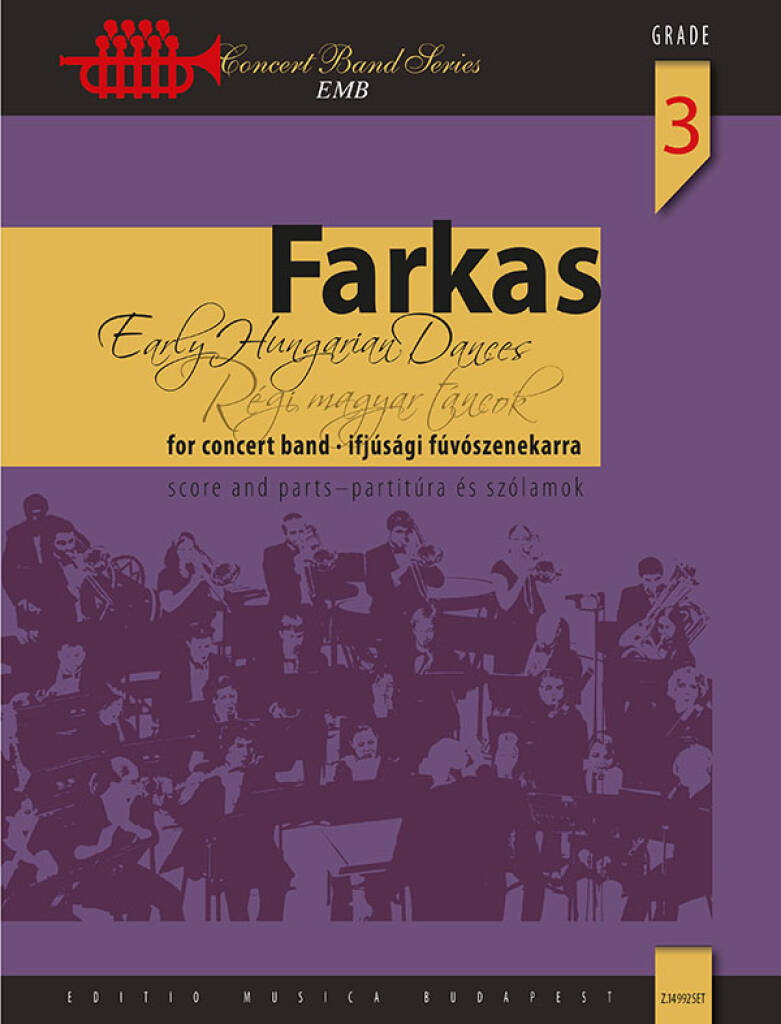
Early Hungarian Dances - Ferenc Farkas
The composer wrote of his work as follows: In the music of Hungary, folk songs are manifestly of great importance, on the other hand our ancient airs and dances play a modest role. For this work I have been influenced by dances of the 17th century, written by unknown amateurs in a relatively simple style. Most of these dances were recorded between the 14th and 18th centuries under the usual form of tablature notation. My interest in this music was first captured in the 1940s. I was so fascinated that I decided to give these melodies new life. I fitted the little eight-bar dances together into ternary and rondo forms, and leaning on early Baroque harmony and counterpoint, I attempted a reminiscence of that atmosphere of the provincial Hungarian Baroque.
Estimated dispatch 7-14 working days
-
 £84.99
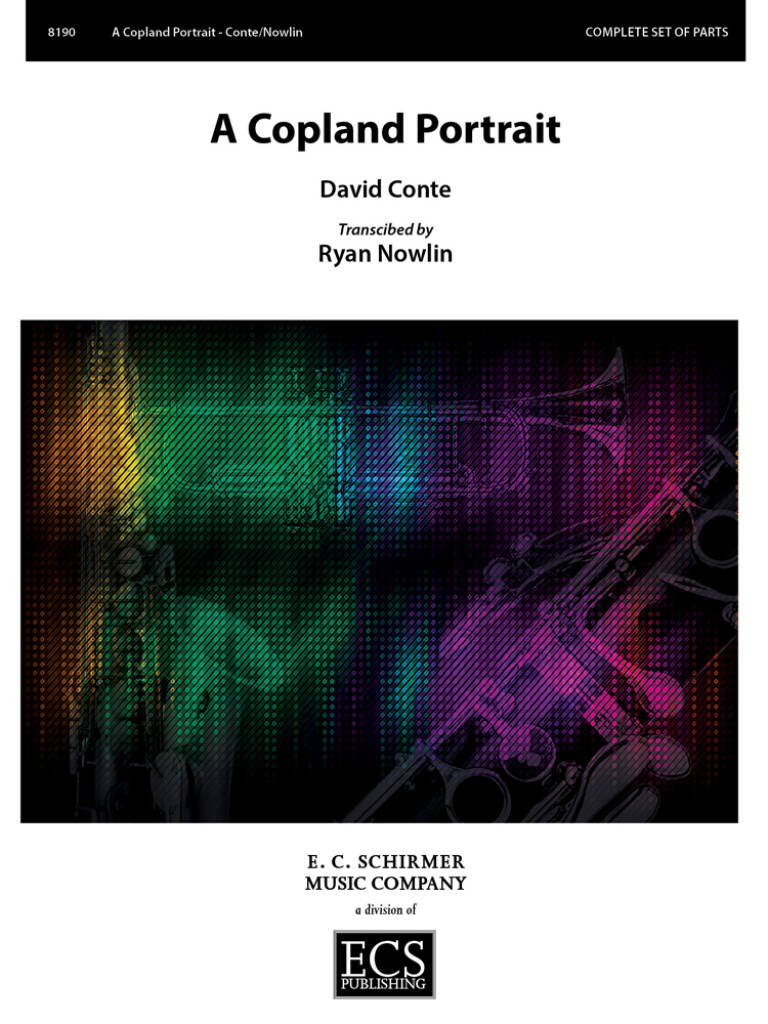
A Copland Portrait - David Conte
Originally commissioned by maestro Neal Gittleman, A Copland Portrait was premiered by the Dayton Philharmonic Orchestra in January 2000. In March of 2015, First Lieutenant Ryan Nowlin's transcription of this work for band was premiered by "The President's Own" United States Marine Band under the direction of Lieutenant Colonel Jason Fettig. ECS Publishing is proud to offer both the band and the orchestra version. Conte on the creation of this overture: "I set out quite consciously to evoke various aspects of Copland's work by combining and recombining them within the terms of my own musical personality. For example, the first theme of A Copland Portrait combines the character of a theme from The Red Pony with the rhythmic texture of the scherzo of the Third Symphony. While composing the piece I was conscious of drawing inspiration from many of Copland's works; a melodic shape here, a harmonic gesture there, until I arrived at something that felt fresh and new to me. A Copland Portrait is cast in a traditional Sonata-Allegro form. After a vigorous, syncopated orchestral tutti, the first theme is announced in the solo oboe, accompanied by a steady eighth-note ostinato. Playful interjections are stated in the flute and bassoon. The syncopated tutti returns; the first theme is stated again, this time in the low winds. This theme builds to a colorful climax, leading into a more dissonant transition section, which gradually slows and gives way to a lilting, more lyrical second theme in the clarinet. After some modest development of the second theme, a more plaintive theme stated in the muted trumpet brings the exposition to a close. A scherzando development section follows; the first four notes of the first theme are inverted and subjected to various contrapuntal treatments. This development section ends with a return of the opening syncopated motive, leading into a recapitulation of the first theme, this time in canon, and the second theme and closing theme, broadly sung. A brilliant toccata-style coda brings A Copland Portrait to a brisk conclusion."
Estimated dispatch 7-14 working days
-
 £174.99
Two Symphonic Interludes - Harrie Janssen
Based on the poems by German poet Carl Hauptmann (late Romanticism) and the English poet William Wordsworth (early Romanticism). Carl Hauptmann was in poor health as a child, but highly intelligent. He studied philosophy, psychology and biology. In the latter he was admitted to the degree of doctor. His marriage provided financial independence, so that he could focus on his studies. Hauptmann wrote various novels, plays, poetry and scientific works. Night Twilight floats above the valley's night mists are hanging, there's a whispering brook. Now the covering veil is lifting quite: come and look! See the magicland before our gaze: tall as dreams the silver mountains stand, crossed by silent silver paths shining from a secret land. Noble, pure, the dreaming country sleeps. By the path the shadow black and hogh of a beach. a wisp of a white smoke creeps to the dark'ning sky. Where the valley is the darkest hued countless little lights shine silently. O my soul! Drink of solitude! Carl Hauptmann Wordsworth 'introduced' a new type of poetry, based on the speech of the common man. This was his answer to the poetry of the classicism which was bound by rigid rules. His definition of poetry was: the spontaneous overflow of powerful feelings from emotions recollected in tranquility. My heart leaps up when I behold a rainbow in the sky My heart leaps up when I behold A rainbow in the sky: So was it when my life began. So is it now I am a man. So be it when I shall grow old, Or let me die! The Child is father of the Man. And I could wish my days to be Bound each to each by natural piety. William Wordsworth In a truly poetic manner Harrie Janssen has transformed the contemplative thoughts of the poets into two compositions for Concert Band.
Estimated dispatch 7-14 working days
-
 £245.50
Symphonie de l'Eau - Serge Lancen
This symphony was composed in 1984 and is dedicated to the great French composer Ida Gotkovsky a good friend of the Lancen family. It was the test piece in the Seccion Primera of the famous Spanish wind band contest Certamen International de Bandes de Msica Ciudad de Valncia and was recorded by the Symphonic Band of the Maastricht Conservatory of Music conducted by Sef Pijpers. Serge Lancen himself related the genesis of this symphony as follows:When I was twelve years old I had started composing a piece which described the cycle of the water. The project was however abandoned and only some themes were left unused. In July 1983, I went by boat to the WASBE conference in Skien, Norway and was seduced by the North Sea. During the travel a musical theme was born and was the trigger for the realisation of my ancient project which I still fancied'. The 'Symphonie de l'Eau' is in fact a musical description of the cycle of the water which the composer defines as follows:'A slight mist rises and turns into a cloud. Water drops fall on the mountain. A brooklet rises and clears a way throughout the alpine pastures. Soon other small watercourses join the original brook that is now reinforced as to become a real roaring mountain river falling in a lake amidst a quiet and poetic surrounding. The water turns again into a river when leaving the lake and gradually becomes a big stream which majestically flows towards the sea. A slight mist is rising from the huge surface and so the cycle of the water starts all over again.
Estimated dispatch 7-14 working days
-
 £186.20
Fin de Siecle - Henk Alkema
About his composition 'Fin de Sicle', completed in 1995, Alkema writes: 'At the end of each century 'everything is allowed' for some time. Everything is being summarized and eventually leads to a last climax. I felt that same feeling of freedom when I started composing 'Fin de Sicle'. Everything is allowed. I did not want to summarize all musical expressions of the twentieth century; I only wanted to summarize my own experiences. To me, this music is the very end and yet also the beginning of something else. I do believe in evolution and growth.'
Estimated dispatch 7-14 working days
-
 £186.20
Music for Gentry - Mickey Nicolas
Let's go back to the fifties. As I have played as a musician at such famous places as Carrre and Maxim's in Paris and the Palm Beach in Cannes, I wanted to recreate the musical climate of that time. This was highly appreciated by the high-life of that time: show business stars, politicians and millionaires alike. Of course, I used the most popular tunes of the fifties as well as the accompaniments to the popular musical acts, the latter mostly using two beat measures. With some nostalgia I used the scale of Jerome Kern's 'I get a kick out of you' to conclude.
Estimated dispatch 7-14 working days
-
 £154.60
Rendezvous - Torstein Aagaard-Nilsen
Rendezvous was commissioned by Krohnengen Brass Band for their 50th Anniversary in 2019. This version for Concert Band was scored autumn 2020.Rendezvous is devided into three sections. Each section are referring to Edvard Grieg's own titles. but twisted, to make sure that everybody understand that this music is a mash-up of themes Edvard Grieg used in opus 54 (for piano) and opus 61 (songs for children).1. Trolltog med avsporing (March of the Trolls derailment)March of the Trolls is a famous part of Edvard Grieg lyric pieces, opus 54.2. Klokkeklang i feil sang (Bell ringing in wrong tune).Bell ringing show that Grieg was one of the first composers to write the way impressionists did. What happens if this beatiful piece is combined with several other themes from the same book? It somehow works in its own way.3. Pep talk til Blakken (Pep talk to Blakken)The riff used in the first part becomes an important part of the third part: a funky treat of the childrens song "Kveldssang for Blakken" (Evening song for Blakken).I felt that a rather tired old horse needed a pep talk more than a slow tune. So that is why you get this music(!) - and this is how my rendezvous with Grieg ends.Not sure what maestro Grieg would have thougt... But, I have read that the fiddlers that played the tunes Grieg used was not happy with the way Grieg used them.So there you go...Torstein Aagaard-Nilsen
Estimated dispatch 7-14 working days
-
 £183.20
Viking Saga - Ray Farr
"Viking Saga" was inspired by my conducting engagements in Norway in the 1980s. Among them was a visit to the Flekkefjord Pike Korps who asked me to write a piece for them. I had just written "Adventures in Brass" which was very popular, particularly with younger bands, so I decided to pursue the creative energy. My teacher, at that time, was Professor Edward Gregson who encouraged me to develop my ideas into a full-scale work. The piece received a few performances in this version but neither I, nor my teacher, were satisfied so the manuscripts lay dormant. In the summer of 2002 a band from Switzerland- Cordula Brass Baden and Christoph Moor, who had played the piece under mydirection in the Swiss National Youth Band, commissioned me to finish the work and make the changes that, I felt, were needed. In 2016 the Tnsberg Wind Band, from Norway, commissioned a wind band version for their performance in the Norwegian Championships held in Trondheim 2017.
Estimated dispatch 7-14 working days
 View Music