
Results
-
 £116.40
Rapsodie sur des Themes Normands - Serge Lancen
The Paris born composer and pianist Serge Lancen (1922-2005) studied the piano with Marguerite Long and composition with Tony Aubin at the conservatory of his native town and was awarded a Prix de Rome. Lancen composed symphonic music, choral works, ballet music and several concertos.In 1960 he met his ancient study friend Dsir Dondeyne, conductor of the Paris Metropolitan Police Band, who incited him to write for symphonic band. Lancen wrote an impressive series of wind band works that earned him an international reputation. Among his most successful compositions are Manhattan Symphony (1962) an Cape Kennedy (1970), but we should not forget that Lancen also wrote several fine works for symphonic bands of average level. So he did in 1976 by writing two rhapsodies based respectively on Breton and Normandy themes. The Rhapsody on Themes from Normandy was recorded in 1977 on a long playing record by the French National Police Band conducted by Pierre Bigot alongside with Le Mont-Saint-Michel, Hymne la Musique and Rapsodie sur des Thmes Breton. Rhapsody on Themes from Normandy is a piece that is characterized by an original orchestration and fluent melodic lines, two main characters of Lancen's music.
Estimated dispatch 7-14 working days
-
 £214.80
Missa Solemnis - Serge Lancen
This Mass has been dedicated to His Holyness Pope John Paul II, to witness Lancens deep and respectful admiration for the Holy Father. The work was composed in 1986 and written for two solo voices: a soprano and a baryton-Martin (high baritone), mixed choir, harp (ad libitum) and symphonic band or organ. It has ten parts: INTROIT - KYRIE - GLORIA - OFFERTORIUM - SANCTUS - PATER NOSTER - AGNUS DEI - COMMUNIO - DEO GRATIAS - and as final part an ALLELUIA. Lancen expressed his views about this Mass as follows: 'The most important aspect of the Mass is the praising of God and the sacrificing to God; that is why I thought it suitable to use both the themes of the Sanctus and the Offertorium in writing the Introtus. It seemed to me also quite logical that the initial themes of the Kyrie and the Agnus Dei would be rather similar as these are two moments where the priest and the worshippers invoke God. The composition ends with a brilliant Alleluia in which I also briefly quote the theme of the Sanctus.' This Mass was premiered on 27 may 1989 at 'Our Lady's Church' in Maastricht, The Netherlands, as part of the celebrations of the fiftieth anniversary of the Roman Catholic Band Federation of the Limburg County. The Bishop Castermans celebrated the Mass, whereas Jan Cober conducted this first performance. The Missa Solemnis is an alternation of meditating, though often impressive, orchestral passages with angelical choral sounds and the pious singing of both soloists. This may not be the type of music we usually expect from Serge Lancen, but nevertheless the composer remains faithful to his own typical style of composition. You can call this work romantic, though it surely is 'contemporary' or, why not, 'from all times'. The instrumentation is varied and extremely rich, mostly due to Lancen's typical use of 'wind band colours'. This Latin Mass suits perfectly well in the tradition of Roman-Catholic Masses that have been written by several great composers.
Estimated dispatch 7-14 working days
-
 £186.20
Wald Sinfonie - Kees Vlak
It was during his stay at Freiburg, Germany, where he was attending a Music Festival, that Kees Vlak found his inspiration for this romantic work. At this festival he was awarded a prize for one of his compostitions, which was played by several bands from different countries. The composer was staying in the small village of Horben, hidden among pine woods on a mountain at the border of the Black Forest. From the balcony of his room he had a splendid view on the Schawinsland Valley, scarcely hidden by the tops of the huge pines. Each morning a blackbird singin in a huge pine next to his window woke him up. This bird song opens the composition.Whenever possible the composer and his wife went for a walk in the Black Rorest. The rediscovery of this wonderful area is expressed by the steadily increasing number of tone colours, used in the orchestration. Each village still boasts its own folk music and dances. More than one hundred bands were playing all around; the Black Forest seemed to be the scene of one huge festival. The image of the Black Forest is also linked to that of hunting scenes, so the next theme is being introduced by hunting horn themes. The second theme paints the lake "Titisee". At first the lake is very calm, but a stiff breeze sets both water and music alike in motion. The small town of Titisee is very popular with tourists and is famous for its woodcutting, its clockworks and musical boxes. It is a popular folk tune, played by a musical box that makes the link with the next theme. The joy and cheerfulness of the dancing village people is expressed by a movement which works out the initial theme.On leaving the little town, one can hear once more the hunting music from the wood as well as the song of the birds. The new theme is againg closely linke d to the hunt and played by the typical German helicon-like euphoniums.this theme interacts with the wecond theme and the word ends with a grnd finale meant as a musical hommage tot this wonderful area.
Estimated dispatch 7-14 working days
-
 £140.80
An Indoor Overture - Willem Strietman
In 1964 I met the American composer, conductor, pianist and educationist Aaron Copland (1900-1990) who was in The Netherlands during an European concert tour. I keep most pleasant memories of his performances and of our conversations. In memory of that great man I made in 1995 a new version of a small composition that I had written in 1970 for the Silver Jubilee of the Metropole Orchestra (of the Dutch Radio Institution) and that was called 'An Indoor Overture'. This short work is a kind of answer to Copland's 'An Outdoor Overture' (1938) in which also light and serious music are harmoniously mixed.Willem Strietman
Estimated dispatch 7-14 working days
-
 £214.80
Skies - Oliver Waespi
Program notes by Oliver Waespi on his composition Skies:Skies is the plural of Sky. We may wonder are there several skies? Is the sky we all long for not the same for everybody? While travelling on foot and "in the open air" I have observed the firmament often in quite different shapes, so that I can say I have indeed experienced the sky in different ways. Years ago I already wanted to portray "my sky" in music; I finally have been able to realise this long-cherished dream.This composition deals with the sky, more precisely with my sensual and emotional experience of the sky in all its aspects. Two point of views are combined in this composition: one showing the sky as it presents itself to me, the other showing the sky as I observe it. The music was bom simultaneously by intemal and extemal inspiration: it describes nature but also the emotional and spiritual experience of nature. To me, the experience of nature is not abstract, but it is connected with concrete ages, places or people from my neighbourhood. This is why I have combined several parts of this composition with certain landscapes.The sky presents itself in different landscapes in the most varied ways: for the sensual experience, there is no sky as such. The indications of places spread all over the score, are primarily clues for myself; they represent certain atmospheres, which I have experienced especially in England and Scotland. They can however also be useful to the musicians and the audience, providing they know those landscapes and the celestial atmospheres linked to them.The music is independent from the atmospheres described in the subtitles, as those are rather connected to a tragic nature, and so the music is not based on any program. Musically spoken, the composition has a symphonic structure, which means that the complete musical material is derived from three contrasting main themes. In the first part, the description of a noctumal sky ("Night") two themes are developed in an organic way; the first, rather "dusky", is to be found with the horns, the second, "in bright daylight", with the oboe and flute, the third, "more quiet" , with the brass instruments. In the next part, we have clouds and rain over the Isle of Skye (one of the Hebrides islands in Scotland) and here several elements of the first theme are still more developed. Then we get an increasingly dark mood, which is released, in heavy chords. Then suddenly, the sun breaks through and the music gets a majestic character. We have a new shape of the initial theme, first with the French horns and then with the trombones. The music gets a quicker tempo and flows into a quick movement describing the winds and waves at sea ("Wind and Waves"). Three themes are gathering and some variations are developed. The music gets more and more energetic and, after a climax, calms down again. Then we have a kind of "summer pastoral" which suggests summer at the South coast of Cornwall ("South Coast of Penwith Peninsuia in Summer"). This is certainly not the hotte st summer in Europe, but still it is beautiful in this country that is blessed with so much rain. In the "pastoral" , the sea is already sketched in broad outlines in the French horn solo. The magnificence of an aftemoon at the seaside is developed at the end of the composition ("Noon at Treen Cliff', a rock protruding in the sea next to Porthcumo at the South Coast of Cornwall); here the music gets stronger and stronger and after a majestic climax it vanishes completely.
Estimated dispatch 7-14 working days
-
 £52.70
Samba di Janeiro - Airto Moreira
The infernal and extremely rhythmical 'Samba di Janeiro' was a hit made popular by the group Bellini years ago. A driving and exotic sounding percussion introduction is followed by a most compelling theme that everybody recognises at once and that will make you jump up and dance. The rather quiet, mesmerising, middle part aims to let you catch your breath, but soon that cintoxicating rhythm returns and there you go again.
Estimated dispatch 7-14 working days
-
 £119.80
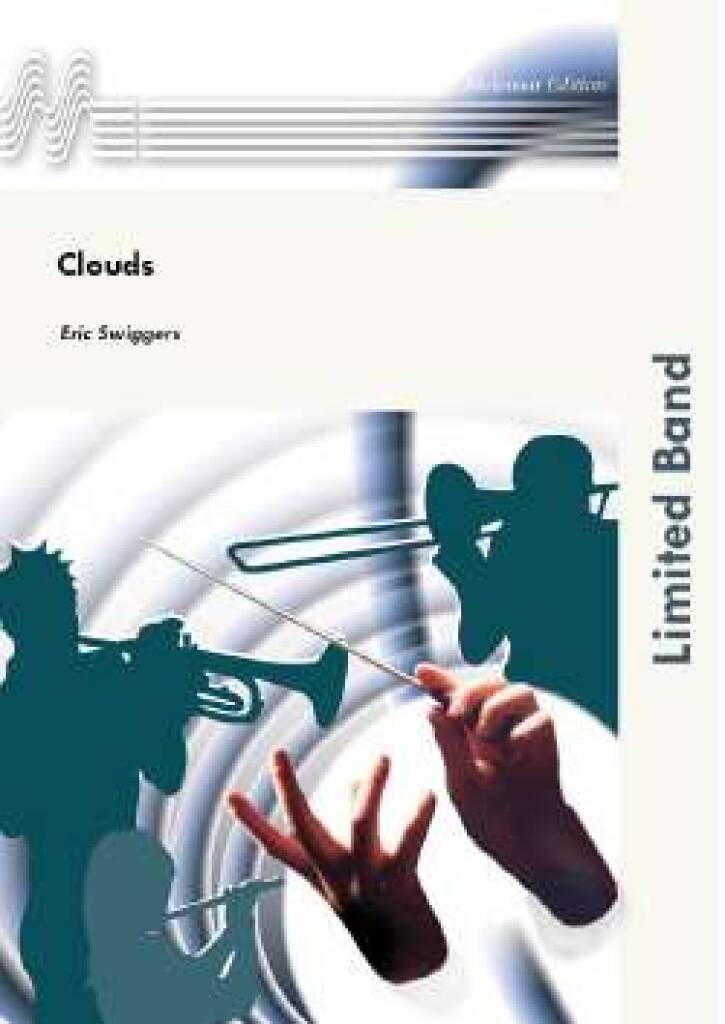
Clouds - Eric Swiggers
This piece was commissioned by Kunstfactor in the Netherlands. This work has been written in a contemporary but accessible idiom. The composition describes three different clouds: 1. Cumulus. Cumulus clouds are a type of cloud with noticeable vertical development and clearly defined edges. They are often described as 'puffy' or 'cotton-like' in appearance. Cumulus clouds mostly forecasts nice, sunny weather. 2. Cirrocumulus. Cirrocumulus clouds are high-altitude clouds that usually occur at an altitude of 6 km to 10 km. Although the term cirrocumulus refers to each cloud, it is typically also used to refer to an entire patch of cirrocumulus. This kind of clouds mostly forecast rainy, stormy weather. 3. Cumulonimbus. Cumulonimbus is a type of cloud that is tall, dense, and involved in thunderstorms and other intense weather. It will be no surprise that thunder and lightning are clearly audible in this third part of 'Clouds'.
Estimated dispatch 7-14 working days
-
 £59.80
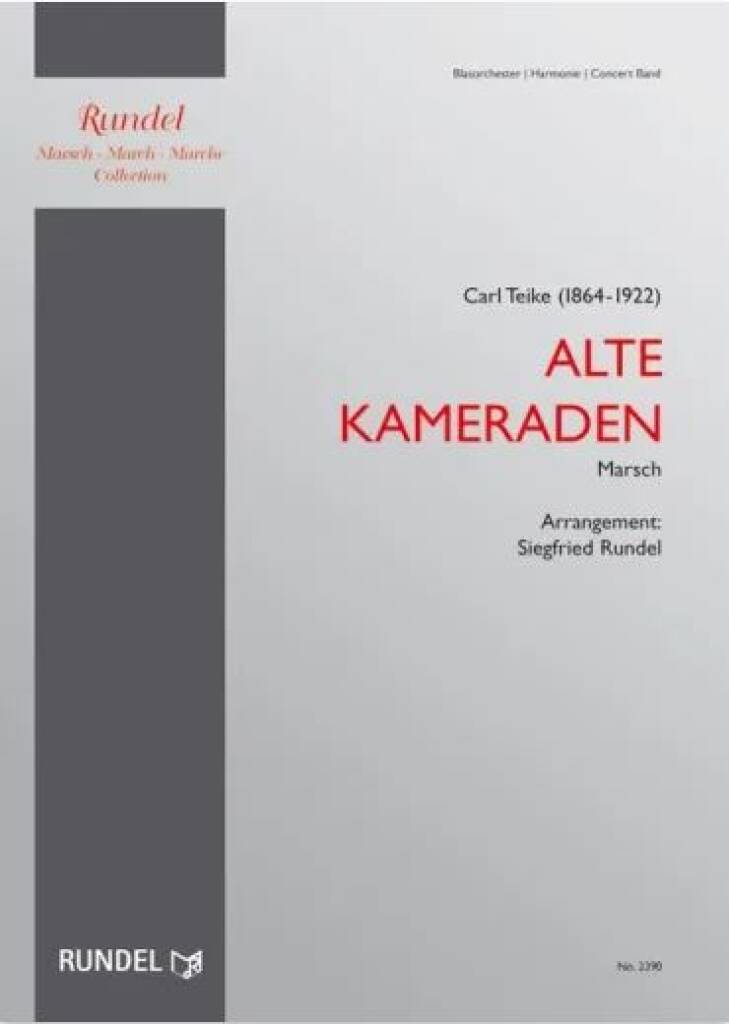
Alte Kameraden - Carl Teike
It is the greatest tragedy in the life of a young composer if he happens to write his most successful piece at the beginning of his musical career. This holds true for Carl Teike, as the unsurpassed success at the beginning of his musical life was his march "Old Comrades". It is a sparkling piece that may well be labeled to be the German "march of marches". Carl Teike was born on Feb. 05, 1864 in Altdamm. After his parents had moved to Stettin, he had early contacts with military music as a youngster. The enthusiasm for this kind of music never left him throughout his life. He began a musical apprenticeship with City Music Director Bttcher in Wollin and already played in the spa orchestra of Bad Misdroy, which Bttcher conducted. Upon completing his apprenticeship, he enlisted as a volunteer in the band of the (5th Wrttemberg) King Karl Grenadiers No. 123 in Ulm. The musical and military environment there proved to be ideal for the ambitious young musician, who hoped to eventually study band music at the University of Music in Berlin. Above all, his military superior, bandmaster Julius Schreck supported young Teike wherever he could. Unfortunately the time in Ulm took a very unhappy turn, as Schreck's successor was extremely resentful towards Teike, and musical support was replaced by sheer harassment. On account of this, Teike retired from the military towards the end of 1889. Short employments in Ravensburg and Ulm evidently did not suit Teike, who was of northern German descent. This is why he applied for the Royal Police Force in Potsdam. Teike was accepted and entered service in 1895. The royal capital of the Hohenzollerns obviously stirred Teike to write a number of brilliant marches. He even became known abroad as the "musical policeman". Unfortunately he contracted a severe pneumonia while on duty, which eventually forced him to retire from the Royal Police Force in Potsdam. On February 01, 1909 he and his family moved to the prosperous provincial city of Landsberg on the Warthe (which is located east of Berlin in present-day Poland). There, Count Clairon d'Haussonville proved to be an understanding superior who paved the way for modest Carl Teike to continue composing, as his creativity had not suffered from this move. The disease which he had caught in Potsdam evidently was more severe than he was inclined to accept. In spring 1922, his state of health became worse, and in May of that year he passed away. Much too early - as many people felt. Teike's marches constitute an enrichment of the German concert march, as he never composed any street marches. Clear structures, musical ingenuity and a multitude of tone colors distinguish his works and shape them into something really new. It is this type of the march in particular that became the bedrock of the universal appeal of the German march. Even today Teike's marches stand unrivaled for musical quality and content - and they never are aggressive. Toward the end of his tour of duty in Ulm, Teike handed a new march to his superior, which, at the time, did not have a title yet. He in turn told Teike to "put it in a stove and burn it". As we know today, this was a classic misappraisal, as Teike subsequently named his march "Old Comrades" in view of his impending retirement. We do not even need to discuss the acceptance the march has met and still meets all over the world, as "Old Comrades" simply always has been a march of universal appeal. In his new arrangement, Siegfried Rundel did not change the essence of Teike's music, he rather sensitively adapted it to modern musical practice and to the instrumentation of the symphonic band on the basis of his deep respect for the works of Carl Teike.
Estimated dispatch 7-14 working days
-
 £228.70
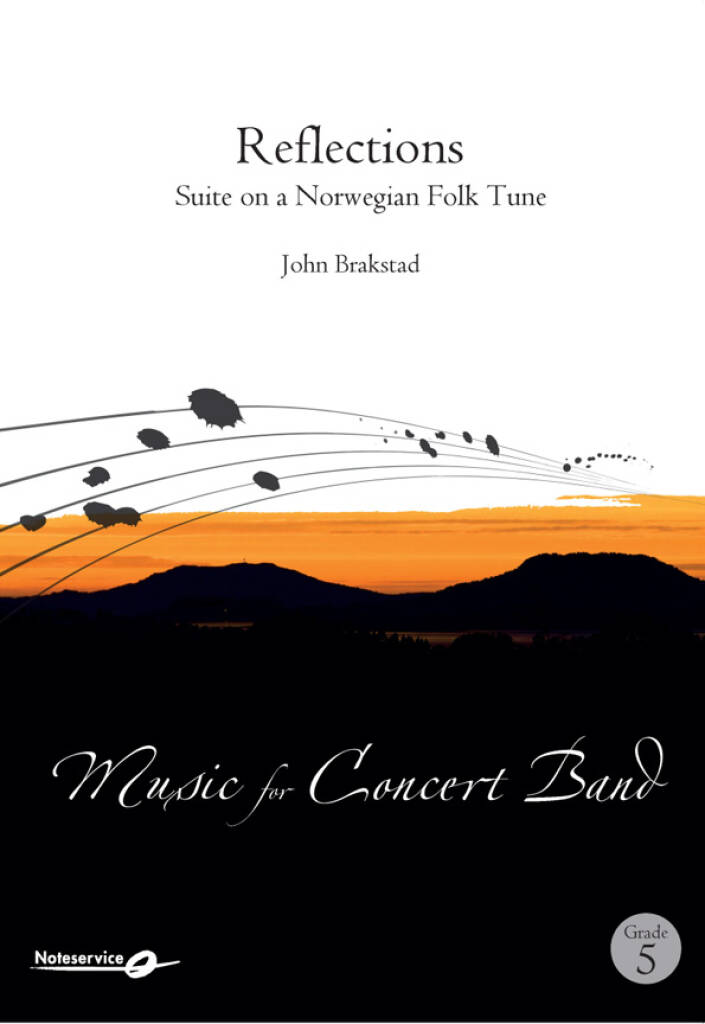
Reflections - Suite on a Norwegian Folk Tune - John Brakstad
The suite is constructed around a Norwegian folk tune. The melody is called "Dark Forebodings", and the words of the song revolve around thoughts and reflections on a future that can take unexpected, insecure, or perhaps dramatic and tragic turns.This is essentially a sad song with a beautiful melody. The folk tune itself is presented in the 2nd movement. In the 1st movement, the folk tune is joined with fleeting themes that indicate the unexpected; as if the music sometimesis confused as to which way to go. There are constant changes in atmosphere and feeling, from the harsh and dissonant, to the harmonious and melodic. The 3rd movement presents a more lively variant of thefolk tune, showing optimism andhappiness, even though the "halting" character of the rhythm underscores the unpredictable. The title "Reflections", therefore, refers to thoughts we can have about life. To the Conductor:The 2nd movement has an alternativeending which is may be used if the movement is played as an independent lyrical piece in a concert.It is advisable to begin first rehersal with the 2nd movement so that the main theme is known, before beginning on the 1st movement with itsmore semi-tonal parts. Intervals and intonation can provide much of the challenge in this movement.The 3rd movement can be more technically challenging, but there is considerable leeway in the tempo marking! It is important to maintain theenergy and intensity of the music through the whole movement.
Estimated dispatch 7-14 working days
-
 £91.20
San Patrizio - Lorenzo Pusceddu
Since 1166, the only sanctuary in Italy dedicated to the memory of Saint Patrick has sat in Colzate. Numerous people visit this sacred place every year, also to admire the extraordinary view from its portico and the luxurious nature that surrounds it. The sanctuary seems to be shaped by nature itself, as its walls blend with the rock on which it rests. The building of this sacred place is associated with the trade relations that the inhabitants of the Seriana Valley shared with merchants from Ireland. It took centuries for the sanctuary to become what we see today: the construction of its nucleus began in the 12th century and ended with the erection of the current portico. This composition depicts in music the veneration that the people of Colzate and neighboring villages have for Saint Patrick. The ternary form recalls the symbol of the clover (in Gaelic Shamrock), with which Saint Patrick explained the Trinity to the people of Ireland.
Estimated dispatch 7-14 working days
 View Music