
Results
-
 £135.80
Ad Quartum - Luciano Feliciani
The city of Quart derives its name from the Latin "Ad quartum ab Augusta lapidem", or four Roman miles from Augusta Praetoria, present-day Aosta, along the ancient Roman consular road of the Gauls. The fortress of Quart, whose construction began in 1185, is the main source of inspiration for the composition. The work begins, in fact, as if wrapped in a mysterious, suspended atmosphere, when the fog that envelops the manor suddenly thins out and lets one see the majestic building in all its austerity. A rhythmically exciting episode follows this brief introduction, ideally describing the events that have marked the long history of these places. The music highlights the percussion instruments, which evoke ancient medieval atmospheres in a modern language. The second theme, derived from the previous one, describes instead emotions and feelings of grandeur, beauty, and peace associated with the splendid Valle d'Aosta mountains that surround Quart. A developed melodic idea, supported by wide-ranging harmonies, attempts to musically portray the extraordinary natural beauty of these places. The reprise of the first theme, varied and presented in a lively and energetic movement, guides the final part of the piece: a coda where all the melodic and rhythmic ideas previously exposed are condensed.
Estimated dispatch 7-14 working days
-
 £105.80
Oros, Little Suite - Daniele Carnevali
This piece was commissioned for the second edition of the "Suoni d'Aspromonte" National Competition which is held in Cittanova in the province of Reggio Calabria. The title, Oros, from the ancient Greek word for "mount", is a clear reference to the Greek culture that colonised Calabria and the magnificence of the Aspromonte massif that dominates the entire region: forests, towns and sea. The piece consists of three movements: Entrata, Serenata and Corteggio, offering rhythms and melodies that reflect present-day tastes rather than local musical traditions. It is specifically intended for bands with lots of young members.
Estimated dispatch 7-14 working days
-
 £113.30
Caleidoscopio - Lorenzo Pusceddu
The incommunicability between different cultures and worlds and the confusion that this generates lie at the heart of this work: the fanfare-like themes that characterise the introduction, together with the "Arabian" melodies of the Presto, represent these differences. The bare theme of the Andante, while offering a glimpse of hope, also describes the impossibility of a meeting and the pain this situation causes. The empty fifth and dissonance of the minor second are elements that feature throughout this work. In the Coda, moreover, all these ideas reappear "kaleidoscopically", amidst a convulsive and excitingly chaotic atmosphere.
Estimated dispatch 7-14 working days
-
 £75.50
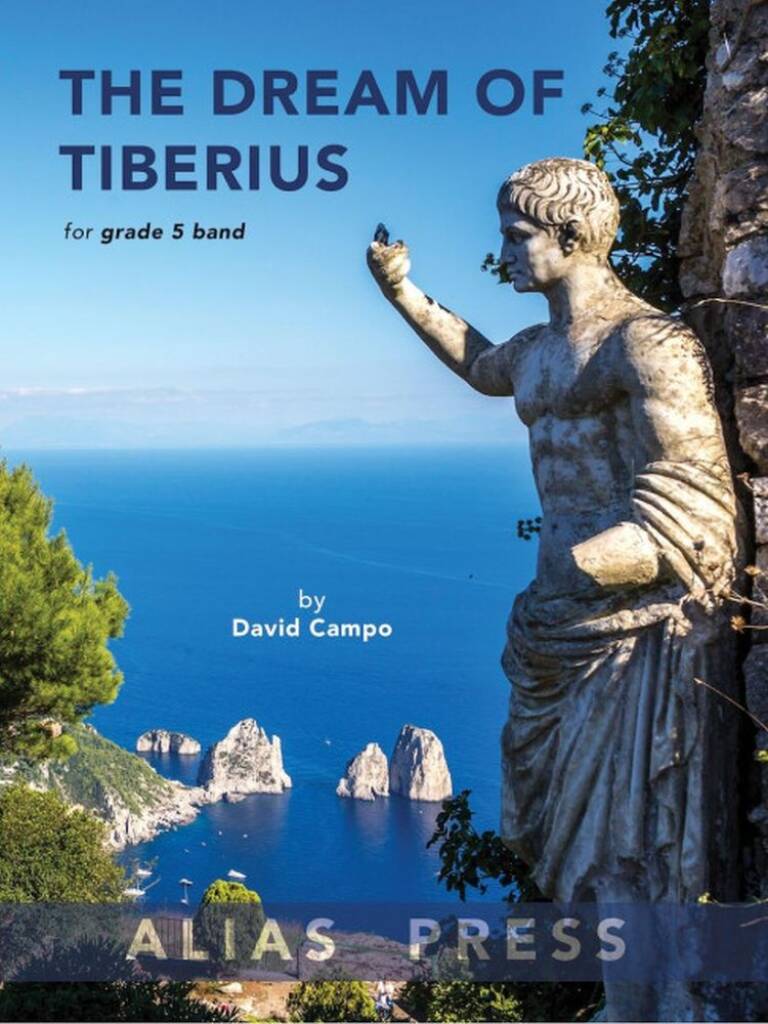
The Dream of Tiberius - David Campo
The Roman Emperor Tiberius was born in 42 BCE to Tiberius Claudius Nero and Livia Drusilla, both descendants of prestigious political families, at a time when Rome was undergoing significant political upheaval. Julius Caesar had begun a brutal civil war in 49 BCE to end Rome's rule as a Republic and consolidate his power as supreme ruler. Following Caeser's assassination in 44 BCE, Tiberius' father backed the forces wishing to return Rome to a Republic, but they were defeated by Caesarian loyalists led by Caeser's heir Octavian. As a result, Tiberius' early life was spent on the run and in political exile with his parents. In 27 BCE, Octavian would become the first Emporer of Rome and assume the name Augustus. Augustus forced Tiberius' parents to divorce and took Tiberius' mother as his new bride, separating the family and forcing Tiberius to live with his father. Upon his father's death, Tiberius went to live with his mother and Emporer Augustus, a situation Tiberius found extremely uncomfortable but one over which he had no control. Having been adopted by the Emperor, Tiberius assumed the military and political life thrust upon him. He proved to be an outstanding military and political leader, and with his marriage to Vipsania Agrippina his life took on a heretofore unknown stability. However, Augustus would intervene in Tiberius' life once more, forcing him to abandon his happy marriage and take Augustus' daughter Julia (Tiberius' step sister) as his new wife. This arrangement, while securing Tiberius' place as Augustus' heir and ensuring he would one day be Emperor of Rome, was disastrous. Julia's drunken licentiousness was a constant source of scandal and embarrassment for Tiberius (and her father, the Emperor) and she was eventually exiled by her father Augustus. Tiberius was named Emperor of Rome upon the death of Augustus in AD 14, assuming his position as the most powerful man on Earth. However, no matter how powerful he had become, Tiberius never felt as if he had ever had any control over his life, having been manipulated from childhood through adulthood by the whims of Augustus. As Emperor, he soon became disgusted with the political intrigue of the Roman Senate and by AD 26 left Rome and took up residence on the island of Capri, where he lived out the rest of his life. History does not regard Tiberius fondly and by all accounts towards the end of his reclusive life on Capri, he had become a miserable, sick and mentally unstable old man reveling in debauchery and cruelty. It is also informative to note that he was Emperor of Rome when Jesus of Nazareth was crucified, and while there is no indication that Tiberius was even aware of the existence of Jesus, as Emperor he was responsible for the appointment of Pontius Pilate as Governor of Judea. Even considering this, it is difficult to look on the life of the Emperor Tiberius and not feel some sympathy and pity. It's in this spirit that I composed "The Dream of Tiberius." I imagine the man sitting in thoughtful seclusion on the beautiful island of Capri imagining what his life might have happily been had not power been thrust upon him: husband, father and humble servant of the people.
Estimated dispatch 7-14 working days
-
 £110.00
Mount Everest - Kees Vlak
This composition basically consists of three fragments and an epilogue (conclusion):1) Plateaux, 2) Sherpas, 3) Climb. The piece starts with a musical depiction of the deserted plateauxs and mountain peaks of the Himalayas. The mysteriousness of theTibetan country was caused by its inaccessibility to other nations. One even believed that there was a paradise behind the huge mountains; the land of Shangra La. 1) After the sound of a gong, the Asian-like theme arises extremely softly from thedecay of the percussion. In bars 4 and 5 the syllables of Hi-ma-la-ya echo. Then a second theme appears; it symbolises the enchantment of the mountaineers by seeing the Mount Everest. 2) Eastern percussion, very evenly without emotion, sound from thedeserted village of the sherpas. The phrasing is prescribed by the number 'three'. From measure 56 Tibetian monks sing a chant, also with the religious background of the number 'three'. 3) The third part starts of with the sight of the giant MountEverest with an entirely new theme, that is played impressively by the strong low brass instruments of the band, immediately followed by the excited big climbing. The many surprises are depicted by the changing time signatures. Two themes are inconstant battle; the binary Himalaya theme and the ternary Mount Everest theme. Only once there is a steely composure. The registers in which the piece is played increase. The tension rises...Then the peak is reached. A long pause follows before onerealises that one is on top of the world. Slowly the emotions of joy grow and lead to an enormous climax. The first enchanted theme sounds again in total glory.
Estimated dispatch 7-14 working days
-
 £75.00
Sonata - Derek Bourgeois
This work, composed in 1998, was commissioned by the American trombonist Don Lucas as a work for trombone and piano and first performed by him in Birmingham on 19th May 2000. Subsequently, I arranged the music for both solo trombone and brass band and solo trombone and wind band so that it now exists in three formats. The first movement, in B flat major, is brisk and energetic, and is cast in sonata form. The second subject is gentler and more lyrical. The second movement, a scherzo in C major, is the most complex of the four. Basically the structure is a rond. For a long time the music remains in the opening 5/8 time until a new theme introduces more broken rhythms in a more jazzy idiom. After a return of the opening theme the following episode is more tonally ambiguous. Finally, the main theme returns to round off the movement. The third movement, a lyrical adagio, is really one long extended melodic flow. The harmonies are lush and the textures simple and direct. The tonal center is A minor, but the music meanders through so many keys, that this key centre is heavily disguised. The finale is a fiery affair. G minor is really its home key, but throughout the movement the music moves about a lot and the second subject is first heard in A flat minor. The movement's underlying sonata structure is masked not only by its loose tonality but also by its frequently changing time signatures. Like the first movement the second subject is more lyrical in nature and for a while it seems that the music will end peacefully, but a final flurry heralds a triple forte unison on the home note of the first movement - B flat. Derek Bourgeois
Estimated dispatch 7-14 working days
-
 £104.50
Meramec Rhapsody - Claude T. Smith
This work is a commission by the Missouri Bandmasters Association to honor the 50th Anniversary of the MMEA. From the opening melody stated by unison flutes, 1st clarinet and 1st trumpet, the work quickly starts through a development of that melody that only this composer does so well. The writing is very "rubato" chorale style often interrupted with short allegro sections but always returning to the opening statement. There is a short flute solo passage as well as a very fluent alto sax solo. A dramatic piece that bands will enjoy playing for years to come.
Estimated dispatch 7-14 working days
-
 £104.50
Buffalo Jump Ritual - Daniel Bukvich
This imaginative work is a musical adventure that recalls the traditional buffalo hunts that took place on the western plains of America. As youd expect, there is an overall Native American feel to the music, as the drama and excitement of the hunt is recreated through a myriad of aggressive elements that drive the piece. ( 7 minutes 12 seconds)
Estimated dispatch 7-14 working days
-
 £104.50
Parade Militaire - Jules Massenet
As a gifted young composer, Jules Massenet (1842-1912) wrote several operas that were never produced or printed; but at the age of 25, he enjoyed his first opera production in Paris. Following that success he became a popular and successful part of the Paris music scene. In 1878, he was appointed professor of advanced composition at the conservatory, and it was while he held this position that he composed his Parade Militaire for orchestra. This lively tune is full of life, energy and subtleties, with great style and elegance, and some sudden dynamic surprises.
Estimated dispatch 7-14 working days
-
£104.50
A Holiday Celebration - Larry MacTaggart
Celebrate your holiday season with this refreshing holiday spectacular by the gifted staff arranger of the United States Air Force Band. It will brighten any Christmas program with its imaginative, coloful orchestrations and its clever, witty presentations of holiday songs that everyone will recognize. It is a fun, exciting musical celebration of the season that will have the audience smiling as they recognize and enjoy the traditional songs that are so familiar.
Estimated dispatch 7-14 working days
 View Music