
Results
-
 £72.99
Jazz Cocktail Suite - I. Spicy - Marc Jeanbourquin
Jazz Cocktail Suite is a sparkling work in three movements where every note is an explosion of flavours! The light and festive first movement (Spicy) begins with sparkling brass and dancing rhythms, then we're off to Latin America, with its bewitching rhythms and sunny melodies, for the second movement (Caliente). Finally, the third movement (Xplosion) tops it all off with a musical explosion of swing, groove, solos, and pure energy.This piece can be performed as a whole, but it is also possible to play just one of the movements, which can be ordered by way of the following edition numbers:2260-26-010 MI. SPICY2261-26-010 MII. CALIENTE2262-26-010 MIII. XPLOSION
Estimated dispatch 7-14 working days
-
 £76.99
Jazz Cocktail Suite - III. Xplosion - Marc Jeanbourquin
Jazz Cocktail Suite is a sparkling work in three movements where every note is an explosion of flavours! The light and festive first movement (Spicy) begins with sparkling brass and dancing rhythms, then we're off to Latin America, with its bewitching rhythms and sunny melodies, for the second movement (Caliente). Finally, the third movement (Xplosion) tops it all off with a musical explosion of swing, groove, solos, and pure energy.This piece can be performed as a whole, but it is also possible to play just one of the movements, which can be ordered by way of the following edition numbers:2260-26-010 MI. SPICY2261-26-010 MII. CALIENTE2262-26-010 MIII. XPLOSION
Estimated dispatch 7-14 working days
-
 £187.00
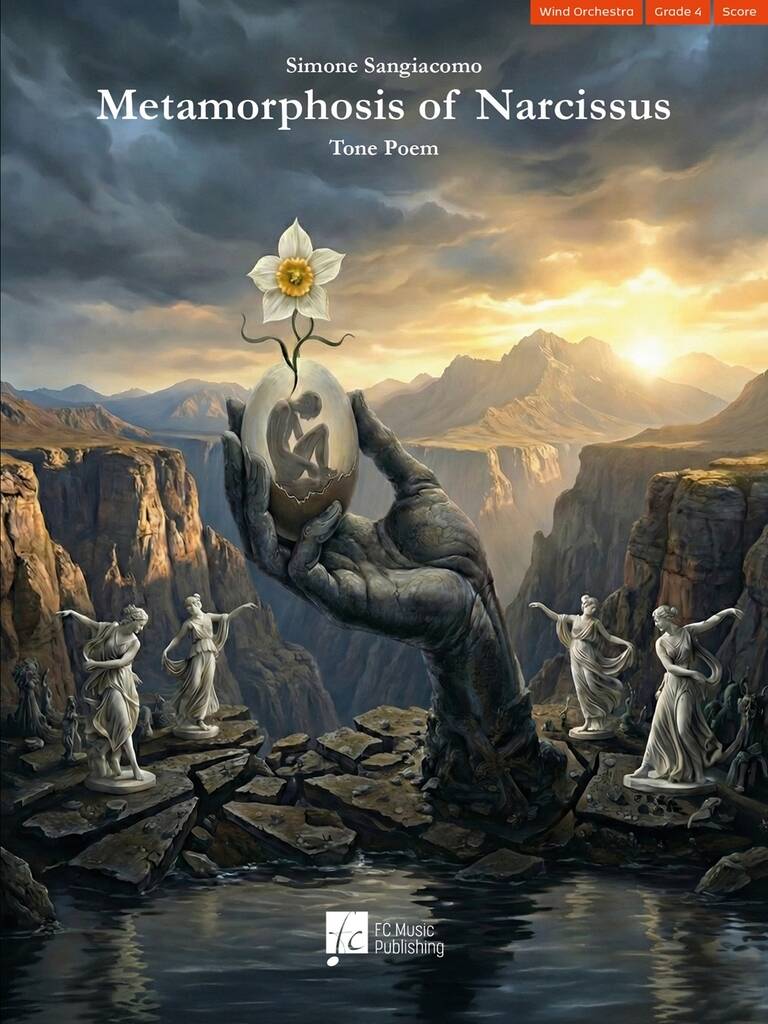
Metamorphosis of Narcissus - Simone Sangiacomo
Metamorphosis of Narcissus, a powerful symphonic poem by young Italian composer Simone Sangiacomo, is inspired by Salvador Dal's surrealist painting. The piece takes the audience on a journey through fragmented rhythms and dissonant harmonies. From the dark, mythical landscapes to the iconic petrified hand holding a cracked egg, the music blurs the lines between illusion and reality. The piece employs innovative sonic techniques to illustrate the metamorphosis and fusion between the human being and his own reflection. Metamorphosis of Narcissuspresents itself as a profound meditation on the boundaries between self-perception, decline, and transformation. In 2024, Metamorphosis of Narcissus won the second prize at the "Winds Composition Contest Saxony" in Dresden, Germany.
Estimated dispatch 7-14 working days
-
 £68.99
The Castle on the Hill - Philip Sparke
The Castle on the Hill was commissioned by the Harmonie l'Abeille de Lucens, based in western Switzerland, and premiered by them in their 2025 Spring Concert on April 12th in the Grande Salle in Lucens. The band has a proud history dating back to 1883 and boasts a separate youth band as well as a music school. The march is in traditional form. After a brief introduction the main theme unfolds on the full band. This is followed by a bold theme in the bass, decorated with woodwind flourishes. A bridge passage leads to a second theme on clarinets and saxophones, repeated by the full band. A change of key heralds the trio section featuring a legato melody, again on clarinets and saxophones and taken up in a fresh key by the full band. This leads directly back to a recall of the opening material in a slightly abridged and decorated version, leading to an emphatic close.
Estimated dispatch 7-14 working days
-
 £87.99
Dancing on the Sand - Etienne Crausaz
Dancing on the Sand immerses us in an unmistakable oriental atmosphere. A moderate introduction underscored by percussions sets the scene. A short clarinet cadenza leads to the second part of the piece, during which an oriental dance built upon irregular rhythms develops, accelerating continuously to reach a dazzling finale. This work will undoubtedly set your concert on fire! This music forms part of the musical tale La Maldiction d'Aragne (Aragne's Curse), commissioned by the Lyre de Courtion (conductor Dominique Morel) on the occasion of its 100th anniversary.
Estimated dispatch 7-14 working days
-
 £233.99
First Symphony, Op. 35 - James Barnes
Composed during the summer and fall of 1974, Barnes' FIRST SYMPHONY, Op. 35 was his master's thesis at The University of Kansas. It was premiered in the spring semester of 1976 by their Symphonic Band, Robert E. Foster conducting. The following year, the symphony was awarded the American Bandmasters Ostwald Composition prize, which led to a second performance (of only the first two movements) by the Northwestern Wind Ensemble at the American Bandmasters convention with Col. Jack Cline (U.S Marine Band) conducting. Following this performance, Barnes submitted the work to several publishers, all of which declined on the basis it was too long and difficult to be marketable. For this reason, Barnes set the work aside and there it remained until 2022, when an offer came from the Osaka Shion Wind Orchestra to record all nine of Barnes'_x001A_symphonies to help celebrate their 100th anniversary. Barnes seized the opportunity, engraving all four movements, with revisions and corrections, an effort that took seven days a week for two months to complete. As a result, after almost fifty years, all nine of the Barnes symphonies are finally available for performance.
Estimated dispatch 7-14 working days
-
 £189.99
Bassoon Concerto - Carl Maria von Weber
This work by Carl Maria von Weber and the BASSOON CONCERTO by W. A. Mozart are the two concertos most often played in the bassoon repertory. The late William Waterhouse asserted: The bassoon concerto by Weber ranks second only to that of Mozart in importance. The concertos by Mozart and Weber were in the repertoire used for the famous playing exams at the Paris Conservatoire, along with newly commissioned works by French composers. This transcription of the Weber for bassoon and small wind band has been completed by R. Mark Rogers.
Estimated dispatch 7-14 working days
-
 £53.50
Forgotten Echoes - Brian Monroe
The clarinet part does not cross the break, trumpets range only to second space A (with an optional C sharp) for trumpet 1, there's plenty of percussion if needed (use or subtract as necessary!). Overall, it adds up to the perfect grade 1 concert piece!
Estimated dispatch 7-14 working days
-
 £244.00
Anemoia - Gauthier Dupertuis
Gauthier Dupertuis wrote Anemoia as part of his master's thesis at the Lausanne University of Music. It is dedicated to the most significant figure in his musical life: his teacher Jean-Claude Kolly.Anemoia is the name given to the feeling of nostalgia that one feels for a time that has never known. This emotion often translates into the uneasy sensation of having lost something important or of not living at the right place or time. Fascinated by this concept, Gauthier Dupertuis tried to translate it into music oscillating between exaltation, anguish and nostalgia.The piece is formed by two movements: (Un)desired sorrow and Behind the glass of time. The first movement initially evokes the feeling of unease one feels when suddenly struck by anemoia. It then evolves into majestic atmospheres, marking our admiration for times gone by. The second movement treats anemoia in a more melancholic way.The premiere took place on 6th December 2024, during Jean-Claude Kolly's last concert as a conductor of the Concordia de Fribourg, marking thirty years spent conducting this wind orchestra.
Estimated dispatch 7-14 working days
-
 £94.00
Altheim - Gauthier Dupertuis
This concert march with a solemn and festive character was commissioned to Gauthier Dupertuis by the the Musikkapelle Altheim e.V (Germany) to celebrate its 100th anniversary. The thematic material of the first section of the march is based on a three-note motif, proclaimed by the brass in the first measure. The second part of this theme presents a recurring motif throughout the piece. This first section has a festive and resolutely giocoso character. The trio presents a new, more lyrical and solemn theme. After a short divertimento based on the material from the first section, the theme returns in a majestic way, leading to a climactic finale. Altheim: a concert march perfect for a festive occasion!
Estimated dispatch 7-14 working days
 View Music