
Results
-
 £101.50
Passacaglia and Interlude - Gerald Sebesky
Gerald Sebesky brings us back to an era for style and form of the past, but with a modern sound. Not dissonant, but changing time meters, and counterpoint all within the Grade 4 performance level. First trumpet's highest note is B flat.
Estimated dispatch 7-14 working days
-
 £218.30
Norsk Kunstnerkarneval Op.14 - Johan S. Svendsen
This well-known work was composed in Christiania in 1874 for a burlesque Carnival in "Kunstnerforeningen".An early title for the work was "Bryllup paa Dovre". The manuscript score and parts at The National Library in Oslo of the early version with this title have much more music than the version printed by C.F. Peters, Leipzig in 1881. The form in this first version was ABA with an additional trio part that later were discarded. In the trio Svendsen used the melody Sterreisen (Os har gjort kva gjeras skulle) from Lindeman's collection of Norwegian Folk Tunes. (Vol. I/115). In the A-part a wedding tune (Bruraslaatten) from Sogn is used (Lindeman Vol. I/476). The Carnival's literary theme was the connection between the cold north and the warm south. Musically the south is represented in Svendsen's music by Raffaele Sacoo's melody from 1835 "Te voglio bene assai".I believe that if Norwegian quality music from this period is going to be performed, it must at least be available. There must be editions for modern instrumentations with full scores. I do this as my contribution to expand and enrich the repertoire for Concert Bands.- Stig Nordhagen -
Estimated dispatch 7-14 working days
-
 £228.70
Konsertouverture - Viktor Widqvist
This piece was composed in 1937 in the composer's later part of life. Here, Widqvist shows his broad competence as a composer by using both classic marching and late-romantic thematic elements with exciting harmonic twists. In addition, you can find a perfect fugue where the composer shows that he masters this advanced composition technique. One can imagine that Widqvist wanted to show off his entire repertoire of knowledge to take the lead in the unspoken competition with colleague and friend Sam Rydberg. Rydberg had several years earlier composed a concert overture with a similar form. However, this piece is simpler in its design and lacks the technical brilliance that Widqvist shows in his contrapuntal treatment and harmonious diversity.The concert overture was re-orchestrated in 1939 by the composer for symphony orchestra, and it is this version and the original score for a large military orchestra that form the basis for this edition. My aim has been to keep all of Widqvist's original intentions, but still make use of all the possibilities of the modern symphonic wind orchestra. The composer's own arrangements for symphony orchestra have been of great help in this work.- Niclas Blixt -
Estimated dispatch 7-14 working days
-
 £68.80
La Morisque from The Danserye - Tielman Susato
Every young musician should begin experiencing different historical styles early in their development. La Mourisque gives them the chance to perform in a homophonic style from the renaissance.This arrangement is an adaptation of Susato's original score from 1551. Some changes have been made to facilitate voice-leading in individual parts. Cadential harmonies have been changed to reflect modern expectations.
Estimated dispatch 7-14 working days
-
 £174.10
Norge i rdt, hvitt og bltt - Lars-Erik Larsson
Norge i rdt, hvitt og bltt ("Norway in Red, White and Blue") was commissioned by the Oslo Fagott Choir (yes, that is indeed a gay men's choir) for a concert with The Staff Band of the Armed Forces in 2015. I was given artistic licence to write a more modern and somewhat 'eclectic' arrangement for this originally Swedish melody written by Lars-Erik Larsson, which became something of a national liberation anthem when Nazi occupation ended in May 1945 - then with new lyrics by Finn B, Bias Bernhoft and Arild Feldborg.After the premiere in Oslo, and a music video with Oslo Fagott Choir and The Staff Band, broadcasted by Norwegian Broadcasting Corporation (NRK) on Constitution Day during coronavirus lockdown in 2020, I was approached by many to write an instrumental version of the arrangement for concert band. This version is now available through Norsk Noteservice.- Petter S. Kragstad -
Estimated dispatch 7-14 working days
-
 £154.60
Vise i vinterlys - Erik Bye
Erik Bye (1926-2004) was a major Norwegian TV-personality in his time, a colourful man with a varied background.He was a great lyricist, and many of his poems and songs have become modern Norwegian classics.This song, which could be translated at A ballad in Winter-light is maybe his only love-poem. He text describes a cold scene, where the lovers meet, and the images Bye paint are cold, bleak - but still with a warm intensity.The norwegian composer Egil Monn-Iversen (1928-2017) has brought a Scandinavian Noir feel to the text, they suit the lyrics perfectly.- John Philip Hannevik -
Estimated dispatch 7-14 working days
-
£53.50
Notzinger Volkstnze - Willy Schneider
Since their first publication Willy Schneider's original compositions based on Swabian folk dances have had a strong influence on form and style. This high quality, genuine folk music, free of all popular clichs, is now again available in the extended instrumentation for modern wind band. This work is particularly suitable for use as a suite accompanying a folk-dance group. Set of parts does not include parts in Benelux notation
Estimated dispatch 7-14 working days
-
 £135.80
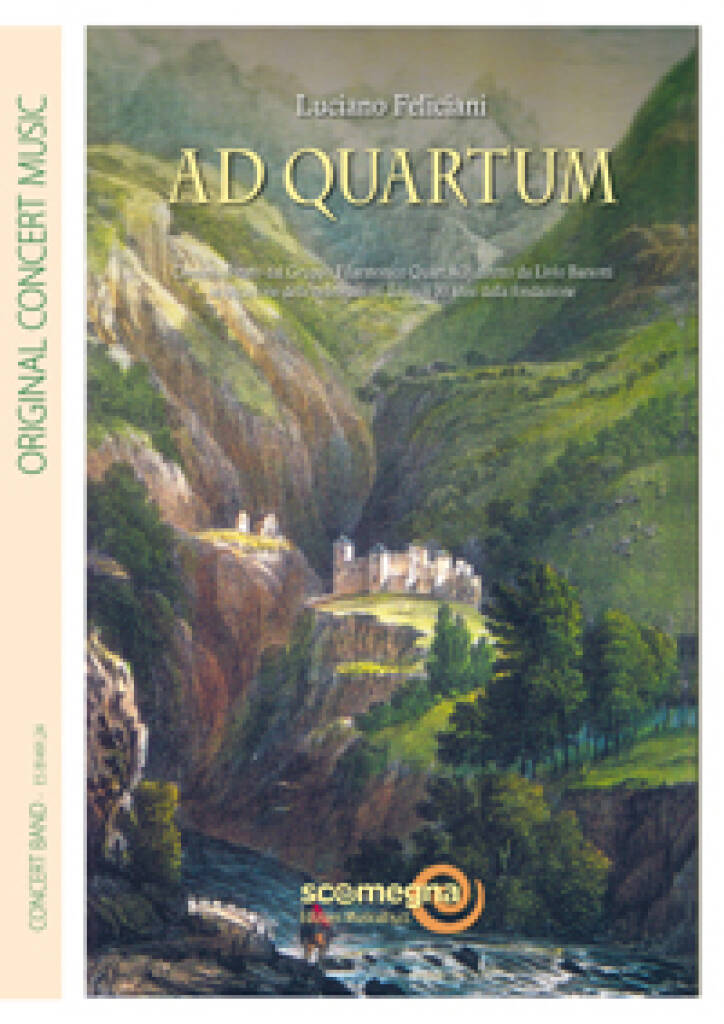
Ad Quartum - Luciano Feliciani
The city of Quart derives its name from the Latin "Ad quartum ab Augusta lapidem", or four Roman miles from Augusta Praetoria, present-day Aosta, along the ancient Roman consular road of the Gauls. The fortress of Quart, whose construction began in 1185, is the main source of inspiration for the composition. The work begins, in fact, as if wrapped in a mysterious, suspended atmosphere, when the fog that envelops the manor suddenly thins out and lets one see the majestic building in all its austerity. A rhythmically exciting episode follows this brief introduction, ideally describing the events that have marked the long history of these places. The music highlights the percussion instruments, which evoke ancient medieval atmospheres in a modern language. The second theme, derived from the previous one, describes instead emotions and feelings of grandeur, beauty, and peace associated with the splendid Valle d'Aosta mountains that surround Quart. A developed melodic idea, supported by wide-ranging harmonies, attempts to musically portray the extraordinary natural beauty of these places. The reprise of the first theme, varied and presented in a lively and energetic movement, guides the final part of the piece: a coda where all the melodic and rhythmic ideas previously exposed are condensed.
Estimated dispatch 7-14 working days
-
 £157.50
Composizione Prima - Flavio Vicentini
Many works are composed with the precise aim of describing landscapes, atmospheres or telling stories. "Composizione Prima", on the other hand, was composed with the sole intention of experimenting with some uses of modern musical language. The piece is formally structured in three movements: allegro, adagio and fanfare, without however complying with any standard pattern. The main theme, "fanfara", can be heard several times throughout the piece. It is the only feature of this work that in any way evokes an onomatopoeic sound, to indicate the gradual approach through three dimensional space of a Napoleonic band (fanfare).
Estimated dispatch 7-14 working days
-
 £157.50
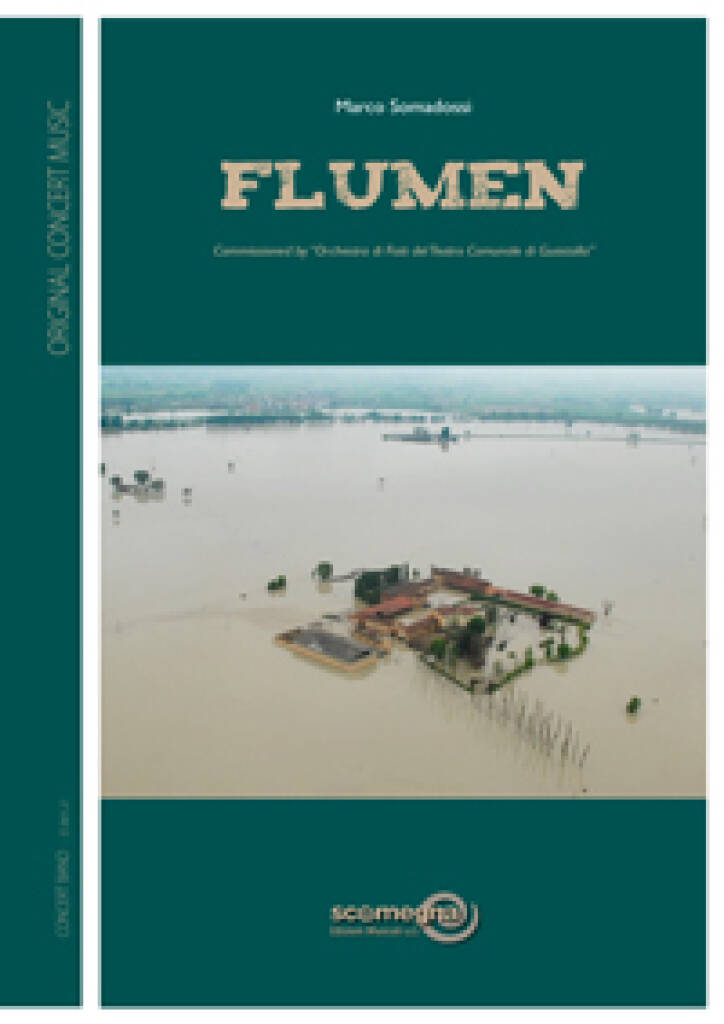
Flumen - Marco Somadossi
In October 2000, the River Po produced its highest flood waters in the last hundred years, provoking a natural disaster of dramatic dimensions. To the thousands of valiant men and women committed to defending their villages against the threat of the flood is dedicated the symphonic poem entitled "Flumen" (river, in Latin), inspired by the thematic material in the Gregorian sequence, "Victimae paschali laudes". The main melody is elaborated and its essence is transfigured in an alchemy of modern sounds from which, at times, archaic echoes emerge. The composition is structured in two parts: the first ("The River") is sullen and menacing, with sounds that portray the turbulent water and the inexorable and frightening rise of the flood;this contrasts with a second section ("The People"), with its primitive rhythms and vaguely multiethnic character (expressed through modal harmonies). Here the work evokes man's ancestral struggle against the forces of nature: the strenuous defence of the Po riverside communities to against the threat of flooding. In the finale, the two themes interweave and overlap, re-establishing a symbolic and primordial equilibrium where man and nature are again in harmony with each other.
Estimated dispatch 7-14 working days
 View Music