Results
-
 £157.50
Composizione Prima - Flavio Vicentini
Many works are composed with the precise aim of describing landscapes, atmospheres or telling stories. "Composizione Prima", on the other hand, was composed with the sole intention of experimenting with some uses of modern musical language. The piece is formally structured in three movements: allegro, adagio and fanfare, without however complying with any standard pattern. The main theme, "fanfara", can be heard several times throughout the piece. It is the only feature of this work that in any way evokes an onomatopoeic sound, to indicate the gradual approach through three dimensional space of a Napoleonic band (fanfare).
Estimated dispatch 7-14 working days
-
 £157.50
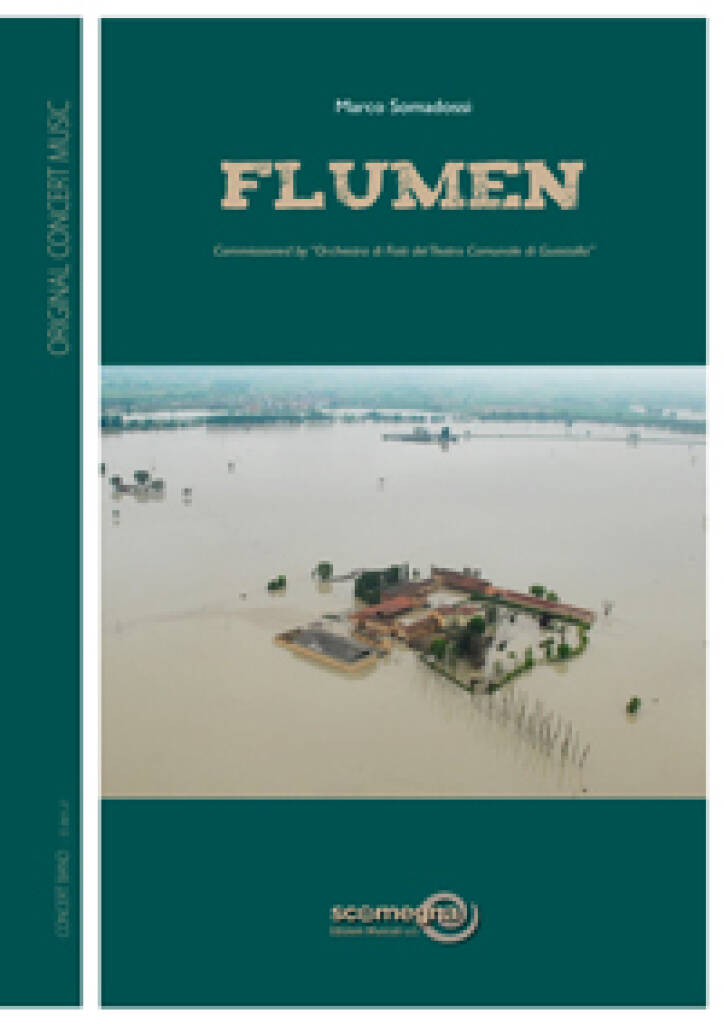
Flumen - Marco Somadossi
In October 2000, the River Po produced its highest flood waters in the last hundred years, provoking a natural disaster of dramatic dimensions. To the thousands of valiant men and women committed to defending their villages against the threat of the flood is dedicated the symphonic poem entitled "Flumen" (river, in Latin), inspired by the thematic material in the Gregorian sequence, "Victimae paschali laudes". The main melody is elaborated and its essence is transfigured in an alchemy of modern sounds from which, at times, archaic echoes emerge. The composition is structured in two parts: the first ("The River") is sullen and menacing, with sounds that portray the turbulent water and the inexorable and frightening rise of the flood;this contrasts with a second section ("The People"), with its primitive rhythms and vaguely multiethnic character (expressed through modal harmonies). Here the work evokes man's ancestral struggle against the forces of nature: the strenuous defence of the Po riverside communities to against the threat of flooding. In the finale, the two themes interweave and overlap, re-establishing a symbolic and primordial equilibrium where man and nature are again in harmony with each other.
Estimated dispatch 7-14 working days
-
 £113.30
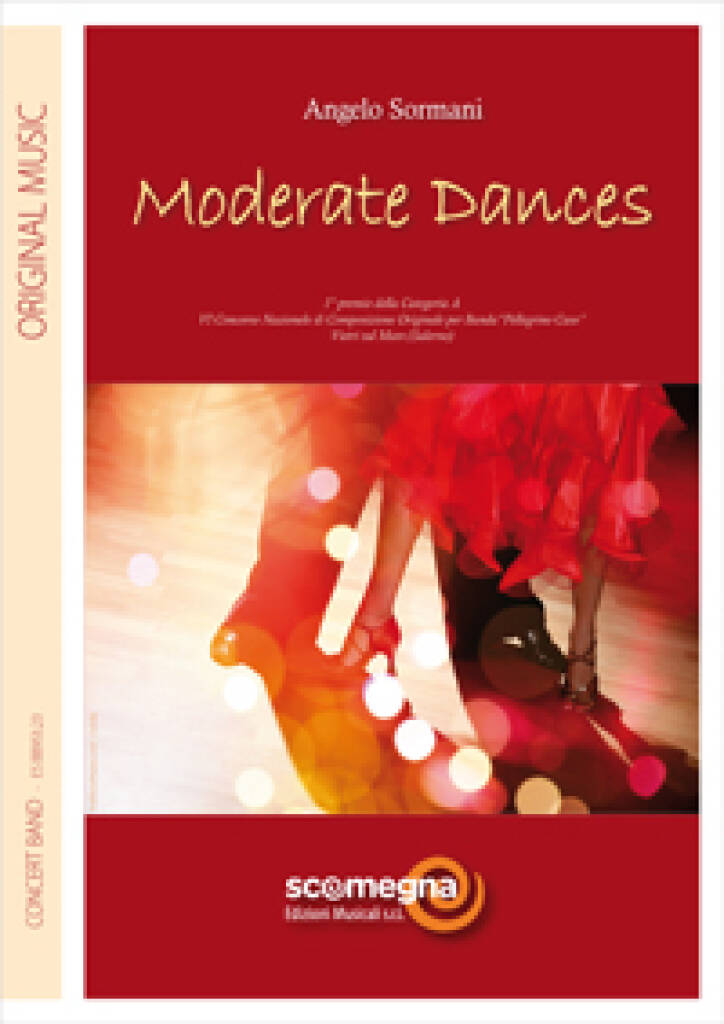
Moderate Dances - Angelo Sormani
This piece is a tribute to dance music, especially passionate, intense and meditative dance music. "Moderate Dances" is divided into three movements: a "Tango", a "Slow Waltz" and a "Bossa Nova". Each movement and each dance has its own particular characteristics but, when combined, these different rhythmic beats and times give the piece a feeling of completeness and uniformity. The Tango started to flourish in the suburbs of Buenos Aires in around 1880. There is still some doubt as to its origins, which may be Cuban (Habanera) but are probably African. It was most popular in Argentina and Brazil: here the male protagonist was originally the "gaucho" with his inseparable guitar, later to be replaced by the proud, elegant "compadre". By around 1910 the Tango had spread to Italy and France. New clubs opened, where the upper classes could watch and dance the Tango. Here the dance also underwent some rapid transformations. The exaggerated and extravagant gestures and body movements disappeared. Slow, gliding steps replaced the old rotational movements. The women's red ankle-boots and the partners "staring into each other's eyes" accentuated the erotic nature and sensuality of this dance. So much so that, in 1913, the German government banned soldiers from dancing the Tango. Those who broke the law were immediately discharged from the army. From a strictly musical perspective, the basic instruments were a flute, a harp (the diatonic harp typically played by the Indians of Paraguay) and a violin, or flute, guitar and violin or even clarinet, guitar and violin. These instruments were easy to transport, ideal for playing at parties, in the streets and in courtyards. The musicians played by ear, frequently improvising: there were no scores, no records, which is the main reason why it is impossible to trace the Tango back to its exact origins. However, the Tango's evolution (and growing popularity) was once again fostered by its fundamental ability to absorb "other" cultures, languages and sounds. And it was the arrival of the "bandoneon" (an accordion-like instrument that was invented in Germany and brought to Rio de la Plata by some immigrant), which replaced the flute, that marked the beginning of the Tango's huge success outside Argentina. A number of talented composers, above all the great Astor Piazzola (1921-1992), transformed the bandoneon from a simple accompanying instrument to a solo instrument that was to become the distinguishing feature of the 20th century Tango. The Slow Waltz originated from the Waltz, the typical dance of the Bavarian and Tyrolese peasants in the 1700s. It was composers like Johann Strauss, father and son, who carried the Waltz to its zenith in the 1800s, creating the sensual and melancholy yet joyful and charming dance we are all familiar with. When the Waltz first became popular in Germany, the members of respectable society were shocked at the closeness of the dancing partners, who had always previously danced apart. The main difference between the Waltz and Slow Waltz is that the latter has a slower, more expressive rhythm: the men wear tails and the women wear ball gowns decorated with beads and feathers and couples dance in graceful rotational movements. "Bossa Nova" is the title of the last movement in the piece. Jobim, the great Brazilian musician, described this musical genre as a combination of modern Jazz and Samba. Bossa Nova means "new wave". This was the name of the artistic and musical movement that evolved in Brazil in the late Fifties and was extremely popular throughout the Sixties. The songs are usually about love or social matters, drawing inspiration from the slums of Rio De Janeiro and the lives of their inhabitants. Bossa Nova, with its original compositions and the artistic talent of its musicians, also became hugely popular in the United States and Europe, and top Jazz musicians (Ella Fitzgerald, Stan Getz, Bob Cooper, Charlie Bird, Sonny Rollins, Dexter Gordon, Dizzy Gillespie) started to include Bossa in their repertoires.
Estimated dispatch 7-14 working days
-
£168.50
The Three Embraces - Carter Pann
The first two of three movements are meant to be aural aromas, says Pann, with soft, languid, and lush winds (a long trail of the softest dynamics). Harp and celesta are used to impart an aura of ancient, inward elegance. The Three Embraces ends with a celebratory mix of pastoral melodies juxtaposed over more modern, angular harmonies. Written to celebrate Allan McMurray's 35 years as Director of Bands at the University of Colorado. (all quotes from the composer) Dur.: 12'30
Estimated dispatch 7-14 working days
-
£150.00
New London Pictures (Score & Parts) - Nigel Hess
New London Pictures represents elements of London in the 21st Century. The Millennium Bridge describes the pedestrian's journey across this wonderful new landmark bridge over the Thames, starting at the imposing Tate Modern, crossing the busy river, and onwards to St. Paul's Cathedral with its bells ringing out over the great city. London Eye is an incredibly large ferris wheel situated on the South Bank of the River Thames. This movement depicts a "flight" on this riverside wheel, at the top of which the anoramic view of London is breath-taking and the exapnse of the music is a suitable depiction of the view. As with all modern cities, London is over-crowded with motor vehicles. London is the first major city in Europe to adopt a Congestion Charge, and this piece (with its stop and go traffic lights) is both racy and comical. Here are Londoners attempting to go about their business in the face of overwhelming odds.....
In stock: Estimated delivery 1-3 days
-
Letters For Home - Peter Meechan
Letters for Home is a three movement work, commissioned by East Lancashire Concert Band with support from Arts Council England, to commemorate the start of the First World War, and the role played in the war by the 'Accrington Pals'. Before each movement a reading should be made - these may be a letter sent from The Front, WW1 poetry, thoughts and reflections recorded elsewhere, or new words, written by local poets, school children or others.Whilst specifically concerned with the First World War, each of the work's movements broadly outlines emotions that would form part of any soldiers lives during any war - and as such, performances of this work can easily be adapted to reflect other wars both modern and historical, and locally sourced words for the readings is highly encouraged.The first movement, "The Bittersweet Love Song" is the story of a soldier saying goodbye to his loved one before leaving for war. The opening passages are of the soldier, perhaps putting to the back of his mind the danger he is facing, singing a love song to his wife or girlfriend. In the following passages we hear his loved one singing "I love you", played by the flute section.We again hear the soldier singing - this time with more of a sense of what lies ahead for him, but now the response is further away as they gradually move more distant from each other. The movement ends without conclusion, but with chords for the soldier's song played hauntingly over the percussion.The second movement, "The Trench", is more self-explanatory. It combines bravado in the percussion opening with the whole band coming together as one - as a unit, before again we hear fear and trepidation in the brass, once more failing to reach a resolution. Perhaps the thoughts of the soldier are interrupted as the percussion once more calls the men to arms. The movement ends with gun shots in the percussion.The final movement, "In Memory", opens with a repetition of the love song from the opening movement, before a slow lament, again never resolving, is heard. It keeps finding a new key, a new place, intending to represent the cyclical nature of war, and again without resolution, suggesting that war is also often that way.Letters for Home is dedicated to Ian McGuinness, whose support, enthusiasm, and sheer hard work led to this work being commissioned and performed, and to the East Lancashire Concert Band, who gave the premiere on 27 September 2014, at the Town Hall, Accrington, home of the Accrington Pals, with the final revision of the work being completed in November of the same year.
Estimated dispatch 5-14 working days
-
The Legend of King Arthur - Peter Meechan
King Arthur is the subject of many tales, stories, myths and legends - from his ascension to the throne by pulling the sword from the stone, his courageous battles with his fellow Knights of the Round Table, to his ultimately tragic love for Guinevere.The Legend of King Arthur is a musical portrayal of some of the most important moments in the legend.The opening of the work - a rock inspired overture - is a reference to Arthur's final resting place (at least, so some legends have it!), the modern day Glastonbury (Avalon in the legend), and it is in this opening that we hear for Arthur's theme.This high octane opening gives way to a mysterious section - as Merlin (the mystical wizard) places in a stone a sword, upon which was inscribed "Whoso pulleth out this sword of this stone is the rightwise born king of all England". The music describes the mystical surroundings as each of the contenders for the throne take their turn - to no avail - and with a return to the original theme, we hear Arthur pull the sword from the stone, to become King of England.Next we hear a depiction of Arthur's greatest victory in battle - The Battle of Mount Badon. He finally defeated the Saxon invaders of Britain - over 900 Saxons perished - and the victory brought about an extended period of peace. Arthur is portrayed as brave, bold and confident as he and his Knights end years of invasion.The penultimate section of the work tells the tale of Arthur's tragic love for Guinevere - his traitorous wife, who through her infidelity with Sir Lancelot (Arthur's most trusted Knight), ultimately leads Arthur in to his final battle with his nephew, Mordred.We hear the final bitter battle, which eventually ends with only Arthur and Mordred fighting. Arthur is wounded, fatally, by his nephew -at which point we hear with a sudden and dramatic sounding of Arthur's theme - and is taken to Avalon to die.
Estimated dispatch 5-14 working days
-
£65.00
Millennium Bridge - Nigel Hess
'Millennium Bridge' describes the pedestrian's journey across this wonderful new landmark bridge over the Thames, starting at the imposing Tate Modern, crossing the busy river, and onwards to St. Paul's Cathedral with its bells ringing out over the great city. This piece is the first movement of the latest work from the pen of Nigel Hess - 'New London Pictures', which represents elements of London in the 21st Century.
In stock: Estimated delivery 1-3 days
-
£65.00
Thirty To Tango - David Matthews
This tango was originally composed in 1990 as the fourth movement of the composer's Fourth Symphony. It was intended there as a modern equivalent of the classical minuet. The tango is the most alluring of contemporary dances, and a number of arrangements of it exist, including ones for solo piano and for various chamber ensembles. This latest version for thirty (or more) players was arranged in 1999 by the composer especially for the Faber Wind Band Series.
In stock: Estimated delivery 1-3 days
-
 £76.99
Drums of the Saamis (Concert Band - Score and Parts) - Hazo, Samuel R.
Drums of the Saamis was commissioned by the Medicine Hat Concert Band Society of Medicine Hat, Alberta, Canada. The piece chronicles the merger of the First Nation (first natives) and modern Albertan cultures. The opening tribal drums followed by the haunting melody simulating the traditional wooden flute comprise two themes that are the foundation for the entire piece. Both elements are developed, varied and enhanced throughout as the listener senses the increasing influence of modern day Alberta through the use of modern sounding chords and rhythms. By the end, the marriage of the old and the new is complete. This powerful work closes as it began; a restatement of themes representing the musical and historical foundation of the region.Duration: 5:00
Estimated dispatch 7-14 working days
 View Music