
Results
-
 £176.50
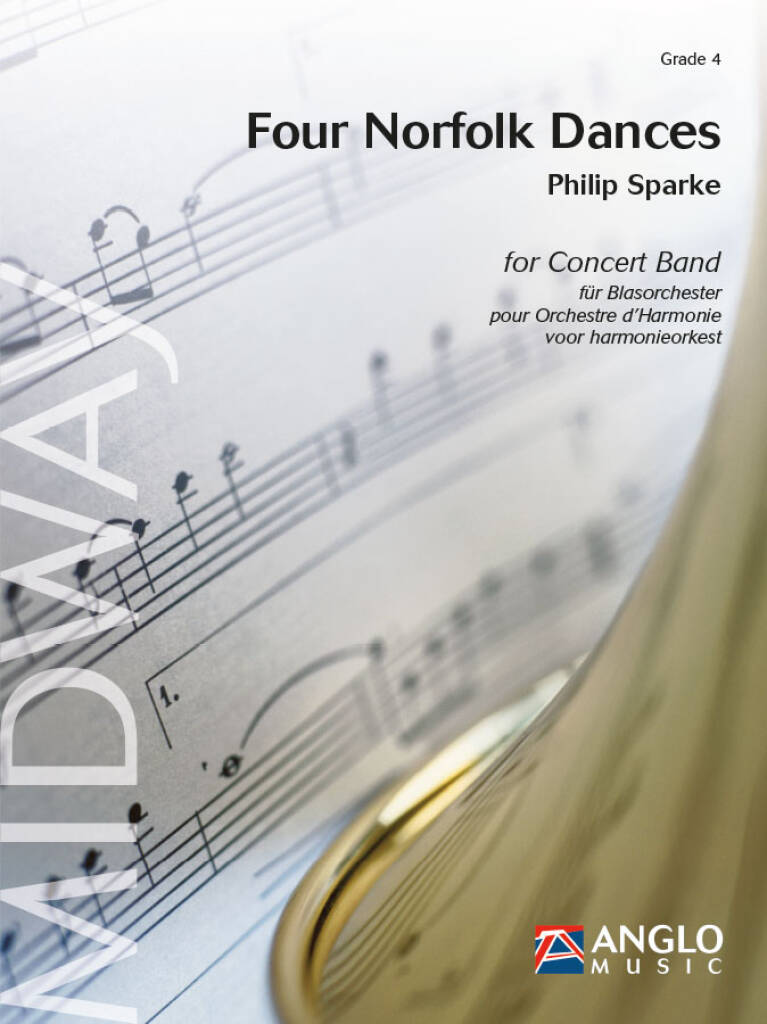
Four Norfolk Dances - Philip Sparke
Norfolk is one of the most beautiful counties in England, famous for its charming villages and boundless broads, a popular centre for sailing holidays. It is also the home of one of the best known of all British composers, Sir Malcolm Arnold. The date of the premiere of this piece was to fall close to his 80th birthday, so Philip Sparke decided to write something of a birthday tribute. Some of Arnold's best-loved orchestral works are his sets of dances: there are two sets of English Dances, Four Scottish Dances, Four Cornish Dances etc., most of which have been arranged for concert band at one time or another. Philip Sparke thought it would be appropriate for the concert band tohave its own set of dances and wrote Four Norfolk Dances very much in the style of Arnold's suites.
Estimated dispatch 7-14 working days
-
 £101.30
Bliv kvar hos mig - William Henry Monk
Willam Henry Monk wrote the music to this psalm in 1861. It's among the most popular all over the world and it's regared as one of the most beautiful melodies ever written.
Estimated dispatch 7-14 working days
-
 £71.50
Stars and Stripes Forever Trio - John Philip Sousa
Americas most famous march, written by the most famous band leader in the world, has entertained and inspired players and audiences since its first performance in 1897. This setting for young bands includes the most famous themes from this great march (the introduction and the trio) so young bands can enjoy performing this world-renowned work. Two versions of the famous piccolo solo are included, one advanced and one easier, so you can feature either a star soloist or the entire flute section.
Estimated dispatch 7-14 working days
-
 £144.99
Suite Marchigiana - Luciano Feliciani
According to a famous statement by Herder, folk songs represent the archives of a nation's knowledge, the expression of its heart and theimage that reflects its history and identity. Suite Marchigiana is a three movement piece, inspired by folk songs from the Marche in central Italy, a region with a very ancient and rich folkloristic heritage. The first movement elaborates on the well-known Pasquella. The Pasquella comes from a traditional winter begging ritual where a group of musicians go from house to house singing verses, wishing their audience good health, wealth and abundance, in return for small amounts of money, food and wine. The second movementis an Andante Triste inspired by an old song called Sona la mezzanotte (The Clock Strikes Midnight), a melancholic song that reminds us of unhappy love stories, bereavement, and so on. Luciano Feliciani concludes the suite with the Saltarello Marchigiano, which is bright and sparkling, and therefore in complete contrast with the previous movement. Although unproven, the Saltarello is thought to have its origins in the 'saltatio' (a latin dance). While the choreae were group dances, circular in structure and with a rhythmic progression, the saltationes were more lively in character. The fast, frenetic and joyous saltarello was without any doubt the most famous musical expression of rural central Italy in the nineteenth century.
Estimated dispatch 7-14 working days
-
 £75.00
Sonata - Derek Bourgeois
This work, composed in 1998, was commissioned by the American trombonist Don Lucas as a work for trombone and piano and first performed by him in Birmingham on 19th May 2000. Subsequently, I arranged the music for both solo trombone and brass band and solo trombone and wind band so that it now exists in three formats. The first movement, in B flat major, is brisk and energetic, and is cast in sonata form. The second subject is gentler and more lyrical. The second movement, a scherzo in C major, is the most complex of the four. Basically the structure is a rond. For a long time the music remains in the opening 5/8 time until a new theme introduces more broken rhythms in a more jazzy idiom. After a return of the opening theme the following episode is more tonally ambiguous. Finally, the main theme returns to round off the movement. The third movement, a lyrical adagio, is really one long extended melodic flow. The harmonies are lush and the textures simple and direct. The tonal center is A minor, but the music meanders through so many keys, that this key centre is heavily disguised. The finale is a fiery affair. G minor is really its home key, but throughout the movement the music moves about a lot and the second subject is first heard in A flat minor. The movement's underlying sonata structure is masked not only by its loose tonality but also by its frequently changing time signatures. Like the first movement the second subject is more lyrical in nature and for a while it seems that the music will end peacefully, but a final flurry heralds a triple forte unison on the home note of the first movement - B flat. Derek Bourgeois
Estimated dispatch 7-14 working days
-
 £78.00
Coronation March - Giacomo Meyerbeer
Giacomo Meyerbeer (1791-1864) was a German opera composer of Jewish origins, who has been described as perhaps the most successful stage composer of the nineteenth century. From 1831 until his death, he remained a dominating figure in the world of opera. His contemporary Hector Berlioz summed up his public career claiming that he 'has not only the luck of being talented, but the talent to be lucky'. His works made him the most frequently performed composer at the world's leading opera houses in the nineteenth century. Giacomo Meyerbeer composed his opera Le Prophte in 1849. In this opera a coronation is preceded by a splendid march. Although the opera itself is rarely performed, the Coronation March has gained a place in the concert repertoire.Franco Cesarini's arrangement for concert band of the Coronation March stands out for its skillful instrumentation which underlines the powerful sounds of this classic concert march.
Estimated dispatch 7-14 working days
-
£79.99
Scherzo from Symphony No. 5 - Dmitri Shostakovich
The second movement of Shostakovich's masterful and subversive Fifth Symphony, written as his career as a composer in communist Russia teetered in the balance, could suggest a barely literate composer from the Bureau of Artists coming to the great Shostakovich to demonstrate, through a most grotesque dance, how simple it is to compose great music under the Soviet System. This transcription of the Scherzo movement was produced by Mark Rogers, who also transcribed the complete symphony. In the transcription of the complete work, all of the music remains in the original key, while in this publication, the second movement is transposed down a whole tone to G minor. Other than the transposition and the removal of some of the more rarely found instruments (E flat clarinet, contrabassoon and harp), the music is intact, and represents the composer's intentions in every way. Conductors who choose to perform this piece will introduce their players to this important voice in Twentieth Century music and bring major issues about political life and its impact on creative life to their students in the most relevant fashion.
Estimated dispatch 7-14 working days
-
 £109.50
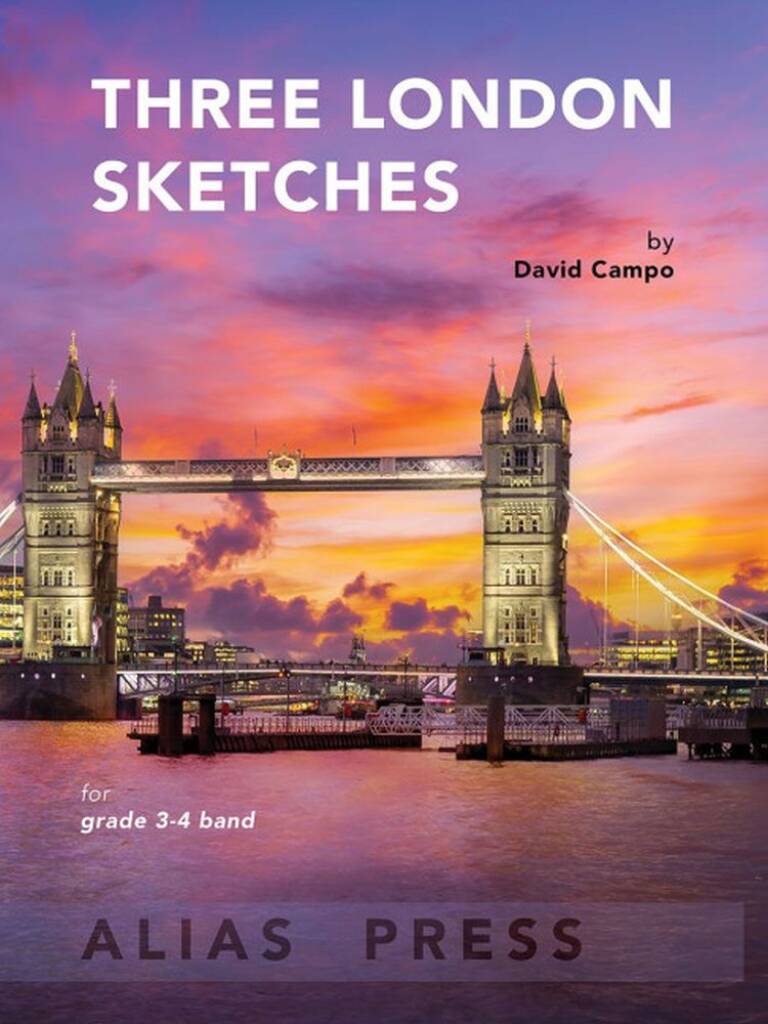
Three London Sketches - David Campo
London is one of my favorite cities in the world, and in 2016 I was invited there to serve as an adjudicator for the London New Year's Day Parade and Gala Concerts. While I was there, I was fortunate to meet and spend time with The Lord Mayor of Westminster Councillor Steve Summers. While his title sounds formidable and intimidating, I found Steve to one of the nicest, most easygoing people I've ever met. And boy, does he love London! He was fond of saying that he had "the best job in the greatest city in the world." He spoke passionately about London and his favorite places in the city, and his enthusiasm was contagious. Some of his favorite places became some of my favorite places, and the inspiration for this piece. I hope that this work not only conveys the beauty and history of these iconic places, but Steve's deep and abiding love for them as well. I. Tower Bridge - The Tower Bridge was built over 120 years ago to ease road traffic while maintaining river access to the busy Pool of London docks. Its giant moveable roadways lift up for passing ships, making it a true engineering marvel. It is also one of the most iconic sites in London, and was used to display the Olympic Rings during the 2012 Olympics. II. St. Paul's (The Whispering Gallery) - The history of St. Paul's Cathedral goes back well over a thousand years, but construction on the current St. Paul's began in 1669 after a fire destroyed the earlier structure. The dome of St. Paul's Cathedral is a whispering gallery; you can whisper against the wall on the inside of the dome and it can be clearly heard on the other side of the dome over 100 ft. away. Imagine the secrets that have passed there... III. Trafalgar Square - The name commemorates the 1805 naval Battle of Trafalgar and is marked by Nelson's Column, a monument to Admiral Horatio Nelson, the hero of the Battle of Trafalgar. It is the heart of London; full of life and constant energy and home to iconic buildings including the National Gallery, St. Martin-in-the-Fields, Canada House and South Africa House. Londoners say that all roads in London lead to Trafalgar Square.
Estimated dispatch 7-14 working days
-
 £134.99
Rhapsody for Flugelhorn - André Waignein
As a trumpet player Andr Waignein has composed many pieces for this instrument; extremely electrifying pieces meant for young trumpet-players, and more demanding works for professionals.With his rhapsody Andr Waignein wanted to compose a piece in which spontaneity dominates and in which the virtuosity, sonority and style of the soloist is featured to its maximum. Although the piece is not one of the most difficult, it nevertheless places high musical demands on the soloist. Following an impressive orchestral opening the soloist comes to the fore, with long phrases followed by more dynamic and rhythmic passages. The second movement gives evidence of extreme sensitivity andoffers the soloist the opportunity to prove that the trumpet (flugel horn) can be a stirring and emotional instrument. The third movement is the most spectacular. The orchestra actively participates with increasingly delicate interventions. The soloist can display all the possibilities offered to him by his instrument. With a long sostenuto on the trumpet (flugel horn) the beautiful rhapsody ends.
Estimated dispatch 7-14 working days
-
£202.99
Nazca Lines - Satoshi Yagisawa
The Nazca lines are a series of geoglyphs located in the Nazca Desert, a high arid plateau that stretches more than 80 km (50 miles) between the towns of Nazca and Palpa on the Pampas de Jumana in Peru.The glyphs are believed to have been created by the Nazca culture between 200 BC and AD 700. They include hundreds of individual figures, ranging in complexity from simple lines to stylized hummingbirds, spiders, monkeys, etc... The creators of the lines and why they were made are unknown. Though many theories exist, such as sun calendars or alien guidance, one by Maria Reiche, German-born mathematician and archaeologist, suggesting that "Ancient people drew geoglyphs of constellations that are most related to water" fascinated me the most.The renderings are explained as part of a practice involving the worship of deities associated with the availability of water, and thus the fertility of crops. The lines were interpreted primarily as sacred paths leading to points of worship and the figures were of sacred animals and objects to invoke their aid. Also, a massive, exactly symmetric arrow more than 50 km long was discovered when NASA launched its Landsat imagery. This geoglyph can only be seen from space. Was this also created by ancient people?(Satoshi Yagisawa)
Estimated dispatch 7-14 working days
 View Music