
Results
-
 £122.50
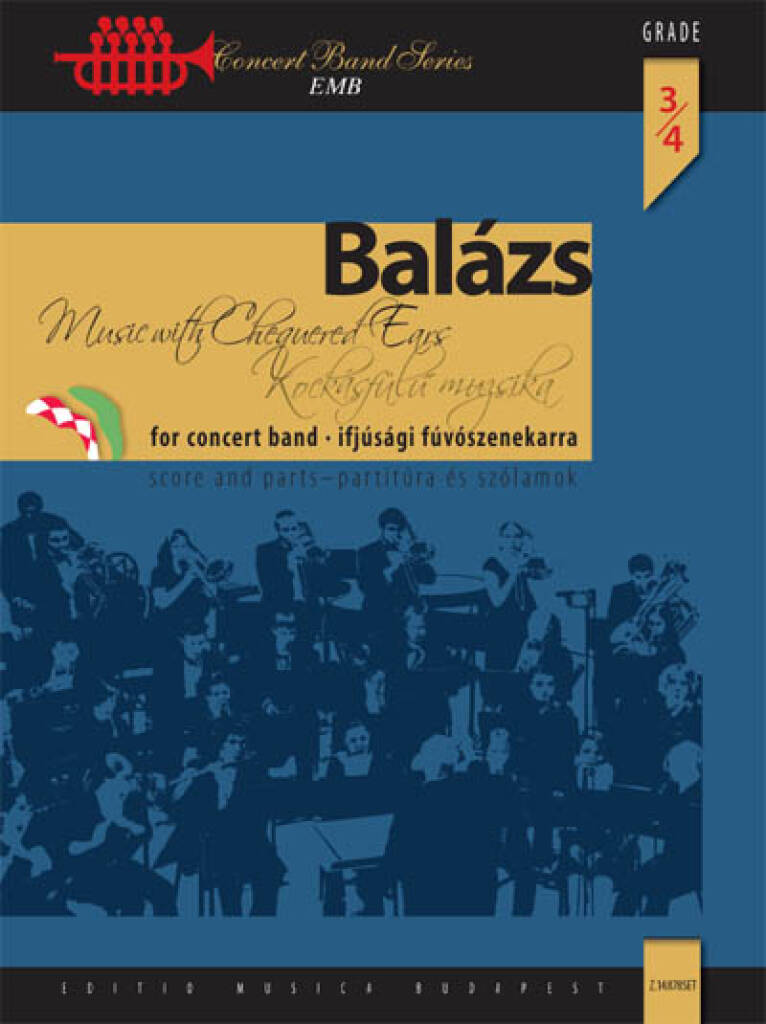
Music With Chequered Ears - Árpád Balázs
Television viewers of nearly a hundred countries have experienced rpd Balzs's touching melodies. The series of cartoons have neither dialogue nor text: the music presents the amiable and entertaining adventures of the rabbit with chequered ears and its friends. Balzs has rephrased and developed the well-known melodies and as a result a ''children's story symphony'' of seven movements has been created in which, in contrast with Prokofiev's Peter and the Wolf, there is no narrator but the instruments themselves represent the story-tellers. The composer has again associated the groups of instruments with one another in a colourful and varied manner, skilfully alternating the modes of solo, chamber orchestra and orchestra. Movements I, II, IV and VII represent a ''short suite'' that can be independently performed, thus due to its duration of four minutes and easier level, ensembles with more modest opportunities can also perform it. The most well-known parts of the cartoon series music - the main title and the ending - are included in both versions.
Estimated dispatch 7-14 working days
-
£78.95
Little Champ - Ted Mesang
As one of the most popular and easy quick-step marches by a well-known educator and composer, Little Champ uses the form with great verve and respect for its conventions. With its memorable themes and countermelodies, this classic deserves to be discovered by a new generation of young musicians, and Quincy Hilliard's concert edition should be just the thing to help that happen. Duration: 2' 30"
Estimated dispatch 7-14 working days
-
 £138.00
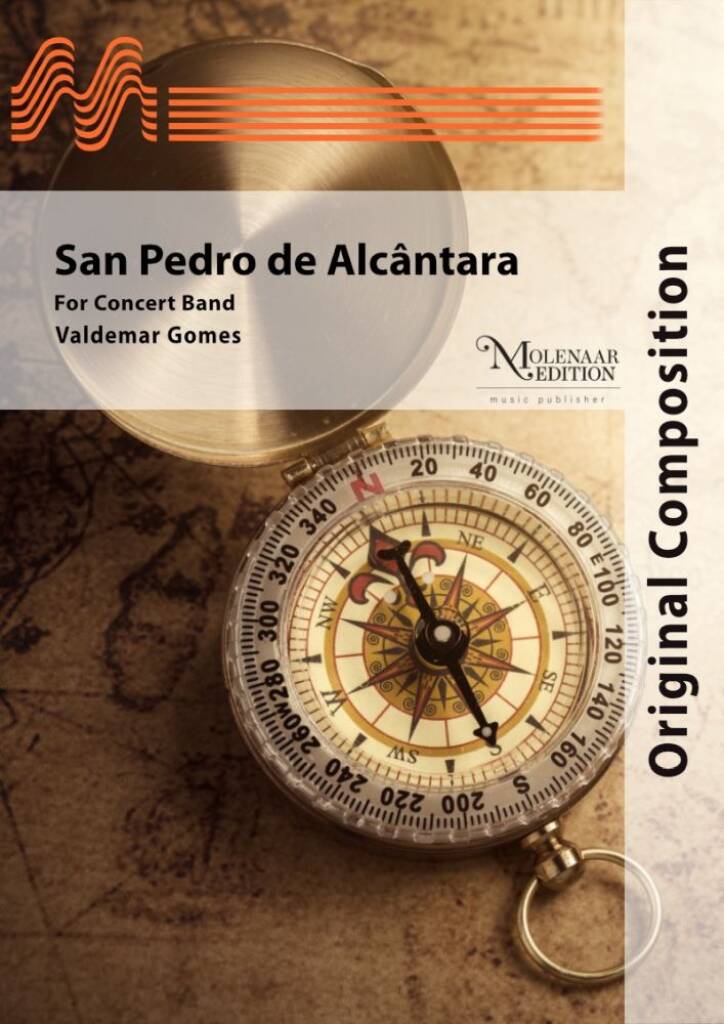
San Pedro de Alcntara - Valdemar Gomes
The Spanish war galleon with 64 cannons, built in Cuba between 1770 and 1771 for an English shipowner in the service of the King of Spain left Peru for Cadiz in 1784 with a huge cargo of copper, gold, silver and other valuables on board. There were also more than 400 people on board, including passengers, crew and Inca prisoners after a revolt. The Atlantic crossing went smoothly, passing Portugal to take advantage of favourable winds. The shipwreck off Peniche was the result of human error, apparently due to French maps with dramatic errors in the position of the islands of Berlengas and neighbouring islets. On 2 February 1786, the sea was calm and the night clear, but they hit the rock formation Papoa and the hull immediately broke in two. The bottom sank quickly, while the deck remained afloat for some time. 128 people lost their lives, including many Indians who were trapped in the basement. This shipwreck is considered one of the most important in maritime history.What the composer wants to convey, and what can be felt as one listens, is first of all the sound of power, of hope, of the glory of conquest, of the splendour of wealth. This is followed by the perception of the maritime environment, the harmony with the softness of the ocean, the gliding of the hull in the foam of the sea on sunny, blue days. But along with this tranquillity, you soon hear a rhythmic chain that makes you feel a representation of the hustle and bustle, of the busy crew, of the hard work of a sailor, of the desperation of an exotic people imprisoned in a dark, damp cellar. A distinct rhythm that reminds us of the "salero" of Andalusia, with its Arab influences and its people, the soothing of the resignation of others who are forced to submit. Then we clearly hear a crescendo that makes us imagine the agony of the collision that precedes the shipwreck. The breaking of the hull, the water flooding everything, the despair, the clash of bodies on the rocks, the tragedy to come. Before the "grand finale", in which the return of musical softness reminds us that the story is over. The supremacy of nature over human greed. The waves, though gentle, sweep the wreckage, the lives and the treasures of the New World to the bottom of the sea.
Estimated dispatch 7-14 working days
-
 £149.40
Bruremarsj fr Sr-Aurdal
This wedding march originates from the Valdres region in Norway. The municipality of Southern Aurdal is known for its two beautiful Stave churches, probably built around 1160-1190.The wedding march is not among the most well-known of its kind in Norway, but it still has a wonderful melody and a nice rhythmical lilt. Make sure that the tunes are played in a flowing and singing style.
Estimated dispatch 7-14 working days
-
 £127.00
Ray of Light - Kevin Houben
Ray of light was composed for the 75th anniversary of the Royal Wind Band (De Heidegalm Berkenbos). The mining environment of Berkenbos (Heusden-Zolder, B) is a proof of what used to be one of the most flourishing industries inLimburg viz. the Mining Industry. Going down the shaft in the elevator for the first time was a sensational experience for every miner: the noise of the closing doors, the shock experienced when the lift cage started moving tofall down whizzingly into the deep at a speed of 30 km an hour. The opening theme of Ray of Light doesn't only reflect the bravery of the descending miners but also their anxiety, their doubt and insecurity. In the solo passage,the anxiety during the long walk in the dark through the mine corridors with only headlamps and mine lamps is clearly audible. Working in the mines wasn't without any danger. The very flammable and at times explosive mine gasesalways posed a hidden threat. Apart from that there was always the continuous danger of collapse. The beautiful choral movements are therefore an ode to the miners that left their lives in the mine. The eastern scale refers tothe multicultural character of the mining environment of Berkenbos with its many commercial shops and different types of housing inherent in mining architecture. The mining profession is still a very dangerous job, but at the endof the dark corridor the miners still see a beam of light as a sign of hope.
Estimated dispatch 7-14 working days
-
 £435.40
Goldberg 2012 - Svein H. Giske
The first time I heard Bach's Goldberg Variations was in the movie Silence of the lambs, in the early 1990s. I noticed the beautiful background music in one of the scenes, but at that time I didn't know what it was. A few years later, when I was studiying at the Grieg Academy, I got to know the entire piece. For me, this is a piece of music which I can listen to countless times. I think it sounds as fresh today as it did more than 15 years ago and it never ceases to inspire me. Both Bach's composition and Glenn Gould's famous 1955 recording (which was the first one I heard) still makes a great impression on me. Before Gould recorded it at age 22, it wasn't a highly ranked piece amongst pianists and Bach was by many viewed as a bit old-fashioned. The young Canadian turned all this around. He managed to portray Bach in a reformed way, producing fine nuances in phrasing and making the many layers in Bach's music more transparent than anyone before him. Thus he plunged both himself and Bach (back) onto the international music scene. When The Norwegian Band Federation (NMF) asked me to write the test piece for NM in 2012, it was only natural for me to use the Goldberg Variations as a starting point and inspiration for my work. Since I was a teenager at NMF's summer courses in the mid eighties I've always listened to many different styles of music. Growing up in Sunnmre with the Brazz Brothers as teachers and mentors, jazz-, pop/rock- and folk music were early on a natural part of my musical background. I also have my classical education from the Grieg Academy on trumpet. As the title of my piece implies, I've wanted to bring Bach to the present and put his music into various modern musical landscapes. I think you can bring about a special kind of energy when music from different genres are mixed and I've tried to do this by mixing Bach with artists and musical styles from the present. In Goldberg 2012, the music is often constructed by several layers, which in a way are living parallel musical lives. They are seemingly moving or floating freely, almost unaware of each other, but bound together by the same basic pulse. The rythms, however, are often notated on a different rythmic subdivision level than the usual 8th- or 16th note levels. By doing this, I hope to achieve transparent sounds that rythmically are perceived as more free and detached from each other. In large sections of the piece, pop/jazz is fusioned with elements from Bach. I guess you could have this little scene as a synopsis for the piece: picture a group of musicians meeting: some are classical performers, some are jazz. They start to improvise together, each in their own voice or musical dialect and I'm sort of in the middle, trying to write down what they are playing. This is what I feel much of Goldberg 2012 is about. The foundation of the piece, in addition to Bach and references from pop/jazz music, lies also in my own material. This material, basically two chords, is heard in it's purest form in the 1st movement. I use these chords to create scales, new chords and different motifs which contribute to blend together the different moods of the piece. It has not been my intention to copy Bach's form (theme and 30 variations), but rather to use the bits and pieces that I like the most as an inspiration for my own variations. The 1st movement, Aria 2, is for my 3rd son, Olav, who was born on the 21st of April 2011, and the 5th movement, From long ago, is dedicated to the memory of my father, Svein J. Giske, who passed away on the 6th of June 2011. -Svein H. Giske, January 2012-
Estimated dispatch 7-14 working days
-
 £214.80
Skies - Oliver Waespi
Program notes by Oliver Waespi on his composition Skies:Skies is the plural of Sky. We may wonder are there several skies? Is the sky we all long for not the same for everybody? While travelling on foot and "in the open air" I have observed the firmament often in quite different shapes, so that I can say I have indeed experienced the sky in different ways. Years ago I already wanted to portray "my sky" in music; I finally have been able to realise this long-cherished dream.This composition deals with the sky, more precisely with my sensual and emotional experience of the sky in all its aspects. Two point of views are combined in this composition: one showing the sky as it presents itself to me, the other showing the sky as I observe it. The music was bom simultaneously by intemal and extemal inspiration: it describes nature but also the emotional and spiritual experience of nature. To me, the experience of nature is not abstract, but it is connected with concrete ages, places or people from my neighbourhood. This is why I have combined several parts of this composition with certain landscapes.The sky presents itself in different landscapes in the most varied ways: for the sensual experience, there is no sky as such. The indications of places spread all over the score, are primarily clues for myself; they represent certain atmospheres, which I have experienced especially in England and Scotland. They can however also be useful to the musicians and the audience, providing they know those landscapes and the celestial atmospheres linked to them.The music is independent from the atmospheres described in the subtitles, as those are rather connected to a tragic nature, and so the music is not based on any program. Musically spoken, the composition has a symphonic structure, which means that the complete musical material is derived from three contrasting main themes. In the first part, the description of a noctumal sky ("Night") two themes are developed in an organic way; the first, rather "dusky", is to be found with the horns, the second, "in bright daylight", with the oboe and flute, the third, "more quiet" , with the brass instruments. In the next part, we have clouds and rain over the Isle of Skye (one of the Hebrides islands in Scotland) and here several elements of the first theme are still more developed. Then we get an increasingly dark mood, which is released, in heavy chords. Then suddenly, the sun breaks through and the music gets a majestic character. We have a new shape of the initial theme, first with the French horns and then with the trombones. The music gets a quicker tempo and flows into a quick movement describing the winds and waves at sea ("Wind and Waves"). Three themes are gathering and some variations are developed. The music gets more and more energetic and, after a climax, calms down again. Then we have a kind of "summer pastoral" which suggests summer at the South coast of Cornwall ("South Coast of Penwith Peninsuia in Summer"). This is certainly not the hotte st summer in Europe, but still it is beautiful in this country that is blessed with so much rain. In the "pastoral" , the sea is already sketched in broad outlines in the French horn solo. The magnificence of an aftemoon at the seaside is developed at the end of the composition ("Noon at Treen Cliff', a rock protruding in the sea next to Porthcumo at the South Coast of Cornwall); here the music gets stronger and stronger and after a majestic climax it vanishes completely.
Estimated dispatch 7-14 working days
-
 £106.99
Lady Claus - Thierry Deleruyelle
The Christmas festive season is a time for sharing the most wonderful stories. There are few female characters in these tales. And yet, they do exist in many countries. In Italy, Mother Christmas is associated with the Befana; in Russia with Babushka; and with Lucia in Scandinavia, Frau Holle in Germany, Mari Lwyd in Wales, and Tante Arie in France. What these women have in common is that they too hand out presents to children.The music begins with a majestic introduction that draws us into the heart of the Christmas legends. The timpani and sleigh bells then launch into a fast, joyful, and dynamic section. Finally, the music softens. A Christmas chorale is first played by the brass section, then taken up by the woodwinds. The piece ends in a hushed atmosphere, as if all that remained was a Christmas tree twinkling in the darkness.Lady Claus was commissioned by the Montbliard Municipal Wind Band, conducted by Laurent Zemp, to mark its 150th anniversary. This work pays tribute to those legendary women who contribute to the beauty and magic of Christmas, not only by delivering presents but also by passing on the human values they embody.[
Estimated dispatch 7-14 working days
-
 £102.99
Music Xperience - Jacob de Haan
The town of Zevenhuizen (Seven Houses) in the Dutch province of Groningen conceived the idea to assemble 777 musicians for an experimental open air concert. Within that context, Jacob de Haan was commissioned to write a special composition for the local music society Concordia on the occasion of its fiftieth anniversary. The full number of musicians could not be realized entirely, but the performance was a great happening nonetheless. Now, the music has been published in a compilation, with the most appealing melodies in a varying style of rock music and ballads. The compelling closing theme of Music Xperience will linger in the minds of many listeners and players long after the concert has ended.
Estimated dispatch 7-14 working days
-
 £84.99
To a Friend - Jacob de Haan
When you have been playing in a band for a long time, you will know that music belongs to the most beautiful moments in life, but also to the roughest times. Making music together can give you strength when things are difficult. To a Friend is a wonderfully comforting work for anyone going through a dark time. Jacob de Haan composed the work for his father in law, Gerard Bosch, a musician to the core. The piece received its first performance just weeks before his passing. On a sun-kissed evening, his friends, the musicians of his two music societies - Oefening Baart Kunst (Practice Makes Perfect) Otterlo, and the Renie Orkest Artillerie Trompetterkorps (Reunion Band Artillery Trumpet Corps) - played the work for Gerard - an unknowing yet beautiful goodbye.
Estimated dispatch 7-14 working days
 View Music