
Results
-
 £57.50
A Precixe Prelude And an Excellent March - Thomas Duffy
Playing one wrong note can ruin the performance of a piece, right? Well, composer Thomas Duffy actually wants the performers to make mistakes in this clever composition! The precise imprecision comes to life as students are asked to intentionally play wrong notes in various parts of the march. After performing this work, you and your students will never look at perfection the same way again! Free interdisciplinary curriculum for the piece is available for download at www.BandQuest.org. BandQuest, an exciting series of new music and accompanying curricula for band, is a program published by the American Composers Forum. The series was started as a response to feedback from music educators that there is a pressing need for new, fresh band music. The heart of this program is new works written by a diverse group of leading American composers who have created challenging pieces that are a true departure from standard middle school repertoire. Every BandQuest project includes a residency component in which the composer works collaboratively with a middle school as they create their new piece. Many BandQuest pieces are accompanied by an interdisciplinary curriculum designed to assist students as they learn the music and to integrate each piece with non-music studies. Visit www.bandquest.org to learn more about this innovative series, and email [email protected] to request a free downloadable audio catalog.
Estimated dispatch 7-14 working days
-
 £264.99
Panoptikum - Thomas Doss
Armin Schaer commissioned this work in his search for a new piece for the tuba. More specifically, he wanted a work that showed off the versatility of this splendid instrument, written in a musical style that is both fresh and modern, while not banishing the orchestra to a simple supporting role. Taking all these specifications into account, Thomas Doss created a work that allows stylistic leaps and is fun, exciting, romantic, and virtuosic, but does not lose sight of the thread that connects the opening measures to the very last.Armin Schaer describes his Panoptikum as follows:Panoptikum is a show of appreciation for my beautiful home and community at LakeConstance, an eventful life, the people that have enriched this life, and a fascinating instrument: the tuba. This work musically embodies the many different moods found around theBodensee - cheerfulness and melancholy, departures and longing, calm and agitation. The roles of the soloist and the orchestra were consciously crafted in a way that does not follow the usual conventions of the genre. The work should spark emotions, address broad segments of listeners, and persuade them of the tuba's ability to be a solo instrument as well as the richness symphonic wind ensembles have to offer. I hope this work enriches the lives of all the soloists and orchestras that cross its path, as well as everyone in the audience who gets to partake!
Estimated dispatch 7-14 working days
-
£69.99
An Irish Lullaby - Stephen Bulla
What can be more charming than a comely Irish folk melody? This is music that allows the band to play in the rubato style, with much room for expression. Found in an old British publication and simply called "Irish Air," this endearing arrangement is a rhapsodic treatment that takes fragments of the melody and develops them into a large symphonic work. The freedom of tempi allows you to work with your band in a sensitively conducted way that only a beautiful piece like this will allow.There is always room on a concert program for at least one lush, melodic contrast piece. Perhaps this one is for you. It's so difficult to describe a thing of real beauty. Please listen tothe demo recording and hear it for yourself.
Estimated dispatch 7-14 working days
-
 £116.40
Quatre Jours a Paris - Kees Vlak
1) 'Jour de Fte. A quiet sunday atmosphere on the Avenue Foch, a residental area for the well-to-do in Paris. It begins with full-sounding chords, with a wealth of added tones. It seems as if many bells are tolling. Birds are tweeting high in the trees. After all this there is a very simple theme without any tension just like a leisure walk. The movement ends the same way it started.2) 'Jour de Java. The 'Java' is the dance of the Bohemians, the Paris gypsies. It is a very capricious dance, which is represented by at certain moments shrill harmonies and the unexpected changes in tonality of this movement.3) 'Jour de Pluie. A rainy day. Seated behind the windows of a sidewalk caf we observe the reflections on the wet streets. Under a fly-over an accordeon plays a sad melody. Old memories pass through our minds.4) 'Jour de Can-Can. Whenever one hears 'Can-Can' the name of Jacques Offenbach crosses our minds. It is the dance of the Folies Bergres, a festival which never seems to end. All the time new solo-dancers come jumping forward.
Estimated dispatch 7-14 working days
-
 £102.99
10W-60 - Naoya Wada
10W-60 is the name of an engine oil that is entirely synthetic, has a very long life and is used mainly in vehicles from which high performance is required. In this way the composer makes the link with speed and energy, two important elements that can also be found in this three-part composition. Naoya Wada dedicated this piece to the famous Japanese trumpet-player Kazuki Hayasaka, and incorporated elements of boogie, Gershwin and rock.
Estimated dispatch 7-14 working days
-
 £174.99
Et in terra Pax - Jan Van der Roost
This piece was commissioned by the 'Concert Band Vlamertinge' and is a plea for peace: the title translates as 'Peace on Earth'. This is expressed by means of the vocal contribution expected from the performers. In various places of the piece you can recognize, the words 'Et In Terra Pax' - an appeal for peace - at first jumbled together but later more rhythmically structured, developing into synchronized massed voices.The work starts with a pentatonic theme based on the notes D, E, G, A and C (taken from 'ConCErtbAnD VlAmErtinGE' and the name of the conductor, NiCk VAnDEnDriessChe). A somewhat sad melody is developed during an orchestral climax which leads to the firstexplosion of sound (measure 62 onwards). Suddenly the opening measures are recaptured, albeit with a differently colored sound: the words 'Et In Terra Pax' bring the first movement to a close. A restless Allegro follows which abruptly stops and is replaced by a calming cho-rale-like passage. A narrator reads aloud the poem 'Sonnet' by the young poet Charles Hamilton Sorley, who was killed during World War I. This poem fittingly puts into words the cruelty and senselessness of war. After the expanded recapitulation of the allegro, the broad, almost infinite atmosphere of the beginning returns. Clarinet and English horn play the pentatonic opening theme once more, this time broadly, while the words 'Et In Terra... Pax' are repeated again and again by the rest of the orchestra.The composer has purposely avoided all forms of aggression and bombastic sounds regularly used in works about war. Fear of violence and destruction can be heard and felt during the allegro passages. The charged opening makes way in the end for hope: May peacefulness replace cruelty in everyday life, too.
Estimated dispatch 7-14 working days
-
 £189.99
Masked - Alex Shapiro
Masked by Alex Shapiro is composed in the exact shape of a Classical Minuet and Trio waltz, though the music--a whimsical if somewhat demented masked ball (or, balls, in this case)--bears little connection to that of Mozart or Haydn. Historically, third movement Minuets gave way to the joke-like Scherzo, and the Trio section tips its hat to some welcome levity. This is one of four movements in Suspended, a piece is composed in the tradition of an 18th century Classical symphony: four contrasting movements which serve specific functions and reveal a story. The work begins in absolute rage and chaos, then alternates between moments of grief and bleakness. Grim reality shifts to a macabre, circus-like insanity, and by the end, flickers of genuine hope contrast a pervasive sense of dread, and finally arrive at more optimistic possibilities. To perform the piece, you'll need an audio system capable of playing the prerecorded audio tracks from a laptop computer via a small digital audio interface connected to an audio mixer. Download information is provided in the printed piece.
Estimated dispatch 7-14 working days
-
 £244.00
Anemoia - Gauthier Dupertuis
Gauthier Dupertuis wrote Anemoia as part of his master's thesis at the Lausanne University of Music. It is dedicated to the most significant figure in his musical life: his teacher Jean-Claude Kolly.Anemoia is the name given to the feeling of nostalgia that one feels for a time that has never known. This emotion often translates into the uneasy sensation of having lost something important or of not living at the right place or time. Fascinated by this concept, Gauthier Dupertuis tried to translate it into music oscillating between exaltation, anguish and nostalgia.The piece is formed by two movements: (Un)desired sorrow and Behind the glass of time. The first movement initially evokes the feeling of unease one feels when suddenly struck by anemoia. It then evolves into majestic atmospheres, marking our admiration for times gone by. The second movement treats anemoia in a more melancholic way.The premiere took place on 6th December 2024, during Jean-Claude Kolly's last concert as a conductor of the Concordia de Fribourg, marking thirty years spent conducting this wind orchestra.
Estimated dispatch 7-14 working days
-
 £65.99
Roman Triumph - Matthew R. Putnam
Regal, triumphant, and magnificent! This new work for young band is unique in all the best ways! Sitting at a tempo and style that is not as common for this grade level, Matthew R. Putnam has given us a throwback to the Appian Way! So much to teach and so much fun, this one is a knock-out!
Estimated dispatch 7-14 working days
-
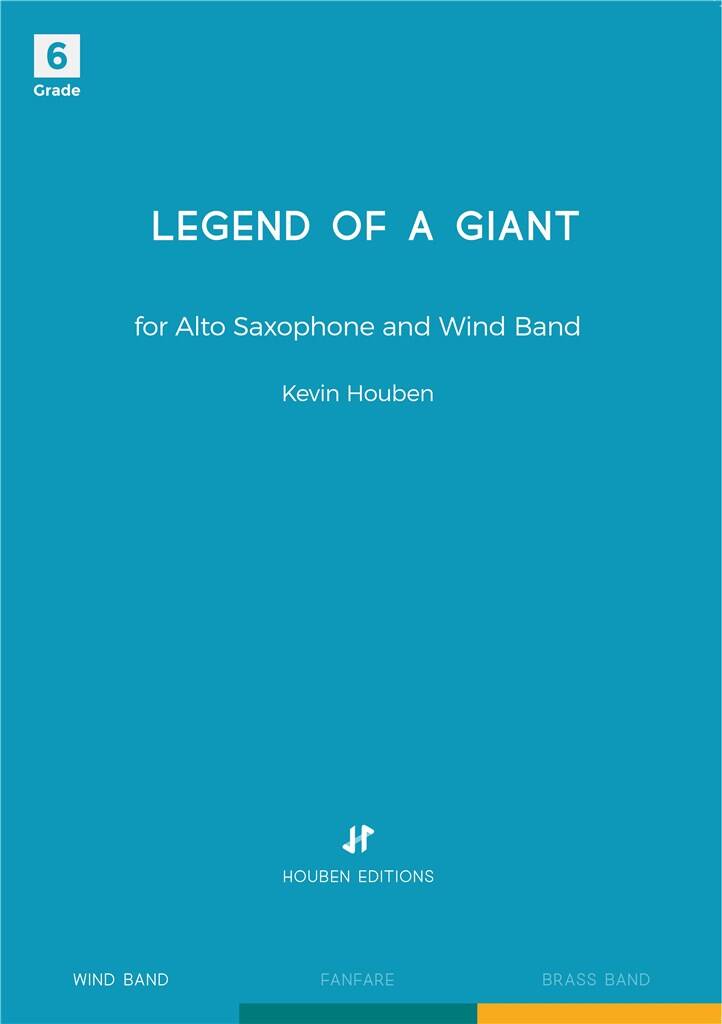 £149.00
Legend of a Giant - Kevin Houben
Legend of a Giant is a composition for solo alto saxophone and Wind Band composed by the Belgian composer Kevin Houben. The composer dedicated this challenging saxophone concerto to the Spanish saxophone virtuoso Mariano Garcia.The work had its premire in May 2021 in the Lemmensinstitute with the Wind Band of the LUCA School of Arts in Leuven (Belgium) conducted by Ivan Meylemans.Mariano Garcia is a full time professor saxophone at the LUCA School ofArts, the Conservatorio Superior de Musica de Aragon in Zaragoza (Spain) and the Wiener Akademie Musik (Austria).As in any classical concerto the saxophone soloist 'competes' with the orchestra: first alternately, in dialogue witheachother, afterwards fraternally together. Moreover the orchestra is regarded as an equal partner, therefore also for the musicians of the orchestra this cinematic score presents a tough challenge.Legend of a giant immerses thelistener in the world of the saxophone and challenges the soloist in the field of lyricism and timbre, but also on a technical level. In this way various aspects and modern playing styles such as bisbigliandos, double staccato,frullatos, glissandos, harmonics of overtones,... pass in review. In a word: a tough 'challenge' for any saxophone virtuoso! (!) A simplified version of the saxophone solo part also exists.
Estimated dispatch 7-14 working days
 View Music