
Results
-
 £214.80
Skies - Oliver Waespi
Program notes by Oliver Waespi on his composition Skies:Skies is the plural of Sky. We may wonder are there several skies? Is the sky we all long for not the same for everybody? While travelling on foot and "in the open air" I have observed the firmament often in quite different shapes, so that I can say I have indeed experienced the sky in different ways. Years ago I already wanted to portray "my sky" in music; I finally have been able to realise this long-cherished dream.This composition deals with the sky, more precisely with my sensual and emotional experience of the sky in all its aspects. Two point of views are combined in this composition: one showing the sky as it presents itself to me, the other showing the sky as I observe it. The music was bom simultaneously by intemal and extemal inspiration: it describes nature but also the emotional and spiritual experience of nature. To me, the experience of nature is not abstract, but it is connected with concrete ages, places or people from my neighbourhood. This is why I have combined several parts of this composition with certain landscapes.The sky presents itself in different landscapes in the most varied ways: for the sensual experience, there is no sky as such. The indications of places spread all over the score, are primarily clues for myself; they represent certain atmospheres, which I have experienced especially in England and Scotland. They can however also be useful to the musicians and the audience, providing they know those landscapes and the celestial atmospheres linked to them.The music is independent from the atmospheres described in the subtitles, as those are rather connected to a tragic nature, and so the music is not based on any program. Musically spoken, the composition has a symphonic structure, which means that the complete musical material is derived from three contrasting main themes. In the first part, the description of a noctumal sky ("Night") two themes are developed in an organic way; the first, rather "dusky", is to be found with the horns, the second, "in bright daylight", with the oboe and flute, the third, "more quiet" , with the brass instruments. In the next part, we have clouds and rain over the Isle of Skye (one of the Hebrides islands in Scotland) and here several elements of the first theme are still more developed. Then we get an increasingly dark mood, which is released, in heavy chords. Then suddenly, the sun breaks through and the music gets a majestic character. We have a new shape of the initial theme, first with the French horns and then with the trombones. The music gets a quicker tempo and flows into a quick movement describing the winds and waves at sea ("Wind and Waves"). Three themes are gathering and some variations are developed. The music gets more and more energetic and, after a climax, calms down again. Then we have a kind of "summer pastoral" which suggests summer at the South coast of Cornwall ("South Coast of Penwith Peninsuia in Summer"). This is certainly not the hotte st summer in Europe, but still it is beautiful in this country that is blessed with so much rain. In the "pastoral" , the sea is already sketched in broad outlines in the French horn solo. The magnificence of an aftemoon at the seaside is developed at the end of the composition ("Noon at Treen Cliff', a rock protruding in the sea next to Porthcumo at the South Coast of Cornwall); here the music gets stronger and stronger and after a majestic climax it vanishes completely.
Estimated dispatch 7-14 working days
-
 £154.60
I'm Headin' Home - Per-Olof Ukkonen
"I don't know why I get ideas on my way home. Maybe it depends on who is waiting...This is my third pop song for Concert Band inspired by going home. Keep the tempo up throughout the song, you are Headin' Home!The first two titles are "Walking Home" and "Another Way Home", both published on Noteservice."Per-Olof Ukkonen
Estimated dispatch 7-14 working days
-
 £137.99
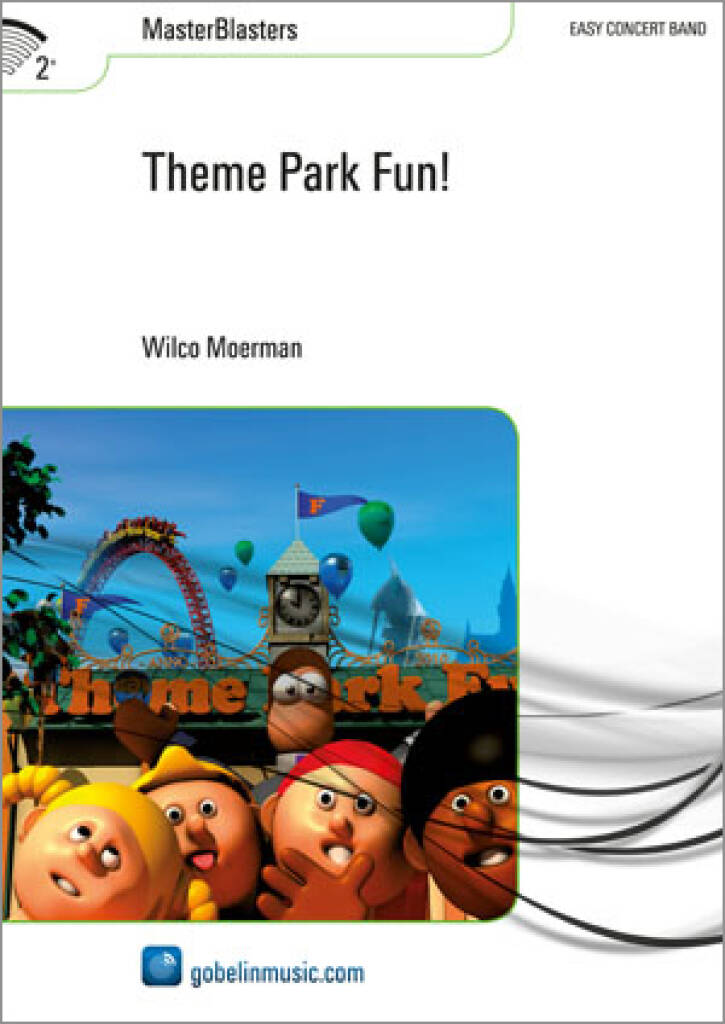
Theme Park Fun! - Wilco Moerman
In Theme Park Fun! your orchestra pays a visit to an amusement park. During your visit, you will experience some spectacular rides and attractions this theme park offers. The uniqueness of Theme Park Fun! is the interplay between music and(moving) images. Animations and illustrations support the visual composition.Part 1: The Entrance & Parade [with animation]The opening of the park is a fact. A day full of fun and pleasure awaits! You and the other visitors willbe confronted with all the rides, attractions and adventures the theme park has to offer. Which ride shall we do first?! There is so much to do and experience on this day in the park! A parade of colorful floats and park figures is passing by.Letthe fun begin!Part 2: The Haunted House [with animation]The only ride in the park that is not related to fun, is the Haunted House. Here visitors will be challenged to visit a house full of ghosts, creepy figures and otherominous things. The clock strikes twelve, there is no turning back. Ghosts are whispering, yelling, screaming... Fortunately it is almost one oclock, so we can leave this creepy place quickly.Part 3: The Swinging Galleon [withillustrations]What a huge pirate ship! Each time you swing back and forth, you will feel that weird feeling in your stomach. When you are thrown completely into the top you will have a fantastic view over the park, but you can not enjoy itfor long. Before you know the ship swings back the other way.Part 4: The Fairy Tale Ride [with illustrations]After all those exciting and spectacular rides and attractions, it is time for a peaceful tour in The Fairy Tale Ride.Surrounded by a fairytale setting, you will discover fable figures, talking animals and colorful designs. Such a beauty and tranquility. Having had this experience, we are ready again for the big rides in the park!Part 5: The Bumper Cars[with illustrations]Now its time to crawl behind the wheel of the Bumper Cars! Shall we all chase the conductor?! Before you know you are hit by another visitor or you will bump against someone else. In this tough ride you can prove yourselfas a real driver, or perhaps as a really bad one.Part 6: The Roller Coaster [with illustrations]The largest, fastest and scariest ride in the park ... we should definitely do the Roller Coaster! All together in the train, theover-the-shoulder restraints are lowering... be ready to ride. The train leaves the station and is heading for the big lift hill. It will be very scary when the train reaches the top and the train will be plunged down the first drop! Loops,corkscrews and other spectacular coaster elements will follow... Before you know it, the ride of your life is over. Shall we ride it again?!Part 7: Leaving the Park [with animation]Unfortunately everything comes to an end. Thisday in the theme park is over, but we have a lot new experiences to talk about! The memories of all the funny and spectacular rides will come up when we walk through the park to the exit. Just one look over the shoulder, the amusement park figuresare waving at us. Hopefully we will come back again soon!
Estimated dispatch 7-14 working days
-
 £159.60
Suite Acadienne - Bernhard Bogisch
1. La belle Franoise.This song tells the story of the beautiful Franoise, who is visited by her lover on the eve of his departure. She helps him prepare for his voyage and they talk for the last time at the foot of a rock, which has been their trysting place. The next day, when he has left the harbour, he hears the sound of a bell. It is the bell that tolls for Franoise, who is being carried to her grave.2. Le Prince Eugne.At least two versions of this song are in existence, both of which are represented here. It tells of the prince Eugne, who, on his way to Paris, encounters twenty of his worst enemies. He manages to kill fourteen of them before his sword breaks. He then asks his page to get him another sword, but the lad is too afraid for his own life. This being the case the prince tells him to tell his wife to take care of his son, who 'will have his revenge by lighting a candle in Paris'.3. Pinson et Cendrouille.This song deals with the marriage of two not further specified animals, who have nothing with which to prepare a wedding feast, and need help from the other animals. But when the rat comes in carrying a fiddle, he is chased away.4. Le Dpart de l'Amant.At least two versions of this song are known, both of which are represented here. It is one of many songs dealing with departure, and is of Canadian origin. The lover is warned of the charms of the pretty 'canadiennes' which among Acadiens refers to French Canadians from Qubec. 'Be true to me save your heart. When I return from my voyage I will make you happy'.5. Le Remde son Talon.This, like many children's/folk songs is a bit of a nonsense song. Marguerite has trouble with the heel of her shoe, and asks her mother for help. Mom suggests various things, such as an onion (too round), a tomato (too flat) etc. In the end it turns out that a bachelor is her best bet.
Estimated dispatch 7-14 working days
-
£264.99
Diferencias on an Old Spanish Song - Yasuhide Ito
I am immensely happy that my Gloriosa, symphonic poem for band (1990), has been performed by so many bands in the last thirty years.During this period, the growth of the internet has made it much easier to access information.When I composed Gloriosa, I only had limited information about the period when Christianity and Western music was first introduced to Japan, and had to rely a lot on my imagination.However, nowadays, it is easy to obtain various source materials and to read interesting studies on the music of the past.In recent years, the music of Luis de Narvez (born ca.1500 - died between 1555-1560), Spanish composer and vihuela player, has become increasingly known, and several CDs of his music are now available.Narvez composed the earliest-known set of diferencias, a forerunner of the variation form. One of his works is Seys diferencias sobre el himno "O gloriosa domina" [Six diferencias on the hymn "O gloriosa domina"] (1538), based on the Spanish Marian hymn, and it was this melody I used in the first movement of my Gloriosa.Western music has been my musical roots since childhood, and throughout my career as a composer, it has continued to fascinate me. One could say that this has provided the inspiration for Diferencias on an Old Spanish Song, my own take on the diferencias form.Actually, such music from the early sixteenth century could sound fresh to our modern ears. So I decided to quote the melody from Narvez's Sey diferencias at the beginning and end of the piece, in order that people can get the feel for the period.The main section (bars 42-390) is formed of 13 diferencias, similar to the first movement of the Gloriosa.In the middle section, which begins after the eighth diferencia(from bar 187), one should be totally absorbed in the tranquility and the beauty of the music. Although it's in the style of a sarabande, it should be taken slower and played as pianissimo as possible.This is followed by folk-style dance music. (As only standard percussion instruments are used, try to be creative with tonal colours and sense of rhythm).The structure of the work is simple, but be aware of the connection between the sections when constructing the whole.Also, think about the tonality. Overall, the work is in F minor. The main section is basically in D minor, but from bar 102, it modulates to A flat minor and G minor, and then in the middle section it suddenly switches to A flat major (which is the furthest key from D minor, and the relative major of F minor). From bar 219, it modulates to F minor and then to C minor, then back to F minor by way of A minor.N.B. The Oboe II part can be substituted by the English Horn (as indicated in the parts). One can choose according to the player's skills or preference.Recent new compositions for wind band are often full of rhythm, dynamism, and tonal colour, and compositional techniques and orchestration have also evolved greatly. Yet on the other hand, they tend to feature fewer melodic or expressive elements. Since this work is the test piece for WMC Kerkrade 2022, I had to think about what "tests" or "challenges" to set, and I decided to compose something that doesn't involve a lot of technical display, but requires beautiful sounds and harmonies, and above all, musical expressivity. I didn't put many expression markings in the score, because I wanted the performers to think about how best to express this music. If it is played merely as notated, it's not going to sound very interesting.Christianity was introduced to Japan in the mid-16th century, but it was subsequently banned and Japan entered a period of national isolation, which meant that there was hardly any international exchange for two hundred years. As a result, the Christian hymns that were introduced prior to the isolation became almost unrecognizable over the centuries. This was the theme I explored in my Gloriosa thirty years ago.Now, in 2021, the whole world has been forced to "isolate" due to the Covid-19 pandemic. In such times, it seems pertinent that I've written a work using this melody again. I sincerely hope that people will be able to gather in Kerkrade in 2022.(English Translation:Nahoko Gotoh)
Estimated dispatch 7-14 working days
-
 £169.99
Olympica - Jan Van der Roost
This "Grand Overture" was commissioned by the "Nagano Community Band" - Japan- on occasion of its jubilee in 1992 and is dedicated to the band's conductor, Ikuo Inagaki.The work is based upon three main themes, each symbolising a certain theme. The first part is characterized by its bright themes played mainly by the brass, accompanied by the woodwinds and festive percussion. This part symbolizes the jubilee which is the origin of the composition. This is followed by a bouncing allegro, in which each register of the band displays brilliant techniques. Especially the woodwinds come to the fore! This movement depicts the industriousness and enthousiasm shown by the members of the"Nagano Community Band" in the carrying out of their hobby. A third, main theme, is choral-like in character and is displayed both in the (soft) brass as well as in the warm medium register of the reeds. Here, nature's beaty in and around the city of Nagano is musically celebrated. Following a "chamber-music episode" (featuring the flute, oboe, clarinet, alto-saxophone and horn) the initial allegro re-occurs, weaving its way towards a grandiose finale, in which the two previous themes are once again apparent. Due to its very colourful scoring and the enormous diversity of musical thoughts and ideas, this composition is a fascinating and memorable piece, worthy a jubilee overture!
Estimated dispatch 7-14 working days
-
 £214.80
Dance Suite - Joseph Horovitz
This work follows a tradition established at the end of the seventeenth century: the creation of a musical structure by using a succession of dance movements, composed in such a way that a satisfying cumulative effect is produced. This method can be traced, starting from the works of Corelli, through the so-called Mannheim school to Mozart, and on to Brahms and beyond. Indeed, most classical symphonies owe their origin to this tradition.Each of the three movements of Dance Suite contains themes and motifs which are based on clearly identifiable dance patterns, more or less traditional and tonal in harmonic language.The first movement is a mixture af march- and gavotte elements, but these occur as variants of a single main theme. The tempo is brisk and the strongly accentuated four-beat measures creates a feeling of motoric drive. This is often counteracted by unexpected syncopation and surprising modulations. Horovitz dispenses with a second subject in favour of a very elaborate development, which makes the final quotation of the theme into a sort of recapitulation.In contrast, the second movement is a gentle, gracefully undulating dance, using two steady beats in every measure. Here there are two themes, the first more rhythmic, the second more lyrical. The second theme always uses the first as accompaniment, rather as a singer might use a guitar. Both themes undergo several modulations before returning to the home key. A Spanish flavour pervades the rhythmic and melodic elements of this movement.The finale is a fast rondo (in 6/8) whose main theme is best described as a tarantella. This alternates several times with a more solid, rustic theme (in 2/4). However, the main theme is recalled in varying guises, including a parody Latin-American version. The orchestration becomes mor elaborate and exciting as the movement proceeds, and the whole work ends with a coda recalling the main rond-theme with an enthusiastic flourish.Joseph Horovitz wrote about Dance Suite: "Most of the melodies and rhythms in the Dance Suite have been in my thoughts for many years, ever since my eraly career as conductor of ballet, and later as composer of some sixteen ballet scores. Some of these ideas were sketched on manuscript paper, others remained in my head and even in my dreams. The composition of this work gave me the chance to search among these half-subconscious sources and to offer my discoveries to the wind-orchestra repertoire."
Estimated dispatch 7-14 working days
-
 £159.60
Sci-Fi Suite of Dances - Bernhard Bogisch
1. Harvest Dance - Phoeboia II Like many of the inhabited planets Phoebia II was first colonized by the survivors of a spaceship crash. There is no certainty as to where these survivors originated from. In the late 21st century many spaceship were launched manned by people who were looking for a new future, away from an over-populated Earth. Some succeeded, some managed to return, some were never heard of again. In 2311 a survey ship had to make an emergency landing on Phoebia II and they found a triving colony there. Although the early history of the colony is shrouded in antiquity, certain aspects of the language, as well as physical features, seem to point to a south-east European origin. The harvest dance, in the aspects of rhythm, melody and harmony has many things in common with the music of what once were the countries of Macedonia, Greece and Turkey, little of which has unfortunately, been left due to primitive recording methods of the period.2. Ritual Seduction Dance - Rugel VWhen first discovered Rugel V was already a very civilized planet populated by a humanoid race and governed by a class of superior females. The first settlers from Earth were held as slaves but gained freedom over the years. It is assumed that this happened because the Earth people were all male and considered very attractive by the native females in comparison with the aboriginal males. The Earth males were evidently very attractive to the native women, who on their part used all their womanly wiles to entice them. We all know that Rugel V is now a very advanced and totally integrated society. The people have not forgotten their roots, and these Ritual Seduction Dances are performed on a regular basis in commemoration of the original Grand Seduction. Musically speaking Romanian origin influenced by native characteristics is virtually certain.3. Attack Dance - Planet Khi't'onThis is the only dance in this suite that is purely native. The natives people know as Khi't'och are now very civilized, but initial contact was difficult due to the difference in physical make-up between the two peoples. Suffice it to say that in the early stages Earth people referred to the Khi't'och as 'mosquito people'. We still don't know very much about them, other then that they have a history of violence but are now quite peaceful although they love to relive their past in a stylised way, not unlike the Maories of the former New Zealand, whose fearsome tattoos were later only painted on. This Attack Dance is, at best, an imitation due to the lack native instruments, and it was a very happy occasion for this composer when, at a concert at the House of Culture on Khi't'on, the Khi't'och showed their appreciation by clicking their feeding tubes and emitting loud shouts.4. Wedding Dance and Prayer - Planet B'lGarThere is little doubt that the people of this planet originate in the former country of Bulgaria. Several examples of similar pieces featuring the quaint 11/8 time signature have been found in old archives and recordings. Russian influence is also noticeable in the prayer the style of which is reminiscent of that of the now extinct sect of Raskolniky.
Estimated dispatch 7-14 working days
-
 £84.99
A Copland Portrait - David Conte
Originally commissioned by maestro Neal Gittleman, A Copland Portrait was premiered by the Dayton Philharmonic Orchestra in January 2000. In March of 2015, First Lieutenant Ryan Nowlin's transcription of this work for band was premiered by "The President's Own" United States Marine Band under the direction of Lieutenant Colonel Jason Fettig. ECS Publishing is proud to offer both the band and the orchestra version. Conte on the creation of this overture: "I set out quite consciously to evoke various aspects of Copland's work by combining and recombining them within the terms of my own musical personality. For example, the first theme of A Copland Portrait combines the character of a theme from The Red Pony with the rhythmic texture of the scherzo of the Third Symphony. While composing the piece I was conscious of drawing inspiration from many of Copland's works; a melodic shape here, a harmonic gesture there, until I arrived at something that felt fresh and new to me. A Copland Portrait is cast in a traditional Sonata-Allegro form. After a vigorous, syncopated orchestral tutti, the first theme is announced in the solo oboe, accompanied by a steady eighth-note ostinato. Playful interjections are stated in the flute and bassoon. The syncopated tutti returns; the first theme is stated again, this time in the low winds. This theme builds to a colorful climax, leading into a more dissonant transition section, which gradually slows and gives way to a lilting, more lyrical second theme in the clarinet. After some modest development of the second theme, a more plaintive theme stated in the muted trumpet brings the exposition to a close. A scherzando development section follows; the first four notes of the first theme are inverted and subjected to various contrapuntal treatments. This development section ends with a return of the opening syncopated motive, leading into a recapitulation of the first theme, this time in canon, and the second theme and closing theme, broadly sung. A brilliant toccata-style coda brings A Copland Portrait to a brisk conclusion."
Estimated dispatch 7-14 working days
-
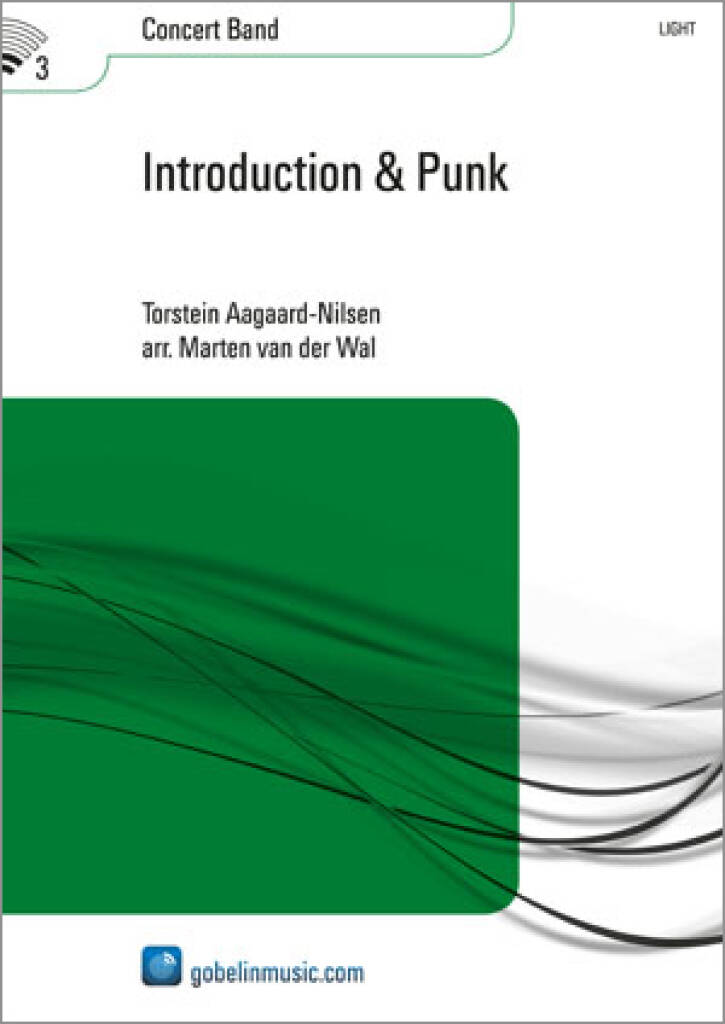 £76.99
Introduction & Punk - Torstein Aagaard-Nilsen
Torstein Aagaard-Nilsen's (1964) way of composing can be described as: uncompromising, wilful and contemporary. It is not surprising, therefore, that this occasionally causes a stir. In the middle of the Seventies a trend arose in youth culture, which was characterized by provocation, distrust of the great ideologies, and the autonomy of the individual. Punk is playful, aggressive, often humorous, and anti-everything, which inevitably leads to self-irony. The first part of Aagaard-Nielsen's composition (Introduction) is a texture based mainly on one short theme. This pompous theme breathes a spirit of cold empty plains, where icy winds sigh around yourhead. In the vehement Punk (Presto barbaro!) there is no longer any question of a theme. The basis for this part is formed by a repetitive motif (a descending minor third). This motif is alternated with very powerful percussion beats and later on shrill harmonies.
Estimated dispatch 7-14 working days
 View Music