
Results
-
 £179.90
In the Air (Concert Band - Score and Parts) - Oswald, Gerald
The composition is upbeat, dynamic, and the notes dance. There is no story to tell, but simply a mood of cheerfulness and levity. In the Air expresses a consistently joyful, light-hearted and positive vibe through its mischievously playful motifs; the music blows through as if a light breeze, a fresh wind. Gerald Oswald was born in 1968 in Gross-St. Florian. He completed his education as a trumpeter at the Johann-Joseph-Fux Conservatory and the University of Music and Performing Arts in Graz. He further pursued studies in conducting and composition under Franz Cibulka at the Johann-Joseph-Fux Conservatory in Graz, Thomas Doss at the Music and Arts Private University of Vienna, the Music School Leonding, and the C. Monteverdi Conservatory in Bolzano. His compositions for wind orchestras are successfully performed worldwide.Duration: 7.15
Estimated dispatch 7-14 working days
-
 £123.40
One Last Journey (Concert Band - Score and Parts) - Hoffmann, Robin
A moving composition portraying the beauty but also ephemeral nature of life itself. Based on a simple seven tone idea, the work develops from a gentle almost intimate mood towards a life- affirming climax. Robin Hoffmann, born 1984, studied composition and arranging at the Dresden College of Music. Since 2006, he has worked as composer, orchestrator and arranger for international film and concert productions. In 2010, the London Symphony Orchestra recorded his violin concerto at Abbey Road studios. His film music for Hero and A Father's Job won numerous international prizes. He was awarded a gold record in 2022 as arranger for Alex Christensen.Duration: 4.00
Estimated dispatch 7-14 working days
-
 £179.90
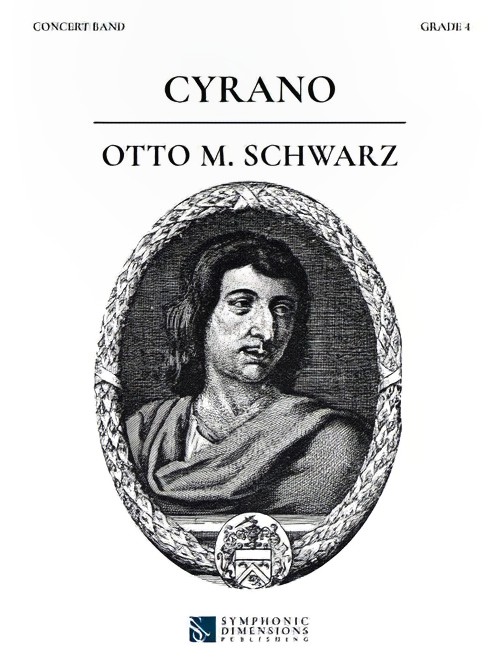
Cyrano (Concert Band - Score and Parts) - Schwarz, Otto M.
What are the true qualities of a person? Outward beauty or inner values? Or perhaps a balance of the two? This question has probably been posed by everyone at some time or another, and the answer is as challenging as it is subjective. This is also the theme of this work. The poet and soldier Cyrano de Bergerac is known for his big nose and his great intellect. The 17th century novelist harbours feelings for the beautiful Roxane but is sure that this love will never be reciprocated. Roxane herself falls in love with the cadet Christian de Neuvillette, who is certainly handsome but could be described as stupid. Cyrano de Bergerac writes love poems on behalf of Christian to win Roxane's heart. And then there is the Count Guiche, who is married but also wants to make her his mistress. Christian and Roxane eventually marry and the furious Count Guiche sends Christian and Cyrano, who serve together in the Captains of Gascony regiment, to the front and, some months later, on a suicide mission. Shortly before the battle, Roxane confesses to her husband that she no longer loves him so much for his beauty as for his inner values. Christian is dismayed and begs Cyrano to tell Roxane the truth, but he can't bring himself to do so. Christian de Neuvillette dies in battle and Cyrano de Bergerac remains silent about the true provenance of the letters. Only much later does the truth come to light: scarred by the war, Cyrano visits Roxane in the convent where she has been living since Christian's death and confesses his love for her. He ultimately dies in Roxane's arms.Duration: 8.30
Estimated dispatch 7-14 working days
-
 £102.80
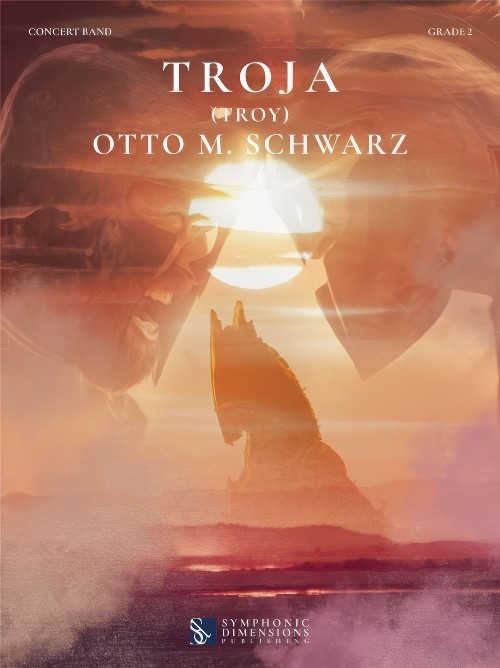
Troja (Troy) (Concert Band - Score and Parts) - Schwarz, Otto M.
The Greek poet Homer wrote about Troy and the Trojan War, which probably took place in what is now Asia Minor, in his Iliad in the 8th century B.C. Nowadays, the term Trojan generally refers to a malware program that is used to gain unauthorised access to computers. This use comes from the legendary Trojan Horse, which saw the turning point in the battle between Greeks and Trojans through the cunning of Odysseus. Let us return to the beginning of the story: Paris, son of the king of Troy, is tasked by Zeus with judging the beauty of the three goddesses Aphrodite, Pallas Athena, and Hera. Aphrodite, the goddess of love, flatters Paris by promising him the most beautiful woman in the world. Soon afterwards, on a journey to Greece, Paris meets the beautiful Helen, who immediately falls in love with him. Since however she is the wife of Spartan king Menelaus, she eventually lets herself be kidnapped by Paris voluntarily. The Greeks then form a large army and go to war against Troy to retrieve Helen, leading to a ten-year siege of the city. The city is eventually conquered not through combat, however, but through Odysseus' cunning ploy. He has the idea of building an enormous wooden horse with warriors hidden inside. The horse is placed at the gates of the city. Thus, the Trojans are tricked into giving up the siege when, despite various warnings, they bring the horse into the city to dedicate it to the goddess Athena. At night, the soldiers climb out of the horse and open the gate for the Greek army. The troops storm the city and burn it to the ground. The royal family and all the Trojan warriors are killed, only Aeneas, the son of Aphrodite, escapes. Later, following many years' wanderings he and his acolytes will become known as the founders of the Roman people. There are various accounts of the fate of the beautiful Helen. She is said to have returned to Sparta with Menelaus and to have ruled there until the end of her life. Or maybe not...Duration: 6.00
Estimated dispatch 7-14 working days
-
 £205.70
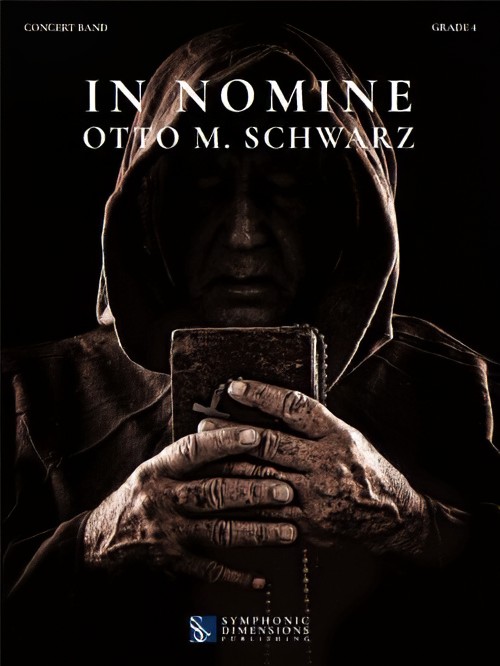
In Nomine (Concert Band - Score and Parts) - Schwarz, Otto M.
How often has something been justified by, declared to be, or blessed as 'in the name of' some cause or other? How can it be that opposing armies and the use of weapons are ever 'in the name of...'? This is a common thread in the history of different faiths. Good was created but evil was committed and all 'in the name of...' This thread is also found in the history of the Premonstratensian Abbey at Wadgassen. The abbey was built in the 12th century on unfertile, desolate moorland, which later evolved into the most powerful religious community in the Saarland. The history of the abbey records quite astounding achievements under the motto desertum florebit quasi lilium ('the desert will bloom like a lily'); but also the harsh treatment of delinquents. The order had its own school, in which children were taught the seven liberal arts (which included music as well as geography and astronomy), but the poor were left to starve outside the abbey walls and were only allowed to eat from the members' leftovers on feast days. The medieval witch trials demanded their pound of flesh, and one group that fell victim were ecstatic dancers who moved wildly to music, which was interpreted as the devil's work. The result: a show trial that sentenced the dancers to death by fire. All in the name of... The year is 1789: Abbot Bordier is in the tenth year of his command. He does not yet know that he is to be the last abbot of an almost 700-year tradition. Not far from the abbey is the French border, which has long been making itself felt with the sound of gunfire, and the brothers continue to keep a nervous eye on it. The first portents of the French Revolution loom, but no one wants to believe it, that is, until the French pound the door down, storm the abbey and come right into the brothers' chambers. In a blind fury, all the pipes of the abbey organ are torn out, icons beheaded with swords and brothers beaten death while numerous buildings are set on fire. The abbey church is in flames. A frantic and desperate escape begins. Abbot Bordier and a handful of brothers make their getaway via the River Saar, adjacent to the abbey, to the neighbouring village of Bous. They survive, but their life, the Premonstratensian abbey, is destroyed. While they flee towards Prague and the sanctuary of the Strahov Monastery, the abbey at Wadgassen is razed to the ground and becomes a stone quarry. The desert blooms once more, however. A few short decades later, a glasswork arises from the foundations of the abbey. As peace returns to the region, it brings jobs and a new vision for its people.Duration: 11.15
Estimated dispatch 7-14 working days
-
 £119.99
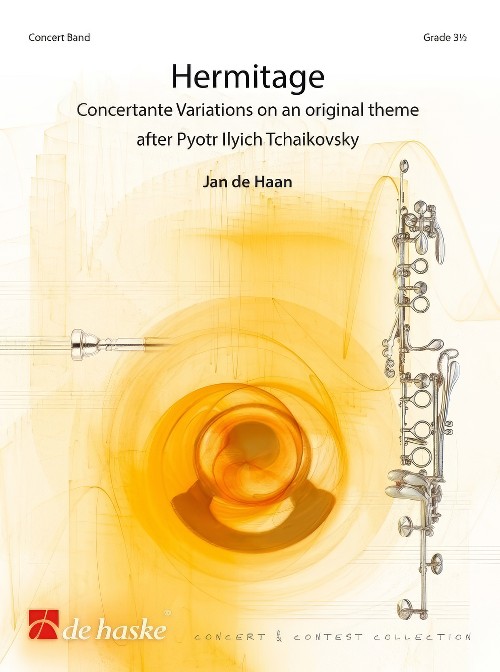
Hermitage (Concert Band - Score and Parts) - De Haan, Jan
Concertante Variations on an original theme after Pyotr Ilyich TchaikovskyJan de Haan drew inspiration for this work from five paintings exhibited in The Hermitage in Saint Petersburg, one of the largest and most versatile museums in the world. He used the melodious Andante cantabile from the String Quartet Op. 11 by the Russian composer Pyotr Ilyich Tchaikovsky as its starting point. Thus, he created his own musical painting, which is just as varied as the underlying canvases, from Cheerful Company by Dirck Hals to Dance II by Henri Matisse. A true work of art!Duration: 13.30
Estimated dispatch 7-14 working days
-
 £100.80
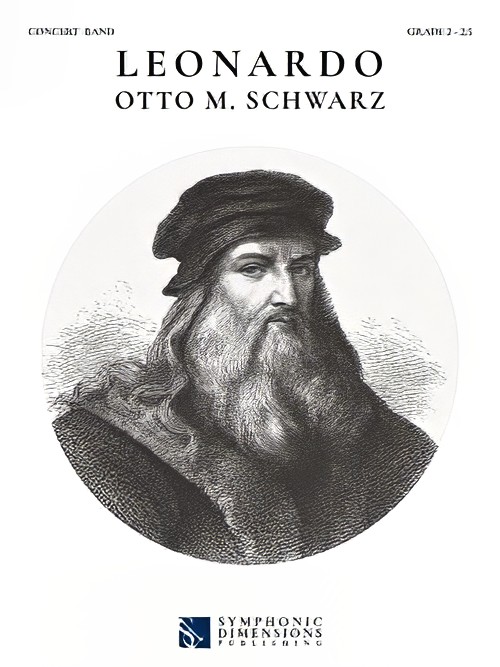
Leonardo (Concert Band - Score and Parts) - Schwarz, Otto M.
Leonardo da Vinci (1452-1519) was a painter, sculptor, inventor, philosopher and researcher. He is renowned as the original 'Renaissance Man'. 'I will preserve the memory of myself in the minds of others' was one of his maxims. Among his most famous works of art are the Mona Lisa, The Last Supper and the Vitruvian Man. He left an extensive collection of handwritten documents in his notebooks. These books, known as codices, survive in various volumes such as the Codex Atlanticus, Codex Madrid, Codex Trivulzianus etc.). They include sketches of ground-breaking inventions as well as studies and commentaries which span the gamut of human study. The left-handed da Vinci wrote the texts in mirror writing. Through wars and other upheavals, the documents were scattered throughout Europe and much of his work disappeared. Leonardo da Vinci wanted to leave a kind of encyclopaedia for posterity and, although it is estimated that up to 80% of his manuscripts were lost, some 6,000 individual documents survive to this day, the contents of which in many cases were only understood centuries later.Duration: 6.00
Estimated dispatch 7-14 working days
-
 £68.80
Adagio (Concert Band - Score and Parts) - Brahms, Johannes - Houben, Kevin
Johannes Brahms can be considered to be one of the top composers of the nineteenth century chamber music. He was a giant in this field and an eminent successor of Beethoven and Haydn. A masterpiece from his chamber music oeuvre is the trio in Eb opus 40 for piano, violin and natural French horn. In 1865, the year of his Horn trio, Brahms's mother Christiane died. It's well known that he fostered deep feelings for her. The slow part of the Horn trio with the tempo indication Adagio Mesto (sad) can be considered as a lamentation for his mother. The first performance of the piece took place in Zurich on 28th November 1865 and it was published a year later in November 1866. In this version for Wind Band Kevin Houben stays as true as possible to the original. The result is a deep and dark orchestration of the wonderful Adagio Mesto. A challenge for any orchestra and extremely suitable as concert piece. Duration: 6.00
Estimated dispatch 7-14 working days
-
 £64.00
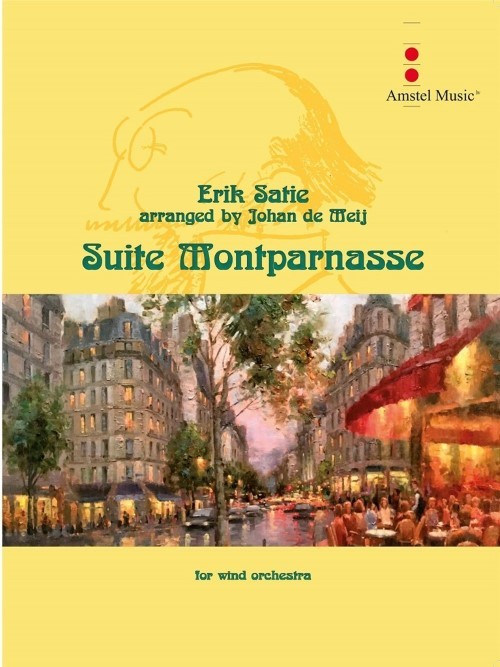
Suite Montparnasse (Concert Band - Score and Parts) - Satie, Erik - De Meij, Johan
Erik Satie, born in Honfleur in Normandy (France) in 1866 is undoubtedly one of the most striking personalities in the history of French music. He composed in various, often quite divergent, styles. Besides light-hearted,entertaining works he also wrote several serious compositions, among which the three ballets: Parade, Rel che and Les Aventures de Mercure. However, his piano pieces, such as Trois Gymnopedies or Gnossiennes will remain his most popular compositions. Satie cooperated with almost all the great artists of his time: Pablo Picasso, Jean Cocteau, Sergei Diaghilev, Georges Braque and composers Darius Milhaud (Le Groupedes Six) and Claude Debussy. Johan de Meij made an orchestration of three short pieces by Erik Satie: I. Les Pantins dansent - II. Choral No.2 - III. Passacaille. Duration: 7.00
Estimated dispatch 7-14 working days
-
 £64.00
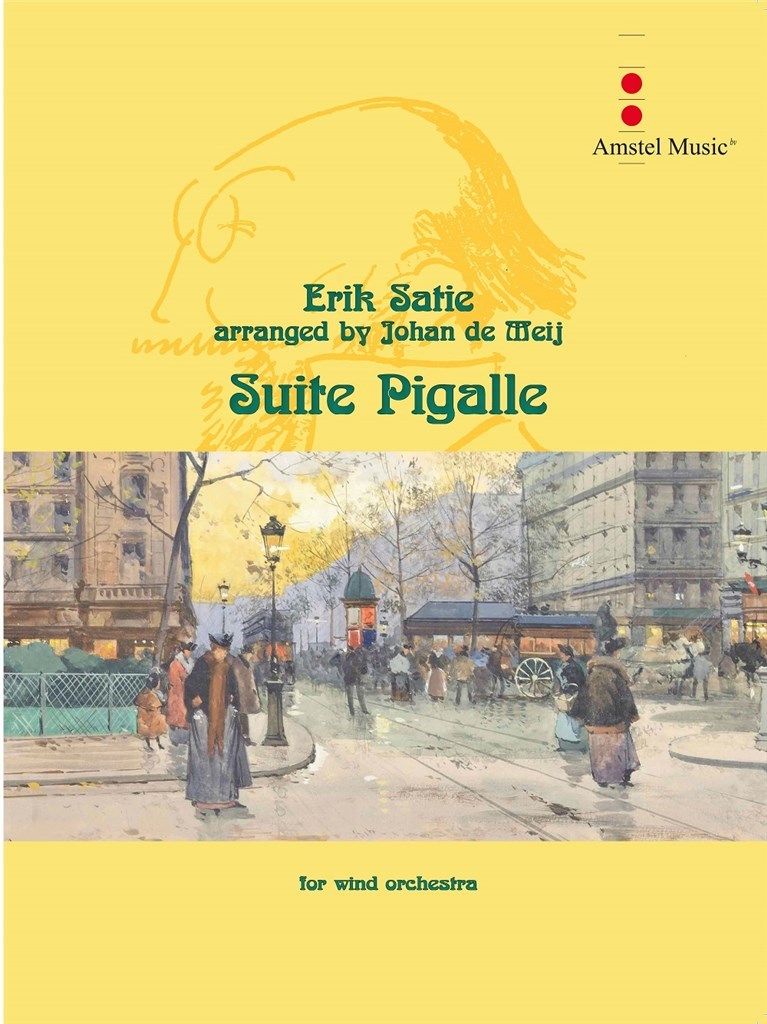
Suite Pigalle (Concert Band - Score and Parts) - Satie, Erik - De Meij, Johan
Erik Satie, born in Honfleur in Normandy (France) in 1866 is undoubtedly one of the most striking personalities in the history of French music. He composed in various, often quite divergent, styles. Besides light-hearted,entertaining works he also wrote several serious compositions, among which the three ballets: Parade, Rel che and Les Aventures de Mercure. However, his piano pieces, such as Trois Gymnopedies or Gnossiennes will remain his most popular compositions. Satie cooperated with almost all the great artists of his time: Pablo Picasso, Jean Cocteau, Sergei Diaghilev, Georges Braque and composers Darius Milhaud (Le Groupedes Six) and Claude Debussy. Johan de Meij made an orchestration of three short pieces by Erik Satie: I. Petite Ouverture Danser - II. Gnossienne No.1 (1890) - III. Gambades.Duration: 8.45
Estimated dispatch 7-14 working days
 View Music