
Results
-
 £149.99
Land of Legends Wind Band Set (Score & Parts)
In 'Land of Legends' German composer Andreas Ludwig (what's in a name) Schulte takes you along to the fictional world of legends, myths and fairy tales. The introduction to the first part (The Castle) describes the majestic contours of the scene of action. Its instrumentation (horns) immediately makes you imagine being in Medieval spheres. The addition of trenchant copper instruments even gives the part a heroic tinge. After entering through the gate, a lot of hustle and bustle appears to be going on in the courtyard. Pages, squires and soldiers are busy attending to their arms. Beer is being brewed, flax is being spun, cattle are being tended and some craftsmen from neighbouring villages are busily at work. In the upper chamber of the round tower lives an old man (The Old Wizard). He hardly ever comes out, and nobody knows exactly what he is doing. It is said that he is engaged in wizardry and magic. It is all very mysterious. There are also festivities, some of them sober, others exuberant. The wedding in the third part is celebrated in a grand manner. With a flourish of trumpets, the bride makes her entrance at the hand of her father. Afterwards, at the party there is dancing to the music played by minstrels and of course a plentiful banquet follows. 11:00
Estimated dispatch 7-14 working days
-
 £59.95
LAST LINCOLNSHIRE POACHER (Programme Concert Band) - Stubbs, Duncan
Another winner from Duncan Stubbs! This time he recreates the famous poacher out again, at the dead of night - until he hears sounds of the police around him. Does he escape? . . . . . . .
Estimated dispatch 7-14 working days
-
 £65.00
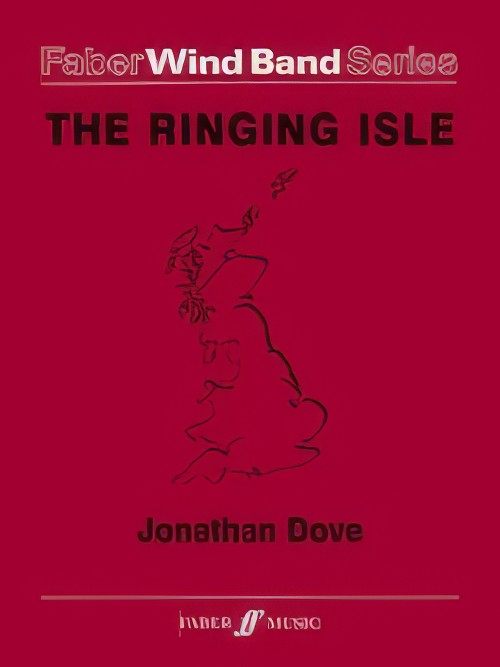
The Ringing Isle (Concert Band - Score and Parts) - Dove, Jonathan - Littlemore, Phillip
Handel called Britain 'the ringing isle' because when he moved to London, he heard bells ringing everywhere: great bells in church towers, and handbells in some of the first private houses he visited. The sound of people 'ringing the changes' is a peculiarly British sound of celebration, and it seems a good starting point for a piece celebrating British musical life. Within The Ringing Isle, Dove incorporates some traditional change-ringing patterns, from 'Grandsire Doubles', 'Oxford Treble Bob Minor' and his own version of 'Plain Bob Major'. Handel's phrase also conjures up an image of a magical island, and so this is how Dove envisaged how it must have been to approach Britain from an ocean voyage.
Estimated dispatch 7-14 working days
-
£149.99
The Road to the West Wind Band Set (Score & Parts)
As he did before in the often played and commonly appreciated 'Lord Tullamore', in which he poetically depicted the landscape and the cultural elements of a small Irish village, in his composition 'The Road to the West' Carl Wittrock has sketched pioneer existence in America in a cinematic manner.In 'The Road to the West' the composer has tried to capture images of pioneer life during the period dating from 1850 to 1890, the days of the so-called Wild West.In those days, the Wild West used to be the territory west of civilization, the domain of cowboys, trappers, and other fortune hunters. In short, ample ingredients for a captivating story.In the first scene a lonely adventurer struggles against nature and the elements. After an exciting adventure he passes through 'the Plains', where majestic views alternated by colossal mountain ranges display an almost unimaginable beauty.After weeks of isolation civilization is reached again. 'The Saloon' is the perfect meeting place - here news is exchanged and hilarious scenes regularly take place. 08:00
Estimated dispatch 7-14 working days
-
£154.99
The Verdict (Concert Band - Score and Parts)
The Verdict shows Otto Schwarz great skill at composing Concert Band items in his typical imaginative film musical style. It tells the tale of two brothers who differed greatly, one was handsome and the other a huntchback. The huntchback stabbed his brother after he had taken his bride from him and for this was sentenced to death. He was given a last minute reprise when he told of a spring that would end the local drought. An epic tale of love and revenge! 11:00
Estimated dispatch 7-14 working days
-
 £23.95
TUBA CONCERTO (Fraser) (Prestige Tuba/Concert Band Extra Score) - Fraser, Bruce
On being asked by James Gourlay, one of the world's leading tuba players, to write this work the composer was given a free hand to write whatever he wanted. A rare request in a commission! To start he created a note-row from t he musical letters of James' name giving a minor seventh chord and an added flattened fifth. From this point everything went into the pot bringing out simplet tunes, cadenzas, and even muti-phonics! A real challenge for the performer but joy for the listener! Duration: 12:31 Grade 4-5 (Solist 5++)
Estimated dispatch 7-14 working days
-
£119.95
TUBA CONCERTO (Fraser) (Prestige Tuba/Concert Band) - Fraser, Bruce
On being asked by James Gourlay, one of the world's leading tuba players, to write this work the composer was given a free hand to write whatever he wanted. A rare request in a commission! To start he created a note-row from t he musical letters of James' name giving a minor seventh chord and an added flattened fifth. From this point everything went into the pot bringing out simplet tunes, cadenzas, and even muti-phonics! A real challenge for the performer but joy for the listener! Duration: 12:31 Grade 4-5 (Solist 5++)
Estimated dispatch 7-14 working days
-
£174.99
Two Symphonic Interludes Wind Band Set (Score & Parts)
Based on the poems by German poet Carl Hauptmann (late Romanticism) and the English poet William Wordsworth (early Romanticism). Carl Hauptmann was in poor health as a child, but highly intelligent. He studied philosophy, psychology and biology. In the latter he was admitted to the degree of doctor. His marriage provided financial independence, so that he could focus on his studies. Hauptmann wrote various novels, plays, poetry and scientific works. Night Twilight floats above the valley's night mists are hanging, there's a whispering brook. Now the covering veil is lifting quite: come and look! See the magic land before our gaze: tall as dreams the silver mountains stand, crossed by silent silver paths shining from a secret land. Noble, pure, the dreaming country sleeps. By the path the shadow black and hogh of a beach. a wisp of a white smoke creeps to the dark'ning sky. Where the valley is the darkest hued countless little lights shine silently. O my soul! Drink of solitude! Carl Hauptmann Wordsworth 'introduced' a new type of poetry, based on the speech of the common man. This was his answer to the poetry of the classicism which was bound by rigid rules. His definition of poetry was: the spontaneous overflow of powerful feelings from emotions recollected in tranquility. My heart leaps up when I behold a rainbow in the sky My heart leaps up when I behold A rainbow in the sky: So was it when my life began. So is it now I am a man. So be it when I shall grow old, Or let me die! The Child is father of the Man. And I could wish my days to be Bound each to each by natural piety. William Wordsworth In a truly poetic manner Harrie Janssen has transformed the contemplative thoughts of the poets into two compositions for Concert Band. 10:45
Estimated dispatch 7-14 working days
-
 £129.99
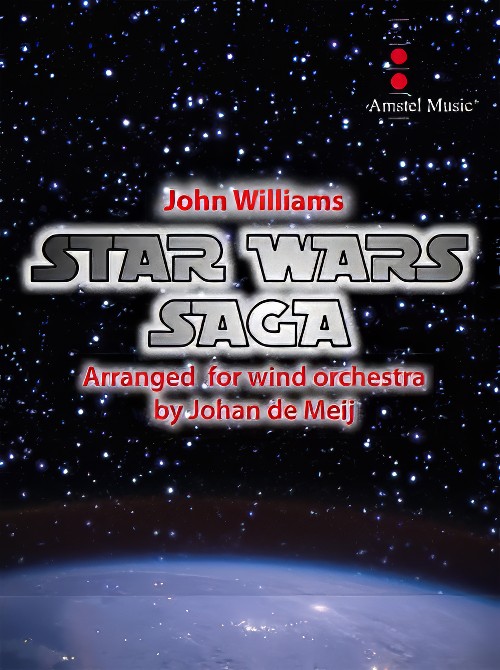
Star Wars Saga (Concert Band - Score and Parts) - Williams, John - De Meij, Johan
John Williams (February 8, 1932) has composed some of the most popular, recognisable and critically acclaimed film scores in cinema history. Williams has won 25 Grammy Awards, five Academy Awards, seven British Academy Film Awards, and four Golden Globe Awards. With 53 Academy Award nominations, he is the second most-nominated individual, after Walt Disney. His compositions are considered the epitome of film music, and he is considered among the greatest composers in the history of cinema. His work has influenced many other composers of film, popular, and contemporary classical music. In 2005, the American Film Institute selected Williams's score to 1977's Star Wars as the greatest film score of all time. In this newly revised arrangement from 1986, arranger Johan de Meij has used themes from Star Wars: A New Hope and The Empire Strikes Back.
Estimated dispatch 7-14 working days
-
 £100.80
Bleak Forest (Concert Band - Score and Parts) - Ziegelback, Andreas
Bleak Forest is a piece for smaller concert bands and offers the musicians above all space to improve their sound and their effect playing. The technical requirements are therefore deliberately kept low. With this piece, the composer won the VLAMO International Composition Contest 2022.Thematically, the work is influenced by the composer's childhood memories. In his hometown there was a dark and mysterious forest, that seemed to the children in the small village to be magical. Without a reasonable explanation, every trip into the woods was exciting and somewhat terrifying. There were tales of dangerous animals, which can be heard at the beginning of the piece, as well as magical beasts. The magic of the forest is depicted musically from bar 70 in the andante section. The snapping of the fingers represents single raindrops. From bar 99 onwards, we hear the trek home, with the occasional moments of trepidation as the children spook each other with their fanciful tales. In the end, though, we arrive safely at home because after all, magical beasts only exist in fairy tales... don't they?Andreas Ziegelback studied music education at the Mozarteum University in Salzburg, and history at the Paris Lodron Universitat, Salzburg. In addition to his studies, he trained in ensemble conducting for wind orchestra with conductor and composer Thomas Doss. It was Doss who sparked Ziegelback's interest in composing. In 2021, Andreas Ziegelback completed his composition studies with Johannes Maria Staud. In 2020, he took part in a brass band composition masterclass in Bern with Oliver Waespi, followed by a premiere by the Swiss Army Brass Band.Duration: 6.00
Estimated dispatch 7-14 working days
 View Music