
Results
-
 £47.50
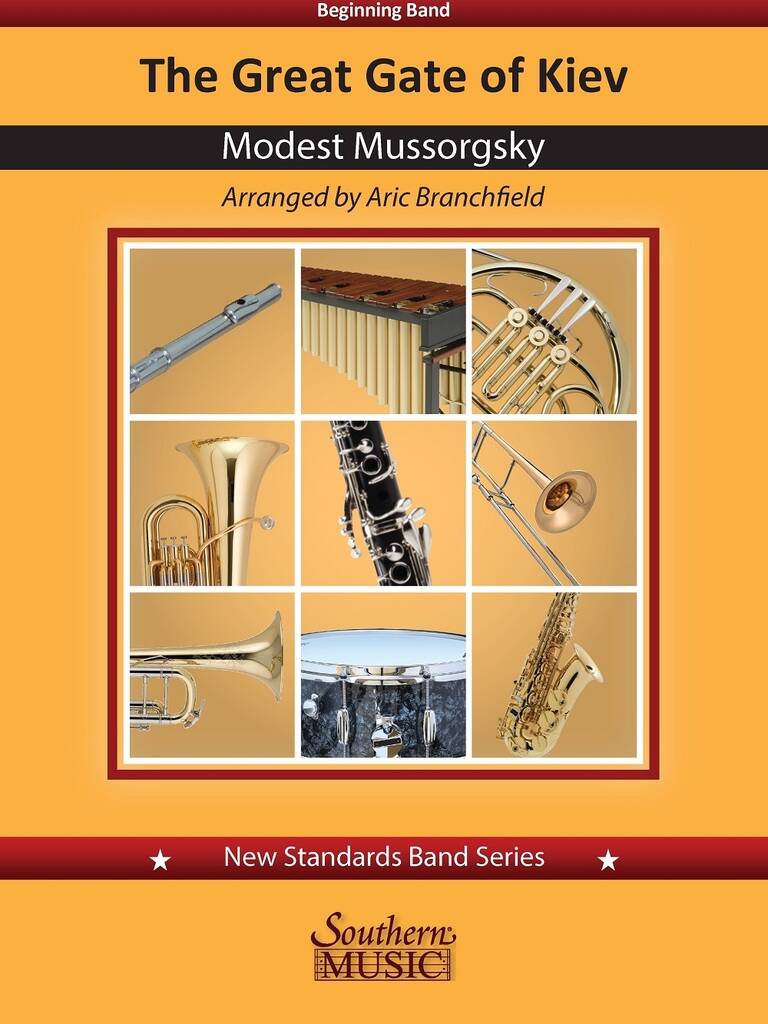
The Great Gate of Kiev - Modest Mussorgsky
It_x001A_s never too early to introduce your students to great music. This outstanding addition to the beginning band repertoire is certain to be a hit with your students and audience. Clarinets remain below the break, first trumpet goes stepwise once to fourth line D.
Estimated dispatch 7-14 working days
-
 £119.60
Frankenstein - Kelly Bennette
This tone poem entitled Frankenstein is based on the original novel by Mary Shelley (1797-1851). Victor Frankenstein creates life from pieces of many dead bodies. Soon, his monster comes to life. Though very intelligent, the monster has the maturity of a child. In a fit of rage, the monster kills William, Victor's younger brother. The monster finds Victor in The Alps and asks him to make him a mate. Victor makes him a mate, but kills her. The enraged monster tells Victor, "I will be with you on your wedding night." The monster forces his way into the wedding and kills Victor's fiance, Elizabeth. Victor chases the monster all the way to the Arctis where he dies of exhaustion. The monster finds Victor's body and realizes he has nothing to live for and goes away to die.
Estimated dispatch 7-14 working days
-
 £42.50
Encore! - Goto Yo
Encore! was commissioned by Ishikawa Prefecture Band Association to celebrate its 50th anniversary in 2010. The commissioning request was that the piece be fun and appropriate as an encore. I made it simple and enjoyable for everyone.The only thing I added was an appealing introduction so each entering section might feel the importance of their instrument. That's why there is a specified appearance order involving standing. It goes from 1) clarinets, 2) piccolo, flute, horn, oboe and bassoon, 3) percussion, 4) euphonium, tuba and double bass, 5) trombone, 6) saxophone to 7) trumpet. Lastly, all sections stand up together and greet the audience. Technically, it's a medium grade level. There are substitutions for bands lacking oboe, bassoon or double bass.The title was selecting hoping for a fun, grand finale. It also means "more" and "again." My hope is for performers and audience to enjoy music, and for Ishikawa Prefecture Band Association to nourish its band movements and activities. I could not ask for more if people come to love music even more by experiencing this work.(Yo Goto)
Estimated dispatch 7-14 working days
-
£179.99
Amazonia - Jan Van der Roost
This major concert work cosists o five movements.1st movement: La Laguna del ShimbeSituated high up in the Andes mountains in Northern Peru are the Huaringas, a group of lagoons in isolated and mysterious surroundings. The water has healing powersand for centuries traditional healers have settled there in small villages. From far the sick come to the Huaringas to be treated in nightly rituals, in which the hallucinating juice of the San Pedro cactus gives the prophet a look inside hispatient. The biggest lagoon is the "Laguna del Shimbe", one of the countless wells of the immense Amazon stream.2nd movement: Los AguarunasFurther downstream in Northern Peru we come across the rain tribe of Los Aguarunas. It's a proud, beautiful andindependent race, which has never succumbed to domination, not even from the Incas. They live from everything the forest has to offer: fish, fruit, plants, ... . They also grow some crops and live as semi-nomads. They take their fate into their ownhands and after having made contact with modern civilisation, they have integrated new elements into their lives without betraying their own ways.3rd movement: MekaronMekaron is an Indian word meaning "picture", "soul", "essence". The Indians are theorigina inhabitants of the Amazon region. They either live in one place as a group or move around a large region. They all have their own political system, their own language and an intense social life. At the same time they are master of music andmedicine. "Everywhere the white man goes, he leaves a wilderness behind him", wrote the North American Indian leader Seatl in 1885. As a result of these contacts with the whites, the disruption of most Indian societies began. (In this century alone,80 tribes have vanished completely).4th movement: KtuajThis is the name of the initiating ceremony of the Krah tribe in the Brazilian state of Goias, in which young boys and girls enter adult life. They are cleansed with water, painted with redpaint and covered with feathers, after which the ritual dance holds the entire tribe spell-bound.5th movement: Paulino FaiakanIn 1988 the Indian chiefs Faiakan and Raoni Kaiapo came to Europe to protest against the building of the Altamira dam inBrazil. As a result of the dam the Indians would be driven from their traditional land and enormous artificial would be created. The project was supported financially by, amongst others, the European Community. In February 1989 the Indian tribesaround Altamira held a protest march for the first time in their history together. Amongst other things they paid tribute tot Chico Mendez, who, murdered in 1988, was the leader of the rubber syndicate and a fierce opponent of the destruction of theBrazilian rain forest. Brazilian and world opinion was awakened. The building of the dam was -albeit temporarily - stopped.
Estimated dispatch 7-14 working days
-
 £116.40
Three Pictures for Band - Oliver Waespi
This composition consists of three sound pictures. When writing this work Oliver Waespi did not have any concrete image such as a scenery or a specific form in mind, but rather some typical visual movements. Hence the successive titles of the different parts: Procession, Dialogue and Waves. Numerous associations mutually link those parts as far as motifs and harmony are concerned. The motif of the ascending and descending fourth plays an important role in many a theme. There are many fourth chords by means of which Waespi tries to put a harmonic and unifying stamp on the compostition as a whole. Moreover there are similar or identical, though varied, motifs in the successive parts.The first part, Cortge (Procession), describes the dignified majestic procession by means of simple precise rhythms. At first the music is scarcely audible, as if coming from a distance; it gradually comes nearer until it reaches its climax in large chords, before fading away again. At each quarter note one could imagine a step. The second part, Dialogue, consists of broad outlines of dialogues between the different orchestral groups. Some instruments are asking questions, others are giving answers. After a rather sad passage, the music turns into a climax followed by a second passage that brings comfort and leads to a quiet ending. In the third part, there is a sudden movement coming up in the shape of waves. The principle of the wave, successively swelling and decreasing, dominates the entire musical structure of this part, even in the separate motifs.As far as the instrumentation is concerned there are the following notes: in the brass band version Oliver Waespi has a definite (orchestral) brass band strength in mind. If some parts (e.g. euphonium and flugelhorn) are played by several musicians, the conductor should feel free either to double or to thin those parts, providing the musical contents are not damaged. The same goes for the fanfare band in which the conductor can feel even more free as to the band's orchestral strenght. Anyway, a convincing overall sound is determining and that is to be realised by any kind of wind band.
Estimated dispatch 7-14 working days
-
 £105.80
No War - Marco Somadossi
The theme of this composition is immediately evident from the title, which almost requires no further explanation. It will never be possible to represent or reproduce the full implications of a tragedy such as war, all too often forgotten, concealed, exploited or written off as being an evil that is "necessary" for the development of civilisation. War changes the course of human history: man kills man, fathers bury their sons, children take up arms, and mankind is devastated by evil, choosing death over life. The atrocities, repeatedly perpetrated and evident to all observers, are an offence to human dignity. Yet they are tolerated and, at times, even re-interpreted as inevitable remedies for "obstacles" to the global economy, in order- it would seem- to build "a better world". And all this goes on despite the fact that the terrible scars left by past wars are still evident and should serve as a warning to ensure that such tragedies do not return to devastate our world. "No War" is thus a heart-felt protest against any form of culture that justifies war as a means of gaining wealth and power, satisfying the economic needs of the richest countries at the expense of the poorest nations. In so doing the one truly fundamental value is annihilated, that of human life.
Estimated dispatch 7-14 working days
-
 £73.60
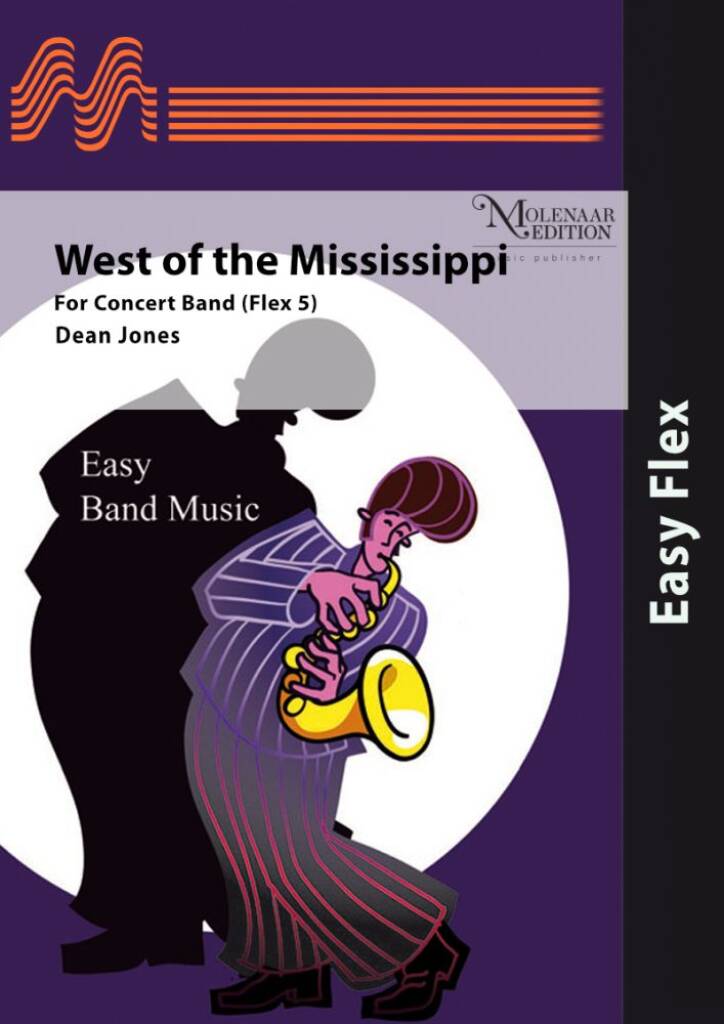
West of the Mississippi - Dean Jones
There's always a sense of adventure about America that makes it a really exciting topic to write about. The 3 States that sprang to mind in bringing a piece of music together were: California, Hawaii and Texas.We start out our American journey on the West Coast....California has provided much in the way of film and music for over 100 years. Combining this sense of free expression with the 'Surfing' culture, this initial section of the piece has an easy-going, fun feel in a pop idiom. Maybe wearing some shades might be quite a good look for this section!We move even further West now to the island of Hawaii where the free and easy goes onto a new level! The use of chromatics is a feature of Hawaiian melodies and has a feel a 'sliding' between notes that somehow sums up this feel of living on a tropical island! Have some fun with this section and have a Hawaiian garland to wear!Back into the USA mainland, and the fabulous state of Texas! Here we have the concept of the old fashioned rodeo and the 'Wild West'. Even today, the culture of horses, cowboys and tales of adventure are celebrated in places such as Fort Worth. The music captures some of these themes and has a fun and enjoyment...some get your Cowboy hats at the ready and enjoy the finale!
Estimated dispatch 7-14 working days
-
 £127.30
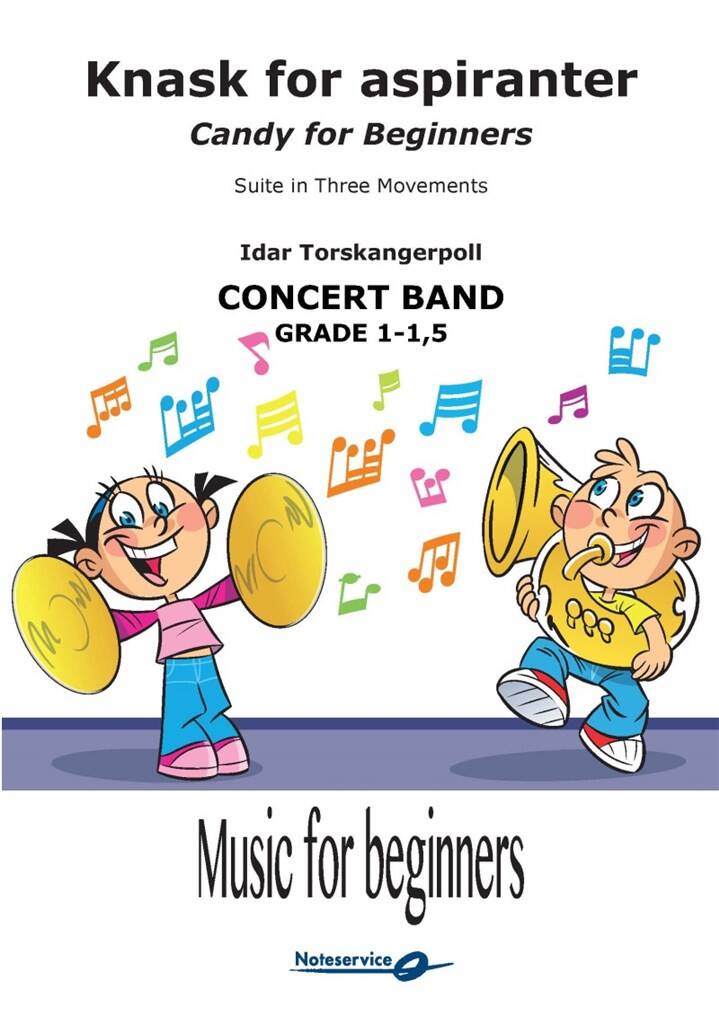
Knask for aspiranter - Suite in Three Movements - Idar Torskangerpoll
Candy for Beginners is a suite of three songs used by the composer with the youngest beginners throughout several years. The method is to sing the melodies before learning it on the instruments. Lyrics about candy has proven to be very popular among the youngsters.... In English it can goes like this: "Candy floss, candy floss, candy floss, candy floss, oh yeah". And: "Soda for me, give me soda for free". And: "Lefse, it is good, lefse, now you should, Lefse, give me one, lefse, sure is fun." The composer urges the band to find their own lyrics to the melodies, making it their own with a local twist. This is a good rhythmic exercise for the young players.
Estimated dispatch 7-14 working days
-
£56.50
Inferno in the Lost Pines - Larry Clark
Larry Clark does it again, with a bold new piece for young students, using only the first 6 notes of the Bb scale and two eighth notes on the same pitch as the most difficult rhythm. The piece is meant to depict the struggle that firefighters go through when trying to tame an out of control brush fire. The piece goes right into the main theme without introduction and then moves into a more subdued second theme, in contrast. After a short development of the themes with interplay between the winds and percussion, the piece builds to a strong coda: a great way to showcase your beginning band at a concert or festival.
Estimated dispatch 7-14 working days
-
 £159.60
Evocazioni (1985) - Paul Huber
This work, composed in 1985, wants to shake you up and put a spell on you at the same time. Today, humanity is threatened by many dangers, many of which we are not able to banish. We need help from a higher power. The Chorale "Aus tiefer Not schrei' ich zu dir" (from deep distress I cry to you) illustrates this. This motif appears in diverse variations. But, in his arrogance the wicked man does not believe in the rule of evil demons in the world.With the Gregorian melody in the sequence "Dies irae" (day of wrath) from the requiem mass, the nearing of disaster is announced: without God man goes astray. He falls into ruin.To deepen the poignancy of this composition, Paul Huber cited a dramatic episode from his symphony "The nostraie aetatis angoribus" (from the anxiety of our time).
Estimated dispatch 7-14 working days
 View Music