
Results
-
 £236.00
Brueghel Suite - Maurice Schoemaker
In September 1925, on the occasion of the sixty-fifth birthday of their 'master', seven students of Paul Gilson gathered to form the first composers' collective in Belgian national music history. The members of Les Synthtistes (the Synthetists) are Ren Bernier, Francis de Bourguignon, Gaston Brenta, Tho Dejoncker, Marcel Poot, Maurice Schoemaker and Jules Strens. Their intent is twofold and both theoretical and practical. Les Synthtistes want to distinguish themselves as the 'Brussels seven' by breaking away from the prevailing late-romantic music of their time. Their theoretical aim is to synthesize the modern tendencies in music from 1925 onwards, to connect with the 'acquisitions of contemporary music' and to apply them within balanced and well-defined forms. Their practical goal is to make it easier to find a stage to perform their new symphonic music by uniting. In a period when there is no professional symphonic orchestra in Belgium, apart from the opera orchestra, they compose and transcribe their original symphonic works for wind band. They work together with Arthur Prevost and the Royal Band of the Belgian Guides which grew into a model instrumentation of 85 musicians during the interwar period. Thanks to Prevost and the Guides a unique collection of original, modern music for wind band by Les Synthtistes can be heard on the Brussels concert stages during the interwar period. Because only a few works of this unique, forgotten collection of 75 works were published, this unique canon remained largely unknown. Thanks to a historical study of sources by Luc Vertommen, these works for wind band are now, a century after their creation, made accessible and recorded for the first time.
Estimated dispatch 7-14 working days
-
 £149.99
Aladdin Suite - Carl Nielsen
The large creative output of the Danish composer Carl Nielsen (1865 - 1931) contains six symphonies, chamber music, vocal works and music for the theatre: two operas (Saul & David and Maskerade) and stage music for sixteen different plays. The stage music for Aladdin was written at the request of Johannes Nielsen, the director of the Royal Theatre in Copenhagen. This production was based on the drama Aladdin (1805) by the Danish author Adam Oehlenschlger. Already before the premiere at the Royal Theatre, Carl Nielsen had adapted some of the music for the concert hall: he conducted the first performance of six of the seven movements of the concert suite on February6th, 1919. Johan de Meij's transcription for symphonic band contains the following movements: I Oriental Festival March II Aladdin's Dream / Dance of the Morning Mist III African Negro Dance
Estimated dispatch 7-14 working days
-
 £74.99
Three Colonial Moments - Rick Kirby
Depicting three contrasting and intriguing settings from early American lore, Rick Kirby masterfully brings these images to life in a suite for band. The first movement tells the legend of The Phantom Drummer with unique orchestrationaleffects. The second movement, The Ladys Lament, mourns the loss of loved ones in the Revolutionary War, and the suite concludes with the lively dance Virginia Two-Step. Rich in stylistic and tonal variety, this is an appealing work forconcert or festival use.
Estimated dispatch 7-14 working days
-
 £137.70
Robin Hood Suite No. 2 - Roar Minde Fagerli
Robin Hood suite 2 is five movements collected from a play written for a summer course arranged by The Norwegian Band Federation. The Composer is inspired by the story of Robin Hood; He who steals from the rich and gives to the poor.The composer describes different charters and places from the story in his music. In the first movement you will meet the merciless Sheriff of Nottingham. The second movement describes the caring Friar Tuck. In the third movement Robin Hood and Lady Marion sneaks around in the Castle. In the fourth movement Prince John's guards hunts Robin. In the fifth movement Robin Hood and his friends celebrate their victory!
Estimated dispatch 7-14 working days
-
 £83.00
Suite Nr.1 Es-Dur op.28/1 - Gustav Holst
Arguably the most important composition in the history of the modern concert band, here for the first time is an edition adapted for contemporary school band instrumentation! Extreme ranges (particularly in the woodwinds) have been eliminated and the brass scored for 3 trumpets, 2 horns, 2 trombones, baritone and tuba. Robert Longfield has painstakingly maintained the integrity, form and character of Holst's work while making it accessible to younger players. Don't miss this opportunity to provide your students the chance to perform a valuable and fulfilling band classic.
Estimated dispatch 7-14 working days
-
 £104.99
The Many Moods of Christmas: Suite No. 4 - Robert Shaw
The extensive passages for orchestra alone in The Many Moods of Christmas suites represent some of Robert Russell Bennett's most brilliant and attractive writing based on familiar carols. This Mark Rogers' edition for wind band alone is the second offering in an ongoing series which will bring all four of these suites to the repertory of band conductors in the coming years. Included are Break Forth, O Beauteous Heavenly Light, The First Nowell, O Little Town of Bethlehem, I Saw Three Ships, and concludes with a rousing version of Deck the Halls with Boughs of Holly.
Estimated dispatch 7-14 working days
-
 £75.00
Shelter Island. Wind band - Nigel Hess
Commissioned in 1985, 'East Coast Pictures' has become a modern classic for all wind bands. 'Shelter Island' is the first movement of the suite. The music conjures up a vivid picture of this small island, moving from a crowdedsummer tourist trap to the onslaught of the Atlantic during the winter.
Estimated dispatch 7-14 working days
-
 £375.00
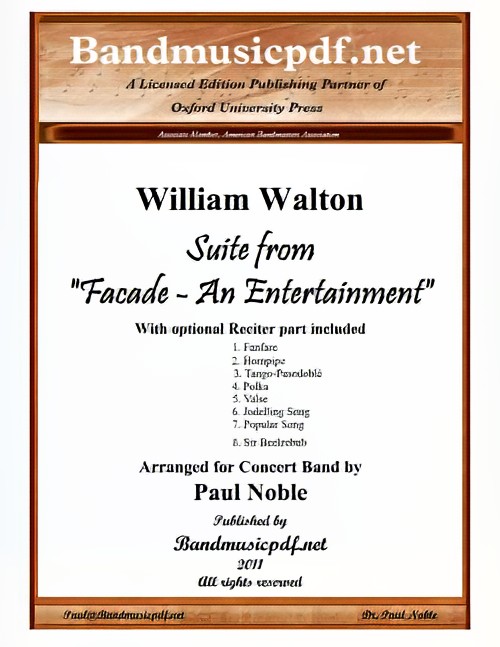
Facade - An Entertainment, Suite from (Concert Band with Optional Narrator - Score and Parts) - Walton, William - Noble, Paul
This Suite from Facade - An Entertainment, composed by William Walton, with poems by Dame Edith Sitwell, presents for the first time a grouping of movements selected and arranged by Paul Noble for Concert Band and optional Reciter. The original composition was written between 1921 and 1928, containing forty-three numbers. They had their origin in a new style of poetry that Edith Sitwell evolved in the early 1920s, poems that her brother Osbert later described as 'experiments in obtaining through the medium of words the rhythm and dance measures such as waltzes, polkas, foxtrots... Some of the resulting poems were sad and serious... Others were mocking and gay... All possessed a quite extraordinary and haunting fascination.' Possibly influenced by the dance references in some of the numbers, Osbert declared that the poems might be further enhanced if spoken to a musical accompaniment. The obvious choice of composer was the young man who lived and worked in an attic room of the Sitwell brothers' house in Carlyle Square W[illiam] T[urner] Walton, as he then styled himself. The now historic first performance of the Facade Entertainment took place in an L-shaped first-floor drawing-room on January 24, 1922. Accompaniments to sixteen poems and two short musical numbers were performed by an ensemble of five players. The performers were obscured from the audience by a decorated front curtain, through which a megaphone protruded for Edith to declaim her poems. This was, as she put it, 'to deprive the work of any personal quality'. The first public performance of Facade was given at the Aeolian Hall on June 12, 1923. By now, fourteen poems had been set, others revised or rejected, and an alto saxophone added to the ensemble. The occasion gave rise to widespread publicity, both pro and contra, and the name of the twenty-one year old W. T. Walton was truly launched. In the ensuing years the Facade has gone through revisions and additions, with full orchestral arrangements of selected movements being made without the Reciter. Former Band Director Robert O'Brien arranged some movements for band, again without Reciter, which are now out of print. So this 'history making' addition is the first opportunity for Concert Bands to present some movements of Facade with poems as originally intended. The luxury of electronic amplification allows the full ensemble to perform without necessarily overshadowing the Reciter. And the arrangements are written with considerable doubling so that the ensemble may play in full, or reduced in size as may be desired for proper balance. And, though not encouraged, the arrangements are written so that the band can perform the music without the Reciter. Program notes are adapted in part from those written by David Lloyd-Jones and published by Oxford University Press in the Study Score of William Walton's Facade Entertainments.
Estimated dispatch 7-14 working days
-
 £67.95
SECOND SUITE IN F (Young Edition) - Holst, Gustav - Longfield, Robert
Along with his First Suite in E-flat, Holst's Second Suite is among the most treasured landmark works for band. In this adaptation, Robert Longfield has adjusted the extreme ranges, used the instrumentation of the contemporary young concert band, and added liberal cues (particularly for oboe, bassoon, and horn). However, the integrity of the original (form, keys, harmony, etc.) is completely intact. An absolute must for young bands. Includes a full performance CD. Dur: 11:00
Estimated dispatch 7-14 working days
-
 £124.95
SWORD AND THE CROWN, The (Prestige Concert Band - Score and Parts) - Gregson, Edward
In 1988 I was commissioned by the Royal Shakespeare Company to write the music for The Plantagenets trilogy, directed by Adrian Noble in Stratford-upon-Avon. These plays take us from the death of Henry V to the death of Richard III. Later, in 1991, I wrote the music for Henry IV parts 1 and 2, again in Stratford. All of these plays are concerned with the struggle for power (the crown) through the use of force (the sword) and they portray one of the most turbulent periods in the history of the British monarchy.This work quickly became established in the mainstream repertoire and has received performances worldwide as well as five commercial recordings and many broadcasts. In 2002 I was approached by the Parc and Dare Band regarding their summer festival and commissioned to do a version for brass band. This was given its first performance in Treorchy Hall by the combined bands of Black Dyke and Parc and Dare conducted by Nicholas Childs.When the Royal Air Force Music Services commissioned me to write a work especially for their British tour in 1991 I immediately thought of turning to this music and transforming some of it into a three-movement suite for symphonic band.The first movement opens with a brief fanfare for two antiphonal trumpets (off-stage), but this only acts as a preface to a Requiem aeternam (the death of Henry V) before changing mood to the English army on the march to France; this subsides into a French victory march, but the English army music returns in counterpoint. Finally, a brief reminder of the Requiem music leads to the triumphal music for Richard Plantagenet, Duke of York, father of Edward IV and Richard III (the opening fanfare transformed).The second movement takes music from the Welsh Court in Henry IV (part 1) which is tranquil in mood; distant fanfares foreboding battles to come are heard, but the folktune is heard three times in different variations and the movement ends as it began with alto flute and gentle percussion.The final movement starts with two sets of antiphonally placed timpani, drums and tam-tam, portraying the 'war machine' and savagery of battle. Trumpet fanfares and horn calls herald an heroic battle theme which, by the end of the movement, transforms itself into a triumphant hymn for Henry IV's defeat of the rebellious forces.- Edward GregsonPerformance time 13'54"Recorded on QPRM117D FESTIVAL OF MUSIC 1991, Massed Bands of the Royal Air ForceRecorded on QPRM120D THE SWORD AND THE CROWN, Central Band of the Royal Air Force'Finale' recorded on QPRM142D FESTIVAL OF MUSIC 2002, Massed Bands of the Royal Air Force)
Estimated dispatch 7-14 working days
 View Music