
Results
-
 £140.80
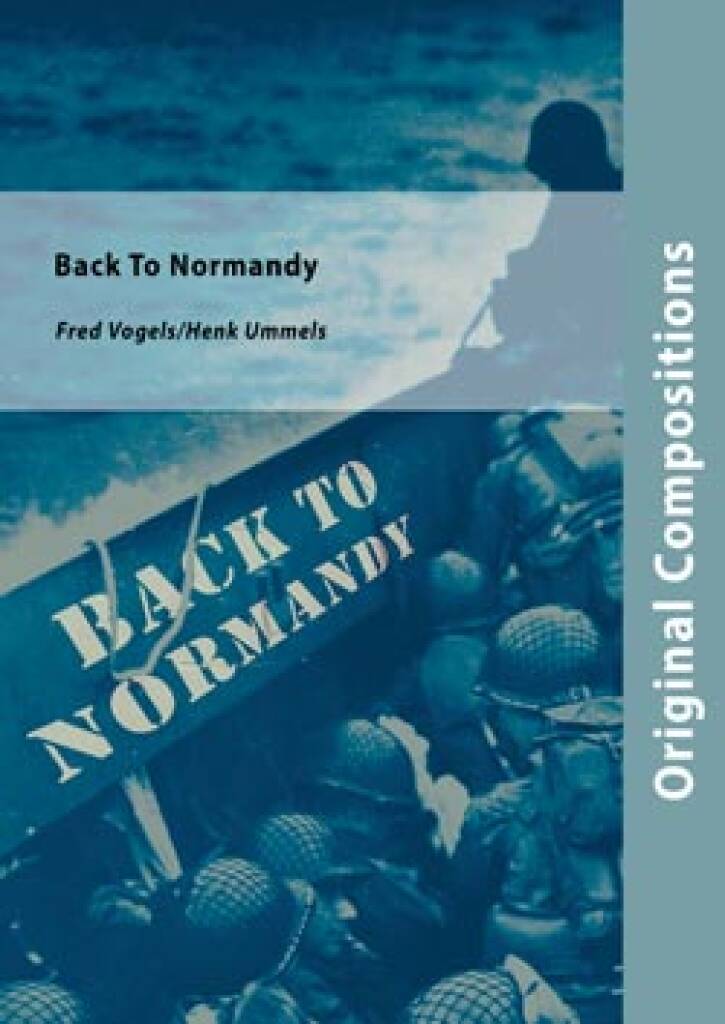
Back to Normandy - Fred Vogels
Back to Normandy is a composition for concert band on the occasion of D-Day. On D-Day (June 6, 1944) the liberation of Western Europe started at the beach of Normandy. A long campaign through Europe followed before the liberation was complete. Back to Normandy describes the first hours of the landing with the shelling of the German positions as a (musical) peak. As an introduction you will see and hear de preperations for the biggest campaign ever. Very special and unique is the fact that the music of Back to Normandy can be performed synchronously with a movie with original footage, specially made for this composition. This will without a doubt be an extra experience for the audience. So far performances like this were exclusively for professional orchestras (like George Fenton, Earth). This piece is specially suitable for concert bands that want to offer their audience something special and also want to honour the liberators. The movie to practise for the concert is on Youtube (meassures and metronome are visible/audiblematen). On the Back to Normandy forum you can get more information or have an exchange of views about this project or D-Day in general. You can download the complete movie here (1, 7 GB). Interaction with the composer is certainly appreciated.
Estimated dispatch 7-14 working days
-
 £96.60
Happy Phone - Henri Gerrits
In this sparkling work, the conductor is interrupted in the middle of a musical adventure by a spontaneous phone call from a member of the orchestra. This unexpected moment adds an extra layer of liveliness and humour to the performance, creating a unique experience every time. This piece is perfect for training orchestras looking for a challenging and inspiring addition to their epertoire. A masterpiece that breaks the boundaries of traditional orchestral music and leaves unforgettable impression at every performance.
Estimated dispatch 7-14 working days
-
 £179.99
Diagram - André Waignein
The story of the origin of Diagram for Symphonic Band is a curious one. Andr Waignein was enjoying a meal together with his great friend Jean-Marie Vivier - representative director of l'Oreal Belgilux and the same man who made the performance of the famous Cantate aux Etoiles, with 750 performers possible. Jean Plaquet, an appreciated associate of both gentlemen was also present.As an acknowledgement, Andr Waignein wanted to dedicate a composition to the band where Mr. Vivier has been chairman for 20 years. In connection with this, Andr Waignein was supposed to receive some extra information about the 120 years old history of this band, which has always been led by a memberof the Vivier family. In a flash this history was presented : using a diagram Mr. Vivier drew the power-lines of this more than 100 year old band.And of course, the title was found ! The only thing left to do, was for Andr Waignein to transform this diagram into music.
Estimated dispatch 7-14 working days
-
 £84.99
Latin Flutes - Wim Laseroms
In this sparkling, joyful composition for three flutes with band accompaniment, the emphasis lies on the predominantly syncopated structure with the supporting percussion group giving the Latin effect a little extra emphasis. This attractive short concert work, with the flute section in the spotlight, is technically uncomplicated and can be easily performed by three reasonably advanced flautists!
Estimated dispatch 7-14 working days
-
 £69.99
Corona - Wim Laseroms
This attractive concert march starts with an elevated, determined intro, followed by a playful theme in the descant register - with, in the reprise, an added counterpart in the tenor register. The following stately bass solo is accentuated by the trumpet section, and a dynamic contrasting effect adds extra colour. The trio part starts with a new cantabile theme, which transforms into a solid tutti version with ornamentations in the descant. After a dynamically varying interlude the trio part is repeated.
Estimated dispatch 7-14 working days
-
 £72.50
Fire Dance - David Shaffer
Big, bold and full of percussion, this exotic high energy Shaffer composition is sure to be a huge favorite with developing bands. Lots of extra percussion parts to keep even the largest drum section involved. Includes a slow "mysterioso" section providing a contrast to the energetic nature.
Estimated dispatch 7-14 working days
-
£87.99
Intrada: Adoration and Praise - Claude T. Smith
This work is an impressive set of variations on the hymn tune "Praise to the Lord, The Almighty." The opening majestic statement is followed by challenging variations. Extra flair can be added with an optional antiphonal brass ensemble amid the dramatic conclusion. An impressive finale for concerts and ceremonies. A supplemental string set (CTS-7829-99) may be purchased separately for performances by combined band and orchestra.
Estimated dispatch 7-14 working days
-
 £76.99
Dear Frog - Victor Trojan
Dear Frog describes the story of a prince who changes into a frog and then waits for a princess to kiss him so that he can turn back into a prince again. A musical satire for the trombone and orchestra. What is remarkable about this work is the use of the "wah-wah sourdine" throughout the entire piece, which gives it an extra amusing flavour.
Estimated dispatch 7-14 working days
-
£109.99
Dublimania - Menno Bosgra
This new work is based on Irish folk music.In the first part, the main theme is presented as a ballad, starting with the piccolo (as replacement for the flute which is widely used in Ireland), moving on the wood section to end with the entire orchestra.It then changes to a kind of rock style theme: powerful, rhythmic accompaniment with effects in dampers, a pedal point and the use of the spoons which is typical of Irish music (Irish pub), high-range bongo drum (replacement for the Bodhran), etc.In this second part I introduced a second theme as a counterbalance, played by several groups, which has clearly a more legato character and therefore sounds more melodious.The climaxof the work starts in the low-range brass section with its marcato theme that is developed with a great deal of rhythmicity in the accompaniment, clusters, etc. into a percussion solo interspersed by the orchestra in five-eight time with frequent parallel movement in chords (folk music style).Towards the end, theme 2 recurs twice: first as heard earlier with an extra counter melody and accompaniment pattern, then in a canonical form, in which the theme is played by three groups. The conclusion is a repeat of the middle section in five-eight time.I have tried to use many of the colours of a wind orchestra by having the wood sections and brass section play alone and making extensive use of dampers. Percussion also has a prominent role throughout the work.
Estimated dispatch 7-14 working days
-
 £84.99
Heart in Motion - Satoshi Yagisawa
Heart in Motion compares the development of an ensemble to a tree, which-with careful nurturing-grows branches, twigs, leaves and fruit. As a fertilizer, you need to add an extra helping of positive attitude, enthusiasm and passion to it.Inspired by these images and concepts, Satoshi Yagisawa has composed Heart in Motionwhich, with a magnificent fanfare followed by a warm-sounding chorale, certainly lives up to its name.
Estimated dispatch 7-14 working days
 View Music