
Results
-
 £86.50
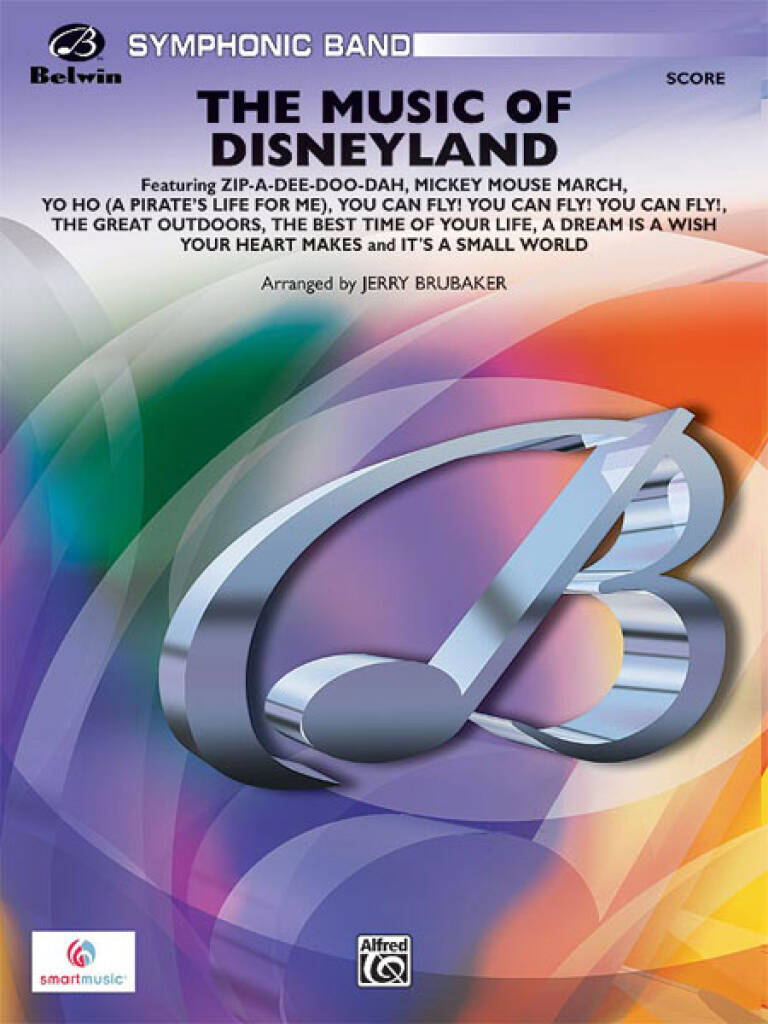
The Music of Disneyland
Jerry Brubaker has selected eight cherished themes that are experienced in every magical visit to Disneyland. Featuring many of the absolute classics that fill a day at the park. This medley is guaranteed to whisk you away to the Magical Kingdom. Titles: Zip-A-Dee-Doo-Dah - Mickey Mouse March - Yo Ho (A Pirate's Life For Me) - You Can Fly! You Can Fly! You Can Fly! - The Great Outdoors - The Best Time of Your Life - A Dream Is a Wish Your Heart Makes - It's a Small World. (8:15) This title is available in SmartMusic.
Estimated dispatch 7-14 working days
-
 £168.50
The Four Noble Truths - Philip Sparke
The Four Noble Truths are the most basic expression of the teaching of Buddha and therefore still form the guidelines for Buddhists to this day. The four truths are Dukkha, which describes times of major stress in our lives - birth, aging, desire and death; Samudaya which describes those parts of our life that induce stress, feeling, craving, desire; Nirodha which tells us how to eliminate those aspects of our lives which induce stress and Magga which describes the eight didciplines which can help us eliminate the origins of stress from our lives. It can be seen from these over-simplified definitions, that the Four Noble Truths fall into two pairs, the first two describingthe origins of stress and the second two describing how we can reduce stress. To reflect this, the four movements of this work are also combined into two pairs - two quick movements and two slow movements. A fascinating work from this great English composer.
Estimated dispatch 7-14 working days
-
£264.99
Diferencias on an Old Spanish Song - Yasuhide Ito
I am immensely happy that my Gloriosa, symphonic poem for band (1990), has been performed by so many bands in the last thirty years.During this period, the growth of the internet has made it much easier to access information.When I composed Gloriosa, I only had limited information about the period when Christianity and Western music was first introduced to Japan, and had to rely a lot on my imagination.However, nowadays, it is easy to obtain various source materials and to read interesting studies on the music of the past.In recent years, the music of Luis de Narvez (born ca.1500 - died between 1555-1560), Spanish composer and vihuela player, has become increasingly known, and several CDs of his music are now available.Narvez composed the earliest-known set of diferencias, a forerunner of the variation form. One of his works is Seys diferencias sobre el himno "O gloriosa domina" [Six diferencias on the hymn "O gloriosa domina"] (1538), based on the Spanish Marian hymn, and it was this melody I used in the first movement of my Gloriosa.Western music has been my musical roots since childhood, and throughout my career as a composer, it has continued to fascinate me. One could say that this has provided the inspiration for Diferencias on an Old Spanish Song, my own take on the diferencias form.Actually, such music from the early sixteenth century could sound fresh to our modern ears. So I decided to quote the melody from Narvez's Sey diferencias at the beginning and end of the piece, in order that people can get the feel for the period.The main section (bars 42-390) is formed of 13 diferencias, similar to the first movement of the Gloriosa.In the middle section, which begins after the eighth diferencia(from bar 187), one should be totally absorbed in the tranquility and the beauty of the music. Although it's in the style of a sarabande, it should be taken slower and played as pianissimo as possible.This is followed by folk-style dance music. (As only standard percussion instruments are used, try to be creative with tonal colours and sense of rhythm).The structure of the work is simple, but be aware of the connection between the sections when constructing the whole.Also, think about the tonality. Overall, the work is in F minor. The main section is basically in D minor, but from bar 102, it modulates to A flat minor and G minor, and then in the middle section it suddenly switches to A flat major (which is the furthest key from D minor, and the relative major of F minor). From bar 219, it modulates to F minor and then to C minor, then back to F minor by way of A minor.N.B. The Oboe II part can be substituted by the English Horn (as indicated in the parts). One can choose according to the player's skills or preference.Recent new compositions for wind band are often full of rhythm, dynamism, and tonal colour, and compositional techniques and orchestration have also evolved greatly. Yet on the other hand, they tend to feature fewer melodic or expressive elements. Since this work is the test piece for WMC Kerkrade 2022, I had to think about what "tests" or "challenges" to set, and I decided to compose something that doesn't involve a lot of technical display, but requires beautiful sounds and harmonies, and above all, musical expressivity. I didn't put many expression markings in the score, because I wanted the performers to think about how best to express this music. If it is played merely as notated, it's not going to sound very interesting.Christianity was introduced to Japan in the mid-16th century, but it was subsequently banned and Japan entered a period of national isolation, which meant that there was hardly any international exchange for two hundred years. As a result, the Christian hymns that were introduced prior to the isolation became almost unrecognizable over the centuries. This was the theme I explored in my Gloriosa thirty years ago.Now, in 2021, the whole world has been forced to "isolate" due to the Covid-19 pandemic. In such times, it seems pertinent that I've written a work using this melody again. I sincerely hope that people will be able to gather in Kerkrade in 2022.(English Translation:Nahoko Gotoh)
Estimated dispatch 7-14 working days
-
£118.99
The Universal Band Collection - Jacob de Haan
A collection of 5 short works in pop style which can be performed by any kind of compilation. The titles can be presented on the programme as separate works but the Universal Band Collection can also be performed as a complete suite. From a didactic point of view it is a suitable work to teach musicians something about the structure in music. For this purpose not only the big structure but also the small structure was kept very clear.Western Girl : A girl from the west of the USA rides her horse across the prairie, dreaming of her future. The rough structure: introduction - theme in a blues scale - the same thing in a different instrumentation - finale.Just a ballad : A balladin pop style with a rough A-B-A form. First there is the introduction of the main theme (A), then follows a tenor melody in minor with a rhythmical reference to the main theme (B). Finally there is the main melody, performed tutti with a different rhythm in the drums (A').Play the Game : An English saying meaning: play fairly. Playful music in up-tempo with a wink to China, where almost all games are manufactured nowadays. Once again an A-B-A structure here.San Diego : A Mexican fugitive enjoys his freedom in America but also remembers his place of birth with melancholy. A sad minor melody with a straight trendy beat appears twice. The second time it has a slightly different instrumentation, in which the muted trumpets represent the Mexican feeling.Final Dance : Eventually there is a dance with an introduction in renaissance style, followed by a fast dance in rock style. All this composed in a classical song structure: introduction, verse, bridge, chorus, shortened verse, bridge, chorus, chorus.
Estimated dispatch 7-14 working days
-
 £84.99
Humanos - Jan Van der Roost
Jan Van der Roost was commissioned to write this hymn by the "International Association for Human Rights" in Frankfurt. The commission specified that the instrumentation of this simple hymn should be so, that it can be performed by a variety of combinations of players. The piece starts with an "intrada" for brass ensemble based on the first bars of the hymn, but is "ad libitum" and can therefore be omitted. The coda can also be left out, depending on the available instrumentation. The piece should be played "legato" to accentuate its hymn-like character.
Estimated dispatch 7-14 working days
-
 £149.40
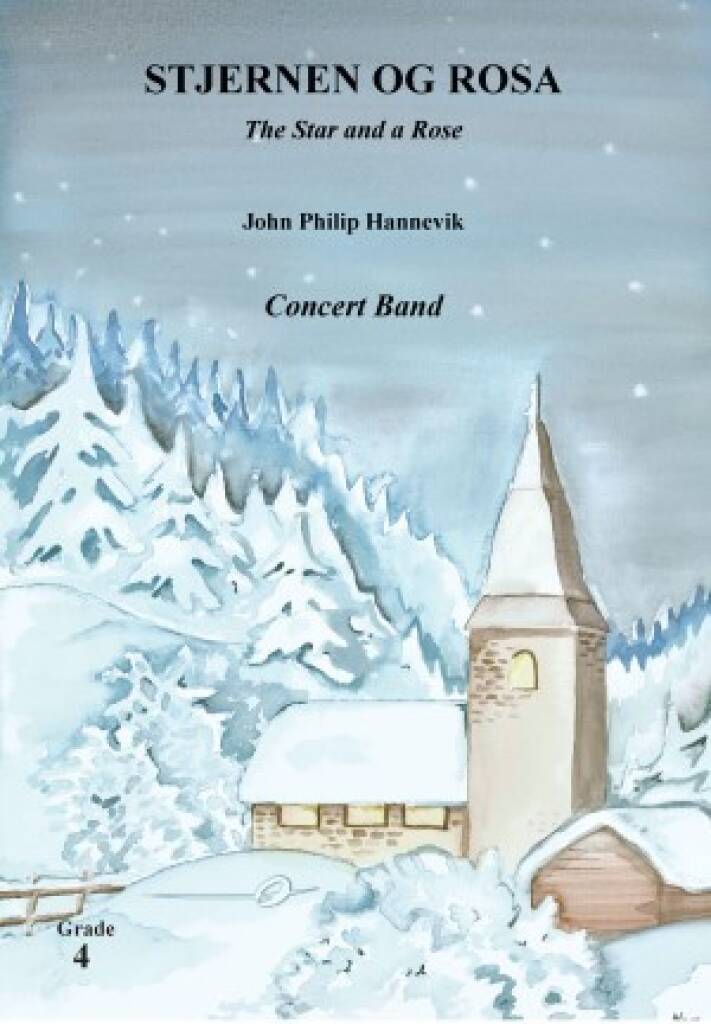
Stjernen og Rosa - John Philip Hannevik
The Star and a Rose is a big-scale Christmas piece for band, featuring four seasonal chorales.The first is a Gregorian-like chant Hodie Christus natus est.In this section of the piece, a soloist can be placed away from the band, maybe on a gallery. The soloist can be a tenor instrument, maybe trombone, or you can feature a vocal soloist.After this, the music leads us on to the old German Christmas chorale Lo, how a rose e'er blooming. This song is given a fairly rhythmical treatment, but make sure that the melody is presented in a cantabile style.An interlude follows, before the piece presents one of the most used and loved Scandinavian Christmas chorales, Mitt hjerte alltid vanker (My Heart will always wander), composed by the Danish bishop Hans Adolph Brorson around 1732. This song is building towards a climax, before the solo horn brings it all down to the Stable view described in the lyrics.Then comes a transition that brings us in to the final section of the piece, which presents the international Christmas Carol Adeste Fideles. As many will notice, I have borrowed a section from David Wilcocks majestic harmonization towards the end.The title of the piece has its background form the lyrics in My heart will always wander, where the text speaks about the stars in the sky. But also in the latin text for Adeste Fideles:Stella duce, Magi, Christum adorantesThe Rose is of course from the lyrics in the chorale Lo, how a Rose.
Estimated dispatch 7-14 working days
-
 £57.50
Carrying You from "Laputa: Castle in the Sky" - Joe Hisaishi
New Sounds in Concert Band Series(NSB) for small band with 2-part choir Duration: approx.4'10" Arranged by Eiji Suzuki"Carrying You" was composed as a theme song to Castle in the Sky, an animated film produced by Studio Ghibli and directed by Hayao Miyazaki, released in 1986. The composer for Castle in the Sky was originally not Joe Hisaishi, but the director Miyazaki strongly requested him. The director told Hisaishi his vision for the film, and based on the world he imagined, Hisaishi made a collection of music called the Image Album. The melody that later becomes the basis for "Carrying You" was born from this album. However, the director Miyazaki was not planning on including a theme song in this film. Isao Takahata, the producer, proposed including a song, for the audience to think over the film at the end. He wanted the audience to think, "While the protagonists sought for the treasure, they didn't obtain any treasure. What did they obtain instead?" They thought, if they are going to create a theme song, it should be something organically connected with the entire film. Takahata requested the director Miyazaki to write the lyrics for the theme song. And to Hisaishi, he gave instructions to create a melody for the theme song using an instrumental piece called "Pazu and Sheeta" from the image album mentioned above. Director Miyazaki handed a piece of memo with lyrics to Takahata. "Carrying You" we hear now is this lyrics with some changes, set to Hisaishi's music. The melody is used at the opening of the film as well as the scene where Laputa is destroyed, and the song is used for the ending. Performance Advice from Arranger Suzuki: This is an extremely simple arrangement that can be performed by lower grade bands and singers. Of course, it can be played without singers and chorus, but the contents of the lyrics are very tasty so if possible, we recommend that you perform using the voices. Depending on your resources, the voice parts can be done as all solo, all female chorus, and so on.
Estimated dispatch 7-14 working days
-
 £76.99
Paper Cut - Alex Shapiro
Composer Alex Shapiro's piece Paper Cut is reminiscent of a movie soundtrack to which the musicians can imagine their own dramatic scene. Paper Cut is written to make the players themselves part of the action with choreographed maneuvers that look as compelling as they sound. In fact, the band members don't even play their instruments until halfway into the piece - instead they play paper along with a prerecorded track! The unusual element of paper and the myriad sounds that can emerge from something so simple offers a fresh view of what music-making can be and opens everyone's ears to the sonic possibilities found among everyday objects. Although Paper Cut was composed with middle schoolers in mind, it's also suited to more advanced musicians, since the paper techniques and the skill of playing against a prerecorded track are interesting for all ages. To perform the piece, you'll need an audio system capable of playing the prerecorded audio tracks from a laptop computer via a small digital audio interface connected to an audio mixer. Download information is provided in the printed piece. A free downloadable interdisciplinary curriculum for teaching Paper Cut is also available for download at www.BandQuest.org. Learn more on YouTube!. Bandquest, an exciting series of new music and accompanying curricula for band, is a program published by the American Composers Forum. The series was started as a response to feedback from music educators that there is a pressing need for new, fresh band music. The heart of this program is new works written by a diverse group of leading American composers who have created challenging pieces that are a true departure from standard middle school repertoire. Every BandQuest project includes a residency component in which the composer works collaboratively with a middle school as they create their new piece.Many BandQuest pieces are accompanied by an interdisciplinary curriculum designed to assist students as they learn the music and to integrate each piece with non-music studies. Visit www.bandquest.org to learn more about this innovative series, and email [email protected] to request a free downloadable audio catalog.
Estimated dispatch 7-14 working days
-
 £104.99
The Spirit of Christmas - Jacob de Haan
The Spirit of Christmas is a medley of charming Christmas carols, all with an international character. The medley consists of the following five carols: Away in a Manger - The First Noel - It Came Upon the Midnight Clear - O Come, All YeFaithful and Hark! The Herald Angels Sing. A four-part choir part in English has been added which can be used ad lib. or you can also opt for singing the melody line only, for example with a soloist and/or the congregation. The arrangementis not too high pitched so that the work can also be used in combination with a children's or High School choir.
Estimated dispatch 7-14 working days
-
 £65.99
Intervalic - Sandy Feldstein
This festival-style piece was written to teach students to recognize most of the major and minor melodic intervals through the two main themes presented. As a bonus, the back page of the parts includes both melodies written out for all instruments so that you can use the piece to teach this concept. Lesson plan materials are included with the score. This piece correlates to Book 2 in "The Yamaha Advantage" band method, but can be used with any program of study.
Estimated dispatch 7-14 working days
 View Music