
Results
-
 £53.50
Can I Have This Dance (from High School Musical 3) (Concert Band - Score and Parts) - Anders & Hassman - Brown, Michael
Here is the tender ballad from Disney's hit movie High School Musical 3 in a great-sounding arrangement for young players. This is sure to be a hit with any audience while providing a nice programming change of pace.Duration: 3:00
Estimated dispatch 7-14 working days
-
 £84.99
Catch Me If You Can (Alto Saxophone Feature with Concert Band - Score and Parts) - Williams, John - Bocook, Jay
Haunting and captivating describe John Williams' score to this hit movie featuring Leonardo DiCaprio and Tom Hanks. The music features an alto sax soloist and a wide variety of unique percussion and scoring devices. This superb arrangement includes the most striking musical themes from the soundtrack in a marvellous concert setting.
Estimated dispatch 7-14 working days
-
 £64.99
How Can I Keep from Singing (Concert Band - Score and Parts) - Hosay, James L.
Duration: 3.00
Estimated dispatch 7-14 working days
-
 £42.50
Can You Feel the Love Tonight (Concert Band - Score and Parts) - John & Rice - Vinson, Johnnie
from The Lion King
Estimated dispatch 7-14 working days
-
 £84.99
Love Can Build a Bridge (Concert Band - Score and Parts) - Sebregts, Ron
Duration: 3:45
Estimated dispatch 7-14 working days
-
 £60.99
CAN YOU FEEL THE LOVE TONIGHT (Young Band) - John & Rice - Bocook, Jay
from The Lion King
Estimated dispatch 7-14 working days
-
 £57.50
I BELIEVE I CAN FLY (Young Band) - Kelly, Robert - Waters, Tim
From the 1996 movie Space Jam (with Michael Jordan) this familiar power ballad features a dynamic pulse and an uplifting spirit in this solidly scored adaptation by Tim Waters.
Estimated dispatch 7-14 working days
-
£184.99
Rubicon - Bert Appermont
The Rubicon is a river in Northern Italy which Julius Caesar crossed with his army in 49 BC in defiance of the leaders of Rome, who feared his power. A civil war against rival Pompey ensued, which culminated in Caesar seizing power as the absoluteruler of Rome. The phrase "crossing the Rubicon" therefore refers to any person committing himself irrevocably to a risky, decisive and irrevocable of course of action.The work consists of three parts that deal with this important moment in history.Part 1 (Meditation) symbolises Caesars request to the Gods to assist him in his difficult choice. In a slow introduction we hear the melancholy and beseeching sounds of the duduk (alternatively, this part can be played by a soprano saxophone)and of the soprano solo singer over the bourdon accompaniment. The soprano solo singer then sings "dona tibi pacem" (give him rest) in a melodious and probing theme.In Part 2 (Battle of Pharsalus) trumpets and trombones resound alternately ina stately Roman fanfare, producing a stereophonic effect. This develops into a martial theme in which Caesars impressive army goes to battle against the army of rival Pompey. While the theme of Caesars army fades away, Pompeys theme emerges as anaive dance in six-eight time. His army is definitely in the majority and it believes it can easily defeat the enemy. Suddenly trumpets and trombones clash on two sides of the orchestra: Caesars army advances and attacks. A fierce battle ensues inwhich the two themes are played alternately as well as simultaneously. Thanks to his shrewd battle tactics, Caesar manages to win this legendary battle after all: his theme resounds ever louder in trumpets and horns until everything dies out andchanges into a kind of reconciliation between the soldiers of the two armies. The melancholy "dona tibi pacem" from part 1 now serves as a reconciliation theme.Caesar is now the sole ruler of the New Roman Empire, which would be destined to leave itsmark on our Western civilisation to this day. The third part is a sparkling succession of dance music (Dance) with many Greek and Roman elements in which Caesars victory is praised and celebrated. It is common knowledge that the culture(arts, gods, etc.) of the Romans drew heavily on Greek culture. I have therefore used an authentic Greek theme (the Seikolos song) several times in this part (bar 17 in the euphonium, bar 60 in the base section, bar 68 in the sopranosaxophone) to suggest the music of that era and to evoke the right atmosphere. After a gradual increase in tempo in the entire orchestra, the opening melody gloriously resounds once more, surrounded by virtuoso dance music. The work ends withbombastic brass fanfares in which Caesars theme triumphs once more.NOTE FOR THE CONDUCTOR:The Armenian duduk and the monochord that are used in the introduction give a special tone to the music, but could be substituted (soprano saxophone instead ofthe duduk) or left out (monochord). The soprano solo is also doubled within the orchestra and could therefore also be left out if necessary, although it does provide the work with an extra dimension. The male voices in the introduction and the finalecould possibly be replaced with a synthesizer with choral setting.As a visual and acoustic element in part 2, the trumpets, the e-flat cornet, the small drum and trombones can be stood up and placed at two sides of the orchestra (bar 80).Seen fromthe point of view of the conductor, put the trumpets, the e-flat cornet and the small drum in the left section and the trombones in the right section of the orchestra. This also helps to create a visual contrast between the two themes of the secondpart. The players can be seated again at bar 97 or bar 121. The soprano soloist can be placed in or in front of the orchestra, depending on what gives the best result. For the conclusion of the work the soprano solo can be sung from afar (from thewings) to create additional atmosphere.This work was composed especially for the "St Joseph" brass band from Pey/Echt (Belgium) with conductor Mark Prils.
Estimated dispatch 7-14 working days
-
 £248.99
Missa Brevis - Jacob de Haan
Missa Brevis, written for choir and wind band, was commissioned by the Conseil Dpartemental pour la Musique et la Culture de Haute-Alsace (Dir.: Philippe Pfisterer) in Guebwiller (France), in celebration of the millennium of Pope Leon IX'sbirth in guisheim (France). The composer conducted the first performance on June 23, 2002. It was performed live for the French television channel France 2. The mass movements Kyrie, Gloria, Credo, Sanctus, Benedictus, and Agnus Deiare very suitable for the Catholic as well as the Protestant liturgy. For this mass, various ways for performing in diverse variable strengths are possible. An instrumental performance is possible if the brass represents the choir parts. In thisoption, it is desirable for the brass to be positioned separately from the rest of the band (on a gallery, for example), so that the idea of two choirs is approached. In a performance with a large choir, the brass can work very well as a support. Inthat case, the dynamics of the brass should be adapted somewhat, since these are actually intended for an instrumental performance. You can also leave out the brass entirely for the benefit of the choir. For the accompaniment of smaller choirs, youcan opt for a small ensemble from the band. This can also be a quartet, put together as desired. For the performance of this mass, the obvious choice is one of the above options. However, as an alternative, a performance with a combination of theseoptions (vocally/instrumentally) is also possible not just from an artistic point of view (variation), but also from a practical starting point for example in the case that the choir has rehearsed only two movements. With a full strength, theconductor can vary the instrumentation to his or her liking. Then the brass can also play a role in the accompaniment (instead of supporting the choir). The following combinations are possible:1. clarinet choir (from Eb Clarinet to BassClarinet)2. clarinet choir + saxophones3. brass (flugelhorns, horns, euphoniums, bass section)4. brass (2 trumpets / 2 trombones)5. double reeds (optional + flute, optional + string bass)6. tutti7. all winds8. allbrassIn a performance by brass band and choir, it is usually advisable to leave out option 1 (choir + brass + band). The choir sings self-reliantly, accompanied by a full brass band. In an instrumental performance, you can consider a combinedquartet (two cornets and two trombones) + brass band.Choral parts available separately.
Estimated dispatch 7-14 working days
-
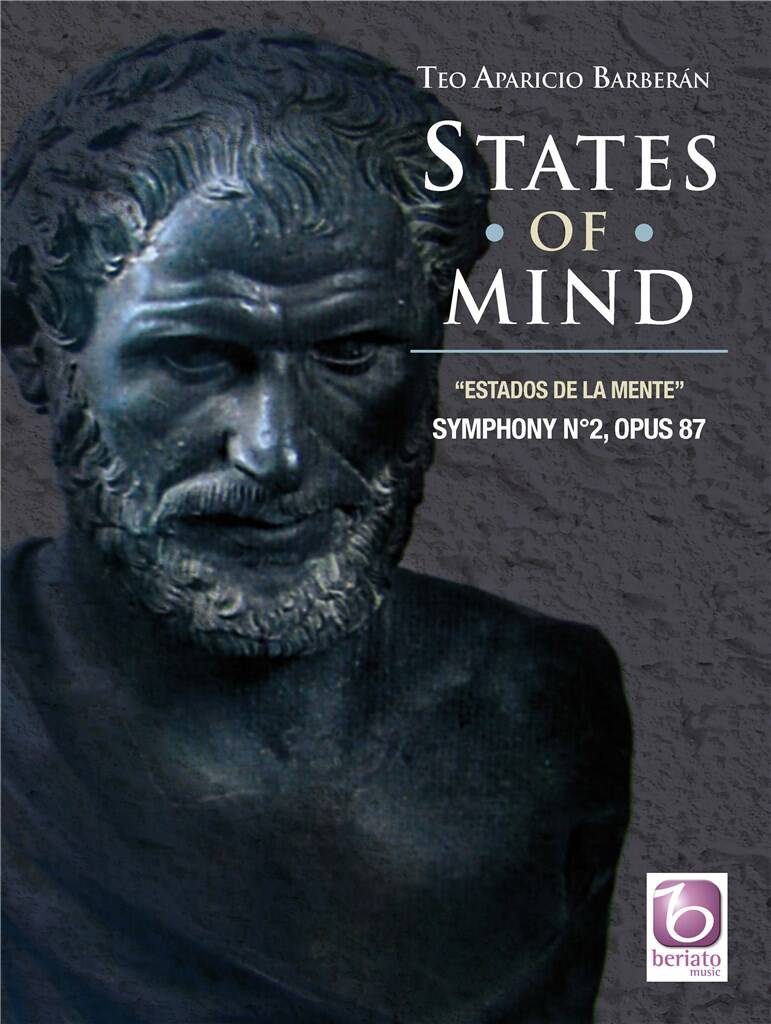 £274.99
Symphony No. 2: States Of Mind, Opus 87 - Teo Aparicio-Barberán
I- Logos (reason)II- Pathos (emotion)III- Ethos (credibility)The ancient Greeks believed that music shaped the character of man. In Egyptian temples, music was an essential part of the magical rites to alter the course of nature or to treat illness.And today we know that sound can actually alter matter. The secret of music lies in harmony and mathematics, as many great musicians and experts have always known.One of the most important qualities of music is that it enables the listener to focushis attention inwards instead of on what is around him. It is indisputable that music can inspire emotion. Music leads us into a universe of emotions that are difficult to put into words. In short, music reaches into corners of our soul and thoughtsthat words cannot reach and makes it possible to more clearly describe these different States of mind.The composer of this symphony also believes that each "musical argument" must be constructed so that it will induce the desired reaction in thelistener.Music: more than wordsIn recent times, most orchestral symphonies have been based on a story, a text or something similar so that their composition must be structured accordingly.The intention of this work by Teo Aparicio-Barbern is quitedifferent. The composer describes the three elements of the argument as the only formal structure of the work. Since certain philosophers in world history were able to subdivide grammatical argument, why shouldnt that also be possible for the musicalargument?Since ancient times the power of the spoken word has captivated mankind. How can an argument move people and mobilise the masses? Where does the power of words come from today? The answer lays not so much in what people say but in how theysay it.Rhetoric is one of the oldest humanist disciplines in Western civilisation. Aristotle, in the 4th century BC, called it the art of persuasion. Indeed, the terms rhetoric and persuasion are mutually interchangeable.More than 2000 years agoAristotle structured his rhetoric according to the following three elements: the logos, the pathos and the ethos.Logos (words, reason) is the reasoning that gives freedom to the structure of the text by expressing what one wishes to say usingspecialist terms. With logos we create arguments to receive public approval and to defend our ideas.Pathos, the second element, refers to the effective use of public psychology. Pathos can be considered as the capacity to induce the desired emotionalresponse in the public, by creating an emotional connection with the public so that they accept our message.The third element, ethos (credibility), refers to the character of the speaker and is perhaps the most important of the three elements.Aristotle based his concept of ethos upon his belief that truth and justice will always have the upper hand over anger. He believed that what was true and good was easier to prove and was more persuasive.This second orchestral symphony from thecomposer from Enguera follows these three parameters of the argument according to Aristotle. Each movement tries to summon a different state of mind in the listener so that the message itself can be better understood and appreciated. Apart from thesethree general concepts the music is only structured, as Claude Debussy would say, in a "formative way".The first movement, logos, is based on a scherzo melody that undergoes various changes in rhythm and harmony. The arguments are presented by meansof conventional techniques of composition. The second movement, pathos, is characterised by suggestions of sound. It is subdivided into two large parts. The first part is based on a five seven sequence with five sounds that are repeated in differentenvironments, structures and dynamics. The second part, which is largely tonal, brings out more directly the emotional overtones that each argument must have. The third movement, ethos, is a faithful rendition of the composers personality. In thislast part, clear rhythmic sequences stand out, there are large dynamic contrasts and lots of tone variation. In addition, and this is quite in keeping with the composers earlier work, the harmony in States of Mind is handled in a manner that is bothoriginal and efficient, as a result of which Aparicio-Barberns message is well understood by the listener.This second symphony by Teo Aparicio-Barbern is devoted to "my dear Henrie Adams, a guiding light in this eternally dark musical world. Thankyou for everything."
Estimated dispatch 7-14 working days
 View Music