
Results
-
 £155.90
Cantina Band - John Williams
Cantina Band (or Mad About Me) was written by John Williams in 1977 for the film Star Wars (later Star Wars IV: A New Hope). Even with quite a bit of the Star Wars music being quite well known, Cantina Band is literally in a style of its own. In the Star Wars-universe this style is called jizz, Williams' take on the more well-known genre jazz. Williams was tasked by Star Wars-creator George Lucas to make music that sounded like several creatures in a future century finding some 1930's Benny Goodman swing band music ... and how they might attempt to interpret it and ended up with Cantina Band #1 and #2. Both numbers are played in the legendary scene taking place in Chalmun's Spaceport Cantina where Luke Skywalker and Obi-Wan Kenobi gets in a fight causing even the band to stop playing.The band, which goes by the name Figrin D'an and the Modal Nodes, comes from the planet Clak'dor VII and specializes in jizz and the nearby, slightly older style of jatz. Performers of this music often go by the name "jizz-wailers", and the Bith people from Clak'dor VII are especially well suited for jizz-wailing since they can hold every note as long as they want thanks to a unique respiratory system - something many perhaps would like to be able to do in the performance of this arrangement as well.The arrangement is relatively faithful to Williams' original version, but with a somewhat different ending. Although the woodwind section undoubtedly has the biggest technical challenges, an understanding of the musical style is the very key to making the arrangement sound good - and here all groups must work together. Playing lightly but quite articulated, and very precise, will be an absolute necessity to get the music drifting off all the way to Tatooine.In measure 113 there is a small improvised solo in either trombone or trumpet, but if you want the real authentic Cantina Band-sound this is of course done on a steel drum.
Estimated dispatch 7-14 working days
-
 £168.50
60 Warm-up Chorales for Concert Band
During his experience as a band conductor and teacher of wind orchestra conducting at university, Franco Cesarini has dealt with the topic of warm-ups very frequently. Throughout these long years of conducting he has had the opportunity to try many existing methods, evaluating their advantages and disadvantages.After a long time, he has decided to compile a collection of chorales for warm-ups, which are organized according to the criteria that he considers most effective.While working on his60 Warm-up Chorales for Concert Band, Franco Cesarini has always borne in mind that amateur musicians play for pleasure.He feels that it is extremely important that they have satisfaction at every moment of the rehearsal and not to start the rehearsal with needless "punishing" exercises. Nobody is really motivated to start playing with scales, long notes, or tricky rhythmical exercises. There is often a distinguished absentee in band rehearsals, namely music itself!Although this publication does not foresee a specific tempo for the chorales, they should often be performed rather slowly but without dragging.Dynamics are not indicated, so that the conductor has the opportunity to draw the attention of the musicians to his gestures and to make them react according to his indications.Timpani and bell parts have been added with the aim of not leaving the percussionists completely inactive during the warm-up phase, but can also be omitted.The chorales are written in four parts (SATB) and are also playable in smaller groups. The four voices can be played in different combinations of woodwinds or brass quartets or in mixed combinations.The collection includes ten chorales for the following keys: D flat major, A flat major, E flat major, B flat major, F major and C major.With his 60 Warm-up Chorales Franco Cesarini would like to convey the message to play the chorales in a musical way, thus raising the musicians' awareness of phrasing, the right interpretation of cadences, rubato and agogic.Above all, never do anything without putting the musical aspect in the foreground. 60 Warm-up Chorales for Concert Band: A perfect collection to warm-up and improve tuning of a concert band!
Estimated dispatch 7-14 working days
-
 £76.80
Teabreak for Band - David Jackson
In everyday life in Great Britain 'tea-time' plays a rather important role and this is what Jackson tried to suggest in this original wind band composition. Jackson was born in 1957 and graduated from the 'Kneller Hall' military school of music where he studied the oboe, the saxophone, arranging and composing for band. In 1976 he joined the army as a musician with the 'Alamein Staff Band of the Royal Tank Regiment'. He actually conducts several wind bands. We already published his succesful band piece 'Sun-Tan' and here is a new piece that adds some British 'flavour' to the wind band repertoire.
Estimated dispatch 7-14 working days
-
 £186.20
Concerto for Alto Saxophone and Band - Ronald Binge
Ronald Binge was born on 15 July 1910 at Derby, England. He studied harmony and counterpoint on his own and tried his hand at arranging and composing during the many years he worked as a pianist and musician in movie theatres. In 1934 he met the conductor of Italian descent Annunzio Paolo Mantovani (1905-1980) and started writing numerous arrangements for the symphony orchestra of this very popular conductor. In fact, Binge is the inventor of the famous 'Mantovani Sound' (with echo effects by the strings) which charmed and pleased millions of music lovers and television spectators all over Europe in the fifties and sixties. In 1952 he scored a hit with ' Elisabethan Serenade'. Binge also wrote classical music and even a series of wind band compositions such as the most popular 'Cornet Carillon'. Ronald Binge died on 6 September 1979 at Ringwood. He dedicated his Concerto for Alto Saxophone (1956) to the famous American saxophone virtuoso Sigurd Rascher (1907-2001), the pioneer of the classical saxophone. At the request of the Dutch wind band publisher Pieter Jan Molenaar, Binge wrote a version for symphonic band. Unfortunately both the editor and the composer died some time later in 1979 and could not attend the premiere of this version by the Dutch Royal Marine Band conducted by Jaap Koops and with Johan Perik as soloist. The concerto consists of three parts. In the dynamic and quick 'Allegro Spirituoso' one can hear the melody alternately with the soloist and the accompanying band. The second part is more lyrical, though passionate as well and it is better known as it is often performed on itself under its title 'Romance'. The final part 'Rondo Allegro Giocoso' is written in rondo form as its title indicates and it allows the soloist to demonstrate his virtuosity in a very lively dialogue with he band.
Estimated dispatch 7-14 working days
-
 £116.40
Three Pictures for Band - Oliver Waespi
This composition consists of three sound pictures. When writing this work Oliver Waespi did not have any concrete image such as a scenery or a specific form in mind, but rather some typical visual movements. Hence the successive titles of the different parts: Procession, Dialogue and Waves. Numerous associations mutually link those parts as far as motifs and harmony are concerned. The motif of the ascending and descending fourth plays an important role in many a theme. There are many fourth chords by means of which Waespi tries to put a harmonic and unifying stamp on the compostition as a whole. Moreover there are similar or identical, though varied, motifs in the successive parts.The first part, Cortge (Procession), describes the dignified majestic procession by means of simple precise rhythms. At first the music is scarcely audible, as if coming from a distance; it gradually comes nearer until it reaches its climax in large chords, before fading away again. At each quarter note one could imagine a step. The second part, Dialogue, consists of broad outlines of dialogues between the different orchestral groups. Some instruments are asking questions, others are giving answers. After a rather sad passage, the music turns into a climax followed by a second passage that brings comfort and leads to a quiet ending. In the third part, there is a sudden movement coming up in the shape of waves. The principle of the wave, successively swelling and decreasing, dominates the entire musical structure of this part, even in the separate motifs.As far as the instrumentation is concerned there are the following notes: in the brass band version Oliver Waespi has a definite (orchestral) brass band strength in mind. If some parts (e.g. euphonium and flugelhorn) are played by several musicians, the conductor should feel free either to double or to thin those parts, providing the musical contents are not damaged. The same goes for the fanfare band in which the conductor can feel even more free as to the band's orchestral strenght. Anyway, a convincing overall sound is determining and that is to be realised by any kind of wind band.
Estimated dispatch 7-14 working days
-
 £339.99
Ensemble Concepts for Band - Value Pak
Introducing the first-ever curriculum for high school band! Essential Musicianship for Band is the perfect tool to assist your ensemble in developing the skills needed to read, rehearse, and perform band repertoire with precision and artistry. Using proven methods for superior sound production and ensemble technique, your students will transform printed notes into a meaningful musical experience. Fits easily into the traditional concert band setting. Ensemble Concepts is designed to help ensembles to acquire maximum performance skills while increasing overall musicianship. Every aspect of ensemble development is introduced individually, in developmental order, then combined for more advanced practice. Also available in the Essential Musicianship curriculum: Masterwork Studies (HL00960078 - 00960095) focuses on six landmark compositions for band (score/parts not included). Two CD-ROMs are included, featuring: 1. Exemplary recordings of each work, performed by some of the world's finest ensembles 2. Practice loops on the more difficult passages for each individual instrument, including tempo adjustment software, on-screen assessment, and a built-in metronome 3. Scale, arpeggio, and articulation studies in all keys Ensemble Concepts - Fundamental Level (HL00960110 - 00960127) Ensemble Concepts - Intermediate Level (HL00960129 - 00960146)
Estimated dispatch 7-14 working days
-
 £371.99
Essential Musicianship for Band
Essential Musicianship for Band is the perfect tool to assist your ensemble in developing the skills needed to read, rehearse, and perform band repertoire with precision and artistry. Using proven methods for superior sound production and ensemble technique, your students will transform printed notes into a meaningful musical experience. Fits easily into the traditional concert band setting. Masterwork Studies, a first-of-its-kind textbook for high school band, focuses on six landmark compositions for symphonic band*. Two CD-ROMs are included, featuring: 1. Exemplary recordings of each work, performed by some of the world's finest ensembles 2. Practice loops on the more difficult passages for each instrument, along with tempo adjustment software, on-screen assessment, and a built-in metronome 3. Scale, arpeggio, and articulation studies in all keys *Score and parts not included Also available in the Essential Musicianship curriculum: Ensemble Concepts - Designed to help intermediate to advanced ensembles acquire maximum performance skills while increasing overall musicianship. Every aspect of ensemble development is introduced individually, in developmental order, then combined for more advanced practice. Ensemble Concepts - Fundamental Level (1st and 2nd year students) Ensemble Concepts - Intermediate Level (2nd and 3rd year students)
Estimated dispatch 7-14 working days
-
 £48.50
Band Rocks! - Ed Huckeby
The percussion section - and your entire band - will love the driving and infectious rhythms of "Band Rocks!" A perfect selection for that first spring concert or recruiting performances to show how much fun band is! With limited ranges and difficulty but maximum appeal, "Band Rocks!" will be a sure hit with your young musicians and audiences alike.
Estimated dispatch 7-14 working days
-
£65.99
And Now, The Band! - Webb
"And Now, The Band!" by Amy Webb puts into play all those concepts you've been teaching your first-year band: articulation, dynamics, crescendos/decrescendos - the list of goes on and on, and they're all here! Designed as a showpiece of everything your young musicians have learned this year, they will sound like a million bucks at your next concert! Excellent as a concert opener, closer, or anywhere - band kids will certainly sound impressive with this exciting piece! Ladies and gentlemen, "And Now, The Band!" A real winner!
Estimated dispatch 7-14 working days
-
 £89.99
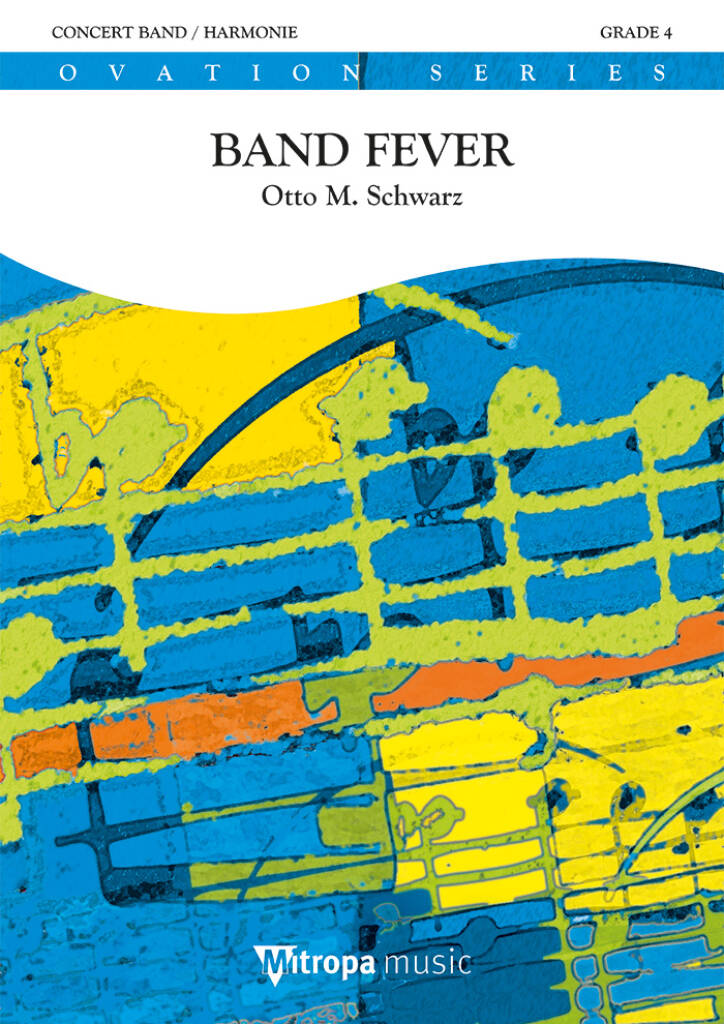
Band Fever - Otto M. Schwarz
Modern wind music in the style of the great Big Bands was the model for the composition Band Fever by Otto M. Schwarz. It was written on commission of the prestigious South Tyrolese concert band, Symphonic Winds. The piece features two soloists, one saxophone and one flugel. Rhythms like Hip Hop Style and Double Samba support a catchy melody, which is later taken up by the full band, forming the basis for the above-mentioned soloists' improvisations. A unique work in the world of wind music, Band Fever allows both soloists and conductor to display individuality and creativity. It is especially suitable as an opener of the light part of a concert, or as afeature number for special soloists in the orchestra.
Estimated dispatch 7-14 working days
 View Music