
Results
-
 £49.18
Illuminate - Wind Band (Andrew Wainwright)
Written for the Chicago Staff Band's tour of England in 2015, this exhilarating work was premiered at The Salvation Army's Boundless International Congress at London's O2 Arena to an audience of 20,000 people. It has since been arranged here for wind band. The piece is structured as a through-composed triptych, weaving together the popularcontemporary worship songs Shine on Us (Michael W. Smith) and Speak, O Lord (Keith and Kristin Getty) with the historic Salvationist anthem The World for God (Evangeline Booth) to explore themes of light, guidance, and mission. The work opens with energy and rhythmic drive, centering on Shine on Us. A stark contrast follows in the meditative middle section. Here, the music explores the contemplative depths of Speak, O Lord, featuring solo horn. The final section introduces a nostalgic and stirring reference to General Evangeline Booth's classic hymn, The World for God. The finale juxtaposes all three themes. As the disparate melodies intertwine and layer upon one another, the music builds to a triumphant climax - a representation of 'illumination' that celebrates a shared faith across generations. PDF download includes score and full set of parts. To view a video of All-Virginia Symphonic Band performing the work please visit: https://www.youtube.com/watch?v=EDhIsM7r4qQ Sheet music available from : UK: www.wind-band-music.co.uk USA: www.solidbrassmusic.com Difficulty Level: Medium Advanced Instrumentation: Piccolo Flute 1-2 Oboe 1-2 Bassoon 1-2 Clarinet in Bb 1-3 Bass Clarinet in Bb Alto Saxophone Tenor Saxophone Baritone Saxophone Trumpet in Bb 1-3 Horn in F 1-4 Trombone 1-2 Bass Trombone Euphonium Tuba Double Bass Timpani Percussion 1-2
In stock: Estimated dispatch 1-3 days
-
 £75.67
Temperamental (Concert Band) Fendall Hill
This work by Fendall Hill was the set test for the 2021 National Brass Band Championships of New Zealand, B Grade. Here it has been adapted for Concert Band. The composer writes: 'J.S. Bach (1685-1750) is deemed by many to be the 'Ulimate Composer'. He added an incredible proportion to the DNA of western music, and his influence is heard in the music of today. Like many artists, he was not overly recognised as a composer during his lifetime, and it took an 1829 performance of the St Matthew Passion by Mendelssohn to ignite a recognition of his place in the music world, a place he has maintained ever since. This piece starts with a similar spark of rediscovery of the music of Bach. It contains arrangements of various works, interspersed with composition based on Bach's chord structures, sections in the style of Bach, and original sections inspired by the moods created along the way. The first section explores the Toccata, and great organ works. This leads into an exploration of his choral works, and a finale based on the Preludes. The word 'Tempered' has different meanings, and all seem to apply to the music of Bach, and these appeal to the musical, engineering and spiritual aspects of my personal life. His music reaches to the humanity and divinity, it has strength, structure and order that creates frameworks in which incredible complexity reigns; and the complexity leads to a wildness, a kind of craziness that represents a range of human moods, and can change without warning. The same piece of music affects people in very different ways. I don't know if it's Bach's music, or us, but it can seem out of control and under control at the same time - the combination is highly temperamental. To view a follow-the-score video of the work please visit: https://youtu.be/6CtYZmCoWIc Sheet music available from: UK: www.wind-band-music.co.uk USA: www.solidbrassmusic.com Difficulty Level: Advanced Instrumentation: Instrumentation: Piccolo Flute 1-2 Oboe Bassoon Clarinet in Bb 1-3 Bass Clarinet in Bb Alto Saxophone 1-2 Tenor Saxophone Baritone Saxophone Trumpet in Bb 1-3 Horn in F 1-4 Trombone 1-2 Bass Trombone Euphonium Tuba Double Bass Timpani Percussion 1-3
In stock: Estimated dispatch 1-3 days
-
 £64.32
Caprice (Euphonium Solo with Concert Band) Andrew Batterham
VIEW SCORE PDF Caprice was written for Matthew van Emmerik, to showcase his virtuosity in an engaging piece of concert music. The work is in theme and variation form, with the primary material being the theme from the last of Paganini's Ventiquattro Capricci per violino solo, a collection of 24 caprices for solo violin. This theme has been the inspiration for similar works by many composers since it was first published, including Liszt, Brahms, Rachmaninov, Benny Goodman and Andrew Lloyd Webber. In this work, the famous theme is treated to a more contemporary approach. The first variation, Capricious, relies on motor rhythms and jagged dialogues between the soloist and the band. It is couched in an organic scale reminiscent of the Phrygian mode. The second variation, Sad, is in direct contrast, acting as a traditional ballad and allowing the soloist to explore the expressive side of the instrument. The third variation, Energetic, is a micro set of variations in itself, designed to display the soloist's innovative technique and stamina. Each section is more challenging than the last, until the work concludes with a whirlwind dance at breakneck speed. Like all of Batterham's recent work, the musical language of Caprice draws upon classical, jazz, funk and ska elements to create a unique sound where anything can happen, and probably will. This arrangement was made possible through Matt's instigation and generosity. To view a video of Matthew van Emmerik performing the version with brass band please visit www.youtube.com/watch?v=D0hsvux_a5o To view a video of Fletcher Mitchell performing the version with piano please visit www.youtube.com/watch?v=NOZ6KRldDVo Sheet music available from : UK: www.wind-band-music.co.uk USA: www.solidbrassmusic.com Instrumentation: Euphonium Soloist Piccolo Flute 1-2 Oboe Bassoon Clarinet in Eb Clarinet in Bb 1-3 Bass Clarinet in Bb Alto Saxophone 1-2 Tenor Saxophone Baritone Saxophone Trumpet in Bb 1-3 Horn in F 1-4 Trombone 1-2 Bass Trombone Euphonium Tuba String Bass Percussion 1-3
In stock: Estimated dispatch 1-3 days
-
£70.00
A Flourish for Wind Band - Malcolm Arnold
Flourish for Wind Band was arranged by Guy Woolfenden from Arnold's Flourish for Orchestra (Op.112), which was written to celebrate the 500th anniversary of the granting of a Charter to the City of Bristol. It was first performed by the Bournemouth Symphony Orchestra.Wind Band Grade 5: AdvancedDuration: 4 minutes
In stock: Estimated delivery 1-3 days
-
 £37.83
Over London Bridge (Wind Band) English Trad. arr. Andrew E. Lawson
Inspired by early works for wind band by British composers Gustav Holst and Ralph Vaughan Williams, this charming concert work is based on an English folk song called As I walked over London Bridge. The arranger Andrew E Lawson writes: 'While I found this folk melody in a set of cello etudes written by Vaughan Williams, it was text that solidified my decision to use this melody, and it is the text that brings some insight into the nature of this folk melody, as well as the nature of the additional original melodies and harmonies throughout the piece.' To view a rolling score video of the work please visit https://www.youtube.com/watch?v=oFWGJWbvqjM Sheet music available from : UK: www.wind-band-music.co.uk USA: https://satradecentral.org Difficulty Level: Medium Advanced Instrumentation: Flute 1-2 Oboe Bassoon Clarinet in Bb 1-3 Bass Clarinet in Bb Alto Saxophone 1-2 Tenor Saxophone Baritone Saxophone Trumpet in Bb 1-3 Horn in F 1-4 Trombone 1-2 Bass Trombone Euphonium Tuba Timpani Percussion 1-3
In stock: Estimated dispatch 1-3 days
-
Fragments for band - Segers Jan
Estimated dispatch 7-14 working days
-
 £69.95
Aylesbury Dances (Concert Band - Score and Parts) - Wiffin, Rob
The suite Aylesbury Dances was commissioned by the Aylesbury Concert Band to mark the occasion of their 25th Anniversary in 2019. Its three movements depict different aspects of Aylesbury: I. Pavane: The Town - Having read something of the town's history and its architecture I decided I wanted to write something ceremonial with the feel of music from Tudor times. Aylesbury was given its charter and borough status in 1554 by Mary Tudor so I took that as my starting point but then added some harmony that moves forward in time. This fits with the town's motto: Semper Prorsum (Always forward) and also with the Band's evolution from Aylesbury Town Band to Aylesbury Community Concert Band to Aylesbury Concert Band. The music can be defined as a pavane, or a cortege. The sense of procession is slightly disturbed by a 'Blue Leanie' moment. The Blue Leanie is an iconic Aylesbury building, an oblique rhombic prism which stands at an angle of 17% inclination. I took a quaver out of the time signature (I know the maths don't work!) to reflect this and added some bluer harmony at that point. This opening movement gives a sense of the grandeur and heritage of Aylesbury town and a chance for my friends from the brass section to warm up! II. Siciliana: Waterside - To balance the outer two movements, the middle movement of the suite has a slow lilting 6/8 rhythm. It is in the style of a Siciliana, a dance form originating in the baroque era. It is a graceful, tender and melancholic dance, cast here in a minor key and featuring the dark voice of the cor anglais. The Siciliana was often linked with pastoral scenes and Aylesbury itself sits amid some beautiful countryside. It may, therefore, seem a bit of a stretch to call this movement 'Waterside', especially as Aylesbury is so far from the sea, but the town has a theatre of that name and that was the genesis for this particular music. There is a statue of Ronnie Barker in the grounds of the Waterside theatre as he started his career in repertory theatre in Aylesbury, so I included a fleeting reference to the theme music of the comedy programme 'Open all Hours'. III. Frolic: Ducks in a Row - It was impossible to write a piece connected with Aylesbury without considering the famous Aylesbury ducks. Duck rearing was a major industry in the town in the 19th century. The white Aylesbury Duck is a symbol of the town, appearing on its coat of arms and in the logo of the Aylesbury Concert Band! This movement is all about trying to get the little darlings in a row so they can sing their 'Duck Chorus' together but they keep on scattering, flying off or swimming away as quickly as they can manage. It's a bit like watching ducks disperse when my dog jumps into the stream after them. Eventually we get more of them in a row - even though they protest. Hidden amongst the ducks is a reference to Erica Miller, saxophonist and chairman of the band, and there's even a veiled reference to a shark in the hope of getting them out of the water. Ducks in a Row is a fun romp bringing this suite of Aylesbury Dances to a suitably celebratory conclusion.- Rob Wiffin.Duration: 9.15
Estimated dispatch 7-14 working days
-
 £37.95
The Year of the Dragon (Prestige Concert Band - Score only) - Sparke, Philip
The 2017 version of The Year of the Dragon was commissioned by the Siena Wind Orchestra and given its world premiere on June 17th 2017 in Bunkyo Civic Hall, Tokyo, conducted by the composer.The original wind band arrangement of The Year of the Dragon was made in 1985, a year after the composer wrote the brass band version. At that time he was still learning the intricacies of writing for wind band (and still is!) and in the 32 years which have elapsed since then, his approach to scoring for the medium has developed and, hopefully, improved.Here are the main differences between the two versions:In the 1980's, the wind band movement was much less international than it is now. British wind bands were still to some extent based on the military band tradition of the time, which tended to use rather smaller instrumentation than the then-dominant American university model. The new version embraces a much more international instrumentation, including low woodwinds and string bass, as well as an expanded percussion section.In the original version there was a touch of naivety in the way the composer wrote for the woodwinds; much of their articulation was transferred too literally from the brass version, resulting in some unidiomatic writing, which he has tried to improve in the new version.In addition to the above, Philip's own compositional style has matured and developed in the intervening 32 years. There are some passages in the original which he simply would not write today - not because they are 'wrong', but because his way of writing has changed. The new version is perhaps how he would have written it today, rather than simply dressing the original version in new clothes.The work is in three movements:Toccata opens with an arresting side drum figure and snatches of themes from various sections of the band, which try to develop until a broad and powerful theme from the middle of the band asserts itself. A central dance-like section soon gives way to the return of this theme, which subsides until faint echoes of the opening material fade to a close.Interlude takes the form of a sad and languid solo for alto saxophone. A chorale for the whole band introduces a brief spell of optimism but the saxophone solo returns to close the movement quietly.Finale is a real tour-de-force for the band with a stream of rapid semi-quavers running throughout the movement. The main theme is heroic and march-like but this is interspersed with lighter, more playful episodes. A distant fanfare to the sound of bells is introduced and this eventually returns to bring the work to a stirring close.
Estimated dispatch 7-14 working days
-
£199.95
The Year of the Dragon (Prestige Concert Band - Score and Parts) - Sparke, Philip
The 2017 version of The Year of the Dragon was commissioned by the Siena Wind Orchestra and given its world premiere on June 17th 2017 in Bunkyo Civic Hall, Tokyo, conducted by the composer.The original wind band arrangement of The Year of the Dragon was made in 1985, a year after the composer wrote the brass band version. At that time he was still learning the intricacies of writing for wind band (and still is!) and in the 32 years which have elapsed since then, his approach to scoring for the medium has developed and, hopefully, improved.Here are the main differences between the two versions:In the 1980's, the wind band movement was much less international than it is now. British wind bands were still to some extent based on the military band tradition of the time, which tended to use rather smaller instrumentation than the then-dominant American university model. The new version embraces a much more international instrumentation, including low woodwinds and string bass, as well as an expanded percussion section.In the original version there was a touch of naivety in the way the composer wrote for the woodwinds; much of their articulation was transferred too literally from the brass version, resulting in some unidiomatic writing, which he has tried to improve in the new version.In addition to the above, Philip's own compositional style has matured and developed in the intervening 32 years. There are some passages in the original which he simply would not write today - not because they are 'wrong', but because his way of writing has changed. The new version is perhaps how he would have written it today, rather than simply dressing the original version in new clothes.The work is in three movements:Toccata opens with an arresting side drum figure and snatches of themes from various sections of the band, which try to develop until a broad and powerful theme from the middle of the band asserts itself. A central dance-like section soon gives way to the return of this theme, which subsides until faint echoes of the opening material fade to a close.Interlude takes the form of a sad and languid solo for alto saxophone. A chorale for the whole band introduces a brief spell of optimism but the saxophone solo returns to close the movement quietly.Finale is a real tour-de-force for the band with a stream of rapid semi-quavers running throughout the movement. The main theme is heroic and march-like but this is interspersed with lighter, more playful episodes. A distant fanfare to the sound of bells is introduced and this eventually returns to bring the work to a stirring close.
Estimated dispatch 7-14 working days
-
 £13.95
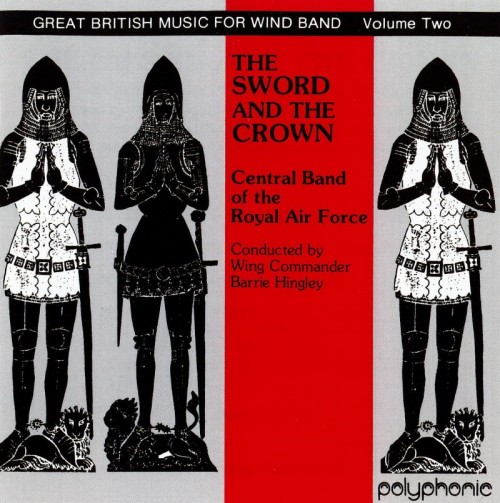
The Sword and the Crown (Concert Band CD)
Great British Music for Wind Band - Volume 2The Central Band of the Royal Air Force conducted by Wing Commander Barrie Hingley1A Pittsburgh OverturePhilip SparkeThe Central Band of the Royal Air Force5.592The Sword and the CrownEdward GregsonThe Central Band of the Royal Air Force13.543Ballad for BandGordon JacobThe Central Band of the Royal Air Force7.224-7A Derbyshire SuiteMichael ShortThe Central Band of the Royal Air Force16.27 On Stanton Moor 5.05 The Cat and the Fiddle 3.04 Lord Musgrave's Dining Room 4.41 Well Dressing 3.328CelebrationPhilip SparkeThe Central Band of the Royal Air Force10.54
Estimated dispatch 7-14 working days
 View Music