
Results
-
 £248.99
Missa Brevis Wind Band Set (Score & Parts)
Missa Brevis, written for choir and wind band, was commissioned by the Conseil D?partemental pour la Musique et la Culture de Haute-Alsace (Dir.: Philippe Pfisterer) in Guebwiller (France), in celebration of the millennium of Pope Leon IX's birth in ?guisheim (France). The composer conducted the first performance on June 23, 2002. It was performed live for the French television channel France 2. The mass movements Kyrie, Gloria, Credo, Sanctus, Benedictus, and Agnus Dei are very suitable for the Catholic as well as the Protestant liturgy. For this mass, various ways for performing in diverse variable strengths are possible. An instrumental performance is possible if the brass represents the choir parts. In this option, it is desirable for the brass to be positioned separately from the rest of the band (on a gallery, for example), so that the idea of two choirs is approached. In a performance with a large choir, the brass can work very well as a support. In that case, the dynamics of the brass should be adapted somewhat, since these are actually intended for an instrumental performance. You can also leave out the brass entirely for the benefit of the choir. For the accompaniment of smaller choirs, you can opt for a small ensemble from the band. This can also be a quartet, put together as desired. For the performance of this mass, the obvious choice is one of the above options. However, as an alternative, a performance with a combination of these options (vocally/instrumentally) is also possible - not just from an artistic point of view (variation), but also from a practical starting point - for example in the case that the choir has rehearsed only two movements. With a full strength, the conductor can vary the instrumentation to his or her liking. Then the brass can also play a role in the accompaniment (instead of supporting the choir). The following combinations are possible: 1. clarinet choir (from Eb Clarinet to Bass Clarinet) 2. clarinet choir + saxophones 3. brass (flugelhorns, horns, euphoniums, bass section) 4. brass (2 trumpets / 2 trombones) 5. double reeds (optional + flute, optional + string bass) 6. tutti 7. all winds 8. all brass In a performance by brass band and choir, it is usually advisable to leave out option 1 (choir + brass + band). The choir sings self-reliantly, accompanied by a full brass band. In an instrumental performance, you can consider a combined quartet (two cornets and two trombones) + brass band. Choral parts available separately. 0:20:00
Estimated dispatch 7-14 working days
-
 £49.95
Cav Party (Concert Band - Score and Parts) - Wiffin, Rob
Cav Party was commissioned by The Band of the Household Cavalry in 2020. The idea was to showcase the various musical elements of the band in a party piece that gets more boisterous as it goes on. It utilises three Eighteenth century melodies associated with the band, starting off with a folkish setting of Handel's March from Scipio for harp, violin, flute and cor anglais (all fully cued on regular wind band instruments) and then into Keel Row where the accordion is featured before the whole band enters, and finally to Money Musk. Both Keel Row and Money Musk are played as Trot Marches by the band.The regimental slow march Scipio comes from Handel's opera of 1725 The Mercy of Scipio, which was based on the life of the Roman General Scipio Africanus.Keel Row is a traditional folk song evoking the life and work of the keelmen of Newcastle upon Tyne. It was first published in 1770, although it could be considerably older. The opening lines of the song describe Sandgate, the part of the quayside overlooking the River Tyne to the east of the city centre where the keelmen lived.Money Musk, also known as Monymusk or Monnymusk was originally a pipe tune composed by Scottish fiddler Daniel (sometimes Donald) Dow (1732 - 1783) in 1776. It takes its name from a baronial estate in Aberdeenshire, Scotland called Monymusk House. The tune first appeared in Dow's Thirty Seven New Reels, c. 1780 under the title Sir Archibald Grant of Monemusk's Reel.Duration: 3.45
Estimated dispatch 7-14 working days
-
 £141.99
Pulcinella (Euphonium Solo with Concert Band - Score and Parts) - Sparke, Philip
Pulcinella was commissioned by the Taiwanese euphonium player Tzu-Hsiang Lin. Lin is a renowned soloist and teacher and a Besson Euphonium Artist. He teaches euphonium at Taipei National University of the Arts, National Taiwan University of Arts, Shih Chien University and National Kaohsiung Normal University. Lin gave the premiere of Pulcinella in both its concert band and brass band versions in January 2021. Pulcinella continues Sparke's series of euphonium solos named after characters of the Italian commedia dell'arte and opens with a long and expressive minor melody for the soloist over a brooding accompaniment. This is taken up briefly by the full band and is extended by the soloist after a change of key. A cadenza, accompanied by fragments of the main melody leads to a complete change of mood, tempo and tonality, introducing a Vivo section starting with a perky syncopated tune for the soloist. The band then uses elements of this new tune to introduce a change of key, where the soloist introduces a more lyrical second subject over a pulsing accompaniment. The band then takes this up and changes key to reintroduce the original Vivo melody, which leads to a short and acrobatic coda to bring the work to a spectacular close. Duration: 6.45
Estimated dispatch 7-14 working days
-
 £175.00
60 Warm-Up Chorales (Concert Band - Score and Parts) - Cesarini, Franco
During his experience as a band conductor and teacher of wind orchestra conducting at university, Franco Cesarini has dealt with the topic of warm-ups very frequently. Throughout these long years of conducting he has had the opportunity to try many existing methods, evaluating their advantages and disadvantages. After a long time, he has decided to compile a collection of chorales for warm-ups, which are organised according to the criteria that he considers most effective. While working on his60 Warm-up Chorales for Concert Band, Franco Cesarini has always borne in mind that amateur musicians play for pleasure. He feels that it is extremely important that they have satisfaction at every moment of the rehearsal and not to start the rehearsal with needless "punishing" exercises. Nobody is really motivated to start playing with scales, long notes, or tricky rhythmical exercises. There is often a distinguished absentee in band rehearsals, namely music itself! Although this publication does not foresee a specific tempo for the chorales, they should often be performed rather slowly but without dragging. Dynamics are not indicated, so that the conductor has the opportunity to draw the attention of the musicians to his gestures and to make them react according to his indications. Timpani and bell parts have been added with the aim of not leaving the percussionists completely inactive during the warm-up phase, but can also be omitted. The chorales are written in four parts (SATB) and are also playable in smaller groups. The four voices can be played in different combinations of woodwinds or brass quartets or in mixed combinations. The collection includes ten chorales for the following keys: D flat major, A flat major, E flat major, B flat major, F major and C major. With his 60 Warm-up Chorales Franco Cesarini would like to convey the message to play the chorales in a musical way, thus raising the musicians' awareness of phrasing, the right interpretation of cadences, rubato and agogic. Above all, never do anything without putting the musical aspect in the foreground. 60 Warm-up Chorales for Concert Band: A perfect collection to warm-up and improve tuning of a concert band!
Estimated dispatch 7-14 working days
-
 £45.00
Christmas Around the Band Room (Concert Band - Score and Parts) - Galvin, Lisa
Who says easy can't be fun? "Christmas Around the Band Room" is a satisfying medley of three holiday favorites, giving every section of the band an opportunity to be spotlighted with the melody! Even the youngest ensembles will gain independence and confidence as they prepare this cleverly-scored full band arrangement using only the first six notes of instruction. This would be an ideal choice for your young band's first holiday concert! Duration: 2.00
Estimated dispatch 7-14 working days
-
 £164.99
Spirit of Endeavour (Concert Band - Score and Parts) - Sparke, Philip
Spirit of Endeavour is a virtuosic piece of music with a positive musical message. It tells the story of a wind band embracing hard work, friendship, musical excellence, love, marriage and birth, as well as the sad loss of cherished members. Composer Philip Sparke decided to salute the history of the Canadian concert band 'Harmonie de Charlesbourg' with a work that falls into two contrasted sections. One Vision deals with forming the band and the subsequent united desire to create an ensemble espousing the idea of musical perfection. The Pursuit of Excellence salutes the 20 years of hard work of the wind band. This concert work ends with a chorale of the full band, symbolising the fulfilment of a united dream!Duration: 9:15
Estimated dispatch 7-14 working days
-
 £75.00
Quelle est Cette Odeur Agreable (Whence is That Goodly Fragrance Flowing?) (Concert Band with Optional Choir - Score and Parts) - Noble & Willcocks
The original setting of this beautiful melody was for Strings and Chorus. This Concert/Wind Band version features the brass ensemble, the woodwind choir, as well as the full band. It is intended for combined Band and Chorus, but may be performed by Band alone. It is completely compatible with the published choral edition, except that it is written one-half step lower (E-flat instead of E major). There are no accidentals, and, apart from the instructions for andante and legato, the phrasing is left to the conductor. The simplicity and rich harmonic structure make this an important addition to the repertoire of young bands, and a perfect piece for any band to program for the Christmas season.
Estimated dispatch 7-14 working days
-
 £44.50
Night (Concert Band - Score and Parts) - Fitzpatrick, Craig
Night is the result of a collaborative project between the composer and the 6th grade beginning band directed by his wife in Morton, Illinois. The students in her band class each write an eight-measure melody as a composition project which is part of the beginning band curriculum. These melodies each start and end on concert B-flat and use only the notes the students have learned on their instruments. The class voted on the best melody, and the winner was "Majestic Night, Oh Winter Night" by Sarah Gunter. The students then observed how this melody was developed by the composer into a concert band piece that they would perform later that year. Compositional terms such as repetition, fragmentation, and augmentation could then be taught to the 6th graders in a piece for young band that was written just for them. Duration: 2.30
Estimated dispatch 7-14 working days
-
 £113.00
Eternal Vigilance (The Long Brave Line) (Concert Band - Score and Parts) - Jager, Robert
The result of a collaborative commission by the U.S. Air Force Academy Band, the U.S. Coast Guard Band, the U.S. Military Academy Band and the U.S. Naval Academy Band, this major work for band takes its title from a quote attributed to Thomas Jefferson, "Eternal vigilance is the price of liberty," and a variation of the West Point motto, "The Long Gray Line." Opening with a tribute to those who have gone before in service to our country, a solemn, noble theme is presented that reappears near the end of the composition. The main body of the work is a series of march-like themes and idiomatic fragments culminating in a glorious full-band fanfare. Following a restatement of the "noble" theme, a stirring coda brings the music to a climactic close.Duration: 8:30
Estimated dispatch 7-14 working days
-
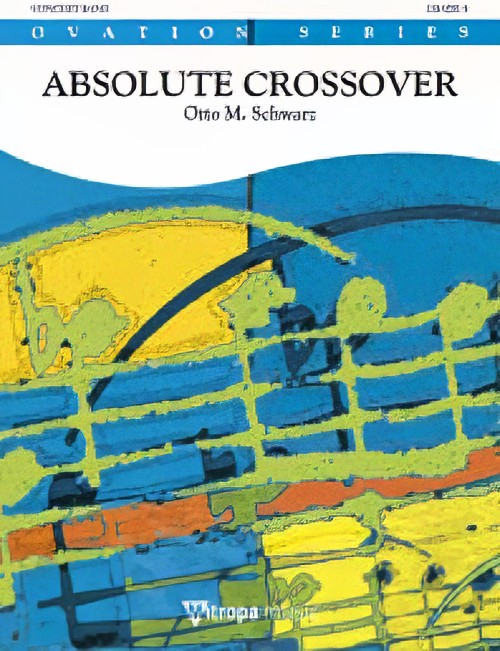 £134.99
Absolute Crossover (Concert Band - Score and Parts) - Schwarz, Otto M.
This composition is made up of three themes, which feature all the facets of the instrumentation of a concert band as well as that of a big band. The symphonic passages, reminiscent of film music, enable the full tone and colour of the concert band to be heard, whilst the big band sound is represented in the rock segments and slow swing sections. The musical journey travels along practically all styles, ending with an impressive tutti, in which the shuffle rhythm of the big band melts together with the grand, classic film music sound of the concert band.Duration: 7:45
Estimated dispatch 7-14 working days
 View Music