
Results
-
£134.99
The Enemy God and the Dance of the Spirits - Sergei Prokofiev
The Russian ballet director Sergei Diaghilev commissioned many composers to write music for the theatre. This was what caused Serge Prokofiev to compose the four part Scytische Suite (also known as Ala and Lolli) in 1916, from which The Enemy God and the Dance of the Spirits can be heard on this CD. This suite is one of Prokofiev's first works, and received negative criticism following its first performance on account of its being "uncivilised". Prokofiev himself wrote after this first performance ". . . The timpani player beat the skin of the timpani to tatters, and the whole orchestra voiced a protest. A cellist complained that he only put up with the violence, createdby the blaring brass, on account of his sick wife and three children . . .".
Estimated dispatch 7-14 working days
-
 £116.40
Norma Ouverture - Vincenzo Bellini
The composer of some famous operas such as 'La Sonnambula' and 'The Puritans', Vincenzo Bellini (1801-1835) was largely self-taught. Although he wrote eleven operas, only 'Norma' remained popular, not in the least because of its splendid lyrical arias such as Casta Diva (Chaste Goddess) and Mira, O Norma (Hear me, Norma) familiar to all music lovers. The opera 'Norma' is written to a libretto by Felice Romani, based on a French melodrama by Alexandre Soumet and Louis Belmontet dealing with a story of Druids during the Roman rule. The story is neither accurate historically nor convincing dramatically, but the score is full of brilliant melodies of a type calculated to exhibit a singer's virtuosity to the utmost. The Gods order the priestess and fortune-teller Norma to give the signal of revolt against the Romans in Gaul, but she postpones this because of her relationship with the Roman proconsul Pollione with whom she secretly had two children. In the meantime, Pollione has fallen in love with the young priestess Adalgisa and Norma wants to take revenge. Finally both Norma and Pollione die on the pyre. This tragical opera in two acts was first performed at the Scala of Milan on 26 December 1831.
Estimated dispatch 7-14 working days
-
 £140.80
Sarka Overture - Zdenek Fibich
This overture introducing Fibich's opera 'Sarka', was composed between 1896 and 1897 and is based on a famous Bohemian legend. Several Czech composers, such as Bedrich Smetana and Leos Janacek, have used this popular national story in opera's and symphonic poems. The relevant legend deals with Vlasta, the courageous Amazone Queen who has a quarrel with the Bohemian knights. After several battles she thinks of a cunning to conquer the knights. She leaves her ally, the beautiful Sarka, tied up to a tree in the middle of the forest. The knight Ctirad finds her, frees her and takes her back to his camp. In the evening he organizes a kind of victory celebration with his friends. At night, while the knights sleep it off, Sarka calls the Amazones. The latter have no difficulties to conquer the sleeping knights. Fibich does not keep strictly to the original legend and made quite some changes, especially at the end of the story.
Estimated dispatch 7-14 working days
-
 £186.20
Remerciements - Serge Lancen
Remerciements' (Thanksgivings) is the fourth religious composi-tion by Serge Lancen. It is a song of praise and thanksgiving, piously devoted to God. As the composer is very happy to live here on earth he wants to express this happiness in his musical language, accompanied by a text glorifying our Creator. The work is written for symphonic band. The text, quoted from or inspired by Psalms and prayers, can either be recited in whatever language or sung in French by a baritone or mezzo-soprano, accompanied by a harp or an organ. There is the 'Sign of the cross' which can be heard up to 12 times. The work consists of five movements: the first one is a call for prayer. In the second one the composer expresses his Thanksgivings to God. This movement is taken from Lancen's 'Pome Oecumnique' (1975) then sung by a soprano accompanied by symphony orchestra. Now it is only played by the band. The third movement is a homage to God using the theme of the 'Benedicamus Domino', dating from the tenth century and already quoted in the introduction. The fourth movement is serious and moving, it implores the beloved ones who have left us. The finale glorifies God. Hallelujah.
Estimated dispatch 7-14 working days
-
 £48.00
Paseo De Otoo - Hans Elzinga
Since 1990 Hans Elzinga performs and teaches South-American traditional music. In this piece 'Paseo de Otoo' (Autumn walk) he tries to make us familiar with the colourful and rhythmical music of the Mexican bandas . A quite original and sparkling piece for symphonic band clearly testifying the composer's passion for this kind of music.Also available with virtual conductor video on YouTube to create a virtual orchestra!! Video to be viewed here:copy this link into your browser:https://www.youtube.com/watch?v=jAIuJtAj8bA
Estimated dispatch 7-14 working days
-
 £211.60
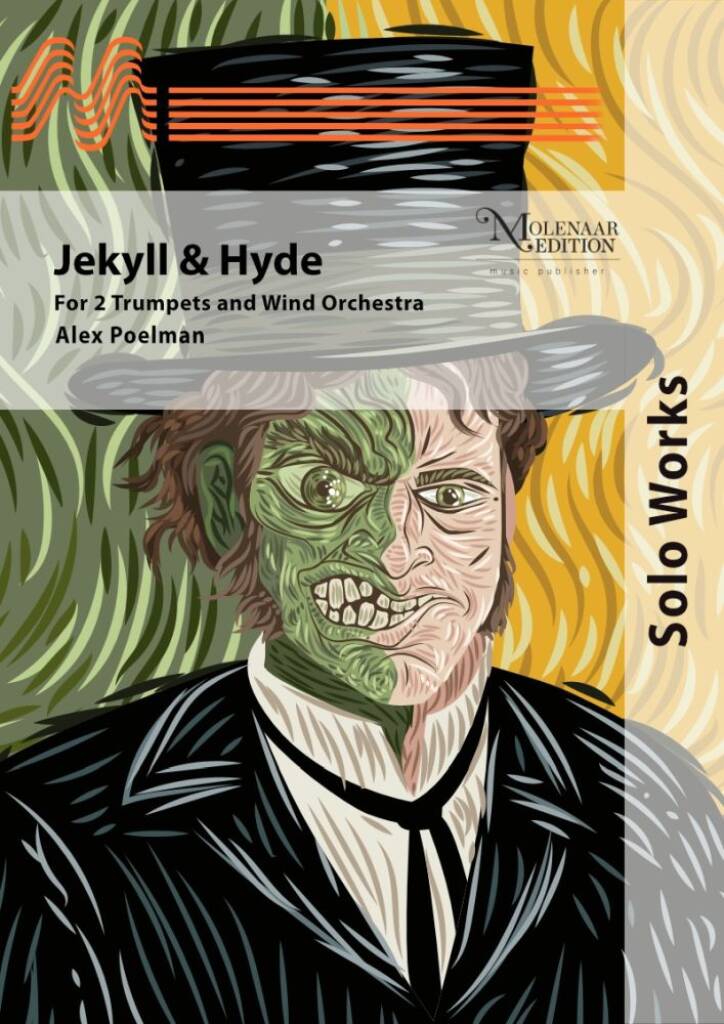
Jekyll & Hyde - Alex Poelman
Dr Jekyll researches the evil in man and succeeds in creating a potion that transforms him into his alter ego, Hyde. However, Jekyll loses control and fights an inner battle with Hyde. He loses this battle when Hyde commits murder. Understanding that there is only one way to resolve this, Jekyll kills himself and thus Hyde. In this solo concert the main characters Jekyll and Hyde are played by two solo trumpeters. The different sides of the trumpet are highlighted in this story: from the lyrical passages (Jekyll) to the sharp, mean and dark passages (Hyde). A challenging adventure for orchestra and soloists.This is rental music. Please contact us at [email protected]
Estimated dispatch 7-14 working days
-
 £33.10
Hunyadi Indul - Ferenc Erkel
The first performance of the opera "Hunyadi Lszl" by Ferenc Erkel (1810-1893) at the National Theater in Pest took place in times that foreboded the revolt of 1848. The rise of this stage work to Hungary's national opera and its ensuing immediate great success probably is due to the plot itself and the atmosphere prevailing in the country at that time. The great flute virtuoso and composer Franz Doppler (1821-1883) asked "Erkel to grant permission to write a march on the basis of motifs from this opera for my citizen's guards band, which he explicitly consented to ..." From the days of the revolution against Habsburg until today the "Hunyadi indul" ("March on Motifs of theOpera 'Hunyadi'") has remained to be popular throughout and therefore may rightly be addressed as a Hungarian national march.
Estimated dispatch 7-14 working days
-
 £134.99
The Secret of Mercury - Jan de Haan
This work was commissioned by the concert band Da Capo Leeuwarden from the Netherlands, which was linked with the Dutch postal service PTT up until 1995. Mercury happens to be the messenger of the gods - a kind of mailman, one could say. Yet the composer did not choose the god but the planet Mercury as his source of inspiration for this work in four uninterrupted movements. He created a multifaceted work in which the mysterious celestial body is represented, as well as a number of space missions exploring it. This interesting subject matter guarantees a composition that fascinates from start to finish.
Estimated dispatch 7-14 working days
-
 £163.00
Suite Siciliana, Op. 57b - Franco Cesarini
Franco Cesarini has written this piece for concert band as a tribute to the town of Bisacquino (Palermo, Italy) of which he is an honorary citizen.TheSuite Siciliana, a 7-movement piece - Intrada, Pavana I>, Gavotta, Barcarola, Tambourin, Siciliana, Tarantella - is characterised by contrasting rhythms and tempo, and consists of these 7 dances. The musical form, typical of the Baroque period, refers to some traditional expressions of art from the land of Sicily: ranging from the rich architecture of the Sicilian Baroque to the colorful majolica ceramics and the characteristic puppets, the "pupi", which narrate a secular tradition.A full immersion into ancient traditions of this beautiful island!
Estimated dispatch 7-14 working days
-
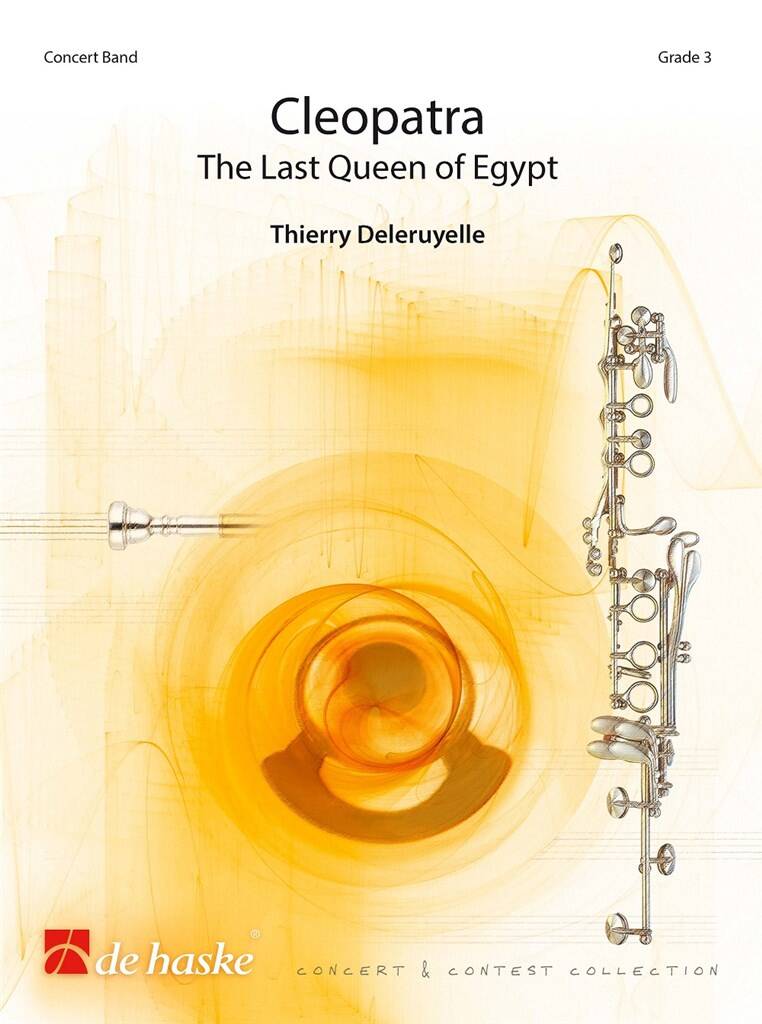 £134.99
Cleopatra - Thierry Deleruyelle
Queen Cleopatra ruled Egypt for over 20 years. She is one of antiquity's best-known women, in particular because of her relationships with Julius Caesar and, above all, Mark-Anthony, but also because the cause of her death remains a mystery. The work is split into three parts and performed without breaks. The first section begins with a bright introduction representing Mark-Anthony. Dynamic in nature and reminiscent of military music, this characterises the Roman general. But soon after, another theme emerges, softer and more melodic, symbolising Cleopatra's femininity. The two characters then combine on a faster tempo. The middle section of the work depicts the love that Mark-Anthony and Cleopatra feel for each other. This passionate relationship lasted ten years and produced three children. This is expressed by a warm and intense theme, just like the beauty of the Egyptian queen. The third and last section opens in a determined and military mood. Mark-Anthony and Cleopatra were often apart, the Roman general was often away on a campaign. They met up in Alexandria to celebrate their triumph. But, as the targets of the jealousy and ambition of Octavius, Julius Caesar's son, the lovers are trapped and await the inevitable conquest of Egypt by the Romans. When Mark-Anthony heard the false news that Cleopatra had committed suicide, he ended his own life. The Queen of Egypt, for her part, was imprisoned shortly afterwards. The two lovers remain one of History's most famous couples. This piece was commissioned by the Wind Orchestra of the town of Antony, near Paris, directed by Philippe Rossignol, to mark its 90th anniversary.
Estimated dispatch 7-14 working days
 View Music