
Results
-
£69.99
Blue Ridge Summit - Bryan Kidd
Get to know the music of Bryan Kidd. He follows the resounding success of his recent release The Road To Chancellorsville and preceding that, his exquisitely beautiful rendition of Be Thou My Vision with this commanding new original composition. Energetic and expansive, Blue Ridge Summit makes full use of the additional excitement and compositional maturity that Grade 3 guidelines permit. If you have used one of Mr. Kidd's previous CMP publications with your band you are sure to want to add this vigorous new composition to your library. If you are not already familiar with this outstanding composer, now is your chance to try one of his works.Superb!
Estimated dispatch 7-14 working days
-
 £159.60
Evocazioni (1985) - Paul Huber
This work, composed in 1985, wants to shake you up and put a spell on you at the same time. Today, humanity is threatened by many dangers, many of which we are not able to banish. We need help from a higher power. The Chorale "Aus tiefer Not schrei' ich zu dir" (from deep distress I cry to you) illustrates this. This motif appears in diverse variations. But, in his arrogance the wicked man does not believe in the rule of evil demons in the world.With the Gregorian melody in the sequence "Dies irae" (day of wrath) from the requiem mass, the nearing of disaster is announced: without God man goes astray. He falls into ruin.To deepen the poignancy of this composition, Paul Huber cited a dramatic episode from his symphony "The nostraie aetatis angoribus" (from the anxiety of our time).
Estimated dispatch 7-14 working days
-
 £228.70
Konsertouverture - Viktor Widqvist
This piece was composed in 1937 in the composer's later part of life. Here, Widqvist shows his broad competence as a composer by using both classic marching and late-romantic thematic elements with exciting harmonic twists. In addition, you can find a perfect fugue where the composer shows that he masters this advanced composition technique. One can imagine that Widqvist wanted to show off his entire repertoire of knowledge to take the lead in the unspoken competition with colleague and friend Sam Rydberg. Rydberg had several years earlier composed a concert overture with a similar form. However, this piece is simpler in its design and lacks the technical brilliance that Widqvist shows in his contrapuntal treatment and harmonious diversity.The concert overture was re-orchestrated in 1939 by the composer for symphony orchestra, and it is this version and the original score for a large military orchestra that form the basis for this edition. My aim has been to keep all of Widqvist's original intentions, but still make use of all the possibilities of the modern symphonic wind orchestra. The composer's own arrangements for symphony orchestra have been of great help in this work.- Niclas Blixt -
Estimated dispatch 7-14 working days
-
 £82.95
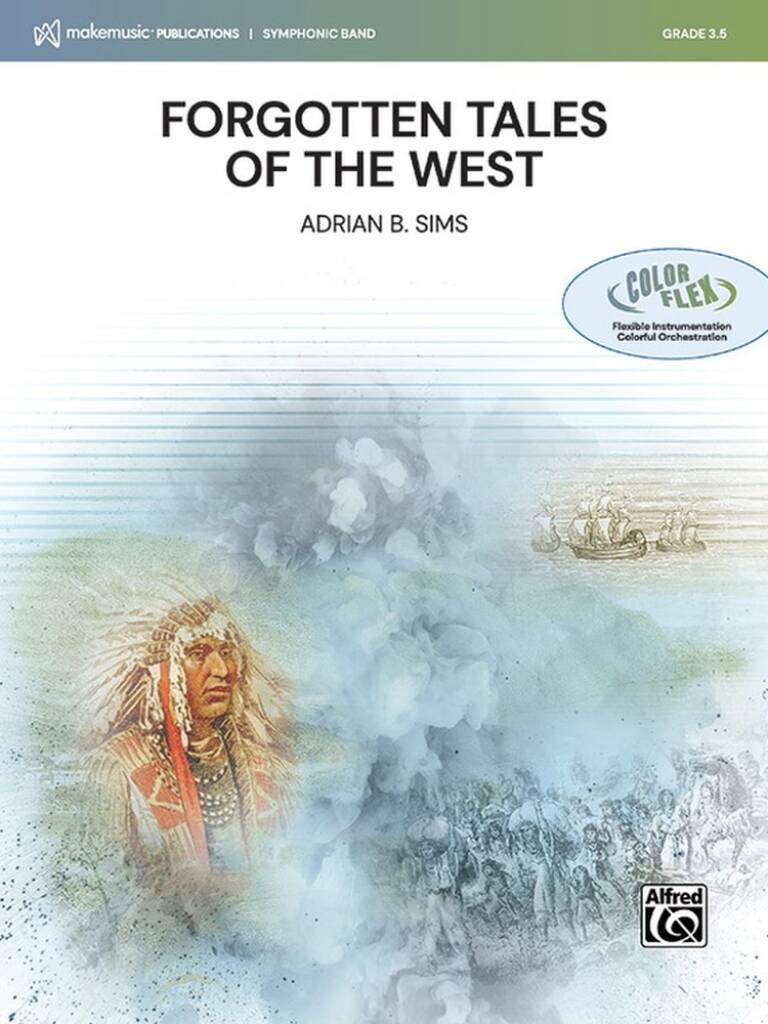
Forgotten Tales of the West - Adrian B. Sims
Now in ColorFlex format for groups with limited instrumentation! This powerful work pays tribute to the many battles fought between the Native Americans and Europeans. Forgotten Tales of the West moves between Native American-influenced themes and western harmonies before adapting into an amalgamation of the two. Incredible writing by Adrian B. Sims, who was a teenager when he composed this piece! (4:15)About ColorFlexConductors no longer need to choose between function and texture! Ensembles with instrumentation challenges still have numerous options to cover all parts, yet orchestration is elevated significantly to be faithful to the composer's original intent. Musicians have more opportunities to rest, and timbre once again becomes a central element of each work. So go ahead and have the best of both worlds: flexible and colorful.
Estimated dispatch 7-14 working days
-
 £148.00
Waterfall - Gauthier Dupertuis
Gauthier Dupertuis was inspired to write the main theme of Waterfall by a stroll near a waterfall that is the pride of his hometown. This piece, composed during lockdown due to Covid-19, is also a reflection on homesickness. Waterfall also expresses the composer's feelings about enjoying a welcome break and return to his roots, which enabled him to spend more time with his loved ones. For him, this waterfall is a symbol: it's not the same water that flows there, but the waterfall is still there, the same as it was when he was a child, like a witness to times gone by. Waterfall is a work with a certain sentimental value for the composer in that it was his very first real composition.The work was premiered on 9th October 2020 by the Wind Band Societat Musical 'La Constncia' of Moixent (Spain) and was conducted by Jos Alberto Pina.
Estimated dispatch 7-14 working days
-
 £124.99
A Hero's Tale - Bert Appermont
This composition is based on the life of the German cavalry general Hans Michael Elias von Obentraut (1574-1625), who was known for his nerve, loyalty and courage. The figure Van Obentraut is closely connected to the town of Seelze, where he died a heroic death and where a monument was erected in his honour. The work consists of four movements in which various aspects of this historical figure are featured. What is extra special about this work is the fact that its first movement (Hymn for a Hero) had been made available as an easy version for flexible band. This makes it possible for a youth or beginner band to play along with a band of adults or advanced players. This hymn can also be played as a separate piece.
Estimated dispatch 7-14 working days
-
 £39.95
Music for Junior Wind Band - Vol. 6 - Adrian Taylor
The arrangements and compositions in these books were written by Adrian Taylor for various beginner or school bands that he has conducted over the years. Children joined these bands on the 2nd parts, usually having only been playing for a year and they then progressed to the 1st parts the following year.This volume of music was orchestrated a little differently to the other volumes but the easiest parts for each instrument continue to be written without key signatures in treble clef, in B flat major for bass clef trombone and euphonium and in E flat major for bass clef tuba. More advanced parts are written with the appropriate key signatures for each piece, reflecting the greater understanding and skills of the players on these parts. Most of the pieces can be played with only a few parts being covered, the addition of the other parts usually enhancing the arrangement rather than simply doubling existing musical lines. The essential parts are the Trumpet (and Clarinet or Cornet) parts, the two Trombone/Euphonium parts and in No. 4, the 1st Horn part. A piano part helps to fill out the harmonies where other parts are missing. The brass parts in the wind band versions are identical to those in the brass versions. This volume was created so that beginner players can play Calypso and When The Saints, which feature in Just Play... Book 1, accompanied by their school band.
Estimated dispatch 7-14 working days
-
 £60.99
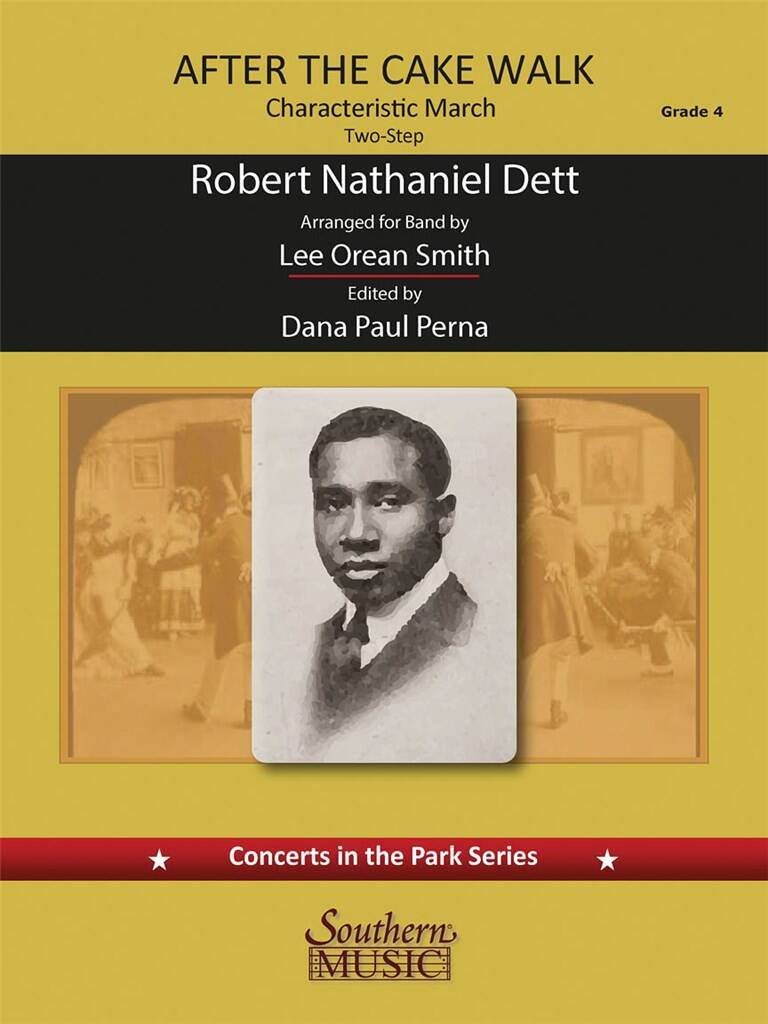
After the Cakewalk - Robert Nathaniel Dett
Despite his having moved to the United States with his family when he was 11 years old, Robert Nathaniel Dett (1882-1943) was born in Canada where glimpses of his talent had already begun to manifest themselves at an early age. Among Dett's earliest titles was his Characteristic March Two-Step, After the Cakewalk. Perhaps written when Dett was just a teenager, this current edition is wholly based upon its original 1901 band publication that was arranged by Lee Orean Smith. Smith was also responsible for preparing Dett's piano solo version for publication, as well as its form for theatre orchestra and mandolin club. Owing to the fact that Smith's highly idiomatic scoring was prepared for a band of that period, this edition adapts, edits and extends Smith's instrumentation in order to make it possible for Dett's music to become available to a new generation of musicians and listeners alike. (Grade 4)
Estimated dispatch 7-14 working days
-
 £104.99
Farewell Medley
While it can be fairly easy to select a musical piece for the beginning of a concert, the search for a proper closing piece can sometimes be more difficult. Helping to fill this gap was Stefan Schwalgin's motivation for this Farewell Medley. In this piece he has woven four world-famous folk tunes from the Anglo/Irish/Scottish culture (Danny Boy, Amazing Grace, The Last Post and Auld Lang Syne) into a high-quality arrangement that allows the band to display its full range of colours at the end of any concert.
Estimated dispatch 7-14 working days
-
£106.95
Cradle of Liberty
Al Hayes was one of seven pseudonyms used by famous march composer Henry Fillmore. Fillmore became so popular and was so prolific in the early part of the 20th century that he had to resort to pennames as to not compete with himself. This is yet another tuneful, well-written march by Fillmore that has been given new life in this setting by arranger Laurie Lafferty. This is the perfect march for use as a festival warm-up that is of a moderate difficulty.
Estimated dispatch 7-14 working days
 View Music