
Results
-
 £514.99
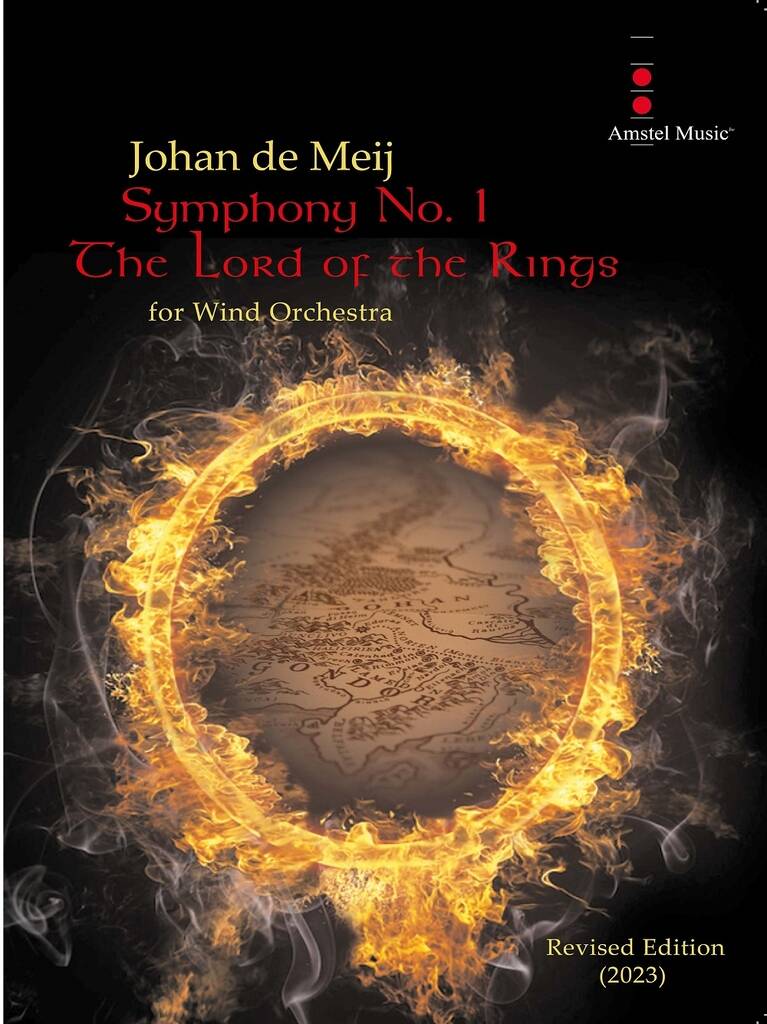
Symphony No. 1 The Lord of the Rings (complete ed) - Johan de Meij
Johan de Meij's first symphony The Lord of the Rings is based on the trilogy of that name by J.R.R. Tolkien. This book has fascinated many millions of readers since its publication in 1955. The symphony consists of five separate movements, each illustrating a personage or an important episode from the book. The movements are: I. GANDALF (The Wizard) II. LOTHLORIEN (The Elvenwood) III. GOLLUM (Smagol) IV. JOURNEY IN THE DARK a. The Mines of Moria b. The Bridge of Khazad-Dm V. HOBBITS The symphony was written in the period between March 1984 and December 1987, and had its premire in Brussels on 15th March 1988, performed by The Royal Band of the Belgian Guides under the baton of Norbert Nozy. In 1989, the Symphony The Lord of the Rings was awarded first prize in the Sudler International Composition Competition in Chicago. In 2001, the orchestral version was premiered by the Rotterdam Philharmonic Orchestra and was recorded by the London Symphony Orchestra.
Estimated dispatch 7-14 working days
-
 £482.99
Symphony in Green - Thomas Doss
As with the first symphony, the second symphony is not programmatic as such, but also takes its inspiration from the confrontation of man with his role in nature. Dedicated to the 2011 National Garden Show in Upper Austria, this symphony earned its subtitle Symphony in Green and explores musically the connotation of this colour as the colour of nature, of life and of hope.
Estimated dispatch 7-14 working days
-
 £115.60
Terrible Symphony - Haakon Esplo
Let us present "Terrible Symphony" - the perfect piece for beginner or junior bands!This fun composition gives young musicians the opportunity to have a great time while driving the conductor crazy. The piece includes well-known themes from great symphonies, along with new music, and not least, lots of silliness and fun. All musicians can join in and come up with more pranks and humorous elements. The audience will laugh out loud and enjoy this crazy and entertaining, yet terrible symphony.Make your concert an unforgettable experience with "Terrible Symphony"!In the score, you will find instructions and suggestions for the conductor as the musicians become increasingly impossible.
Estimated dispatch 7-14 working days
-
 £482.99
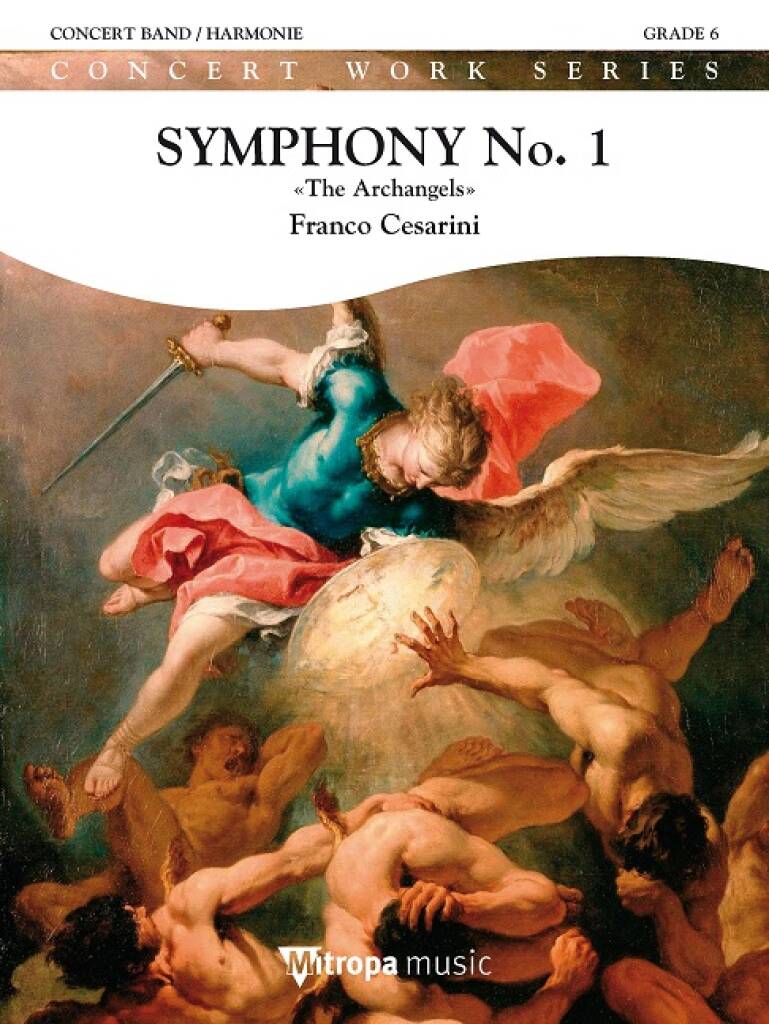
Symphony No. 1 - The Archangels - Franco Cesarini
The Swiss composer Franco Cesarini has waited a long time to write his first symphony and after years of considering and drafting, this Archangels Symphony, Symphony no. 1 is a vast composition consisting of highly dramatic language, intense thematic developments and frequent polyphonic elaborations.The thematic material is taken from old Gregorian melodies that form the basis for the entire work, which is, despite the title, a non-programmatic work. It consists out of 4 movements: Gabriel, the gentle archangel; the supreme healer Raphael; the energetic archangel Michael, the Prince of the heavenly host; and surprisingly the archangel Urile, the'forgotten' archangel.A true masterpiece and a fantastic musical challenge!
Estimated dispatch 7-14 working days
-
 £520.99
A Colour Symphony - Philip Sparke
Philip Sparke's third symphony, A Colour Symphony, was commissioned by "sinfonischen blasorchester wehdel" conducted by Thomas Ratzek. In the five movements (white, yellow, blue, red and green) the composer creates links betweenthe instrumentation and harmonic elements and the actual colour of the spectrum the movement stands for. In order to create the greatest richness possible, Philip Sparke used a very large instrumentation including low woodwinds, harp, piano andcelli. A Colour Symphony is an impressive and iconic addition to the standard repertoire for large symphonic bands.
Estimated dispatch 7-14 working days
-
 £286.40
Fifth Symphony - Alfred Reed
This work was commissioned by the Senzoku Gakuen College of Music in Tokyo in celebration of its 70th anniversary in 1994. However, in view of the invitation by WASBE (World Association of Symphonic Bands and Ensembles) for its Wind Orchestra to perform at the 7th annual convention of this association, to be held in Hamamatsu, Japan, in the summer of 1995, it was decided to premiere the music at that time instead of the anniversary year itself. The symphony is in three movements, with an introduction marked 'Moderately and sustained' leading to the first movement proper, a driving 'Allegro assai' whose main thematic material is first heard in the timpani and mallet percussion. The second movement, from which the symphony drives its sub-title, is an extended treatment of one of the oldest and most beloved Japanese folk songs 'Sakura' ('Cherry Blossoms'), a long-breathed elegiac melody taken as the basis for a free variation development through all the individual sections of the orchestra. The third movement is a brilliant rondo form (Allegro Molto, con fuoco) in which some elements of the preceding two movements are incorporated to bring the entire work to a breath-taking conclusion in a final burst of virtuoso performance from every instrument in the ensemble. The 'Fifth Symphony (Sakura)' was first performed on July 26th 1995, by the Senzoku Gakuen Symphonic Wind Orchestra under the direction of the composer, at the 7th WASBE Conference in Hamamatsu, Japan.
Estimated dispatch 7-14 working days
-
 £233.99
First Symphony, Op. 35 - James Barnes
Composed during the summer and fall of 1974, Barnes' FIRST SYMPHONY, Op. 35 was his master's thesis at The University of Kansas. It was premiered in the spring semester of 1976 by their Symphonic Band, Robert E. Foster conducting. The following year, the symphony was awarded the American Bandmasters Ostwald Composition prize, which led to a second performance (of only the first two movements) by the Northwestern Wind Ensemble at the American Bandmasters convention with Col. Jack Cline (U.S Marine Band) conducting. Following this performance, Barnes submitted the work to several publishers, all of which declined on the basis it was too long and difficult to be marketable. For this reason, Barnes set the work aside and there it remained until 2022, when an offer came from the Osaka Shion Wind Orchestra to record all nine of Barnes'_x001A_symphonies to help celebrate their 100th anniversary. Barnes seized the opportunity, engraving all four movements, with revisions and corrections, an effort that took seven days a week for two months to complete. As a result, after almost fifty years, all nine of the Barnes symphonies are finally available for performance.
Estimated dispatch 7-14 working days
-
 £139.90
Tempo di Marcia from Symphony No. 1 - Einar Englund
Einar Englund (1916-1999) was a major Finnish composer of symphonies, concertos and film music. His first symphony (1946) bears the title "War Symphony", not given by the composer. He preferred to think think of it rather as a euphoric shout of joy at living to survive the hells of war. The first movement Tempo di marcia depicts seemingly never-ending marching through Karelia during the Soviet-Finnish war. Influences from Sibelius and Shostakovich are present.American conductor Robert J. Ambrose's arrangement of Englund's Tempo di Marcia is scored for wind band. The duration is 9 minutes. This product includes the full score and the parts:PiccoloFlute 1-2Oboe 1Oboe 2 doubling English hornBassoon 1-2Clarinet 1-3 B-flatBass Clarinet B-flatSoprano Saxophone (opt.) (part for alto saxophone II provided in lieu of soprano saxophone)Alto SaxophoneTenor SaxophoneBaritone SaxophoneHorn 1-4 FTrumpet 1-3 B-flatTrombone 1-3Euphonium (BC)TubaTimpaniPercussion 1-4Harp (opt.)Double Bass
Estimated dispatch 7-14 working days
-
 £407.00
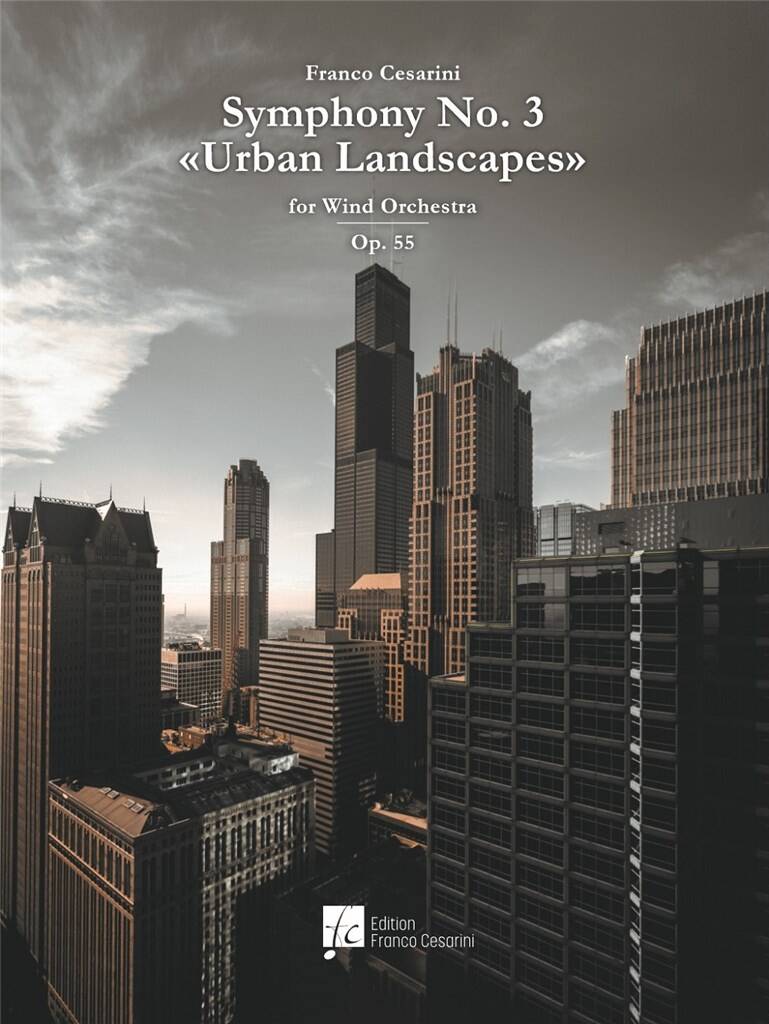
Symphony Nr. 3 Urban Landscapes Op. 55 - Franco Cesarini
Fascinated by the beauty of Chicago, Franco Cesarini has translated his emotions into music: this is how Symphony No. 3 "Urban Landscapes" Op. 55, was born, a musical portrait of this metropolis overlooking Lake Michigan. The composition is divided into three movements: The Wrigley Building from Dawn to Noon, Blue Silhouette and Cloud Gates, which by sharing the same thematic material arranged in cyclical form, strengthen the overall cohesion of the piece. The first movement, preceded by a short slow introduction in which the main theme is presented in an almost dreamlike form, metaphorically represents the city at dawn. The sudden change of time symbolizes the start of activities with all its noises and sounds: you can hear the bell that announces the closing of the subway doors, the sound of cars speeding by, the siren of a patrol car. If the first movement represents the day, the second introduces a nocturnal environment: a melancholic melody played by the English horn anticipates a more animated tempo depicting melodies coming from jazz clubs. Powerful fanfares that take up the second theme of the first movement introduce the third movement. In this finale, the role of the two themes is reversed compared to the first movement and one takes the place of the other in a kind of games of mirrors. Symphony No. 3 "Urban Landscapes" Op. 55: a sumptuous musical portrait of the "Windy City".
Estimated dispatch 7-14 working days
-
 £248.99
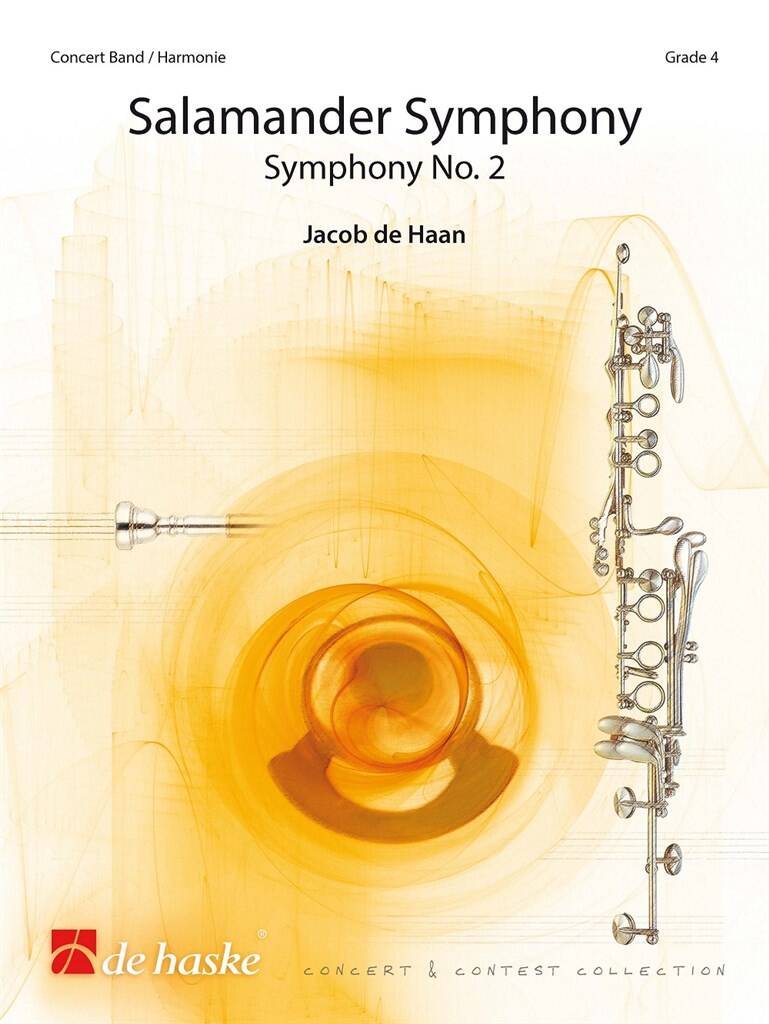
Salamander Symphony - Jacob de Haan
Salamander Symphony is a three-movement work for symphonic wind band in which the city of Kornwestheim, situated in Baden-Wrttemberg, occupies centre stage. It is the name of the well-known shoe factory that was established there in 1899 and that symbolizes the industrial and social development of the city. In the symphony, we find various references to the mythological meaning of salamanders: they are vigorous creatures that contain the soul of fire. Without salamanders there would not be any fire. In addition, a salamander can change its shape and serve as a kind of vehicle through time. In the Berber culture, the salamander represents change.
Estimated dispatch 7-14 working days
 View Music