
Results
-
 £1.95
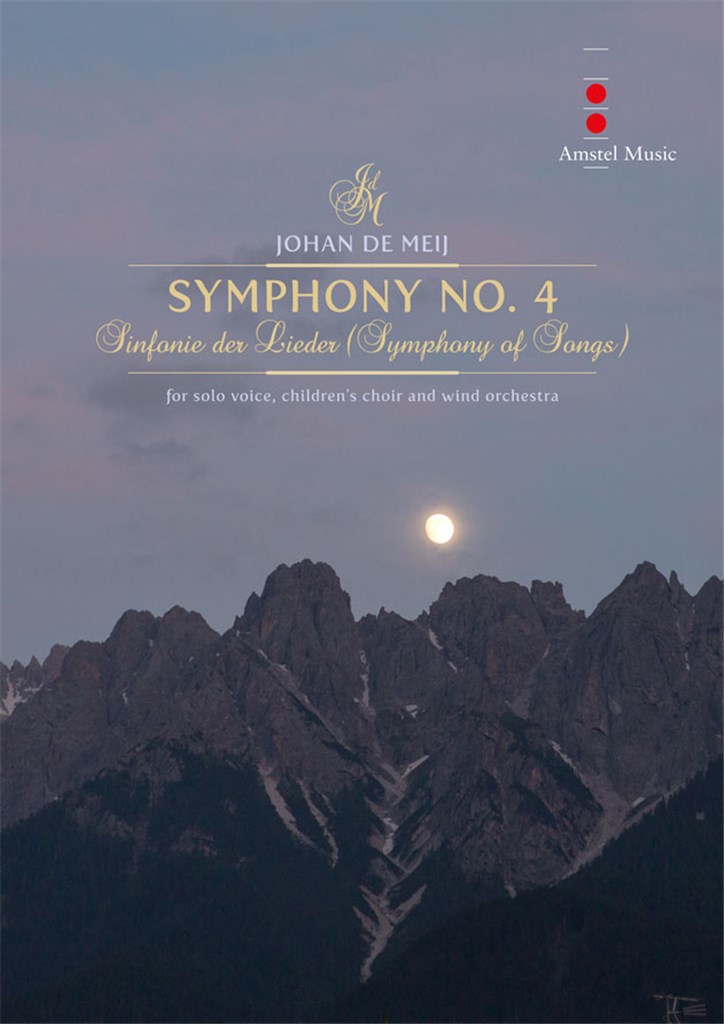
Symphony No.4: Symphony of Songs (SATB Choral Octavo) - De Meij, Johan
Johan de Meij's 4th Symphony for solo voice, children's choir and wind orchestra is inspired by a variety of 19th century German poems.The first three movements use lyrics from the same source as Gustav Mahler did earlier: Kindertotenlieder by Friedrich Ruckert.:Ein Jahr ist nun geschwundenWenn zur Thur hereinWiedersehnThe second half of the symphony continues on the death theme, using a poem by Heinrich Heine (Two Brothers). The last two songs, Early Spring and Song of the Harlequin by Hugo von Hofmannsthal are a metaphor for rebirth, new life and hopeZwei Bruder (Heinrich Heine)Vorfruhling (Hugo von Hofmannsthal)Liedchen des Harlekin (Hugo von Hofmannsthal)Duration: 30:00
Estimated dispatch 7-14 working days
-
 £482.99
Symphony No.1 - The Archangels (Concert Band - Score and Parts) - Cesarini, Franco
The Swiss composer Franco Cesarini has waited a long time to write his first symphony and after years of considering and drafting, this Archangels Symphony, Symphony nr. 1 is a vast composition consisting of highly dramatic language, intense thematic developments and frequent polyphonic elaborations. The thematic material is taken from old Gregorian melodies that form the basis for the entire work, which is, despite the title, a non-programmatic work. It consists out of 4 movements: Gabriel, the gentle archangel; the supreme healer Raphael; the energetic archangel Michael, the Prince of the heavenly host; and surprisingly the archangel Urile, the 'forgotten' archangel. A true masterpiece and a fantastic musical challenge!Duration: 31:20
Estimated dispatch 7-14 working days
-
£340.00
Symphony No.4: Symphony of Songs (Solo Voice, Children's Choir and Concert Band - Score and Parts) - De Meij, Johan
Johan de Meij's 4th Symphony for solo voice, children's choir and wind orchestra is inspired by a variety of 19th century German poems.The first three movements use lyrics from the same source as Gustav Mahler did earlier: Kindertotenlieder by Friedrich Ruckert.:Ein Jahr ist nun geschwundenWenn zur Thur hereinWiedersehnThe second half of the symphony continues on the death theme, using a poem by Heinrich Heine (Two Brothers). The last two songs, Early Spring and Song of the Harlequin by Hugo von Hofmannsthal are a metaphor for rebirth, new life and hopeZwei Bruder (Heinrich Heine)Vorfruhling (Hugo von Hofmannsthal)Liedchen des Harlekin (Hugo von Hofmannsthal)Duration: 30:00
Estimated dispatch 7-14 working days
-
 £132.00
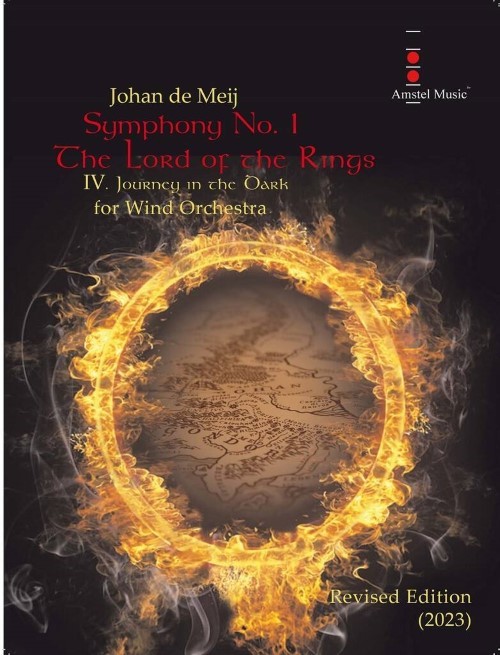
Journey in the Dark (from Symphony No.1: The Lord of the Rings) (Concert Band - Score and Parts) - De Meij, Johan
Revised 2023 editionJohan de Meij's first symphony The Lord of the Rings is based on the trilogy of that name by J.R.R. Tolkien. This book has fascinated many millions of readers since its publication in 1955. The symphony consists of five separate movements, each illustrating a personage or an important episode from the book. The fourth movement describes the laborious journey of the Fellowship of the Ring, headed by the wizard Gandalf, through the dark tunnels of the Mines of Moria. The slow walking cadenza and the fear are clearly audible in the monotonous rhythm of the low brass, piano and percussion. After a wild pursuit by hostile creatures, the Orks, Gandalf is engaged in battle witha horrible monster, the Balrog, and crashes from the subterranean bridge of Khazad-D m in a fathomless abyss. To the melancholy tones of a Marcia funebre, the bewildered Companions trudge on, looking for the only way out of the Mines, the East Gate of Moria.Duration: 9.00
Estimated dispatch 7-14 working days
-
 £132.00
Gollum (from Symphony No.1: The Lord of the Rings) (Concert Band - Score and Parts) - De Meij, Johan
Revised 2023 EditionJohan de Meij's first symphony The Lord of the Rings is based on the trilogy of that name by J.R.R. Tolkien. This book has fascinated many millions of readers since its publication in 1955. The symphony consists of five separate movements, each illustrating a personage or an important episode from the book. The third movement describes the monstrous creature Gollum, a slimy, shy being represented by the soprano saxophone. It mumbles and talks to itself, hisses and lisps, whines and snickers, is alternately pitiful and malicious, is continually fleeing and looking for his cherished treasure, the Ring.Duration: 9.45
Estimated dispatch 7-14 working days
-
 £132.00
Lothlorien (from Symphony No.1: The Lord of the Rings) (Concert Band - Score and Parts) - De Meij, Johan
Revised 2023 editionJohan de Meij's first symphony The Lord of the Rings is based on the trilogy of that name by J.R.R. Tolkien. This book has fascinated many millions of readers since its publication in 1955. The symphony consists of five separate movements, each illustrating a personage or an important episode from the book. The second movement is an impression of Lothlorien, the elvenwood with its beautiful trees, plants, exotic birds, expressed through woodwind solos. The meeting of the Hobbit Frodo with the Lady Galadriel is embodied in a charming Allegretto; in the Mirror of Galadriel, a silver basin in the wood, Frodo glimpses three visions, the last of which, a large ominous Eye, greatly upsets him.Duration: 7.45
Estimated dispatch 7-14 working days
-
 £132.00
Gandalf (from Symphony No.1: The Lord of the Rings) (Concert Band - Score and Parts) - De Meij, Johan
Revised 2023 editionJohan de Meij's first symphony The Lord of the Rings is based on the trilogy of that name by J.R.R. Tolkien. This book has fascinated many millions of readers since its publication in 1955. The symphony consists of five separate movements, each illustrating a personage or an important episode from the book. The first movement is a musical portrait of the wizard Gandalf, one of the principal characters of the trilogy. His wise and noble personality is expressed by a stately motif which is used in a different form in movements IV and V. The sudden opening of the Allegro vivace is indicative of the unpredictability of the grey wizard, followed by a wild ride on his beautiful horse, Shadowfax.Duration: 6.30
Estimated dispatch 7-14 working days
-
 £79.99
Juba Dance (from Symphony No.1 in E minor) (Concert Band - Score and Parts) - Price, Florence - Bocook, Jay
Florence Price (1887-1953) is noted as the first African-American female composer of symphonic works, and is only in recent years beginning to receive the recognition so richly deserved. Her Symphony No. 1 was completed in 1932 and first performed in 1933 by the Chicago Symphony Orchestra. Here is a sparkling transcription for band of the third movement (Juba Dance). Duration: 3:45
Estimated dispatch 7-14 working days
-
 £150.00
Symphony No.3, Finale from (Organ Symphony) (Concert Band - Score and Parts) - Saint-Saens, Camille - VanDoren, Evan
The Finale to Saint-Saens' 3rd Symphony (with Organ) is a shimmering, sparkling explosion of color that stands out among the classical repertoire as one of its most exciting endings! Evan VanDoren has masterfully captured Saint-Saens' unique compositional color and style, adjusting the key for maximum playability, while staying true to the original work! Duration: 8.00
Estimated dispatch 7-14 working days
-
 £407.00
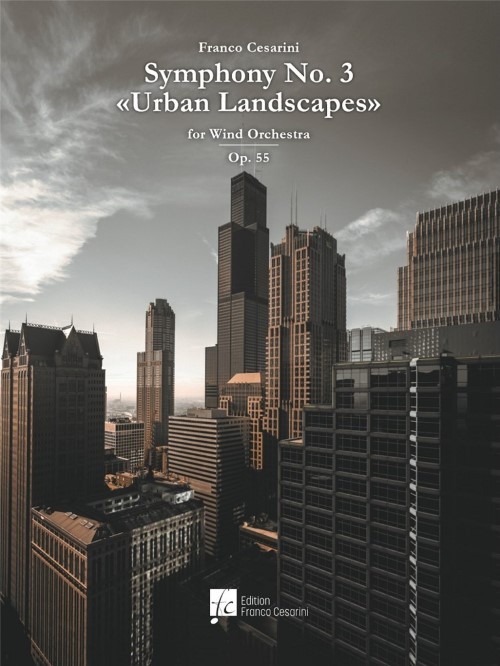
Symphony No.3 (Urban Landscapes) (Concert Band - Score and Parts) - Cesarini, Franco
Fascinated by the beauty of Chicago, Franco Cesarini has translated his emotions into music: this is how Symphony No. 3 "Urban Landscapes" Op. 55, was born, a musical portrait of this metropolis overlooking Lake Michigan. The composition is divided into three movements: The Wrigley Building from Dawn to Noon, Blue Silhouette and Cloud Gates, which by sharing the same thematic material arranged in cyclical form, strengthen the overall cohesion of the piece. The first movement, preceded by a short slow introduction in which the main theme is presented in an almost dreamlike form, metaphorically represents the city at dawn. The sudden change of time symbolizes the start of activities with all its noises and sounds: you can hear the bell that announces the closing of the subway doors, the sound of cars speeding by, the siren of a patrol car. If the first movement represents the day, the second introduces a nocturnal environment: a melancholic melody played by the English horn anticipates a more animated tempo depicting melodies coming from jazz clubs. Powerful fanfares that take up the second theme of the first movement introduce the third movement. In this finale, the role of the two themes is reversed compared to the first movement and one takes the place of the other in a kind of games of mirrors. Symphony No. 3 "Urban Landscapes" Op. 55: a sumptuous musical portrait of the "Windy City". Duration: 27.00
Estimated dispatch 7-14 working days
 View Music