
Results
-
 £514.99
Symphony No. 1 The Lord of the Rings (complete ed) - Johan de Meij
Johan de Meij's first symphony The Lord of the Rings is based on the trilogy of that name by J.R.R. Tolkien. This book has fascinated many millions of readers since its publication in 1955. The symphony consists of five separate movements, each illustrating a personage or an important episode from the book. The movements are: I. GANDALF (The Wizard) II. LOTHLORIEN (The Elvenwood) III. GOLLUM (Smagol) IV. JOURNEY IN THE DARK a. The Mines of Moria b. The Bridge of Khazad-Dm V. HOBBITS The symphony was written in the period between March 1984 and December 1987, and had its premire in Brussels on 15th March 1988, performed by The Royal Band of the Belgian Guides under the baton of Norbert Nozy. In 1989, the Symphony The Lord of the Rings was awarded first prize in the Sudler International Composition Competition in Chicago. In 2001, the orchestral version was premiered by the Rotterdam Philharmonic Orchestra and was recorded by the London Symphony Orchestra.
Estimated dispatch 7-14 working days
-
 £482.99
Symphony in Green - Thomas Doss
As with the first symphony, the second symphony is not programmatic as such, but also takes its inspiration from the confrontation of man with his role in nature. Dedicated to the 2011 National Garden Show in Upper Austria, this symphony earned its subtitle Symphony in Green and explores musically the connotation of this colour as the colour of nature, of life and of hope.
Estimated dispatch 7-14 working days
-
 £332.99
Symphony No. 9, Op. 160 - James Barnes
Premiered on September 21, 2018 in Lawrence, Kansas by the University of Kansas Wind Ensemble (Dr. Paul Popiel, conducting), James Barnes' Ninth Symphony was composed between January and late June of that same year. This large work was commissioned by a consortium of twenty-one college bands, community bands, professional bands and individuals to help mark the 70th birthday of the composer (b. 1949). It is an expansive forty-minute work in four movements, of which the composer writes, This is my last symphony... this work represents a compendium of all that I have learned during the fifty years of composing and scoring for this wonderful new medium: the modern wind band. The first movement, subtitled Elegy, is based around G minor. It is the longest movement of the symphony. Tragic and despondent in character, it is cast in sonata-allegro form. The second movement is entitled Scherzo. Barnes claims that I have always wanted to write a waltz, and that is how this movement is cast, in a modified rondo form in D minor. In contrast to the mood of the first movement, the scherzo is a delightful posy of expansive melody, splashy color, humor and rhythm. The third movement, which is in a modified tertiary form, is entitled Night Music. In contrast to the scherzo, this movement begins with a mysterious incantation, first displayed by solo Alto flute. The music becomes even darker and more mysterious, while overall the movement effectively expresses an otherworldly mood, ending with a solo soprano offstage which suddenly emerges, eerily singing a modified version of the opening incantation. Cast in sonata-allegro form, the fourth movement is most definitely a rousing Finale, beginning with a brilliant fanfare and undergoing several mood transformations before emerging into the final coda, ending the symphony with an energetic splash of color.
Estimated dispatch 7-14 working days
-
 £115.60
Terrible Symphony - Haakon Esplo
Let us present "Terrible Symphony" - the perfect piece for beginner or junior bands!This fun composition gives young musicians the opportunity to have a great time while driving the conductor crazy. The piece includes well-known themes from great symphonies, along with new music, and not least, lots of silliness and fun. All musicians can join in and come up with more pranks and humorous elements. The audience will laugh out loud and enjoy this crazy and entertaining, yet terrible symphony.Make your concert an unforgettable experience with "Terrible Symphony"!In the score, you will find instructions and suggestions for the conductor as the musicians become increasingly impossible.
Estimated dispatch 7-14 working days
-
 £482.99
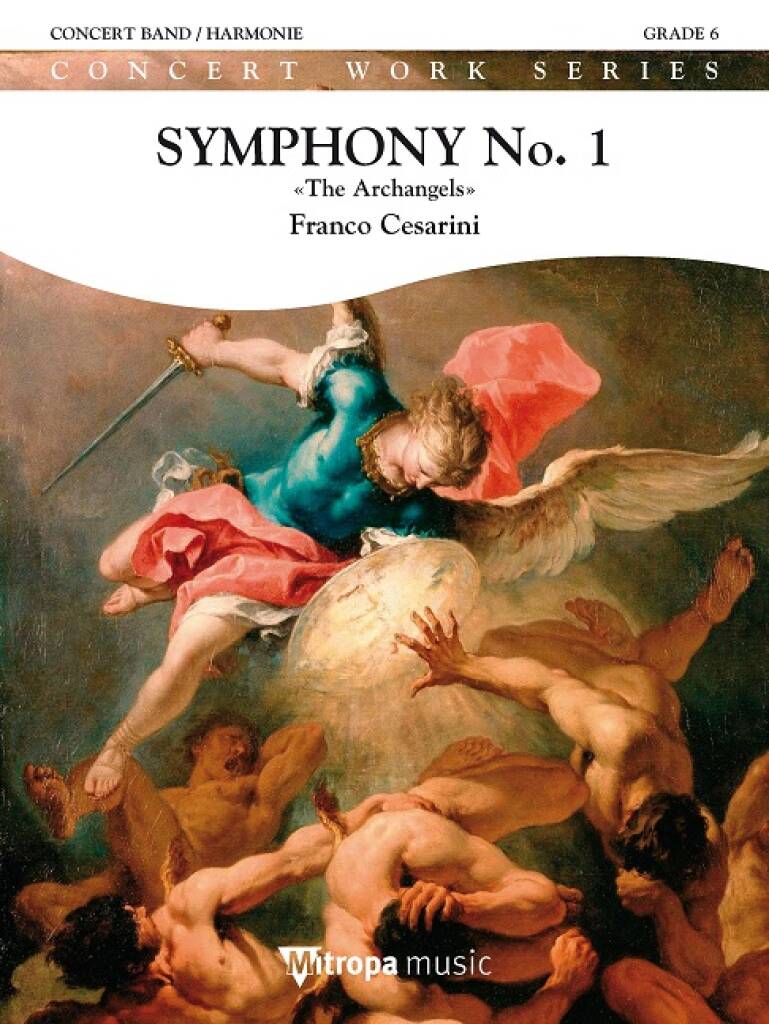
Symphony No. 1 - The Archangels - Franco Cesarini
The Swiss composer Franco Cesarini has waited a long time to write his first symphony and after years of considering and drafting, this Archangels Symphony, Symphony no. 1 is a vast composition consisting of highly dramatic language, intense thematic developments and frequent polyphonic elaborations.The thematic material is taken from old Gregorian melodies that form the basis for the entire work, which is, despite the title, a non-programmatic work. It consists out of 4 movements: Gabriel, the gentle archangel; the supreme healer Raphael; the energetic archangel Michael, the Prince of the heavenly host; and surprisingly the archangel Urile, the'forgotten' archangel.A true masterpiece and a fantastic musical challenge!
Estimated dispatch 7-14 working days
-
 £520.99
A Colour Symphony - Philip Sparke
Philip Sparke's third symphony, A Colour Symphony, was commissioned by "sinfonischen blasorchester wehdel" conducted by Thomas Ratzek. In the five movements (white, yellow, blue, red and green) the composer creates links betweenthe instrumentation and harmonic elements and the actual colour of the spectrum the movement stands for. In order to create the greatest richness possible, Philip Sparke used a very large instrumentation including low woodwinds, harp, piano andcelli. A Colour Symphony is an impressive and iconic addition to the standard repertoire for large symphonic bands.
Estimated dispatch 7-14 working days
-
 £274.99
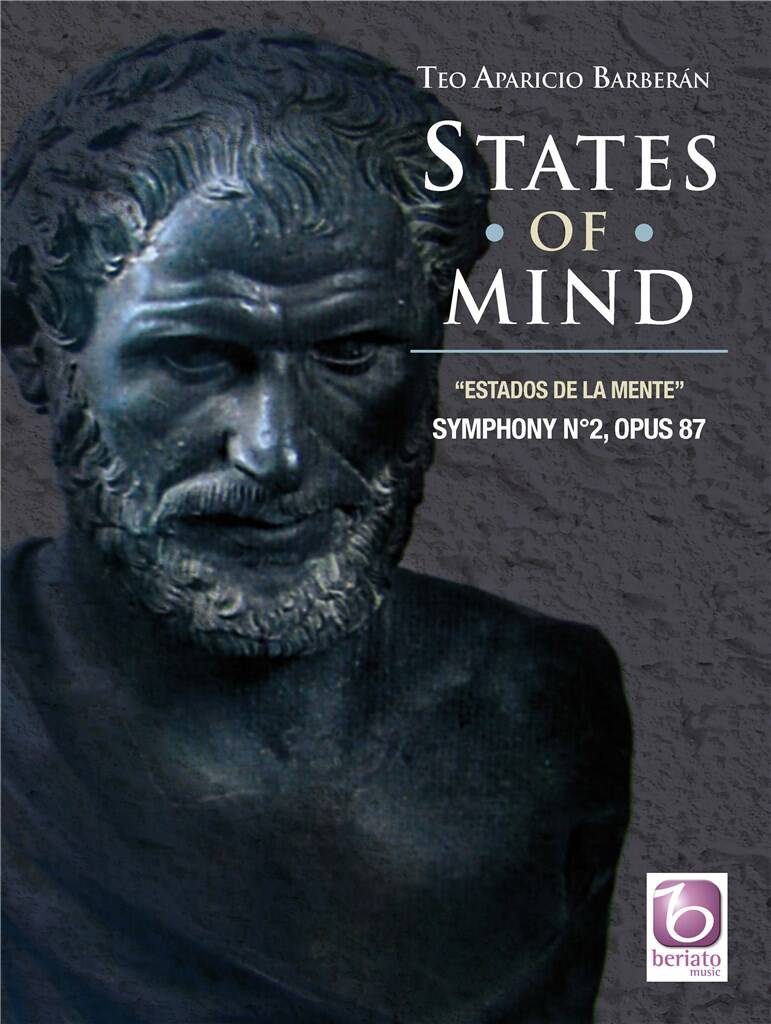
Symphony No. 2: States Of Mind, Opus 87 - Teo Aparicio-Barberán
I- Logos (reason)II- Pathos (emotion)III- Ethos (credibility)The ancient Greeks believed that music shaped the character of man. In Egyptian temples, music was an essential part of the magical rites to alter the course of nature or to treat illness.And today we know that sound can actually alter matter. The secret of music lies in harmony and mathematics, as many great musicians and experts have always known.One of the most important qualities of music is that it enables the listener to focushis attention inwards instead of on what is around him. It is indisputable that music can inspire emotion. Music leads us into a universe of emotions that are difficult to put into words. In short, music reaches into corners of our soul and thoughtsthat words cannot reach and makes it possible to more clearly describe these different States of mind.The composer of this symphony also believes that each "musical argument" must be constructed so that it will induce the desired reaction in thelistener.Music: more than wordsIn recent times, most orchestral symphonies have been based on a story, a text or something similar so that their composition must be structured accordingly.The intention of this work by Teo Aparicio-Barbern is quitedifferent. The composer describes the three elements of the argument as the only formal structure of the work. Since certain philosophers in world history were able to subdivide grammatical argument, why shouldnt that also be possible for the musicalargument?Since ancient times the power of the spoken word has captivated mankind. How can an argument move people and mobilise the masses? Where does the power of words come from today? The answer lays not so much in what people say but in how theysay it.Rhetoric is one of the oldest humanist disciplines in Western civilisation. Aristotle, in the 4th century BC, called it the art of persuasion. Indeed, the terms rhetoric and persuasion are mutually interchangeable.More than 2000 years agoAristotle structured his rhetoric according to the following three elements: the logos, the pathos and the ethos.Logos (words, reason) is the reasoning that gives freedom to the structure of the text by expressing what one wishes to say usingspecialist terms. With logos we create arguments to receive public approval and to defend our ideas.Pathos, the second element, refers to the effective use of public psychology. Pathos can be considered as the capacity to induce the desired emotionalresponse in the public, by creating an emotional connection with the public so that they accept our message.The third element, ethos (credibility), refers to the character of the speaker and is perhaps the most important of the three elements.Aristotle based his concept of ethos upon his belief that truth and justice will always have the upper hand over anger. He believed that what was true and good was easier to prove and was more persuasive.This second orchestral symphony from thecomposer from Enguera follows these three parameters of the argument according to Aristotle. Each movement tries to summon a different state of mind in the listener so that the message itself can be better understood and appreciated. Apart from thesethree general concepts the music is only structured, as Claude Debussy would say, in a "formative way".The first movement, logos, is based on a scherzo melody that undergoes various changes in rhythm and harmony. The arguments are presented by meansof conventional techniques of composition. The second movement, pathos, is characterised by suggestions of sound. It is subdivided into two large parts. The first part is based on a five seven sequence with five sounds that are repeated in differentenvironments, structures and dynamics. The second part, which is largely tonal, brings out more directly the emotional overtones that each argument must have. The third movement, ethos, is a faithful rendition of the composers personality. In thislast part, clear rhythmic sequences stand out, there are large dynamic contrasts and lots of tone variation. In addition, and this is quite in keeping with the composers earlier work, the harmony in States of Mind is handled in a manner that is bothoriginal and efficient, as a result of which Aparicio-Barberns message is well understood by the listener.This second symphony by Teo Aparicio-Barbern is devoted to "my dear Henrie Adams, a guiding light in this eternally dark musical world. Thankyou for everything."
Estimated dispatch 7-14 working days
-
 £233.99
First Symphony, Op. 35 - James Barnes
Composed during the summer and fall of 1974, Barnes' FIRST SYMPHONY, Op. 35 was his master's thesis at The University of Kansas. It was premiered in the spring semester of 1976 by their Symphonic Band, Robert E. Foster conducting. The following year, the symphony was awarded the American Bandmasters Ostwald Composition prize, which led to a second performance (of only the first two movements) by the Northwestern Wind Ensemble at the American Bandmasters convention with Col. Jack Cline (U.S Marine Band) conducting. Following this performance, Barnes submitted the work to several publishers, all of which declined on the basis it was too long and difficult to be marketable. For this reason, Barnes set the work aside and there it remained until 2022, when an offer came from the Osaka Shion Wind Orchestra to record all nine of Barnes'_x001A_symphonies to help celebrate their 100th anniversary. Barnes seized the opportunity, engraving all four movements, with revisions and corrections, an effort that took seven days a week for two months to complete. As a result, after almost fifty years, all nine of the Barnes symphonies are finally available for performance.
Estimated dispatch 7-14 working days
-
 £139.90
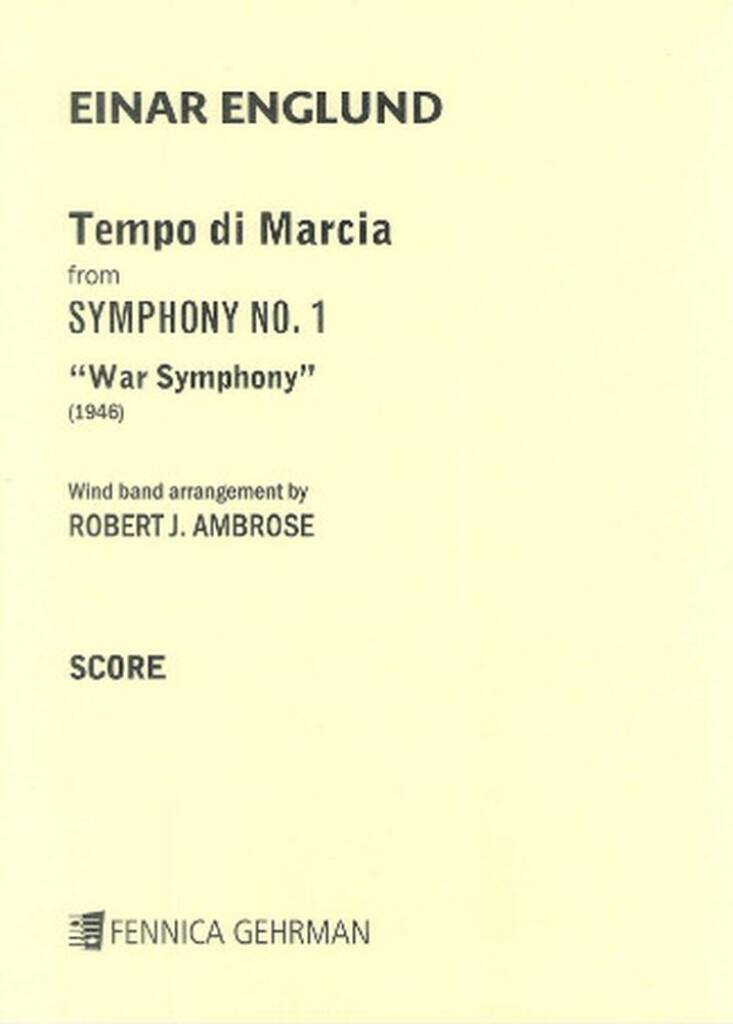
Tempo di Marcia from Symphony No. 1 - Einar Englund
Einar Englund (1916-1999) was a major Finnish composer of symphonies, concertos and film music. His first symphony (1946) bears the title "War Symphony", not given by the composer. He preferred to think think of it rather as a euphoric shout of joy at living to survive the hells of war. The first movement Tempo di marcia depicts seemingly never-ending marching through Karelia during the Soviet-Finnish war. Influences from Sibelius and Shostakovich are present.American conductor Robert J. Ambrose's arrangement of Englund's Tempo di Marcia is scored for wind band. The duration is 9 minutes. This product includes the full score and the parts:PiccoloFlute 1-2Oboe 1Oboe 2 doubling English hornBassoon 1-2Clarinet 1-3 B-flatBass Clarinet B-flatSoprano Saxophone (opt.) (part for alto saxophone II provided in lieu of soprano saxophone)Alto SaxophoneTenor SaxophoneBaritone SaxophoneHorn 1-4 FTrumpet 1-3 B-flatTrombone 1-3Euphonium (BC)TubaTimpaniPercussion 1-4Harp (opt.)Double Bass
Estimated dispatch 7-14 working days
-
 £407.00
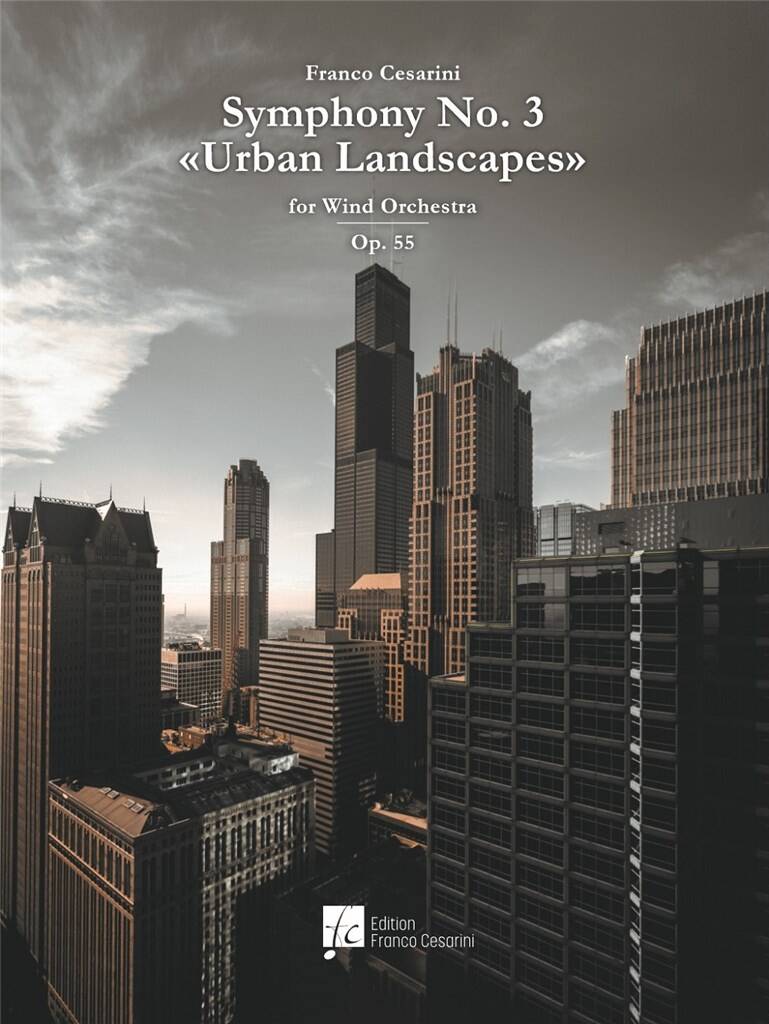
Symphony Nr. 3 Urban Landscapes Op. 55 - Franco Cesarini
Fascinated by the beauty of Chicago, Franco Cesarini has translated his emotions into music: this is how Symphony No. 3 "Urban Landscapes" Op. 55, was born, a musical portrait of this metropolis overlooking Lake Michigan. The composition is divided into three movements: The Wrigley Building from Dawn to Noon, Blue Silhouette and Cloud Gates, which by sharing the same thematic material arranged in cyclical form, strengthen the overall cohesion of the piece. The first movement, preceded by a short slow introduction in which the main theme is presented in an almost dreamlike form, metaphorically represents the city at dawn. The sudden change of time symbolizes the start of activities with all its noises and sounds: you can hear the bell that announces the closing of the subway doors, the sound of cars speeding by, the siren of a patrol car. If the first movement represents the day, the second introduces a nocturnal environment: a melancholic melody played by the English horn anticipates a more animated tempo depicting melodies coming from jazz clubs. Powerful fanfares that take up the second theme of the first movement introduce the third movement. In this finale, the role of the two themes is reversed compared to the first movement and one takes the place of the other in a kind of games of mirrors. Symphony No. 3 "Urban Landscapes" Op. 55: a sumptuous musical portrait of the "Windy City".
Estimated dispatch 7-14 working days
 View Music