
Results
-
 £90.30
Concertino Opus 26 - Carl Maria von Weber
Carl Maria von Weber (1786-1826) was a pupil of Michael Haydn. Before he was fifteen years old he had already composed an opera, a mass and piano music. He was subsequently director of the Prague Opera House and Music Master at the Dresden Court. The overtures to his operas DER FREISCHTZ and OBERON are still often performed by wind bands, though it is often lesser known that von Weber also wrote pieces for 'Harmoniemusik', such as a CONCERTINO IN C for oboe and small wind band.Von Weber wrote most of his clarinet works for the famous German clarinettist Heinrich Brmann (1784-1874). This was the case for his CLARINET CONCERTO No1 in F and his CLARINET CONCERTO No2 in Eb and for the CONCERTINO, all composed in 1811. Von Weber was very impressed by Brmann's virtuosity and the expressiveness of the clarinet. The CONCERTINO is one of the very great works of the classical clarinet repertoire. A slow introduction is followed by a cheerful theme repeated with several contrasting variations. This pre-eminently romantic clarinet piece was scored for symphonic band by the French composer and arranger Charles Lhomme (Hargicourt 1889).
Estimated dispatch 7-14 working days
-
 £116.40
Meistersinger von Nurnberg - Richard Wagner
In 1867 Richard Wagner completed his only comic opera 'Die Meistersnger von Nrnberg' (The Mastersingers of Nuremberg) for which he himself had written the libretto, based on the 'Nuremberg Chronicles' from 1697 by Johann Christoph Wagenseil. The plot is partly historical, partly romantic and partly satirical. The prelude is based on some of the main themes of the opera; it starts with the impressive martial processional theme of the Mastersingers and also boasts a passionate love theme as well as the famous contest song which the hero, Walter, has to sing in order to win both the contest and his beloved Eva's hand. Willem Steijn wrote this fine arrangement for symphonic band.
Estimated dispatch 7-14 working days
-
 £96.00
Overture La Poupe de Nuremberg - Adolphe Charles Adam
Adolphe Adam earned his living as a music critic and a composer, though he himself considered composing as mere pastime. He is still famous because of his ballet music and he was said to find his inspiration while looking attentively at the young female dancers' legs. His comic opera La Poupe de Nuremberg was most successful in Paris in the nineteenth century. The splendid overture is a highlight of the French opera and a real asset for any orchestra.
Estimated dispatch 7-14 working days
-
 £76.99
The Magic of Andrew Lloyd Webber - Andrew Lloyd Webber
Andrew Lloyd Webber's spectacular music for the stage is featured in this exciting medley. Songs include: Superstar (Jesus Christ Superstar), I Don't Know How To Love Him (Jesus Christ Superstar), Don't Cry For Me Argentina (Evita), Memory (Cats), The Phantom Of The Opera (The Phantom Of The Opera).
Estimated dispatch 7-14 working days
-
 £83.00
El Gato Monts (The Wild Cat) - Manuel Penella
In a famous moment from Manuel Penella's 1916 opera El Gato Monts ("The Wildcat"), a matador sings exuberantly to his beloved young gypsy woman that he will fight the bulls for her. In this marvelous adaptation, Shelley Hanson combines the march melody from this scene along with another melody from the opera in creating a well-balanced and appealing work for the concert stage.
Estimated dispatch 7-14 working days
-
£60.99
Der Zaubermarsch - Rob Ares
On 30th September 1791, a few months before his death, the opera "Die Zauberflote" (The Magic Flute) by Wolfgang Amadeus Mozart was given its first performance. It was remarkable that despite his ill health and his disastrous financial situation he was able to compose a work of such comic genius. Mozart composed the overture in the two days before the premier of the opera and it is on this overture that this transcription is based. To perform the work 'a la Mozart' only the timpani part should be used, the additional percussion parts have been added by the arranger and are therefore optional.Mozart 40th SymphonyThe Austrian composer Wolfgang Amadeus Mozart lived atragically short life of thirty-five years. Towards the end of his life in the summer of 1788, he wrote three symphonies in the span of a little over six weeks. His Symphony No.40 in G Minor was one of those great works. This setting of the first movement from that Symphony provides ample demonstration of the composer's grace, inventiveness and pervasive sense of humour, which can be found throughout his music.
Estimated dispatch 7-14 working days
-
 £102.99
The Fairy Tale King - Jacob de Haan
This work is inspired on the dramatic life story of Ludwig II, former king of Bavaria. He was given the nickname Fairy Tale King because of his eccentric lifestyle, his love for medieval sagas, and the building of extravagant fantasy palaces, such as the world famous Neuschwanstein Castle. Ludwig II grew up in a strict environment but found support through his friendships, love for romantic fairytales, and the music of the German 19th century composer Richard Wagner. After Ludwig's sudden accession to the throne followed a cancelled wedding and a tragic ending, after which he became a national icon of Bavaria. The music reflects his eventful life with fairy-tale-like, romantic and dramatic sounds. Two themes from Wagner's famous opera Lohengrin form a returning homage to his tragic life story.
Estimated dispatch 7-14 working days
-
 £53.95
French Chanson - P. Certon
French Chanson, arranged by Steven J. Pyter, is a rousing arrangement of a famous 16th-century choral work. The tuneful Renaissance art song tells a light-hearted story of gossip and rumor, with lyrics roughly translating to "I will tell you!" The story centers around a jealous husband suspicious of his beautiful wife. Like opera, the piece employs dramatic and whimsical characteristics to tell a passionate story. This arrangement alternates between tutti statements and short interludes to feature each instrument family in the band---woodwinds, brass, and percussion. The intensity and playfulness make for a great concert opener! (1:40)
Estimated dispatch 7-14 working days
-
 £66.95
Polka: From Schwanda the Bagpiper - Douglas E. Wagner
A true classic of the concert band repertoire, the upper-end transcription of this excerpt from Czech composer Jaromr Weinberger's folk opera Schwanda the Bagpiper has appeared on countless concert programs and contest lists for the past nine decades. At long last, this cheerful work is available in a solid scoring for younger players, expanding its appeal to many more ensembles and audiences. Arranged from the original orchestral score, all parameters of this level have been observed for ease of preparation. (2:00)
Estimated dispatch 7-14 working days
-
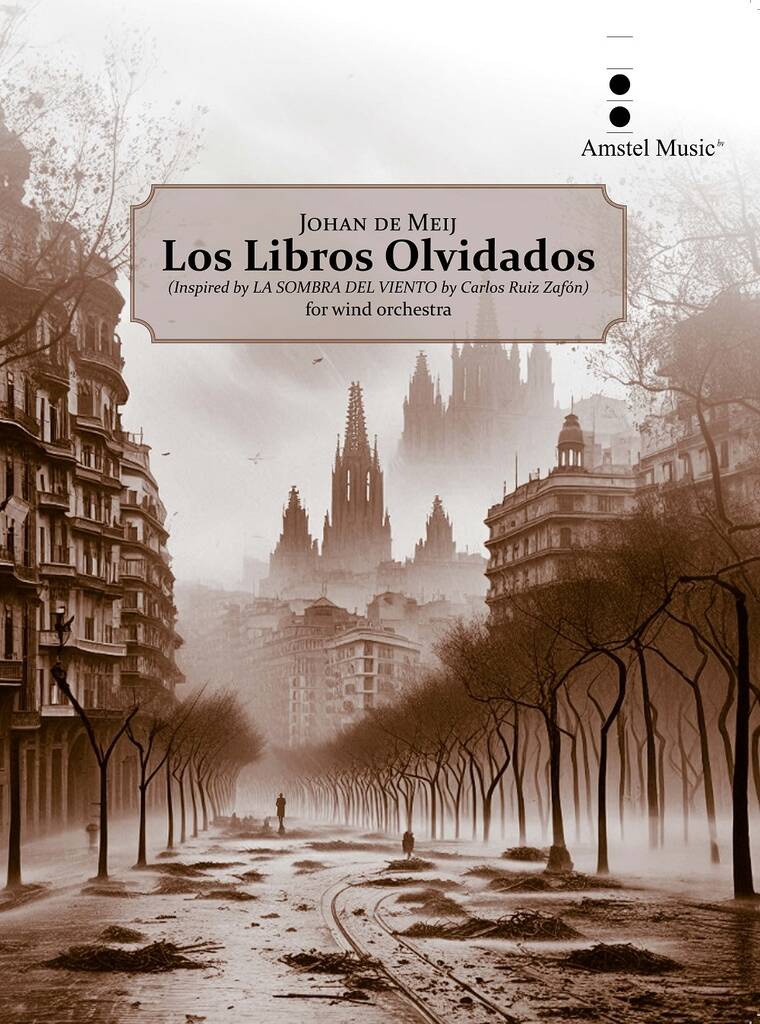 £225.99
Los Libros Olvidados - Johan de Meij
1. Barcelona 19452. Los Libros Olvidados - El Cementerio3. Las Ramblas - Els Quatre Gats4. Coubert - El Hombre sin Rostro5. Bea (Beatriz)6. El Inspector Fumero7. La Ciudad de las SombrasThis is a story wrapped within a story that unfolds in Barcelona 1945, following World War II. The protagonist, Daniel Sempere, is the teenage son of an antiquarian book dealer, who one day takes him to the Cemetery of Forgotten Books, a mysterious place with labyrinthine corridors where rare and banned books are stacked in massive dusty piles. His father tells Daniel to select a book, but it will be his responsibility to protect it. Daniel picks La Sombra del Viento (The Shadow of the Wind), a novel by a forgotten author Julin Carax. Daniel immediately starts reading the book, and the story unwinds itself into a compelling and complicated plot. As he reads, Daniel finds himself and his own life merging into the story's plot. It transpires that there is a mysterious man named Lan Coubert ('the man without a face') who is determined to destroy all copies of Carax's books. Daniel is threatened by Coubert and is determined to find out what happened to Carax, who fled to Paris and subsequently disappeared. Daniel finds that his own life has much in common with the author's. The book mixes magic realism, page-turning mystery, and Daniel's own real life. Daniel's once ordinary teenage existence is now filled with larger-than-life colorful and at times, terrifying characters. Among them are Fermn Romero de Torres, a beggar who Daniel and his father befriend and employ in the family bookstore; the evil police inspector Javier Fumero, who could be compared to Scarpia in Puccini's opera Tosca or Javert in Les Misrables. The corrupt Fumero uses the war as an excuse to practice his sadism and is widely feared in Barcelona. He is represented in the music by a fascist military march. The city of Barcelona becomes a character in the book and in the music. The Ramblas, the boulevard running through Barcelona's Gothic Quarter and the famous caf Els Quatre Gats (the four cats) come alive in the score through a Cobla, the traditional wind ensemble playing a sardana, typical Catalan folk music. Two parallel love stories turn up the heat: Julin Carax's passionate, forbidden love for Penlope, and Daniel's equally passionate and forbidden love for Beatriz (Bea). Bea's sultry love theme is based on the first three letters of her name, with the ascending intervals B-E-A. Johan de Meij New York, October 17th, 2023
Estimated dispatch 7-14 working days
 View Music