
Results
-
£67.50
Mechanical Mice - Graydon A. Toms
EEEEEEEK! It's a whimsical excursion into the realm of the mechanical mice! It's a rodent round-up! It's a veritable vortex of vagabond voles! Are we to be vexed by vociferous vermin? Let's find out while we have some fun!Your young band will love playing this one, as well as using their instruments in a creative but non-standard way. The effect of the little clicking critters can be quite amazing. Whoa! Here comes the CAT! Beware, though, because you know your band will want to play it again and again.Graydon Toms has composed some great music for young bands in the past, and this new one is sure to please the entire audience as well as the musicians. You've found a greatnew tune for your young band! CongRATulations!
Estimated dispatch 7-14 working days
-
 £93.50
Bamboo Warrior - Christina Huss
This piece is truly epic! It is lush, it is tuneful, and it is aggressive. Composer Christina Huss was clearly inspired by the music of the far east harmonically and with authentic instruments like the Taiko drum. It is a musical and dramatic work.
Estimated dispatch 7-14 working days
-
 £159.60
Drieluik - Oscar van Hemel
Drieluik is one of the pearls in the repertoire, which is specifically written for wind band. It is an interesting piece in a contemporary idiom that was written ahead of its time (1969). This is a revised and colourful orchestration, and hopefully returns Triptych to its former glory, and gives it the attention it deserves. It is an exciting composition for the musicians, with many chamber music type moments, various solo opportunities and full of energy.
Estimated dispatch 7-14 working days
-
 £214.80
Missa Solemnis - Serge Lancen
This Mass has been dedicated to His Holyness Pope John Paul II, to witness Lancens deep and respectful admiration for the Holy Father. The work was composed in 1986 and written for two solo voices: a soprano and a baryton-Martin (high baritone), mixed choir, harp (ad libitum) and symphonic band or organ. It has ten parts: INTROIT - KYRIE - GLORIA - OFFERTORIUM - SANCTUS - PATER NOSTER - AGNUS DEI - COMMUNIO - DEO GRATIAS - and as final part an ALLELUIA. Lancen expressed his views about this Mass as follows: 'The most important aspect of the Mass is the praising of God and the sacrificing to God; that is why I thought it suitable to use both the themes of the Sanctus and the Offertorium in writing the Introtus. It seemed to me also quite logical that the initial themes of the Kyrie and the Agnus Dei would be rather similar as these are two moments where the priest and the worshippers invoke God. The composition ends with a brilliant Alleluia in which I also briefly quote the theme of the Sanctus.' This Mass was premiered on 27 may 1989 at 'Our Lady's Church' in Maastricht, The Netherlands, as part of the celebrations of the fiftieth anniversary of the Roman Catholic Band Federation of the Limburg County. The Bishop Castermans celebrated the Mass, whereas Jan Cober conducted this first performance. The Missa Solemnis is an alternation of meditating, though often impressive, orchestral passages with angelical choral sounds and the pious singing of both soloists. This may not be the type of music we usually expect from Serge Lancen, but nevertheless the composer remains faithful to his own typical style of composition. You can call this work romantic, though it surely is 'contemporary' or, why not, 'from all times'. The instrumentation is varied and extremely rich, mostly due to Lancen's typical use of 'wind band colours'. This Latin Mass suits perfectly well in the tradition of Roman-Catholic Masses that have been written by several great composers.
Estimated dispatch 7-14 working days
-
 £140.80
Cinquantieme - Serge Lancen
Cinquantieme, the fiftieth composition for symphonic band by Serge Lancen, was composed in the fall of 1993. It is written in an overture form and built on four distinct themes. First there is a merry and dynamic March, followed by a Waltz of the same character; then comes a small melody and finally the March turns up again, but this time it ends with a triumphant theme. The overture is dedicated to Alain Thiery and his Symphonic Band of Pont-Ste-Marie/La-vau/Creney. It was premiered during the gala concert closing the 120th anniversary celebrations of that band. The number in the title 'Cinquantieme' (Fiftieth), indicates the richness of Lancen's wind band repertoire. Fascinated by the symphonic band's extremely rich range of tone colours, Lancen has devoted all his talent and passion to it. For this type of orchestra he has written symphonies, rhapsodies, several concertos and even religious compositions with choirs and soloists.
Estimated dispatch 7-14 working days
-
 £159.60
Suite Acadienne - Bernhard Bogisch
1. La belle Franoise.This song tells the story of the beautiful Franoise, who is visited by her lover on the eve of his departure. She helps him prepare for his voyage and they talk for the last time at the foot of a rock, which has been their trysting place. The next day, when he has left the harbour, he hears the sound of a bell. It is the bell that tolls for Franoise, who is being carried to her grave.2. Le Prince Eugne.At least two versions of this song are in existence, both of which are represented here. It tells of the prince Eugne, who, on his way to Paris, encounters twenty of his worst enemies. He manages to kill fourteen of them before his sword breaks. He then asks his page to get him another sword, but the lad is too afraid for his own life. This being the case the prince tells him to tell his wife to take care of his son, who 'will have his revenge by lighting a candle in Paris'.3. Pinson et Cendrouille.This song deals with the marriage of two not further specified animals, who have nothing with which to prepare a wedding feast, and need help from the other animals. But when the rat comes in carrying a fiddle, he is chased away.4. Le Dpart de l'Amant.At least two versions of this song are known, both of which are represented here. It is one of many songs dealing with departure, and is of Canadian origin. The lover is warned of the charms of the pretty 'canadiennes' which among Acadiens refers to French Canadians from Qubec. 'Be true to me save your heart. When I return from my voyage I will make you happy'.5. Le Remde son Talon.This, like many children's/folk songs is a bit of a nonsense song. Marguerite has trouble with the heel of her shoe, and asks her mother for help. Mom suggests various things, such as an onion (too round), a tomato (too flat) etc. In the end it turns out that a bachelor is her best bet.
Estimated dispatch 7-14 working days
-
 £35.50
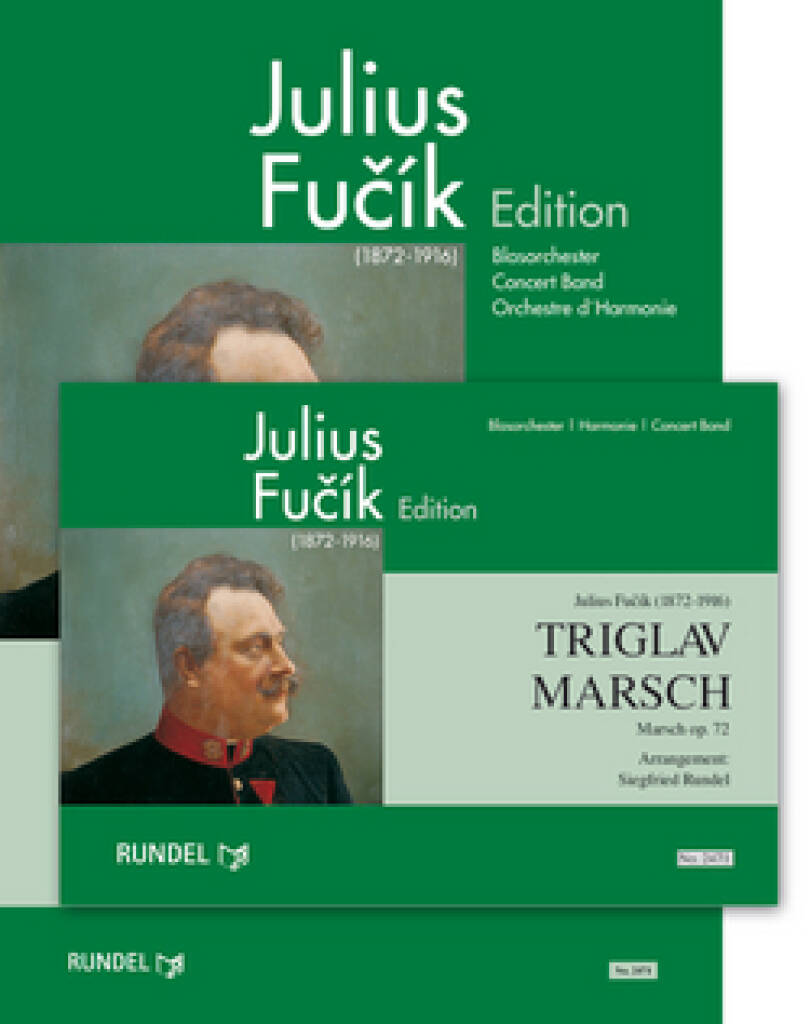
Triglav - Julius Fucik
Julius Fuc k (1872-1916) appreciated life in Sarajevo. First compositions were written, which soon made him become one of the leading representatives of his profession in Austria-Hungary. Among those works also figured his elaborate piece "Austria's Glory and Honor", which unfortunately remains kind of ill-fated up to now. Yet another area of activities, where Fu k was able to demonstrate his talents was to stage the symphony concerts introduced by him in Sarajevo. Late in fall of the year 1900 Fuc k's time had come, when the regiment deployed from Sarajevo to Budapest. He lived in that metropolis on the Danube for the next some ten years, and during that period most of hisworks were composed. At that time his popularity also grew from day to day. The first performances of his works met with general interest, and not only numerous officers most of them were friends of Fuc k attended these events, they rather were attractions for all ranks of the society. It should also not be overlooked that music publishers were anxious to secure almost each one of his works for their publishing company, and most of them were printed immediately after their premieres. In 1899 the "Laban March" was written as his Opus 44. It was dedicated to Major General Rudolf Laban of Vralje, commander of the 3d Mountain Brigade which was stationed in Nevesinje. The title of the march then changed to "Eiserne Brigade" ("Iron Brigade") until it finally became known as "Danubia". It was first printed as late as 1933 by Bohuslav Leopold (Edition Continental). Leopold was a musician in Fuc k's regimental band, and later a successful publisher. He succeeded in securing the best of Fuc k's works for his company. Sketches of "Triglav" date back to 1903. The title alludes to the highest mountain of the province of Slovenia, and this was probably an apt means in the eyes of the composer to demonstrate his "Slavonic patriotism".
Estimated dispatch 7-14 working days
-
 £154.60
Den store dagen - Benny Borg
This beautiful song contains a huge contrast between the hopeful and the disappointing. A mother has her birthday and is waiting her children to celebrate it. Each verse starts optimistically, but the short chorus is characterized by the disappointment, that everyone calls, and cannot come. This has been tried recreated musically, mostly in the last two choruses, as it dawns on her that she will not receive a visit. It's a beautiful tune, but with a serious message that it's easy to take someone for granted.One of the elements the musicians came up with after rehearsal, was that they really liked the change between the ballad parts with even eights and the swing parts. This also gives the piece a sense of "parlando" character, which tells a story, and is therefore important to focus. It is not quite simple, as the melody also in those parts with even eights has some triplet rhythms. Therefore, this is a topic you can work on.Regarding instrumentation, Flugelhorn, Alto Saxophone and Euphonium have important roles, in addition to the rest of the first parts in the Band. The arrangement is written so you are not depending on "special" instruments. Important details are also often duplicated so you can use the arrangement for a smaller Wind Band.It is also possible to use a vocal soloist, but then you must soften the instruments that holds the melody.
Estimated dispatch 7-14 working days
-
 £113.30
Moderate Dances - Angelo Sormani
This piece is a tribute to dance music, especially passionate, intense and meditative dance music. "Moderate Dances" is divided into three movements: a "Tango", a "Slow Waltz" and a "Bossa Nova". Each movement and each dance has its own particular characteristics but, when combined, these different rhythmic beats and times give the piece a feeling of completeness and uniformity. The Tango started to flourish in the suburbs of Buenos Aires in around 1880. There is still some doubt as to its origins, which may be Cuban (Habanera) but are probably African. It was most popular in Argentina and Brazil: here the male protagonist was originally the "gaucho" with his inseparable guitar, later to be replaced by the proud, elegant "compadre". By around 1910 the Tango had spread to Italy and France. New clubs opened, where the upper classes could watch and dance the Tango. Here the dance also underwent some rapid transformations. The exaggerated and extravagant gestures and body movements disappeared. Slow, gliding steps replaced the old rotational movements. The women's red ankle-boots and the partners "staring into each other's eyes" accentuated the erotic nature and sensuality of this dance. So much so that, in 1913, the German government banned soldiers from dancing the Tango. Those who broke the law were immediately discharged from the army. From a strictly musical perspective, the basic instruments were a flute, a harp (the diatonic harp typically played by the Indians of Paraguay) and a violin, or flute, guitar and violin or even clarinet, guitar and violin. These instruments were easy to transport, ideal for playing at parties, in the streets and in courtyards. The musicians played by ear, frequently improvising: there were no scores, no records, which is the main reason why it is impossible to trace the Tango back to its exact origins. However, the Tango's evolution (and growing popularity) was once again fostered by its fundamental ability to absorb "other" cultures, languages and sounds. And it was the arrival of the "bandoneon" (an accordion-like instrument that was invented in Germany and brought to Rio de la Plata by some immigrant), which replaced the flute, that marked the beginning of the Tango's huge success outside Argentina. A number of talented composers, above all the great Astor Piazzola (1921-1992), transformed the bandoneon from a simple accompanying instrument to a solo instrument that was to become the distinguishing feature of the 20th century Tango. The Slow Waltz originated from the Waltz, the typical dance of the Bavarian and Tyrolese peasants in the 1700s. It was composers like Johann Strauss, father and son, who carried the Waltz to its zenith in the 1800s, creating the sensual and melancholy yet joyful and charming dance we are all familiar with. When the Waltz first became popular in Germany, the members of respectable society were shocked at the closeness of the dancing partners, who had always previously danced apart. The main difference between the Waltz and Slow Waltz is that the latter has a slower, more expressive rhythm: the men wear tails and the women wear ball gowns decorated with beads and feathers and couples dance in graceful rotational movements. "Bossa Nova" is the title of the last movement in the piece. Jobim, the great Brazilian musician, described this musical genre as a combination of modern Jazz and Samba. Bossa Nova means "new wave". This was the name of the artistic and musical movement that evolved in Brazil in the late Fifties and was extremely popular throughout the Sixties. The songs are usually about love or social matters, drawing inspiration from the slums of Rio De Janeiro and the lives of their inhabitants. Bossa Nova, with its original compositions and the artistic talent of its musicians, also became hugely popular in the United States and Europe, and top Jazz musicians (Ella Fitzgerald, Stan Getz, Bob Cooper, Charlie Bird, Sonny Rollins, Dexter Gordon, Dizzy Gillespie) started to include Bossa in their repertoires.
Estimated dispatch 7-14 working days
-
 £109.50
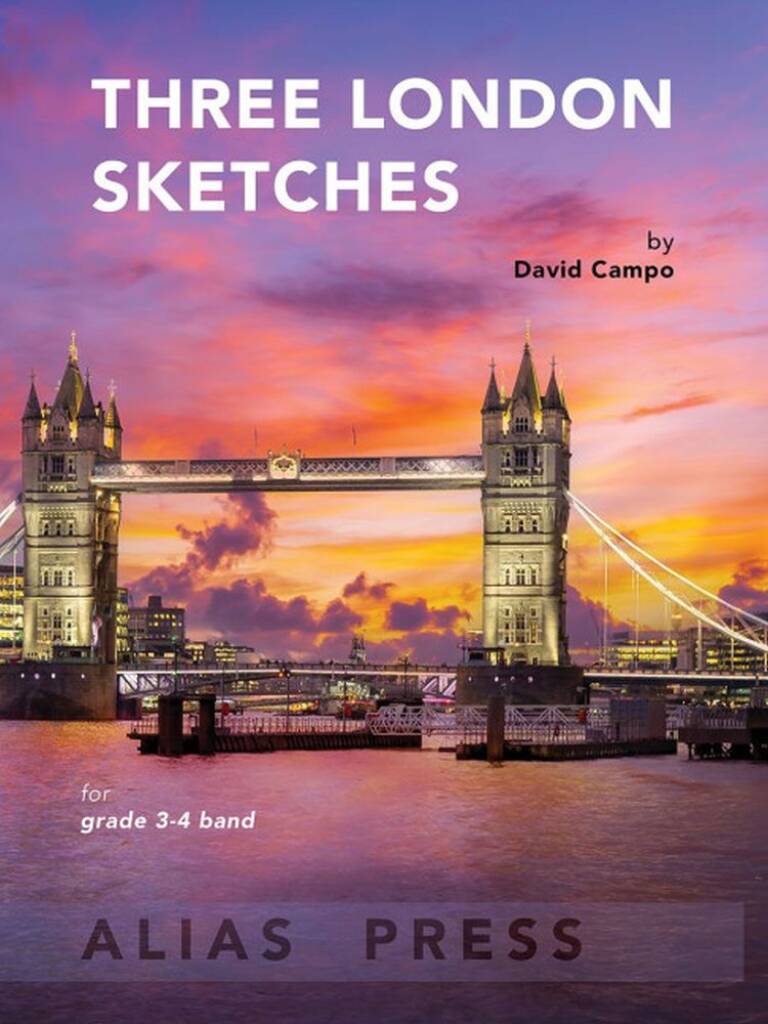
Three London Sketches - David Campo
London is one of my favorite cities in the world, and in 2016 I was invited there to serve as an adjudicator for the London New Year's Day Parade and Gala Concerts. While I was there, I was fortunate to meet and spend time with The Lord Mayor of Westminster Councillor Steve Summers. While his title sounds formidable and intimidating, I found Steve to one of the nicest, most easygoing people I've ever met. And boy, does he love London! He was fond of saying that he had "the best job in the greatest city in the world." He spoke passionately about London and his favorite places in the city, and his enthusiasm was contagious. Some of his favorite places became some of my favorite places, and the inspiration for this piece. I hope that this work not only conveys the beauty and history of these iconic places, but Steve's deep and abiding love for them as well. I. Tower Bridge - The Tower Bridge was built over 120 years ago to ease road traffic while maintaining river access to the busy Pool of London docks. Its giant moveable roadways lift up for passing ships, making it a true engineering marvel. It is also one of the most iconic sites in London, and was used to display the Olympic Rings during the 2012 Olympics. II. St. Paul's (The Whispering Gallery) - The history of St. Paul's Cathedral goes back well over a thousand years, but construction on the current St. Paul's began in 1669 after a fire destroyed the earlier structure. The dome of St. Paul's Cathedral is a whispering gallery; you can whisper against the wall on the inside of the dome and it can be clearly heard on the other side of the dome over 100 ft. away. Imagine the secrets that have passed there... III. Trafalgar Square - The name commemorates the 1805 naval Battle of Trafalgar and is marked by Nelson's Column, a monument to Admiral Horatio Nelson, the hero of the Battle of Trafalgar. It is the heart of London; full of life and constant energy and home to iconic buildings including the National Gallery, St. Martin-in-the-Fields, Canada House and South Africa House. Londoners say that all roads in London lead to Trafalgar Square.
Estimated dispatch 7-14 working days
 View Music