
Results
-
 £159.60
Sculptures Of An Exhibition - Kees Vlak
This composition was commissioned by the village of Midden-Beemster to commemorate the 375th anniversary of the polder of the same name. It was premiered in august 1987 by the Beemster Fanfare Band. On this occasion some twenty sculptors were invited to create a work of art. Those sculptures were set up at the most picturesque areas of the polder. On a 40 km long bicycle route one can admire the curious statues wile enjoying the beautiful scenery as well. The compostition is based on two themes: a main theme and the promenade theme.1.Introduction: After the grandiose presentation of the main theme, on the dominant, we leave the village to the sound of some pretty music.2.Promenade and Watchman: After some time, we discover a dark statue hidden in the bushes; it is shaped like a square standing on one of its corners. It is called "Watchman". We hear the promenade theme as a solo and all next themes will be variations.3.A Building of Willow-trees: Far away on a dike, we discover the huge skeleton of a kind of house. It is a construction of skilfully interwoven willow-branches. The musical themes are also interwoven. The sculpture is called "Construction of wood used by the farmers".4."Die Flsse, ah die Flsse"and Promenade: We continue our trip and see now a horn of plenty, made of brown ceramics and set up on the green slope of an old fortress. The sun shines on the sheep being at pasture under the willow-trees. No doubt, this scene will have something to do with abundance.5.Cardplayers in front of the Nightingale: A statue in cast iron, representing two carplayers, has been erected in front of the windmill called "The Nightingale". This sculpture suggests a rather animate atmosphere. The opponents with the trumpets and the trombones suggest the cardgame. The trumpets are constantly changing from players. At a certain moment the trumpet gets hold of the decisive trick and starts a victorious blow. The trombone, however, repeats this shout of joy with quite some perverse delight and in a completely wrong pitch. The game continues and after a climax all cards are finally thrown on the table.6.Autumn and Promenade: The trip now brings us a white sculpture in ceramics, decorated with some autumn leaves. Is this a seated man or a chair? Anyway, it looks very nostalgic. This is the time for a moment of reflection with the oboe or the saxophone. It is called "Autumn".7. The Powerlifter: Somewhat hidden in a ditch, we discover a small statue in cast iron, representing a powerlifter who is going to give way under the weight. The music uses the main theme with powerlifting euphoniums, saxophones and clarinets.8.The Bull: Here we have another cast iron sculpture, but this time it is a really powerful figure. This "Bull" statue uses the same theme as that of the powerlifter, but it gets a stronger foundation from the bass insturments.9.Mirror and Promenade: While strolling alongside the channel we suddenly see four mirrors. They not only reflect themselves, but also mirror in the water of the channel. These reflections are suggested by the use of tuned percussion. The promenade theme is also used in mirror image.10.Reflictions or...?: On top of the dike we have a nice view on a farmyard with its orchard. A very big net, coverd with sparkling tin plates, has been stretched between the trees. This sculpture is called "Reflections of ...?. Of what? Yes, of course, reflections of the times when the polder was a lake and the sun was reflecting in the wild waves.11.Willpower: Finally we discover a big statue in cast iron. It is not clear whether it is a man or a woman. Anyway the enormous bundles of muscles in the legs and the thighs are striking. This sculpture is called "Willpower". The idea of determination is musically suggested by a very long preamble to the promenade theme in one great stringendo, leading to the conclusion of the trip.12.The beautiful country: Here we have the most beautiful picture. The magnificent Beemster Polder in bloom. We see a nice windmill with decorated wings. We hear the main theme, now on the tonic.
Estimated dispatch 7-14 working days
-
£68.99
Fairy Tail Suite - Tsutomu Tajima
This work was complete in January 2013 to commemoration the 50th anniversary of the Iwate Prefecture Band Association. Conditions at the request were as follows:1: Does not have to be particularly relating to Iwate. It should be something that would be widely familiar to the whole country. 2: Should suit the contest piece requirements. 3: Must be a song that can be used at a graduation ceremony for student procession and recessional.4: Must include vocal parts with a beautiful melody.5: Must be a march.6: Must be a song that would be loved by many.They are difficult requests. I hope to satisfy at least one of them.We selected Yanagida Kunio's book "Tono Monogatari" as the cornerstone of the work, chose four stories that fit the image, and stuck close to the source of the story. Then, "prelude music" was added, making it a suite consisting of five movements.I. "Prelude" What kind of story will it be? An exciting opening expresses such a feeling.II. "Zashikiwarashi" Spirit that brings good fortune and wealth. It appears at midnight and makes mischief, something silly, not serious. Zashikiwarashi moves quickly, dances, plays its games, hiding and reappearing often. These characteristics are considered cute and the music depicts such a mischievous Zashikiwasi.III. "Oshirasama" A girl and her horse love each other. Her father forbids this, and kills the horse. The beautiful daughter clings to the horse and cries. Eventually, the daughter and the horse rise to heaven, slowly and gradually, remembering former happy days. The music captures this ascension to heaven.IV. "Yamanba (Mountain witch)" Run away, run away, its chasing, still chasing. Run away, and still chasing. The girls hides. Yamanba searches. It keeps chasing, endlessly, following her everywhere. Chasing, chasing, and finally... Seriously and comically depicting the chase situation in fugue style.V. "Kappa" Staring into the distance. It looks gallant. What is it looking at? Staring beyond the mountain? Perhaps it is longing for hope and happiness. This is an homage, a march, and cheering song for Kappa who never gives up and embraces dreams and hope.It is my wish that many people become familiar with this song.(2013.3.31 Tsushima Tashima)
Estimated dispatch 7-14 working days
-
 £435.40
Goldberg 2012 - Svein H. Giske
The first time I heard Bach's Goldberg Variations was in the movie Silence of the lambs, in the early 1990s. I noticed the beautiful background music in one of the scenes, but at that time I didn't know what it was. A few years later, when I was studiying at the Grieg Academy, I got to know the entire piece. For me, this is a piece of music which I can listen to countless times. I think it sounds as fresh today as it did more than 15 years ago and it never ceases to inspire me. Both Bach's composition and Glenn Gould's famous 1955 recording (which was the first one I heard) still makes a great impression on me. Before Gould recorded it at age 22, it wasn't a highly ranked piece amongst pianists and Bach was by many viewed as a bit old-fashioned. The young Canadian turned all this around. He managed to portray Bach in a reformed way, producing fine nuances in phrasing and making the many layers in Bach's music more transparent than anyone before him. Thus he plunged both himself and Bach (back) onto the international music scene. When The Norwegian Band Federation (NMF) asked me to write the test piece for NM in 2012, it was only natural for me to use the Goldberg Variations as a starting point and inspiration for my work. Since I was a teenager at NMF's summer courses in the mid eighties I've always listened to many different styles of music. Growing up in Sunnmre with the Brazz Brothers as teachers and mentors, jazz-, pop/rock- and folk music were early on a natural part of my musical background. I also have my classical education from the Grieg Academy on trumpet. As the title of my piece implies, I've wanted to bring Bach to the present and put his music into various modern musical landscapes. I think you can bring about a special kind of energy when music from different genres are mixed and I've tried to do this by mixing Bach with artists and musical styles from the present. In Goldberg 2012, the music is often constructed by several layers, which in a way are living parallel musical lives. They are seemingly moving or floating freely, almost unaware of each other, but bound together by the same basic pulse. The rythms, however, are often notated on a different rythmic subdivision level than the usual 8th- or 16th note levels. By doing this, I hope to achieve transparent sounds that rythmically are perceived as more free and detached from each other. In large sections of the piece, pop/jazz is fusioned with elements from Bach. I guess you could have this little scene as a synopsis for the piece: picture a group of musicians meeting: some are classical performers, some are jazz. They start to improvise together, each in their own voice or musical dialect and I'm sort of in the middle, trying to write down what they are playing. This is what I feel much of Goldberg 2012 is about. The foundation of the piece, in addition to Bach and references from pop/jazz music, lies also in my own material. This material, basically two chords, is heard in it's purest form in the 1st movement. I use these chords to create scales, new chords and different motifs which contribute to blend together the different moods of the piece. It has not been my intention to copy Bach's form (theme and 30 variations), but rather to use the bits and pieces that I like the most as an inspiration for my own variations. The 1st movement, Aria 2, is for my 3rd son, Olav, who was born on the 21st of April 2011, and the 5th movement, From long ago, is dedicated to the memory of my father, Svein J. Giske, who passed away on the 6th of June 2011. -Svein H. Giske, January 2012-
Estimated dispatch 7-14 working days
-
 £199.99
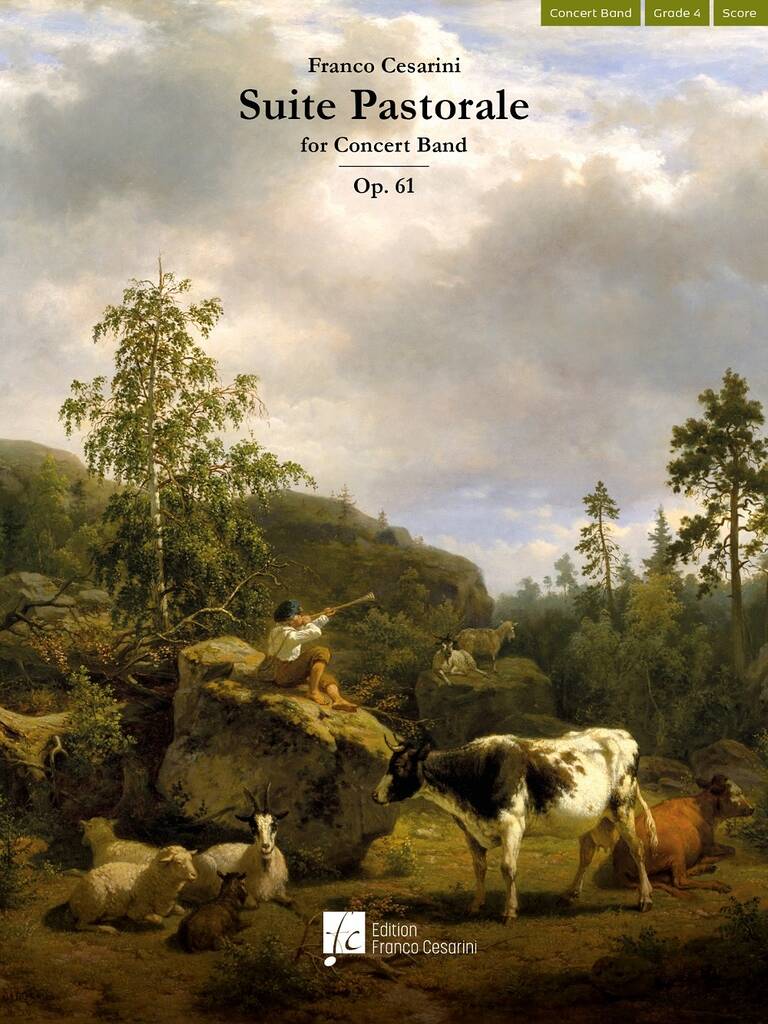
Suite Pastorale - Franco Cesarini
Suite Pastorale, made up of three movements - Idyll, Playful Shepherd Boys, Rain Upon the Fields - is characterized by an idealization of the simplicity of country life in close contact with nature. Suite Pastorale depicts the eternal and fascinating myth of Arcadia: a world in which man lives in harmony with nature, immersed in bucolic forest landscapes, one of the most important imaginary places to escape to for those who were, and still are, tired of culture and civilization. The evocative Arcadian world is made almost mythological by the attention dedicated to it by poets, writers, playwrights, painters, and composers who over the centuries have drawn lifeblood from it for their works. Full of metaphorical meanings, it is a place of shelter, a place to live and sing about love, even if it means disappointment, and it is the place of civilization opposed to barbarism. It is a symbol of happiness, a real and intact image of reality, motionless in space and time, where nothing changes. The myth of the "locus amoenus" has not disappeared but has kept all its charm intact over the centuries.Suite Pastorale was commissioned to Franco Cesarini by the concert band of Aldeno (Trento/Italy) for the 100th anniversary of its foundation (1923-2023.Suite Pastorale: an ideal concert piece that will delight your audience!
Estimated dispatch 7-14 working days
-
 £214.80
Skies - Oliver Waespi
Program notes by Oliver Waespi on his composition Skies:Skies is the plural of Sky. We may wonder are there several skies? Is the sky we all long for not the same for everybody? While travelling on foot and "in the open air" I have observed the firmament often in quite different shapes, so that I can say I have indeed experienced the sky in different ways. Years ago I already wanted to portray "my sky" in music; I finally have been able to realise this long-cherished dream.This composition deals with the sky, more precisely with my sensual and emotional experience of the sky in all its aspects. Two point of views are combined in this composition: one showing the sky as it presents itself to me, the other showing the sky as I observe it. The music was bom simultaneously by intemal and extemal inspiration: it describes nature but also the emotional and spiritual experience of nature. To me, the experience of nature is not abstract, but it is connected with concrete ages, places or people from my neighbourhood. This is why I have combined several parts of this composition with certain landscapes.The sky presents itself in different landscapes in the most varied ways: for the sensual experience, there is no sky as such. The indications of places spread all over the score, are primarily clues for myself; they represent certain atmospheres, which I have experienced especially in England and Scotland. They can however also be useful to the musicians and the audience, providing they know those landscapes and the celestial atmospheres linked to them.The music is independent from the atmospheres described in the subtitles, as those are rather connected to a tragic nature, and so the music is not based on any program. Musically spoken, the composition has a symphonic structure, which means that the complete musical material is derived from three contrasting main themes. In the first part, the description of a noctumal sky ("Night") two themes are developed in an organic way; the first, rather "dusky", is to be found with the horns, the second, "in bright daylight", with the oboe and flute, the third, "more quiet" , with the brass instruments. In the next part, we have clouds and rain over the Isle of Skye (one of the Hebrides islands in Scotland) and here several elements of the first theme are still more developed. Then we get an increasingly dark mood, which is released, in heavy chords. Then suddenly, the sun breaks through and the music gets a majestic character. We have a new shape of the initial theme, first with the French horns and then with the trombones. The music gets a quicker tempo and flows into a quick movement describing the winds and waves at sea ("Wind and Waves"). Three themes are gathering and some variations are developed. The music gets more and more energetic and, after a climax, calms down again. Then we have a kind of "summer pastoral" which suggests summer at the South coast of Cornwall ("South Coast of Penwith Peninsuia in Summer"). This is certainly not the hotte st summer in Europe, but still it is beautiful in this country that is blessed with so much rain. In the "pastoral" , the sea is already sketched in broad outlines in the French horn solo. The magnificence of an aftemoon at the seaside is developed at the end of the composition ("Noon at Treen Cliff', a rock protruding in the sea next to Porthcumo at the South Coast of Cornwall); here the music gets stronger and stronger and after a majestic climax it vanishes completely.
Estimated dispatch 7-14 working days
-
 £435.40
Continental Divide - Stig Nordhagen
The title is "Continental Divide" and it has nothing to do with tectonic plates, but is another word for "Watershed". It is the place where the the water flows in opposite directions. For example, when you drive up a mountain, the water flows downwards, the same does it when you drive down the other side. On top there is usually a water, and it is in this water, or musical idea if you like, that it is a continental divide. What I intend is that in this piece there are some musical motifs that change character and direction. They can be in the foreground and carry the play, or they may be in the background as a countermeasure. It can also be from horizontal lines to vertical. Orrhythmical patterns that dont find their match until far into the piece.
Estimated dispatch 7-14 working days
-
 £149.40
Answer Me, My Love - Fred Rauch
"Answer Me, My Love" was originally written with German lyrics by Fred Rauch and music by Gerard Winkler under the title "Mutterlein". Shortly after, Carl Sigman wrote the English lyrics and gave it the title "Answer Me, My Love" which is now the most famous version. It became a hit in 1953, but it was during 1954 that Nat King Cole recorded it and made it a chart-topper in both the US and Europe. In 2000 the Canadian composer and singer Joni Mitchell included it on her successful record album "Both Sides Now". Available solo parts in this arrangement: C-Instruments TC C-Instruments BC Bb-Instruments Eb-instruments
Estimated dispatch 7-14 working days
-
 £228.70
Pulsar - The Metamorphosis of a Star - John Brakstad
4th July in 1054 AD one of the most spectacular events was witnessed in the Cosmos. A massive star blew out; a supernova explosion.From the Earth it appeared as a new, bright star; the most brilliant in the sky. It was visible for three weeks, also in daylight, before it then faded away.But what was left of it is spectacular. Today we call it the "Crab Nebula".And in the very centre of the Nebula lies the remnant of the star; the core crushed by the force of gravity.This is a rotating neutron star, a pulsar, just 20 kilometres across, but so dense that it weighs more than our sun.As the neutron star spins, ejected particles stream out from its poles at almost the speed of light.These jets create powerful beams that sweep around as the star rotates.When the beams sweep across the Earth, they can be heard as regular pulses. We call them pulsars.In this piece there are three percussion parts. In addition there is an "optional part" to replace the marimba and vibraphone written in the three original percussion parts if desired. This fourth part is shown in the full score.
Estimated dispatch 7-14 working days
-
 £118.99
Cats - Andrew Lloyd Webber
The Musical CATS, with music by Andrew Lloyd Webber is based on the 1939 poetry collection Old Possum's Book of Practical Cats by T. S. Eliot. It became Lloyd Webber's third great success, after the musicals Jesus Christ Superstar and Evita. He began setting Eliot's poems to music in 1977, and the compositions were first presented as a song cycle in 1980. Producer Cameron Mackintosh then recruited director Trevor Nunn and choreographer Gillian Lynne to turn the songs into a complete musical. CATS became one of the longest-running shows in West End and Broadway history. It received its world premiere at the New London Theatre in 1981, where it played for 21 record-breaking years and almost 9,000 performances. The following year, CATS opened at New York's Winter Garden Theatre, its home for the next 18 years, garnering seven 1983 Tony Awards, including Best Musical. The show returned to Broadway in 2016, where it had a successful pre-tour run at the Neil Simon Theatre. CATS has been presented in over 30 countries, translated into 16 languages, and seen by more than 73 million people worldwide. Lloyd Webber's magnificent musical score includes the poignant hit song Memory, which has been recorded by over 150 artists, from Barbra Streisand to Liberace to Barry Manilow. It took 7,486 chandelier crashes for Lloyd Webber's The Phantom of the Opera to take over from CATS as the longest-running show in Broadway history in January 2006.
Estimated dispatch 7-14 working days
-
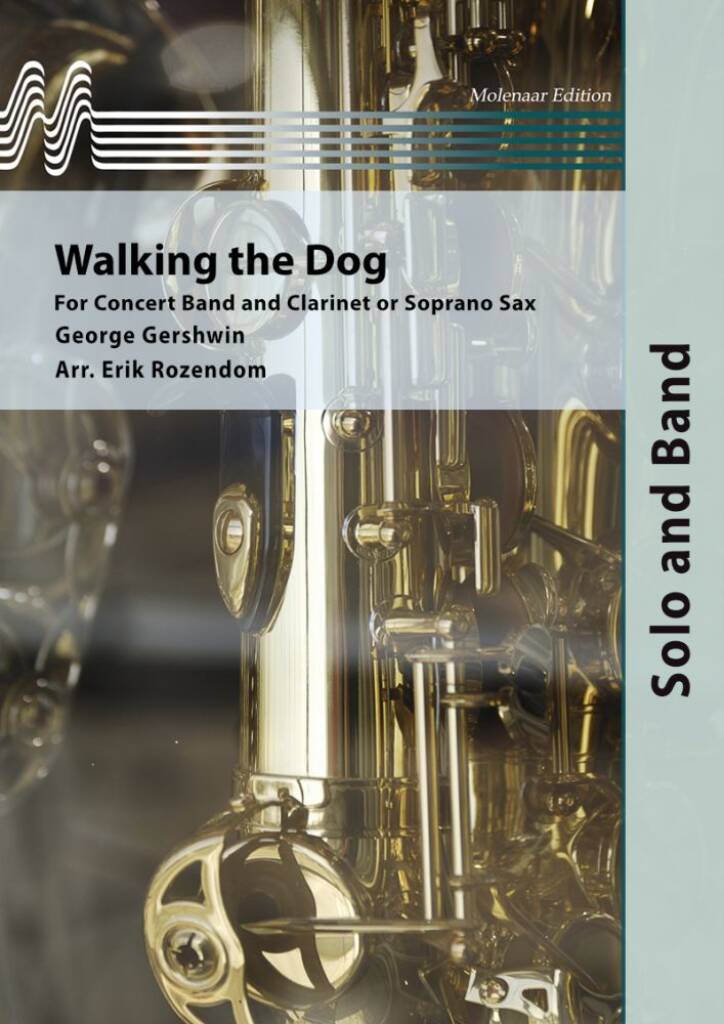 £69.00
Walking the Dog - George Gershwin
Walking the Dog is one of the many songs George Gershwin wrote for the film "Shall We Dance." George Gershwin at the height of his powers. Instead of the bustling, complex symphonic scores he was now accustomed to writing, it is a simple, elegant little walk, as the title suggests.In the 1937 film, it accompanies a scene of (you guessed it) walking a little dog, aboard the luxurious deck of a cruise ship. Since it was heard in the film, however, the tune has taken on a life of its own and has become a popular piece for clarinetists around the world. In 1960, the song was published as "Promenade." Interestingly, it is also the only part of the film score of "Shall We Dance" that remains - the rest of the film's music unfortunately remains unpublished there are not even any recordings.
Estimated dispatch 7-14 working days
 View Music