
Results
-
 £174.10
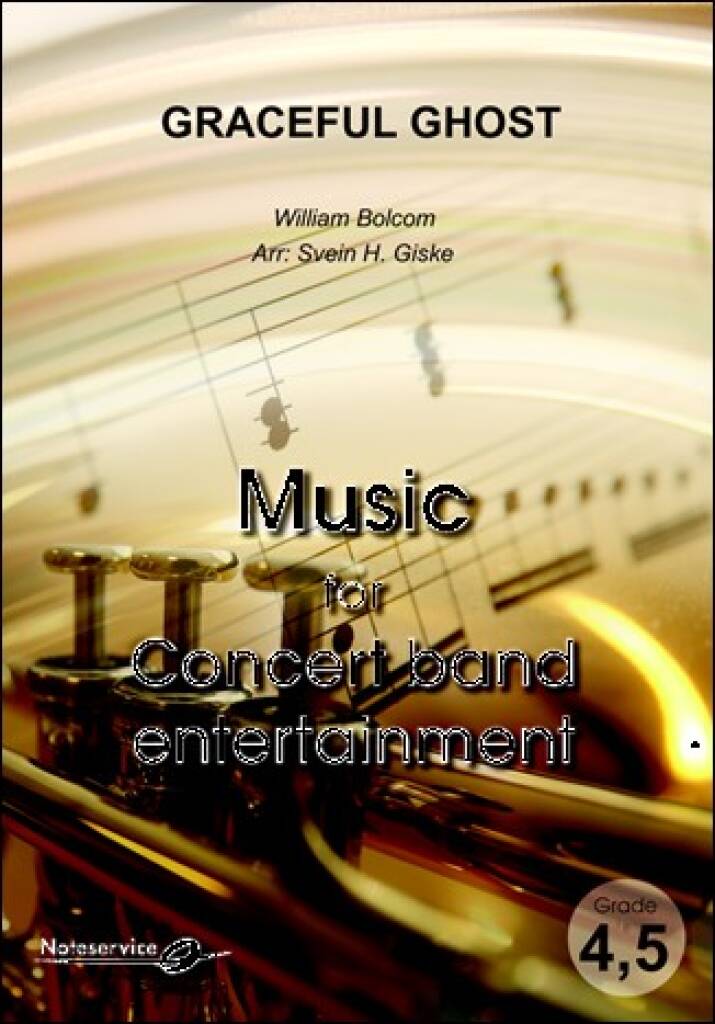
Graceful Ghost - William Bolcom
I came to know of this piece when hearing famous Norwegian ragtime pianist Morten Gunnar Larsen playing it at a concert with the Norwegian Navy Band Bergen.I was struck by its melancholic beauty and wanted to arrange it for band. Ragtimes are rarely in a minor key (which this one is) and when you first hear it, you might think it was written around the time when Scott Joplin was the main ragtime composer. But, if you listen more carefully, you notice that some of the harmoniesare more advanced than one might expect in traditional ragtime, giving the piece a slightly more contemporary feel. The composer William Bolcom wrote Graceful Ghost in 1970 to honour the memoryof his father and it is one of his mostpopular pieces.
Estimated dispatch 7-14 working days
-
 £129.99
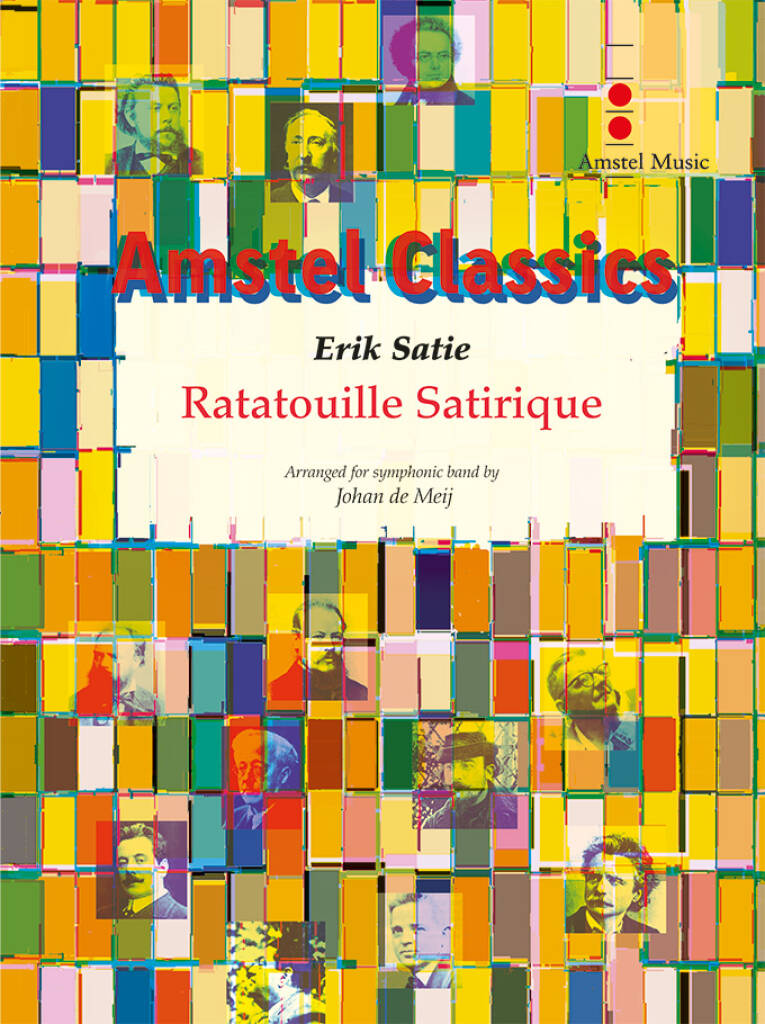
Ratatouille Satirique
Erik Satie, born in Honfleur in Normandy (France) in 1866 is undoubtedly one of the most striking personalities in the history of French music. He composed in various, often quite divergent, styles. Besides light-hearted, entertaining works he also wrote several serious compositions, among which the three ballets: Parade, Rel che and Les Aventures de Mercure. However his piano pieces, such as Trois Gymnopdies or Gnossiennes will remain his most popular compositions. Satie co-operated with almost all great artists of his time: Pablo Picasso, Jean Cocteau, Sergej Diaghilev and Georges Braque and the composers Darius Milhaud (Le Groupe des Six) and Claude Debussy. Johan deMeij made an orchestration of three short pieces by Erik Satie: I. Prlude (from: Jack in the Box) II. Rverie (from: Trois petites pices montes) III. Marche: Le Piccadilly (1904) It was only after Satie's death in 1925 that the manuscript of the piano piece Jack in the Box was recovered. Satie himself thought he had lost the manuscript in a bus. When his flat in Arceuil was cleaned out, a small notebook was discovered behind his piano and it contained the manuscript which was assumed to be lost forever. The Rverie (De l'Enfance de Pantagruel) is an extract from Trois petites pices montes, originally composed for small symphony orchestra. In this suite it is meant as a restful intermezzo. It is clear that, as with Milhaud (La Cration du Monde) and Debussy (Golliwogg's Cakewalk; Le Petit Ngre), it is hard to deny obvious influences of jazz music in Erik Satie's compositions. Le Piccadilly, dating from 1904, displays a lot of similarities with the compositions of Scott Joplin.
Estimated dispatch 7-14 working days
-
 £137.99
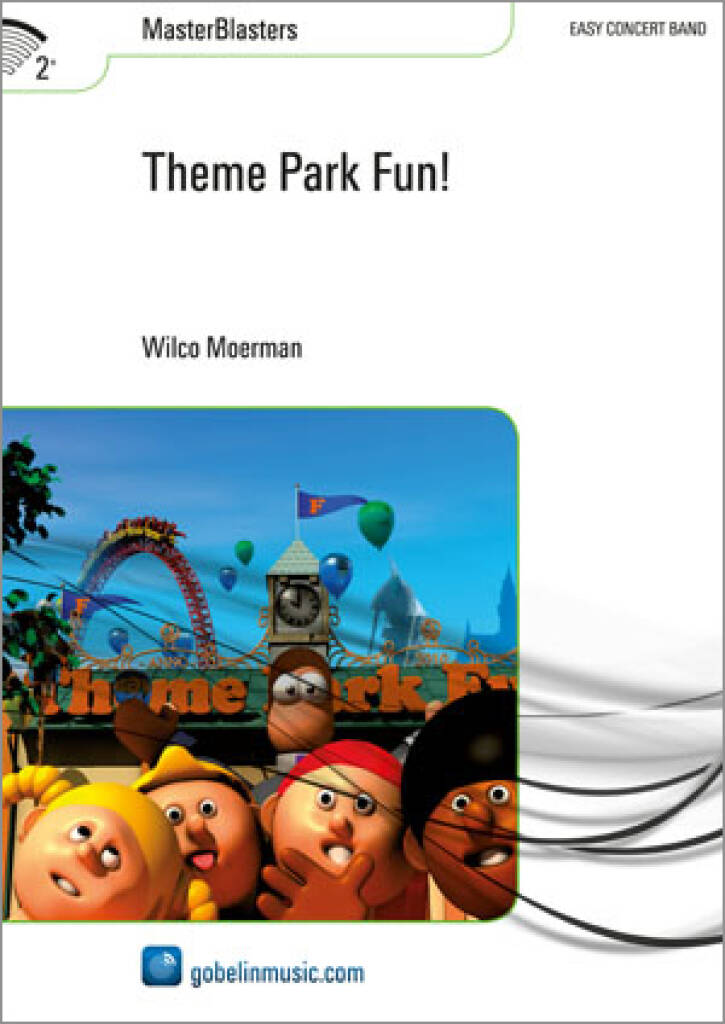
Theme Park Fun! - Wilco Moerman
In Theme Park Fun! your orchestra pays a visit to an amusement park. During your visit, you will experience some spectacular rides and attractions this theme park offers. The uniqueness of Theme Park Fun! is the interplay between music and(moving) images. Animations and illustrations support the visual composition.Part 1: The Entrance & Parade [with animation]The opening of the park is a fact. A day full of fun and pleasure awaits! You and the other visitors willbe confronted with all the rides, attractions and adventures the theme park has to offer. Which ride shall we do first?! There is so much to do and experience on this day in the park! A parade of colorful floats and park figures is passing by.Letthe fun begin!Part 2: The Haunted House [with animation]The only ride in the park that is not related to fun, is the Haunted House. Here visitors will be challenged to visit a house full of ghosts, creepy figures and otherominous things. The clock strikes twelve, there is no turning back. Ghosts are whispering, yelling, screaming... Fortunately it is almost one oclock, so we can leave this creepy place quickly.Part 3: The Swinging Galleon [withillustrations]What a huge pirate ship! Each time you swing back and forth, you will feel that weird feeling in your stomach. When you are thrown completely into the top you will have a fantastic view over the park, but you can not enjoy itfor long. Before you know the ship swings back the other way.Part 4: The Fairy Tale Ride [with illustrations]After all those exciting and spectacular rides and attractions, it is time for a peaceful tour in The Fairy Tale Ride.Surrounded by a fairytale setting, you will discover fable figures, talking animals and colorful designs. Such a beauty and tranquility. Having had this experience, we are ready again for the big rides in the park!Part 5: The Bumper Cars[with illustrations]Now its time to crawl behind the wheel of the Bumper Cars! Shall we all chase the conductor?! Before you know you are hit by another visitor or you will bump against someone else. In this tough ride you can prove yourselfas a real driver, or perhaps as a really bad one.Part 6: The Roller Coaster [with illustrations]The largest, fastest and scariest ride in the park ... we should definitely do the Roller Coaster! All together in the train, theover-the-shoulder restraints are lowering... be ready to ride. The train leaves the station and is heading for the big lift hill. It will be very scary when the train reaches the top and the train will be plunged down the first drop! Loops,corkscrews and other spectacular coaster elements will follow... Before you know it, the ride of your life is over. Shall we ride it again?!Part 7: Leaving the Park [with animation]Unfortunately everything comes to an end. Thisday in the theme park is over, but we have a lot new experiences to talk about! The memories of all the funny and spectacular rides will come up when we walk through the park to the exit. Just one look over the shoulder, the amusement park figuresare waving at us. Hopefully we will come back again soon!
Estimated dispatch 7-14 working days
-
 £116.40
Quatre Jours a Paris - Kees Vlak
1) 'Jour de Fte. A quiet sunday atmosphere on the Avenue Foch, a residental area for the well-to-do in Paris. It begins with full-sounding chords, with a wealth of added tones. It seems as if many bells are tolling. Birds are tweeting high in the trees. After all this there is a very simple theme without any tension just like a leisure walk. The movement ends the same way it started.2) 'Jour de Java. The 'Java' is the dance of the Bohemians, the Paris gypsies. It is a very capricious dance, which is represented by at certain moments shrill harmonies and the unexpected changes in tonality of this movement.3) 'Jour de Pluie. A rainy day. Seated behind the windows of a sidewalk caf we observe the reflections on the wet streets. Under a fly-over an accordeon plays a sad melody. Old memories pass through our minds.4) 'Jour de Can-Can. Whenever one hears 'Can-Can' the name of Jacques Offenbach crosses our minds. It is the dance of the Folies Bergres, a festival which never seems to end. All the time new solo-dancers come jumping forward.
Estimated dispatch 7-14 working days
-
 £38.20
Royal Jubilee - Henk van Lijnschooten
On the occasion of the 75th anniversary of the Royal Dutch Federation of Wind Bands Mr. Henk van Lijnschooten was commissioned to compose a festive march. The main condition for the composer to fulfill was to make this march suitable for execution by bands of varying levels.Almost every one of the appr. 1000 orchestras united in the Federation have the march Royal Jubilee in their possession. The positive response of numerrous bands proves that it is not just some "composition for an occasion" but a march of lasting value which can be used to advantage on festive and solemn events.Royal Jubilee is based on Dutch motifs. The first section is dominated by the initial motiv of the Dutc National Anthem Wilhelmus. It is not just by chance that it is done in marching tempo, the National Anthem stems from a seventeenth century marching song. It was later in history that is grew customary to perform the Wilhelmus at a more solemn tempo. The second section (trio) of Royal Jubilee is of a more solemn character and at its end a fragment can be heard of a song (wier Neerlands Bloed) that served as the Dutch National Anthem for some time but later went into oblivion. The scoring of Royal Jubilee has made it suitable for any type of windband, whereas a drumband could be added ad libitum.
Estimated dispatch 7-14 working days
-
 £60.50
Where Falcons Soar - Christian Earl
Here is a piece certain to be a success! It is so musical it will be enjoyed by good high school, college, and adult bands; yet it is easy enough that a good junior high or middle school band can be successful with it. Employing a joyous, rhythmic triple meter, the piece gets off to a frollicking good start. The opening section leads to a beautiful, slower, melodic section, and the work concludes with vigor and vitality as it romps to an exciting conclusion.
Estimated dispatch 7-14 working days
-
 £139.00
Me and Mrs. Jones - Kenneth Gamble
Me and Mrs. Jones was written by Kenny Gamble, Leon Huff and Cary Gilbert in 1972, and was first recorded by Billy Paul on the album 360 Degrees of Billy Paul. The song is about a man who has an affair with Mrs. Jones, and how the two secretly meet every day in the same cafe, even though they may know it's not quite right: "We got a thing going on/we both know that it's wrong/but it's much too strong/to let it go now." Paul has stated that he was sure the song was going to be a hit even before it was released, as "it's a song everyone can relate to", but already from the start the lyrics were considered somewhat controversial and the song were banned from several radio stations. Nevertheless, it became one of the best-selling singles of 1972 and Paul received a Grammy for Best Male R&B Vocal Performance.Well known is also Michael Bubl's version of the song, released on the album Call Me Irresponsible in 2007. It is his version that has been the inspiration for this arrangement, which brings out even more of the jazz elements Bubl has found in the song. The arrangement is quite demanding for the ensemble, and requires great rhythmic precision in particular.
Estimated dispatch 7-14 working days
-
 £149.40
Storsltt - Øystein Olsen Vadsten
"Storsltt" or in English "Grand Nordic Tune" is one of many original pieces written by composer ystein Olsen Vadsten. "Sltt" is a general term for music played to traditional Norwegian dances."Grand Nordic Tune" was a commissioned work for the Rlingen Musikklag's 70-year anniversary concert in 2022, where the piece was premiered. They wanted something a little pompous, and preferably something in the style of Nordic folk music, which the composer is known for. The title in Norwegian then was obvious, "Storsltt", which in Norwegian has a double meaning, both a big tune and, in a double meaning, pompous or magnificent.As usual, the starting point is a traditional Nordic dance form, and this time the choice fell on the distinctive Swedish "polska", which is played in . The dance, despite its name, reportedly has no connection to Poland, but is entirely of Scandinavian origin. It has been danced for centuries, and has also been called the devil's dance, because it had a hypnotizing effect on people, so that they could not stop, but danced themselves to death. Hence people thought that it must have been the devil who caused it.Traditionally, there is a lot of repetition in this type of music, which contributes to this hypnotic effect.
Estimated dispatch 7-14 working days
-
 £126.50
Beating Beats - Jan Van der Roost
Beating Beats rhythmically is a rather special piece: more conventional metres are manipulated in such a way that the listener (without score) may be confused and even misled at various points! The 'regular four beat accents in a 4/4 measure for example are often not adhered to, giving the impression of a different metre altogether. However, at the same time it may be that some instruments do follow this "normal" 4/4 metre, thus confusing everyone - performers and listeners alike! On one hand, it is a "simple" piece with very playable and melodic themes, but their mysterious rhythmic makes it not only sound more complicated, but also makes for a greater challenge for both players and the conductor! As is mostly the case with Jan Van der Roost's works, the orchestration is both colourful and contrasting, with every section of the modern wind orchestra used equally. All in all, it's a work full of surprises with some unexpected harmonies and special melodic lines but above all, with metrical and rhythmical sure to catch you unawares!
Estimated dispatch 7-14 working days
-
 £171.00
Passacaglia and Fugue in C-minor BWV 582 - Johann Sebastian Bach
The Passacaglia is a set of instrumental variations based on an ostinato bass. Bach's Passacaglia and Fugue in C-minor for organ represents the pinnacle of what had been achieved in this compositional form at that time. In Franco Cesarini's arrangement for large wind orchestra, the particularly careful interpretation of the original piece enables him to exploit all the sound colors at his disposal, and in this sumptuous guise Bach's work also takes on a grandiose dimension, albeit tinged with late-Romanticism. The exposition of the beautiful theme begins in the bass part, immediately creating a solemn and serious atmosphere which is accentuated by the intensely pathetic character of the first variations. Up to the tenth variation it remains confined to the bass, but in subsequent ones it also passes to the soprano and alto register. The integrity of the theme is also embellished with elegant arpeggios, in whose lower and higher extensions the theme can be distinguished. Towards the end it returns to the bass in an impressive thickening of the polyphonic texture that swiftly re-establishes the key of C-minor. The "Thema fugatum" which follows immediately does not constitute a Fugue in its own right, rather it is nothing but the twenty-first and most extensive variation of the Passacaglia. This time Bach uses only the first half of the theme, superimposing a rhythmic countersubject that considerably enlivens the entire development of the composition. The polyphonic discourse becomes increasingly dense, until the building tension peaks in a powerful "Neapolitan sixth" chord, followed by a sudden pause. This culminating moment then leads to the coda and final cadence on a bright C-major chord.
Estimated dispatch 7-14 working days
 View Music