
Results
-
 £109.99
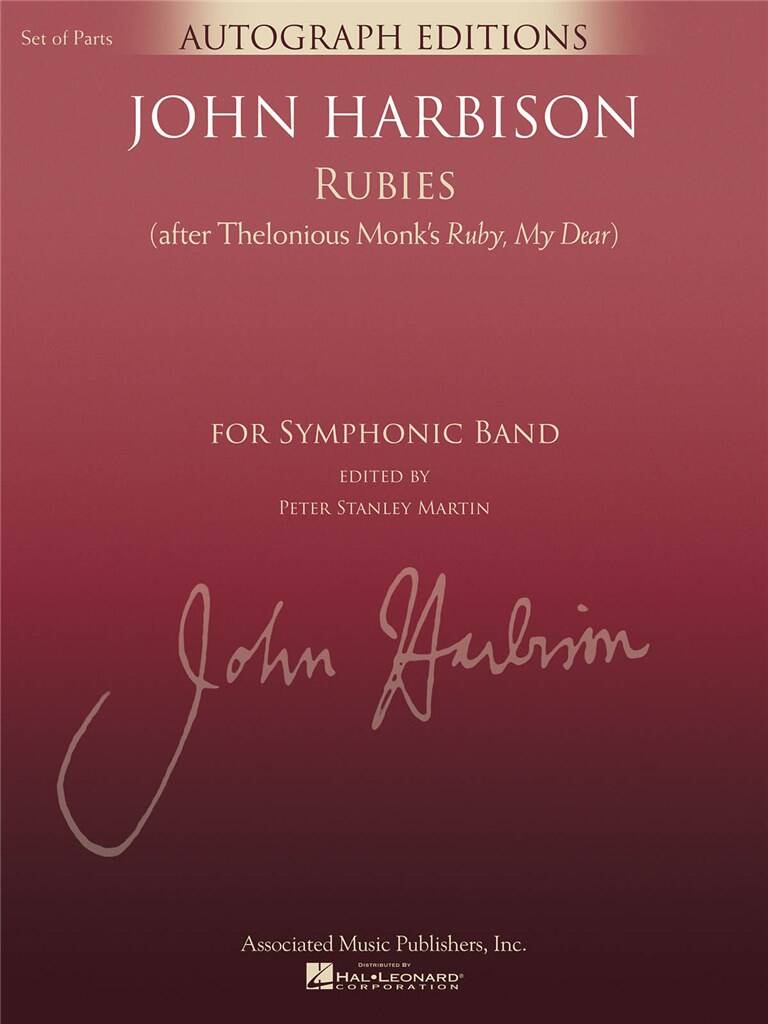
Rubies (After Thelonious Monk's Ruby, My Dear) - John Harbison
Composer John Harbison writes: 'Rubies is a version of Thelonious Monk's 'Ruby, My Dear', which he composed while still in his teens. When I was invited by the Seattle Symphony to make a short piecereflecting my first musical passions, my thoughts were of Bach and Monk. Since I had recently made some Bach-like chorale preludes, I chose to make a version of Monk's tune, first in a chamber-musical, contrapuntal manner, then inthe grand orchestral style I had always heard lurking there.' Dur: 5:30 (Recorded live by the Rutgers Symphony Band - Peter Stanley Martin, guest conductor).
Estimated dispatch 7-14 working days
-
 £42.50
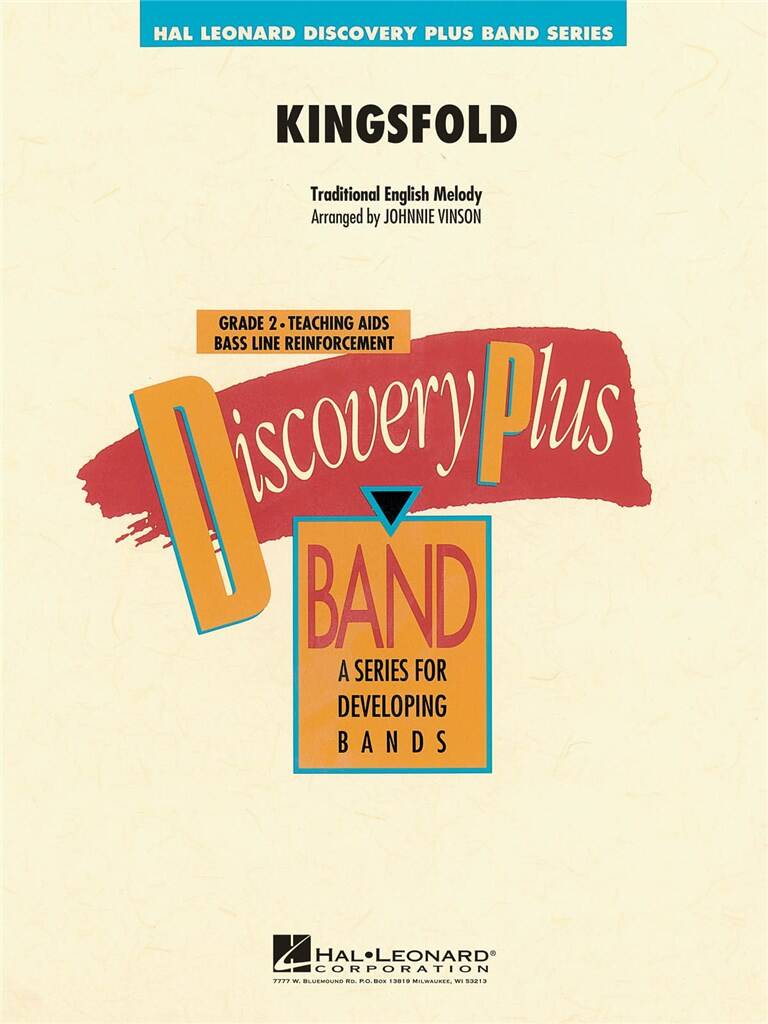
Kingsfold - Traditional
The haunting melody of this traditional tune likely dates to the Middle Ages, and was published by British composer Ralph Vaughan Williams in the 1906 English Hymnal. Freely adapted by Johnnie Vinson in this setting for youngbands, the minor melody is stated first by low clarinets and horns. The next section introduces an original theme, which is then combined with the first melody in the moving final section. Beautifully paced and scored largely inchoral fashion, this is a wonderfully fresh and unique offering for holiday or winter concerts.
Estimated dispatch 7-14 working days
-
 £76.99
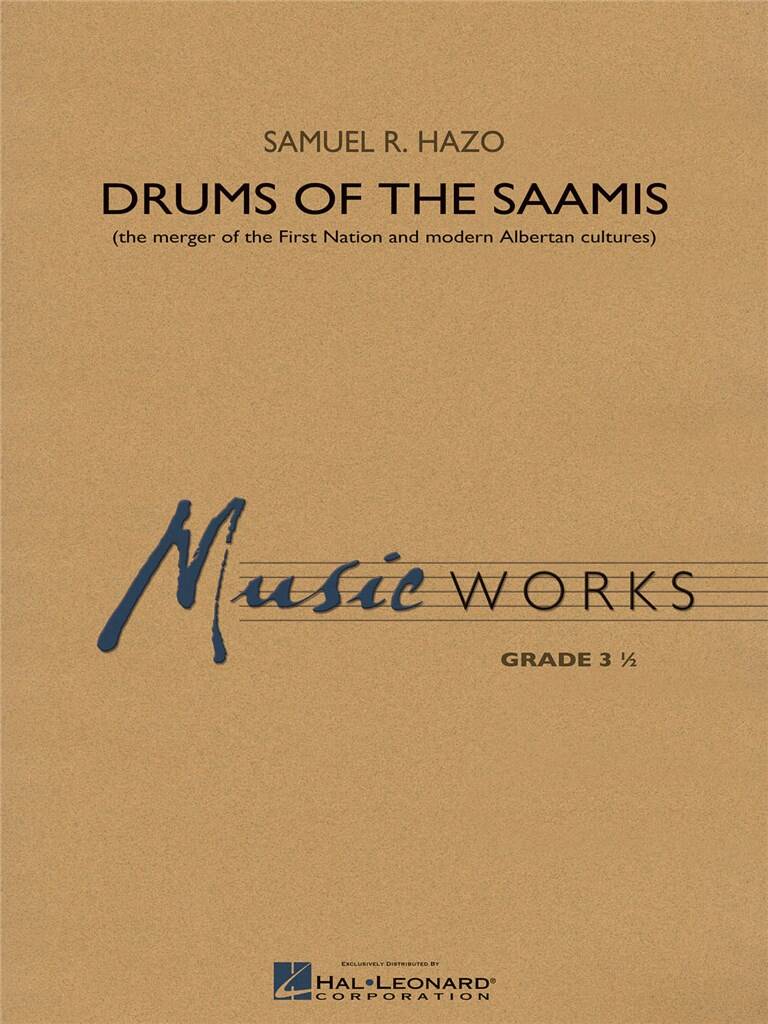
Drums of the Saamis - Samuel R. Hazo
Drums of the Saamis was commissioned by the Medicine Hat Concert Band Society of Medicine Hat, Alberta, Canada. The piece chronicles the merger of the First Nation (first natives) and modern Albertan cultures.The opening tribal drums followed by the haunting melody simulating the traditional wooden flute comprise two themes that are the foundation for the entire piece. Both elements are developed, varied and enhanced throughout as the listener senses the increasing influence of modern day Alberta through the use of modern sounding chords and rhythms.By the end, the marriage of the old and the new is complete. This powerful work closesas it began; a restatement of themes representing the musical and historical foundation of the region. Dur: 5:00
Estimated dispatch 7-14 working days
-
 £76.99
Tight Squeeze - Alex Shapiro
From the acclaimed composer of Paper Cut, AlexShapiro, this unique, high-energy work could bedescribed by the following: imagine Arnold Schoenberg,Henry Mancini, and Charlie Parker walking into adance club in Havana, and staying for three minutes. Tight Squeeze ventures into new territory as it exploreschromaticism and syncopation against a prerecordedpercussion groove. The result is the repertoire's first electroacoustictwelve-tone techno Latin bebop band piece! Okay, maybe Schoenbergdid all that first, but it never sounded quite like this! To perform the piece, you'll need an audio system capable of playing the prerecorded audio tracks from a laptop computer via a small digital audio interface connected to an audio mixer. Download information is provided in the printed piece.
Estimated dispatch 7-14 working days
-
£50.50
Bad Elf! - Newton
A humorous and creative holiday selection combining "Up on the Housetop" and "Good King Wenceslas." Using the first six notes introduced in most method books, Bryce Newton has crafted a piece that is educational and fun for your musicians' first holiday performance. The limited instrumentation works well for more mature groups with limited rehearsal time. Festive and entertaining, Bad Elf! will make for an entertaining addition to your next holiday program.
Estimated dispatch 7-14 working days
-
£58.50
Mama Sea Turtle - Hoefle
The first movement in "Water Tales, A Suite for Band," this lyrical work is a beautiful depiction of a sea turtle departing the beach after laying her eggs in the sand. This piece in time is a great opportunity for your students to work on slurs and phrasing while they learn about these amazing, endangered water creatures. This first installment of this marine-based suite has great potential for themed concerts and cross-curricular activities!
Estimated dispatch 7-14 working days
-
£149.99
Jello, The Colours Of My Soul - Ben Haemhouts
Jello...The Colours of my Soul is an assignment that was written to be a lasting memory of the untimely, dramatic death of a young child. The work came about due to various conversations between the father and the composer whereby the final resultmust be seen as an attempt by the composer to musically translate the feelings of the parents.The first part of the title, "Jello", is a combination of the names of the two children of the commissioner, namely Jelle and Lobcke, and "the Colours of mySoul" are the colours of the soul of the parents who despite the loss of one of their children, continue to cherish their two children. The introduction provides the atmosphere of grieving for the loss, whereby use is made of pure fifths in order toportray the solidarity with nature, as we are familiar with in symphonies by Bruckner. A little later a bit of the first theme is suggested, which develops into a real funeral march.The Dies Irae, as this occurs in Berlioz's Fantastic Symphony (F, E,F, D, E, C, D), forms a leitmotiv through the entire work in order to symbolise the constant battle between life and death.Shortly before the storm-passage, (where a wind machine is used) which announces disaster, fragments from children's songs areplayed to the accompaniment of a rising choir piece from behind the stage, which strengthens the imminent confrontation with death.After the introduction of the two themes in the long introduction, a quick passage follows in which all kinds ofbeautiful memories are recalled. There is story telling, laughing, and dancing. One of the previous children's songs is also cited. The Dies Irea is heard once again, this time short and fast.Bit by bit happy elements are steadily distorted untilseriousness breaks through again, like an unavoidable and unstoppable evil. The entire piece becomes evermore stirring, as if a big climax will follow. At this moment a very long fermata makes a sudden end to the hysterical allegro. The crucialmoment in the work follows...How does one deal with something as tragic as the death of one's own child? Does one mourn for what no longer is and what never will be? Or does one try to cherish the beautiful moments and continue to live with thesecolourful memories?A subdued, dignified choir piece captures the beautiful memories and ends in a positive, hopeful tone.
Estimated dispatch 7-14 working days
-
£64.99
1st Holiday Suite - Mike Hannickel
Recognize each of the winter celebrations in one piece of music. Kwanzaa, Hanukkah, and Christmas are all represented in this very easy beginning band arrangement. If your group is ready to graduate from unison method book lines, they are ready for this arrangement. Beginning band director/composer Mike Hannickel has made sure that this piece will be accessible to any first year group.If you used this composer's FIRST CHRISTMAS SUITE with your groups in the past, you are sure to like this one, too.Happy Holidays!
Estimated dispatch 7-14 working days
-
£134.30
Wellingtons Sieg - Ludwig van Beethoven
After the 'Battle of Vitoria', Beethoven's friend Johann Nepomuk Maelzel talked him into writing a composition for his panharmonicon (a kind of 'mechanical orchestra') to commemorating this battle. The piece, 'Wellingtons Sieg' ('Wellington's Victory') was dedicated to the Prince Regent, later King George IV and first performed in Vienna on 8 December 1813 at a concert to benefit Austrian and Bavarian soldiers wounded at the 'Battle of Hanau', with Beethoven conducting. It was an immediate crowd-pleaser and met with much enthusiasm from early concertgoers and the piece proved to be a substantial money-maker for Beethoven. 'Wellingtons Sieg' is something of a musical novelty. Besides the orchestra, on stage there are two 'sides', British and French, both playing the same instruments: Trumpets, Snare Drums, 'Canon' and Ratchet. The work has two parts: the 'Battle' ('Schlacht') and the 'Victory Symphony' (Sieges Sinfonie). The first part is programme music describing two approaching opposing armies and contains extended passages depicting scenes of battle. It uses 'Rule Britannia' for the British side and 'Marlbrough s'en va-t-en guerre' for the French side. The 'Victory Symphony' exhibits some typical Beethoven composing techniques. It can be considered as a sonata form that, stripped of the development section, comes equipped with an extended coda. Dutch arranger Andreas van Zoelen transcribed 'Wellingtons Sieg' for Symphonic Band.
Estimated dispatch 7-14 working days
-
£89.99
Ide Fixe - Thomas Doss
Written to celebrate the Zeppelin-Foundation's centennial, Thomas Doss' first symphony represents the passionate history of the world's most renowned airship. Throughout his contrasting score, Thomas Doss has captured Count vonZeppelin's obsession and the subsequent realization of his dream of producing a flying cigar! The first movement describes how passionate Count von Zeppelin was about his idea and the vision that got hold of him. Towards the endof the movement the music swells to a pictorial image of the count, in which he sees the ship floating above himself. Dur: 8:05 (Grade 5)
Estimated dispatch 7-14 working days
 View Music