
Results
-
 £104.50
Echoes of the Morning Trumpet - John Prescott
Echoes of the Morning Trumpet is based on a hymn tune entitled Morning Trumpet by B.F. White that was first published in The Sacred Harp Hymn Book of 1844, a book that was originally printed in shaped notes. The Sacred Harp style of singing is characterized by stark chords with plenty of open fifths and equal participation by all performers who sit and stand in blocks, by section, facing the leader in the middle. This piece features a trumpet solo in the opening, accompanied by the singing of the members of the ensemble. Various treatments of the hymn that highlight the ensemble colors follow before the magnificent close.
Estimated dispatch 7-14 working days
-
£514.99
The Venetian Collection
The Venetian Collection by Johan de Meij consists of four movements which are all a musical reflection of the four paintings of the same names from the Peggy Guggenheim Museum in Venice.Voice of Space is the first movement of The Venetian Collection. The picture on which the music is based on was painted by the Belgian surrealist artist Ren Magritte. Along with Ensor, Permeke and Delvaux he was one of the most important painters of the 20th century.The Red Tower was inspired by the painting of the same name (La Torre Rossa) by the Italian artist Giorgio de Chirico, and was awarded first prize in the International Composition Contest in Oman. One of the towers of the mediaevalwalls of the Italian town of Soncino (home to the band for whom Johan de Meij wrote the work for) shows a remarkable resemblance to the tower in the work of De Chirico. Magic Garden contrasts starkly with the other movements of the cycle. As with the painting, Johan de Meij has tried to reflect the colourful, naive dream world of Paul Klee. The transparent texture, in which the woods play an important role, makes a striking impression throughout this serene movement.Empire of Light is also based on a work by Ren Magritte. He was a versatile and productive artist producing over 1100 paintings and 700 gouaches. Johan de Meij used the painting Empire of Light as his theme for the last movement of his Venetian Collection.
Estimated dispatch 7-14 working days
-
 £146.30
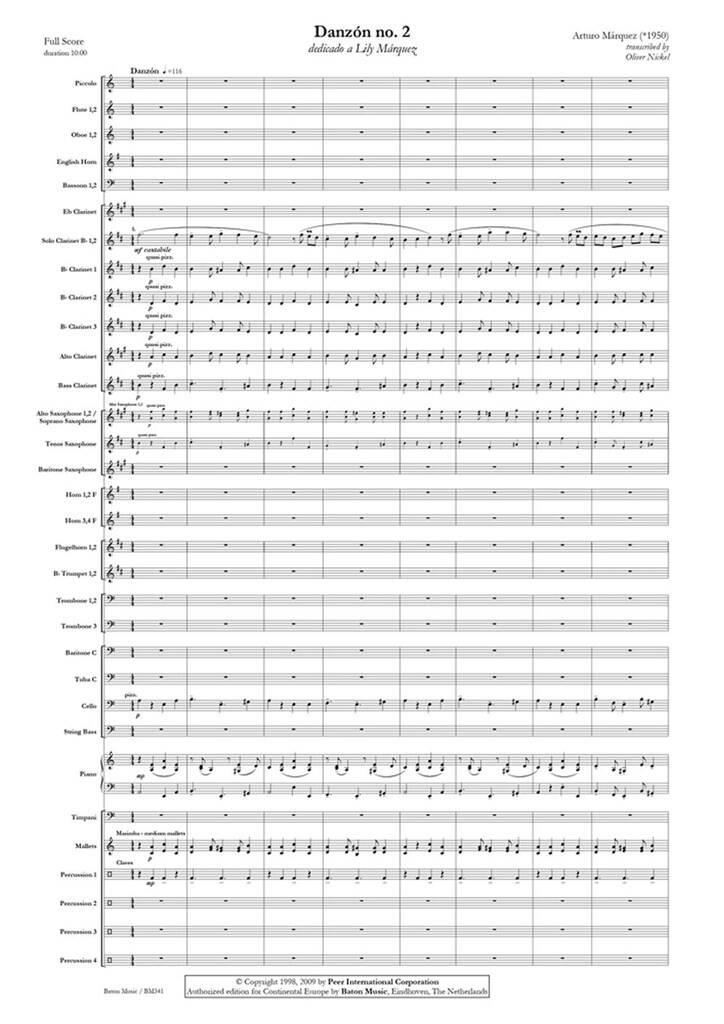
Danzn No. 2 - Arturo Márquez
Danzn no. 2 by the Mexican composer Arturo Mrquez was included on the program of the Simn Bolvar Youth Orchestra of Venuzuela conducted by Gustavo Dudamel on their 2007 tour of Europe and the United States. As a result of the strong public response to the orchestra's performance of the piece, Danzn no. 2 has established itself as one of the signature pieces performed by the orchestra. It has also opened the door for the discovery of other pieces by the composer that are increasingly being performed throughout the world and extensively in Latin America. The arrangement for Symphonic Windorchestra is made by Oliver Nickel.
Estimated dispatch 7-14 working days
-
 £102.99
Karachi Boulevard - Willy Fransen
Karachi Boulevard is a piece of music is inspired by the city of Karachi in Pakistan. This composition was made according to the theme-and-variations principle.The main theme of the work consists of a whole musical scale and this immediately gives the arrangement an Oriental flavour. This theme is cleverly disguised in endless, almost unrecognisable variations in a series of short interconnected fragments. Following a brief presentation of the thematic material, a rhythmic allegro part, in 7/8 time, is played by the piccolo. Next, some improvisation by the clarinet are played with vocal accompaniment by a number of "inhabitants" of Karachi. In the following part, anextremely moody and impressionist andante breaks through the hectic confusion when a flute solo brings a totally different variation of the theme. After this variation, a compelling folk dance in 3/4 time is played and the piece ends in a grand finale whereby the theme can be heard once again, albeit reduced to its simplest form and enhanced by rhythmic decorations from the woodwind.Despite the many variations, this exceptional piece is composed of different parts that form a logical sequence and make a very strong musical impression on the audience.
Estimated dispatch 7-14 working days
-
£184.99
Il Cantico - Oliver Waespi
Commissioned by the Stadtharmonie Zurich Oerlikon-Seebach for the 2005 WASBE Conference in Singapore"Il Cantico" was inspired by the poem "Cantico di Frate Sole" (Canticle of Brother Sun) by St. Francis of Assisi. In this famous mystic poem, St. Francis expresses his gratitude to God for the creation of nature, the sun, the earth and the living beings."Il Cantico" is based on specific parts of St. Francis's poem. A slow, dreamlike song in the flute leads gradually to the appearance of the sun, the light energy of which is expressed by radiant, powerful music in the brass instruments. The next, slower part of the work is dedicated to the moon (sora luna), a sort of mirror of thesun, and to the stars (le stelle). The music becomes more thoughtful, leads to a calm sound field in the woodwinds and later to a mystic horn solo. Still during the slow part, several chord fragments flash up, thereby announcing the fast ultimate part of the work. This part is about the fire (frate focu) illuminating the night, some sort of representative of the sun on earth. Towards the end of the work, the sun theme is combined with the fire theme.Besides these images, a purely musical structure guides the development of Il Cantico. Almost the entire piece evolves from a basic four-tone cell which appears in the horns and flute at the beginning. Consequently, the work is mainly monothematic and structured in the form of a metamorphosis. The basic cell gradually leads to a rich melodic and harmonic development. This basic material is later completed by a new chord series belonging to the fire theme. In the conclusion both approaches are combined.
Estimated dispatch 7-14 working days
-
 £174.99
Et in terra Pax - Jan Van der Roost
This piece was commissioned by the 'Concert Band Vlamertinge' and is a plea for peace: the title translates as 'Peace on Earth'. This is expressed by means of the vocal contribution expected from the performers. In various places of the piece you can recognize, the words 'Et In Terra Pax' - an appeal for peace - at first jumbled together but later more rhythmically structured, developing into synchronized massed voices.The work starts with a pentatonic theme based on the notes D, E, G, A and C (taken from 'ConCErtbAnD VlAmErtinGE' and the name of the conductor, NiCk VAnDEnDriessChe). A somewhat sad melody is developed during an orchestral climax which leads to the firstexplosion of sound (measure 62 onwards). Suddenly the opening measures are recaptured, albeit with a differently colored sound: the words 'Et In Terra Pax' bring the first movement to a close. A restless Allegro follows which abruptly stops and is replaced by a calming cho-rale-like passage. A narrator reads aloud the poem 'Sonnet' by the young poet Charles Hamilton Sorley, who was killed during World War I. This poem fittingly puts into words the cruelty and senselessness of war. After the expanded recapitulation of the allegro, the broad, almost infinite atmosphere of the beginning returns. Clarinet and English horn play the pentatonic opening theme once more, this time broadly, while the words 'Et In Terra... Pax' are repeated again and again by the rest of the orchestra.The composer has purposely avoided all forms of aggression and bombastic sounds regularly used in works about war. Fear of violence and destruction can be heard and felt during the allegro passages. The charged opening makes way in the end for hope: May peacefulness replace cruelty in everyday life, too.
Estimated dispatch 7-14 working days
-
 £116.40
Three Pictures for Band - Oliver Waespi
This composition consists of three sound pictures. When writing this work Oliver Waespi did not have any concrete image such as a scenery or a specific form in mind, but rather some typical visual movements. Hence the successive titles of the different parts: Procession, Dialogue and Waves. Numerous associations mutually link those parts as far as motifs and harmony are concerned. The motif of the ascending and descending fourth plays an important role in many a theme. There are many fourth chords by means of which Waespi tries to put a harmonic and unifying stamp on the compostition as a whole. Moreover there are similar or identical, though varied, motifs in the successive parts.The first part, Cortge (Procession), describes the dignified majestic procession by means of simple precise rhythms. At first the music is scarcely audible, as if coming from a distance; it gradually comes nearer until it reaches its climax in large chords, before fading away again. At each quarter note one could imagine a step. The second part, Dialogue, consists of broad outlines of dialogues between the different orchestral groups. Some instruments are asking questions, others are giving answers. After a rather sad passage, the music turns into a climax followed by a second passage that brings comfort and leads to a quiet ending. In the third part, there is a sudden movement coming up in the shape of waves. The principle of the wave, successively swelling and decreasing, dominates the entire musical structure of this part, even in the separate motifs.As far as the instrumentation is concerned there are the following notes: in the brass band version Oliver Waespi has a definite (orchestral) brass band strength in mind. If some parts (e.g. euphonium and flugelhorn) are played by several musicians, the conductor should feel free either to double or to thin those parts, providing the musical contents are not damaged. The same goes for the fanfare band in which the conductor can feel even more free as to the band's orchestral strenght. Anyway, a convincing overall sound is determining and that is to be realised by any kind of wind band.
Estimated dispatch 7-14 working days
-
 £184.00
Dunkirk - José Alberto Pina
Dunkirk is a French city that served as a backdrop for the Allied military operation between May and June 1940. Known as Operation Dynamo, it consisted of the evacuation of Allied troops that had been encircled by the Nazi German army during the Battle of Dunkirk in full invasion of France. Almost the entire British Expeditionary Force, part of the Belgian army andthree units of the French army had to evacuate the beaches and the port of Dunkirk before the German offensive. In spite of the bombings and the cornered by the German military, they were able to rescue more than 300, 000 soldiers. Jos Alberto Pina has tried to reflect the most dramatic moments of this operation. The composition is divided into small sections. It beginswith ''The Prologue'' where the main theme of Dunkirk appears, followed by ''The mole, the beach'', where the long wait was taking over the soldiers. In ''The bombers'' you can hear how little by little these planes were getting closer to take a nosedive and destroy the lives of the soldiers. ''The Dunkirk Spirit'' is a term in the British press that refers to the solidarity of the Britishpeople as they played a fundamental role, using small boats to get close to the beach and help with the transfer of soldiers. ''The Failed Evacuation'' is related to how the soldiers try to survive while trying to climb the big ships, but the bombers end up sinking without the possibility of surviving. In ''The Hymn'', the melody of the beginning of the work is listening again onthe trumpet, now developed throughout the orchestra and with great lyricism and nobility to finish with ''The Successful Evacuation'', where the full orchestra along with the drums will put a spectacular ending to this fantastic composition by Jos Alberto Pina.
Estimated dispatch 7-14 working days
-
 £189.70
Sing Sang Sung - Gordon Goodwin
"Sing Sang Sung" is inspired by "Sing Sing Sing" from the legendary 1938 Carnegie Hall Concert by Benny Goodman & His Orchestra. The famous "Jungle Groove" presented by drummer Gene Krupa and the opening riff from the 1938 performance is retained in this brilliant, swinging tune composed by Gordon Goodmin. The style changes from swing to "jungle groove" (with extensive use of tom-toms), is essential for both these tunes. The best sound recording of "Sing Sang Sung" is "Swingin' For the Fences" by Gordon Goodwin Big Phat Band released in 2000. But, you should also listen to the original "Sing Sing Sing" from the 1938 Benny Goodman recording as well!
Estimated dispatch 7-14 working days
-
 £57.50
Hambone - Libby Larsen
Libby Larsen used three inspirations from her life to write Hambone. First, she was inspired by early rock 'n roll rhythms, particularly those written by Bo Diddley, from her high school days when she had her own rock band. The second inspiration is the African-American tradition of hamboning - clapping and slapping to create fun, new rhythms, and finally the melodies of the traditional cakewalk, reminiscent of Debussy's Golliwog's Cakewalk. The curriculum explores all three of these inspirations with various musical and visual examples, and explains African American oral traditions, linking this piece to places all over the world, from Ghana and the Ivory Coast to Paris, France. A free downloadable interdisciplinary curriculum for teaching Hambone is available at www.BandQuest.org. Learn more on YouTube! BandQuest, an exciting series of new music and accompanying curricula for band, is a program published by the American Composers Forum. The series was started as a response to feedback from music educators that there is a pressing need for new, fresh band music. The heart of this program is new works written by a diverse group of leading American composers who have created challenging pieces that are a true departure from standard middle school repertoire. Every BandQuest project includes a residency component in which the composer works collaboratively with a middle school as they create their new piece. Many BandQuest pieces are accompanied by an interdisciplinary curriculum designed to assist students as they learn the music and to integrate each piece with non-music studies. Visit www.bandquest.org to learn more about this innovative series, and email [email protected] to request a free downloadable audio catalog.
Estimated dispatch 7-14 working days
 View Music