
Results
-
£64.99
Phantom Regiment - Leroy Anderson
This work was written by Leroy Anderson in 1951 and premiered by him when he recorded it for Decca. Interestingly, in 1956 the Phantom Regiment Drum and Bugle Corps of Rockford, Illinois changed their original name from the Rockford Rangers after having heard the piece played by a different corps. The music emulates the sound of distant trumpets and soldiers marching, drawing closer to the listener bit by bit. As the music gains strength, the marching and trumpets get louder and after passing the audience, it slowly fades away as they disappear into the distance again. This exclusive Southern band edition by Mark Rogers reintroduces Anderson's enchanting work to new generations of audiences.
Estimated dispatch 7-14 working days
-
 £159.99
Guardian Angels - Kevin Houben
Guardian Angels gives a musical expression to the legend of Reverend Louis Henri Bhler referring to the use of Psalm 34.North-west Veluwe and in particular Oldebroek (The Netherlands) has a very rich religious tradition which is demonstrated by its monumental churches. They tell the story of a stirring history in which Reverend Bhler played a crucial role. Inspired by his arrival as a pastor in 1870 in the neighbouring Oosterwolde, two big religious communities came into existence with their characteristic churches but this rivalry also resulted in great social unrest.This composition reflects on this striking personality and in particular on the story of the Angel Guard.'One evening Reverend Bhler has given a sermon in Oldebroek and he walks over the Church path through the pastures to Oosterwolde. On this dark and stormy evening Bhler's opponents are waiting for the pastor in ambush. They want to drown him in a watercourse near the Church path but abandon their plan because Bhler is accompanied by two men. The next day it comes to an encounter between Bhler and his opponents. They repent their, fortunately unexecuted , plan. Bhler firmly believes that on the previous night he walked alone over the Church path, and was not accompanied by two men. It was concluded that it must have been the angels who had protected Bhler.'Psalm 34 is central to this composition and this because of its powerful melody but also because the lyrics of verse 4 of the rhymed version fit in well with the special legend of Reverend Bhler:The Lord's angel gathered round himAn invincible heavenly guard,Who tries God's will, around himSo he's well guard(ed)A second melodious and harmonic cell is a musical transformation of the name 'Bhler'. This cell is varied in major and minor third chords and sometimes used as the main idea or apotheosis, but also serves as an accompanying cell or as a bridge between other melodic and rhythmic constructions.The composition was made possible by contributions of: Mr Evert van de Poll, owner of the Van Gelder Groep, Het Prins Bernhard Cultuurfonds Gelderland en Het Feteris Oosterbaan Fonds.
Estimated dispatch 7-14 working days
-
 £91.99
Guardians of the Waves - Philip Sparke
Guardians of the Waves was commissioned by the Japan Coast Guard Band to celebrate their 30th anniversary in 2018. They gave the premiere as part of a 30th anniversary concert on November 8th that year. Set in traditional march form, Guardians of the Waves opens with a short introduction, which leads to the main theme, played initially by the brass and then repeated with a florid woodwind descant. The theme is extended and morphs into a second theme, first played tutti and then quietly repeated by bassoon, tenor sax and euphonium. This leads to a conventional 'bass strain', played twice with varying accompaniments. A quieter trio section follows, delicately scored and featuring the tenor instruments of the band. Taken up by the full band, this leads back to a recall of the introduction and a return to the main two themes, which lead to a triumphal close.Recorded by the Kobe College Wind Orchestra and its conductor Osama Matsuura
Estimated dispatch 7-14 working days
-
 £407.00
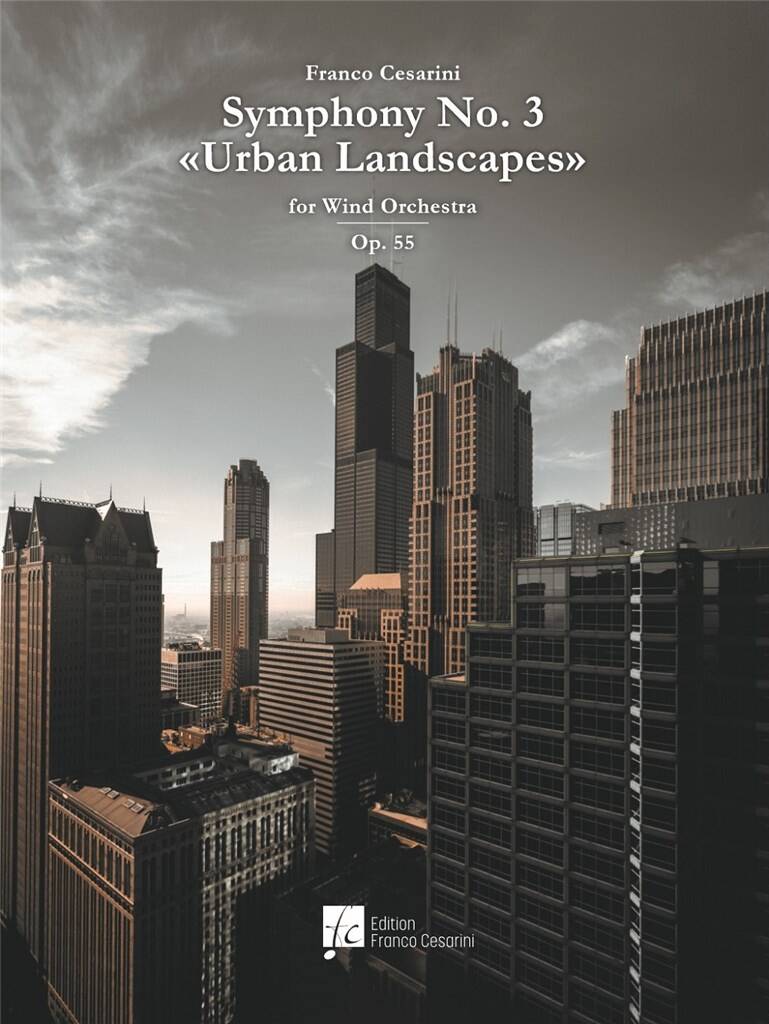
Symphony Nr. 3 Urban Landscapes Op. 55 - Franco Cesarini
Fascinated by the beauty of Chicago, Franco Cesarini has translated his emotions into music: this is how Symphony No. 3 "Urban Landscapes" Op. 55, was born, a musical portrait of this metropolis overlooking Lake Michigan. The composition is divided into three movements: The Wrigley Building from Dawn to Noon, Blue Silhouette and Cloud Gates, which by sharing the same thematic material arranged in cyclical form, strengthen the overall cohesion of the piece. The first movement, preceded by a short slow introduction in which the main theme is presented in an almost dreamlike form, metaphorically represents the city at dawn. The sudden change of time symbolizes the start of activities with all its noises and sounds: you can hear the bell that announces the closing of the subway doors, the sound of cars speeding by, the siren of a patrol car. If the first movement represents the day, the second introduces a nocturnal environment: a melancholic melody played by the English horn anticipates a more animated tempo depicting melodies coming from jazz clubs. Powerful fanfares that take up the second theme of the first movement introduce the third movement. In this finale, the role of the two themes is reversed compared to the first movement and one takes the place of the other in a kind of games of mirrors. Symphony No. 3 "Urban Landscapes" Op. 55: a sumptuous musical portrait of the "Windy City".
Estimated dispatch 7-14 working days
-
 £224.99
Lux Futura - Kevin Houben
Lux Futura (Light of the Future) was commissioned by the Royal Wind Orchestra Delft and is inspired by the letters 'D-E-L-F-T' using the letter notation system by Bla Bartk. In this 'Delft' cell, there is referral to the 'Trinitas', the bourdon bell of the Old Church in Delft, that only tolls during a funeral of a member of the Dutch Royal Family. The Delft melody switches to the 'Agneta March', which is a reference to the history of the Royal Wind Orchestra Delft. Further on the love theme, played by the bass instruments represents the love of the inhabitants for their city throughout space and time. In the middle movement, the beauty of the city is depicted by the coranglais (English horn) solo, as an ode to the lovely city of Delft. When performed, one can choose to use sound city samples recorded in Delft to create a truly magnificent spectacle. The three samples can be downloaded from websites www.halleonardeurope.com or www.kevinhouben.be.
Estimated dispatch 7-14 working days
-
 £435.40
Goldberg 2012 - Svein H. Giske
The first time I heard Bach's Goldberg Variations was in the movie Silence of the lambs, in the early 1990s. I noticed the beautiful background music in one of the scenes, but at that time I didn't know what it was. A few years later, when I was studiying at the Grieg Academy, I got to know the entire piece. For me, this is a piece of music which I can listen to countless times. I think it sounds as fresh today as it did more than 15 years ago and it never ceases to inspire me. Both Bach's composition and Glenn Gould's famous 1955 recording (which was the first one I heard) still makes a great impression on me. Before Gould recorded it at age 22, it wasn't a highly ranked piece amongst pianists and Bach was by many viewed as a bit old-fashioned. The young Canadian turned all this around. He managed to portray Bach in a reformed way, producing fine nuances in phrasing and making the many layers in Bach's music more transparent than anyone before him. Thus he plunged both himself and Bach (back) onto the international music scene. When The Norwegian Band Federation (NMF) asked me to write the test piece for NM in 2012, it was only natural for me to use the Goldberg Variations as a starting point and inspiration for my work. Since I was a teenager at NMF's summer courses in the mid eighties I've always listened to many different styles of music. Growing up in Sunnmre with the Brazz Brothers as teachers and mentors, jazz-, pop/rock- and folk music were early on a natural part of my musical background. I also have my classical education from the Grieg Academy on trumpet. As the title of my piece implies, I've wanted to bring Bach to the present and put his music into various modern musical landscapes. I think you can bring about a special kind of energy when music from different genres are mixed and I've tried to do this by mixing Bach with artists and musical styles from the present. In Goldberg 2012, the music is often constructed by several layers, which in a way are living parallel musical lives. They are seemingly moving or floating freely, almost unaware of each other, but bound together by the same basic pulse. The rythms, however, are often notated on a different rythmic subdivision level than the usual 8th- or 16th note levels. By doing this, I hope to achieve transparent sounds that rythmically are perceived as more free and detached from each other. In large sections of the piece, pop/jazz is fusioned with elements from Bach. I guess you could have this little scene as a synopsis for the piece: picture a group of musicians meeting: some are classical performers, some are jazz. They start to improvise together, each in their own voice or musical dialect and I'm sort of in the middle, trying to write down what they are playing. This is what I feel much of Goldberg 2012 is about. The foundation of the piece, in addition to Bach and references from pop/jazz music, lies also in my own material. This material, basically two chords, is heard in it's purest form in the 1st movement. I use these chords to create scales, new chords and different motifs which contribute to blend together the different moods of the piece. It has not been my intention to copy Bach's form (theme and 30 variations), but rather to use the bits and pieces that I like the most as an inspiration for my own variations. The 1st movement, Aria 2, is for my 3rd son, Olav, who was born on the 21st of April 2011, and the 5th movement, From long ago, is dedicated to the memory of my father, Svein J. Giske, who passed away on the 6th of June 2011. -Svein H. Giske, January 2012-
Estimated dispatch 7-14 working days
-
 £79.99
Commemoration - James Barnes
Commemoration was commissioned by the members of the Northwest North Carolina Bandmasters Association to recognize the distinguished career of Dr. William A. Gora, the longtime Director of Bands at Appalachian State University, who passed away in 2015. Bill was loved by his students, respected by his peers and cherised by his many friends. A brilliant musician, a fine conductor and a warm human being with a marvelous sense of humor, Bill has been sorely missed by all. Gora was friends with composer James Barnes for over 40 years. They met when Barnes was still in graduate school at Kansas and Gora had just finished his DMA at the University of Florida. When the NNCBDA asked Barnes to compose a work in Bill's honor, he was honored to do so. He decided to write a cheerful work for Bill, full of energy, color and melody, because he knew this is what he would have wanted; no funeral dirges for Bill Gora. The soft middle portion of the work, a hymn-like tune scored in saxophone choir, was included because Bill was a fine saxophonist and, for many years, the saxophone teacher at ASU.
Estimated dispatch 7-14 working days
-
 £104.99
Addio Napoli
Addio Napoli is a medley of well-known Neapolitan melodies, including Torna a Surriento by Ernesto de Curtis (1875 1937), Neapolitan Dance by Pyotr Ilyich Tchaikovsky (1840 1893) which he used in his famous ballet, SwanLake Maria, Mari!, a Neapolitan song by composer Eduardo di Capua (1865 1917), and of course, Funicul, Funicul by composer Luigi Denza (1846 1922). This cheerful medley by the renowned arranger Wil Van der Beek is ideal for allof your concerts!
Estimated dispatch 7-14 working days
-
 £92.99
Final Covenant - Fisher Tull
As the title implies, the work expresses the deep religious emotions of the promises made by God to mankind. Two thematic elements are employed: the first, a dramatic proclamation, is introduced by horns and subsequently taken bytrumpets and woodwinds - the second plaintive theme, in the manner of a supplication, is presented by oboes followed by flutes and clarinets. The first theme returns leading to a climactic section by the full ensemble. Adevelopment section focuses on fragments from the principal theme culminating in a brief brass fanfare based on the earlier accompanying motives. The recapitulation of the principal theme brings the work to a quiet and peacefulclose. (8:00)
Estimated dispatch 7-14 working days
-
£109.99
Remember The '80
This is the follow-up to Filip Sandras's top-selling hit Remember the 70s". He has arranged the following hits for this version: What's another year", popularised by the version by multiple Eurovision Song Festival winner Johnny Logan, Josephine" by Chris Rea, Alive and Kicking" by the Simple Minds and Freedom" by 80s superband Wham!
Estimated dispatch 7-14 working days
 View Music