
Results
-
 £47.50
Ridgeview Centrum - Alvin Singleton
Ridgeview Centrum is a fanfare written in composer Alvin Singleton's style of subtle spontaneity, which is experienced through a fusion of classical and folk music elements. In the historic tradition of fanfares, this work was written by Singleton in honor of the students and band teacher he worked with during his BandQuest residency at Ridgeview Middle School in Atlanta, Georgia. (Includes score and parts.) BandQuest, an exciting series of new music and accompanying curricula for band, is a program published by the American Composers Forum. The series was started as a response to feedback from music educators that there is a pressing need for new, fresh band music. The heart of this program is new works written by a diverse group of leading American composers who have created challenging pieces that are a true departure from standard middle school repertoire. Every BandQuest project includes a residency component in which the composer works collaboratively with a middle school as they create their new piece. Many BandQuest pieces are accompanied by an interdisciplinary curriculum designed to assist students as they learn the music and to integrate each piece with non-music studies. Visit www.bandquest.org to learn more about this innovative series, and email [email protected] to request a free downloadable audio catalog.
Estimated dispatch 7-14 working days
-
 £57.50
Ghost Walk - Chris Brubeck
Composer Chris Brubeck wrote Ghost Walk as part of his BandQuest residency at West Rocks Middle School in Connecticut. The piece combines Brubeck's lifelong experiences with both jazz and classical idioms, creating a work that's as fun to play as it is to hear. The title was inspired by the wedding of Brubeck's son at Gettysburg College, which hosts a ghost walk, as well as the minor mode and haunting atmosphere of the piece. Learn more on YouTube! BandQuest, an exciting series of new music and accompanying curricula for band, is a program published by the American Composers Forum. The series was started as a response to feedback from music educators that there is a pressing need for new, fresh band music. The heart of this program is new works written by a diverse group of leading American composers who have created challenging pieces that are a true departure from standard middle school repertoire. Every BandQuest project includes a residency component in which the composer works collaboratively with a middle school as they create their new piece.Many BandQuest pieces are accompanied by an interdisciplinary curriculum designed to assist students as they learn the music and to integrate each piece with non-music studies. Visit www.bandquest.org to learn more about this innovative series, and email [email protected] to request a free downloadable audio catalog.
Estimated dispatch 7-14 working days
-
 £84.99
Hungarian Rondo - Árpád Balázs
The Hungarian Rondo by rpd Balzs is cheerful, good-humoured music, a finely formed work crafted withgreat professional skill. Its structure is clear: the double recurrence of the rondo theme results in a five-part form. The two episodes differ in character. The first consists of increasingly densely woven imitations that chase eachother playfully, the second evokes the mood of bagpipe tunes. In the latter, above the melody moving evenly in crotchets in the middle parts a pastel-tinted cloud of woodwind notes floats upwards, while the sound is extended downwards by the deep-toned brass stepping lower by semitones. A brilliant device by the composer! In thecourse of its repeats the rondo theme appears more and more richly garbed, particularly the sparkling semiquavers of the woodwind make it ever more decorative. The Hungarian Rondo is the kind of music that drives your cares away.
Estimated dispatch 7-14 working days
-
 £139.99
Le Cortge du Roi Renaud - Franco Cesarini
Le cortge du roi Renaud is a suite in five parts. It is based on tales that originated in southern European folk songs, dating back as far as the 16th century. A large portion of these songs are of the genre "Complaintes" songs in which the text gives a detailed description of events having a generally criminal or macabre character. The most familiar song to feature the tales of Roi Renaud is "Fualdes", consisting of 48 verses.The first part of the suite is based on the song "La Porcheronne" (The Swineherd). It telis the story of a young woman forced by her mother-in-law to tend pigs while her husband is away fighting in the war. She is freed only when her husband returns sevenyears later.The next part tells the story of "La mrquise Empoisonne" (The Poisoned Marquise). A marquise is coerced by her king to become his mistress. The jealous queen poisons her by means of a bouquet of deadly scented fiowers.Despite having the character of a merry dance, the third part, "La maumarie vengee" (The Avenged Wedding), expresses the touching story of Queen Clotilde, persecuted for her refusal to live according to the Aryan beliefs."La belle engloutie" (The Swallowed Beauty) relates the tale of the young wife of King Renaud. She cannot imagine a life without her husband, who was mortally wounded in the war, and begs the earth to open and swallow her up so thst she may rejoin her love.The gruesome content of the final part,"Le tueur de femmes" (The Wife Killer), bears a strong resembiance to the tale of Bluebeard. The story is about a young wife in danger of being drowned in a pond by her husband, which is what happened to her 13 predecessors. Thanks to her cunning, she manages to turn the tables and contrive her husband's demise.
Estimated dispatch 7-14 working days
-
 £149.99
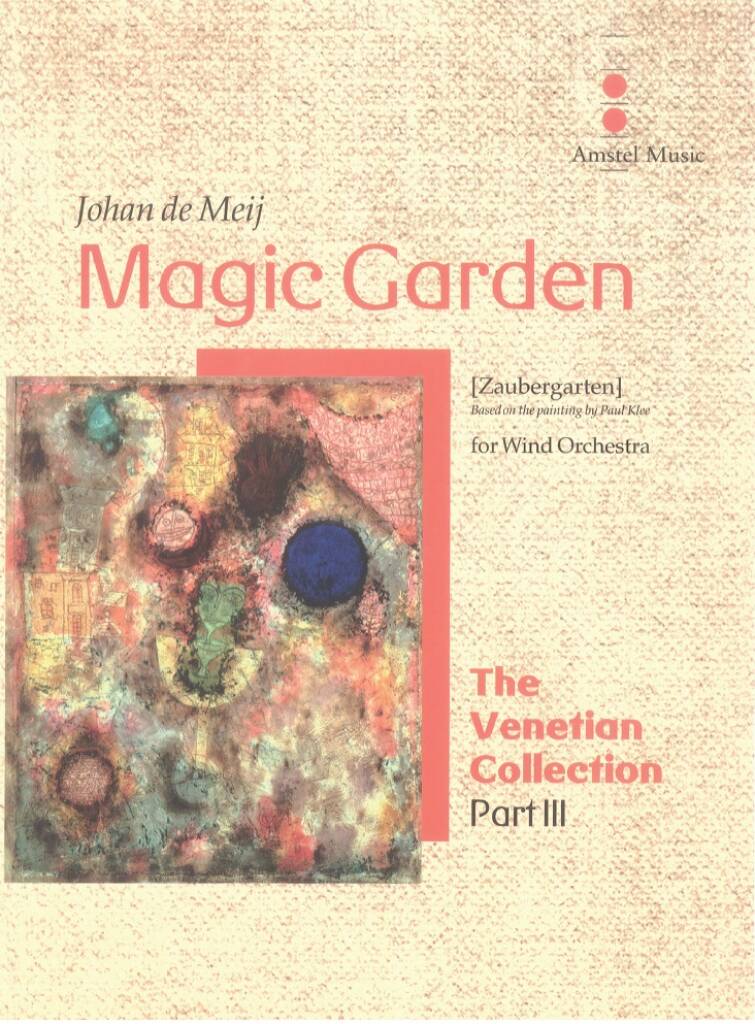
Magic Garden - Johan de Meij
Inspired by a painting by German artist Paul Klee [1879 - 1940], this work forms the third movement of The Venetian Collection. Completely different than the other parts of the cycle, this movement illustrates Klee's colorful,naive dream world by means of a fragile, transparent texture, bringing the woodwinds into the limelight. The rather abrupt conclusion is preceded by a breathtakingly fast unison passage for the complete woodwind group. (Duration8:00)
Estimated dispatch 7-14 working days
-
 £153.50
Our First Band Concert - David Shaffer
(David Shaffer, James Swearingen, Robert W. Smith, Rob Grice)Stretch your budget dollars with this collection of four popular and contrasting Sound Foundations series publications!This set includes:"Starburst Fanfare" an energetic opener by David Shaffer"Heroes and Glory" a delightful overture by James Swearingen"Be Still My Soul" a beautiful lyrical arrangement by Robert W. Smith"12 The Clock Strikes" a humorous musical work by Rob GriceAll 4 selections are at the grade .5 level, utilizing just the first six notes learned in band instruction, and perfect for that first semester concert!
Estimated dispatch 7-14 working days
-
 £107.50
Our First Christmas Concert! - James Swearingen
Stretch your beginning band budget dollars at Christmastime with this outstanding collection of four holiday favorites! Includes four complete band arrangements in one, all grade 1.5.Includes:A CHRISTMAS CLASSIC by James SwearingenDOWN THROUGH THE CHIMNEY by Jerry WilliamsSOUNDS OF THE SEASON by James SwearingenA SNOWY CHRISTMAS DAY by Jerry Williams
Estimated dispatch 7-14 working days
-
 £159.00
Our First Spring Concert! - Ken Harris
Got the end of the year empty budget blues? Program your beginning band's spring concert with this great value of four beginning band selections in one bargain-priced package!Includes:PATRIOTS ON PARADE MARCH by Ken HarrisAS THE EAGLE FLIES by James SwearingenSONG OF THE TELEGRAPH by David ShafferTACO TIME by Ed Huckeby
Estimated dispatch 7-14 working days
-
£134.99
Recalls - Ben Haemhouts
Recalls obviously refers to memories. This piece of music is in fact a series of flashbacks, however, it does not highlight the actual memories of specific thoughts, people or events.The composition evolves around the late Frans Steurs, who for manyyears was the inspirational artist behind the brass band that is currently commissioning this work. The main theme of the work is based on the name STEURS". E = mi, U = do, R = re and S = "si" which is Dutch for the note "ti". This idea forms themusical theme for the entire composition and different variations are used throughout. The structure of the work is based on the concept of a story which father Steurs is telling his two daughters, who play the flute and the clarinet. Each part ofthe work has a story-like character:1. Introduction: following a short ominous intro, the main theme is presented for the first time.2. The Story: father Steurs has both his daughters on his knee and he tells them stories from the old days. Trumpetsand trombones play variations of the theme. The story gets very exciting (accelerande, poco a poco agitato) until the tale takes a dramatic turn when the father tells an exciting story at the time of the Second World War. He tells of being hunteddown by the occupying army and these adventurous episodes are related to us musically in part3. Danger, with its skilful references to "vor dem Sturm" from "Eine Alpensinfonie" by Richard Strauss.4. called Fugitives, is about how he fled in the nightfrom the enemy and this is reflected in the bass tones of a new theme. The aggression of the war is illustrated from bar 117 onwards, by a harsh brass section. The main theme is repeated once again and this time up-tempo. The second theme is broughtonce again from bar 149 onwards.5. Dialogues, depicts the conversations between the two daughters and their father. Father speaks (bar 155); the daughters answer (bar 164 - flute, bar 166 - clarinet); bar 178: father answers with the tune of the maintheme to the two daughters. The discussions gradually intensify but ultimately end in peace in the last part called Conclusion.The piece of music "Recalls" is a free interpretation by the composer who consulted the letters between the two daughtersof Steurs and their father and in this respect it is not really music for a programme."
Estimated dispatch 7-14 working days
-
£137.99
Three Onegin Dances - Pyotr Ilyich Tchaikovsky
Tchaikovsky is best known for his purely instrumental compositions. However, we must not underestimate him as a composer of operas. Many of his operas such as Pique Dame and Eugene Onegin are still performed regularly throughout the world. Eugene Onegin (also called Jevgeny Onegin), composed in 1877-1878, was not called an opera by Tchaikovsky himself, but "lyric scenes". The work is entirely dominated by lyricism. However, there are two moments that contrast sharply with this lyricism: two ball scenes, for which Tchaikovsky wrote a waltz and a polonaise.After opening with a less well-known allegro dansant, this arrangement features the aforementioned waltz, which can beconsidered a beautiful Russian equivalent of the Faust Waltz by Charles Gounod. In the opera, this waltz is actually played by a military band. The arrangement concludes with the pompous polonaise (also mentioned above) which opens the last act: the ideal music to characterize high aristocracy in the salon of a palace in St. Petersburg.
Estimated dispatch 7-14 working days
 View Music