
Results
-
 £317.99
Music of the Spheres - Philip Sparke
The piece reflects the composer's fascination with the origins of the universe and deep space in general. The title comes from a theory, formulated by Pythagoras, that the cosmos was ruled by the same laws he had discovered that govern the ratios of note frequencies of the musical scale. ('Harmonia' in Ancient Greek, which means scale or tuning rather than harmony - Greek music was monophonic). He also believed that these ratios corresponded to the distances of the six known planets from the sun and that the planets each produced a musical note which combined to weave a continuous heavenly melody (which, unfortunately, we humans cannot hear). In this work, these six notesform the basis of the sections MUSIC OF THE SPHERES and HARMONIA. The pieces opens with a horn solo called t = 0, a name given by some scientists to the moment of the Big Bang when time and space were created, and this is followed by a depiction of the BIG BANG itself, as the entire universe bursts out from a single point. A slower section follows called THE LONELY PLANET which is a meditation on the incredible and unlikely set of circumstances which led to the creation of the Earth as a planet that can support life, and the constant search for other civilisations elsewhere in the universe. ASTEROIDS AND SHOOTING STARS depicts both the benign and dangerous objects that are flying through space and which constantly threaten our planet, and the piece ends with THE UNKNOWN, leaving in question whether our continually expanding exploration of the universe will eventually lead to enlightenment or destruction.
Estimated dispatch 7-14 working days
-
 £176.50
Masquerade - Philip Sparke
MASQUERADE was commissioned by Stadtmusik Willisau from Switzerland (Reto Gdel, conductor) to celebrate their 175th anniversary in 2003 and first performed by them in November that year. 1. OvertureThe first movement opens with a fanfare-like figure, featuring the brass, before the main them is introduced over staccato chords. After a short, syncopated interlude a legato theme is introduced in the tenor register and material is developed until the music slows temporarily. The opening theme returns and the 'tenor' tune is taken up by the whole band until the opening fanfare returns to close the movement. 2. ElegyThe slow movement opens intensely with a bare two-part theme, whichleads to a passionate chorale-style melody. A second theme is introduced and leads to a climax, a return of the chorale theme and a pianissimo repeat which again leads to a full-band climax. The two-part theme returns quietly to create a peaceful close. 3 InterludeA short movement which changes the mood to introduce:- 4 FinaleThree violent chords preface a lively syncopated opening theme. The trumpets introduce a second idea, which is treated fugally, and this in turn leads to the main melodic idea of the movement, over staccato chords. A contrasting subject is then introduced in the middle of the band, followed by echoes of the first movement fanfare. The opening theme returns and material is revisited until the opening fanfare returns in full to end the work triumphantly.
Estimated dispatch 7-14 working days
-
 £91.99
The Sun Will Rise Again - Philip Sparke
The composer writes:"On March 11th 2011 a massive 9.0- magnitude earthquake occurred off the coast of north-eastern Japan.I'm writing these programme notes barely a week later and the death toll caused by the quake and resulting tsunami already exceeds 6000, with thousands of people still unaccounted for. I have many friends associated with many bands throughout Japan and one of these, Yutaka Nishida, suggested I write a piece to raise money to help those affected by the disaster. I was immediately attracted by the idea and have arranged Cantilena (a brass band piece recently commissioned by the Grenland International Brass Festival, Norway) for wind band, giving it a new title tohonour my friends in the Land of the Rising Sun.I will be donating royalties from this piece to the Japanese Red Cross Society Emergency Relief Fund and am delighted to say that my distributors, De Haske, who will generously also donate all net profits from sales of this piece, have pledged a substantial advance payment to the Red Cross so that what little help this project generates can be immediate.It is my sincere wish that this 'Band Aid' project will allow wind bands around the world support the people of Japan, where bands are a way of life for many, in this difficult time".Philip Sparke
Estimated dispatch 7-14 working days
-
£161.00
Parade - Erik Satie
Parade is a ballet with music by Erik Satie and a one-act scenario by the French artist Jean Cocteau composed in 1916-1917 for Sergei Diaghilev's Ballets Russes and premiered in 1917 in Paris, with costumes and sets designed by Pablo Picasso. Cocteau started writing a scenario - the theme being a publicity parade in which three groups of circus artists try to attract an audience to an indoor performance - to which Satie composed the music. The score contained several 'noise-making' instruments (typewriter, foghorn, an assortment of milk bottles, pistol,...), which had been added by Jean Cocteau. Dutch arranger Guus Dohmen transcribed Satie's Parade for Symphonic Band including all of Jean Cocteau's extraordinary additions.
Estimated dispatch 7-14 working days
-
£109.99
Dublimania - Menno Bosgra
This new work is based on Irish folk music.In the first part, the main theme is presented as a ballad, starting with the piccolo (as replacement for the flute which is widely used in Ireland), moving on the wood section to end with the entire orchestra.It then changes to a kind of rock style theme: powerful, rhythmic accompaniment with effects in dampers, a pedal point and the use of the spoons which is typical of Irish music (Irish pub), high-range bongo drum (replacement for the Bodhran), etc.In this second part I introduced a second theme as a counterbalance, played by several groups, which has clearly a more legato character and therefore sounds more melodious.The climaxof the work starts in the low-range brass section with its marcato theme that is developed with a great deal of rhythmicity in the accompaniment, clusters, etc. into a percussion solo interspersed by the orchestra in five-eight time with frequent parallel movement in chords (folk music style).Towards the end, theme 2 recurs twice: first as heard earlier with an extra counter melody and accompaniment pattern, then in a canonical form, in which the theme is played by three groups. The conclusion is a repeat of the middle section in five-eight time.I have tried to use many of the colours of a wind orchestra by having the wood sections and brass section play alone and making extensive use of dampers. Percussion also has a prominent role throughout the work.
Estimated dispatch 7-14 working days
-
£264.99
Diferencias on an Old Spanish Song - Yasuhide Ito
I am immensely happy that my Gloriosa, symphonic poem for band (1990), has been performed by so many bands in the last thirty years.During this period, the growth of the internet has made it much easier to access information.When I composed Gloriosa, I only had limited information about the period when Christianity and Western music was first introduced to Japan, and had to rely a lot on my imagination.However, nowadays, it is easy to obtain various source materials and to read interesting studies on the music of the past.In recent years, the music of Luis de Narvez (born ca.1500 - died between 1555-1560), Spanish composer and vihuela player, has become increasingly known, and several CDs of his music are now available.Narvez composed the earliest-known set of diferencias, a forerunner of the variation form. One of his works is Seys diferencias sobre el himno "O gloriosa domina" [Six diferencias on the hymn "O gloriosa domina"] (1538), based on the Spanish Marian hymn, and it was this melody I used in the first movement of my Gloriosa.Western music has been my musical roots since childhood, and throughout my career as a composer, it has continued to fascinate me. One could say that this has provided the inspiration for Diferencias on an Old Spanish Song, my own take on the diferencias form.Actually, such music from the early sixteenth century could sound fresh to our modern ears. So I decided to quote the melody from Narvez's Sey diferencias at the beginning and end of the piece, in order that people can get the feel for the period.The main section (bars 42-390) is formed of 13 diferencias, similar to the first movement of the Gloriosa.In the middle section, which begins after the eighth diferencia(from bar 187), one should be totally absorbed in the tranquility and the beauty of the music. Although it's in the style of a sarabande, it should be taken slower and played as pianissimo as possible.This is followed by folk-style dance music. (As only standard percussion instruments are used, try to be creative with tonal colours and sense of rhythm).The structure of the work is simple, but be aware of the connection between the sections when constructing the whole.Also, think about the tonality. Overall, the work is in F minor. The main section is basically in D minor, but from bar 102, it modulates to A flat minor and G minor, and then in the middle section it suddenly switches to A flat major (which is the furthest key from D minor, and the relative major of F minor). From bar 219, it modulates to F minor and then to C minor, then back to F minor by way of A minor.N.B. The Oboe II part can be substituted by the English Horn (as indicated in the parts). One can choose according to the player's skills or preference.Recent new compositions for wind band are often full of rhythm, dynamism, and tonal colour, and compositional techniques and orchestration have also evolved greatly. Yet on the other hand, they tend to feature fewer melodic or expressive elements. Since this work is the test piece for WMC Kerkrade 2022, I had to think about what "tests" or "challenges" to set, and I decided to compose something that doesn't involve a lot of technical display, but requires beautiful sounds and harmonies, and above all, musical expressivity. I didn't put many expression markings in the score, because I wanted the performers to think about how best to express this music. If it is played merely as notated, it's not going to sound very interesting.Christianity was introduced to Japan in the mid-16th century, but it was subsequently banned and Japan entered a period of national isolation, which meant that there was hardly any international exchange for two hundred years. As a result, the Christian hymns that were introduced prior to the isolation became almost unrecognizable over the centuries. This was the theme I explored in my Gloriosa thirty years ago.Now, in 2021, the whole world has been forced to "isolate" due to the Covid-19 pandemic. In such times, it seems pertinent that I've written a work using this melody again. I sincerely hope that people will be able to gather in Kerkrade in 2022.(English Translation:Nahoko Gotoh)
Estimated dispatch 7-14 working days
-
£84.99
The Magic Flute - Wolfgang Amadeus Mozart
Any list of Mozart's greatest works should include this overture. Loved by millions, Mozart's Magic Flute is remarkable for so many reasons and worthy of study by every musician! Why should we deny young band students the joy of playing Mozart just because they don't happen to use a bow on their instruments? Mozart belongs to Everyone! Skillfully brought to the concert band stage by an arranger who works with young bands daily, this somewhat shortened version of the enigmatic Overture is accessible to young bands, but retains a great deal of authenticity. There is added versatility built into this arrangement. A nice performance is possible by using a completeWoodwind section and a Timpanist only. Inspiring!>/I>
Estimated dispatch 7-14 working days
-
 £149.99
Nemu-Susato - Jan Van der Roost
Commissioned by the Japan Band Clinic Committee of Yamaha for the Nemu Band Directors Clinic in Nemu no Sato, May 18-20, 1997.The surprising title of this work is an indication of its content. By combining the somewhat similar names 'Nemu no Sato' and 'Susato' into a new word, Jan Van der Roost has produced a significant and interesting subject. The Yamaha corporation has extensive facilities in Nemu no Sato, Japan, including a concert hall, recording studios, hotel and so on. Concerts, workshops, clinics and other events are held here, including the annual Nemu Band Directors Clinic, which consists of numerous musical events. Jan Van der Roost served as guest conductor andspeaker in 1994. He was invited again for the 1997 clinic, this time with a composition assignment. The difficulty level of his new piece was to be Grade 2 - 3 bands. With this in mind, Mr. Van der Roost strove to create a renaissance-like sound. Simultaneously he wished to create a tribute to Tielman Susato who, like Jan Van der Roost, lived and worked in Antwerp in the 16th century. The first performance of Nemu-Susato was conducted by the composer, performed by the Tokyo Metropolitan Police Band, and took place during the Nemu Band Directors Clinic on May 19, 1997.
Estimated dispatch 7-14 working days
-
£104.99
Nocturne - Pyotr Ilyich Tchaikovsky
Tchaikovsky is best known for his purely instrumental compositions. However, we must not underestimate him as a composer of operas. Many of his operas such as Pique Dame and Eugene Onegin are still performed regularly throughout the world. Eugene Onegin (also called Jevgeny Onegin), composed in 1877-1878, was not called an opera by Tchaikovsky himself, but "lyric scenes". The work is entirely dominated by lyricism. However, there are two moments that contrast sharply with this lyricism: two ball scenes, for which Tchaikovsky wrote a waltz and a polonaise.After opening with a less well-known allegro dansant, this arrangement features the aforementioned waltz, which can beconsidered a beautiful Russian equivalent of the Faust Waltz by Charles Gounod. In the opera, this waltz is actually played by a military band. The arrangement concludes with the pompous polonaise (also mentioned above) which opens the last act: the ideal music to characterize high aristocracy in the salon of a palace in St. Petersburg.
Estimated dispatch 7-14 working days
-
 £420.99
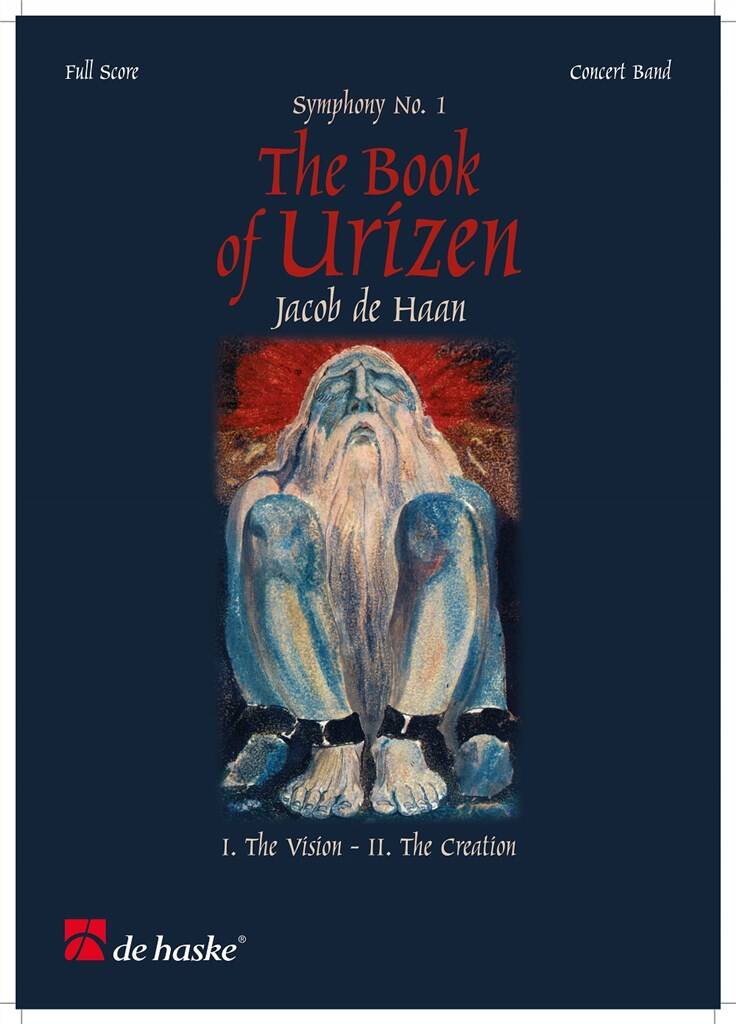
The Book of Urizen I + II - Jacob de Haan
The Book of Urizen is Jacob de Haan his first Symphony for concert band, solo soprano, and a male narrator in which sound collages of expressions are used. The piece is inspired by the compelling visionary poem of the samename (which the poet illustrated himself) by the Englishman William Blake (1757-1827). The Vision, first movement and The Creation, second movement of The Book of Urizen are available by following editionnumber: DHP 1043551. The Web, the third movement of The Book of Urizen is available by the following edition number: DHP 1125252. Download the audio samples from the 'Attachments'.
Estimated dispatch 7-14 working days
 View Music