
Results
-
£179.99
Amazonia - Jan Van der Roost
This major concert work cosists o five movements.1st movement: La Laguna del ShimbeSituated high up in the Andes mountains in Northern Peru are the Huaringas, a group of lagoons in isolated and mysterious surroundings. The water has healing powersand for centuries traditional healers have settled there in small villages. From far the sick come to the Huaringas to be treated in nightly rituals, in which the hallucinating juice of the San Pedro cactus gives the prophet a look inside hispatient. The biggest lagoon is the "Laguna del Shimbe", one of the countless wells of the immense Amazon stream.2nd movement: Los AguarunasFurther downstream in Northern Peru we come across the rain tribe of Los Aguarunas. It's a proud, beautiful andindependent race, which has never succumbed to domination, not even from the Incas. They live from everything the forest has to offer: fish, fruit, plants, ... . They also grow some crops and live as semi-nomads. They take their fate into their ownhands and after having made contact with modern civilisation, they have integrated new elements into their lives without betraying their own ways.3rd movement: MekaronMekaron is an Indian word meaning "picture", "soul", "essence". The Indians are theorigina inhabitants of the Amazon region. They either live in one place as a group or move around a large region. They all have their own political system, their own language and an intense social life. At the same time they are master of music andmedicine. "Everywhere the white man goes, he leaves a wilderness behind him", wrote the North American Indian leader Seatl in 1885. As a result of these contacts with the whites, the disruption of most Indian societies began. (In this century alone,80 tribes have vanished completely).4th movement: KtuajThis is the name of the initiating ceremony of the Krah tribe in the Brazilian state of Goias, in which young boys and girls enter adult life. They are cleansed with water, painted with redpaint and covered with feathers, after which the ritual dance holds the entire tribe spell-bound.5th movement: Paulino FaiakanIn 1988 the Indian chiefs Faiakan and Raoni Kaiapo came to Europe to protest against the building of the Altamira dam inBrazil. As a result of the dam the Indians would be driven from their traditional land and enormous artificial would be created. The project was supported financially by, amongst others, the European Community. In February 1989 the Indian tribesaround Altamira held a protest march for the first time in their history together. Amongst other things they paid tribute tot Chico Mendez, who, murdered in 1988, was the leader of the rubber syndicate and a fierce opponent of the destruction of theBrazilian rain forest. Brazilian and world opinion was awakened. The building of the dam was -albeit temporarily - stopped.
Estimated dispatch 7-14 working days
-
 £149.99
St. Martin's Suite - Jan Van der Roost
This suite was composed by Jan Van der Roost on the occasion of the 110th anniversary of the 'Koninklijke Sint Martinusfanfare' (Royal Saint Martinus Fanfare Band) from Halle (Belgium). The composer was required to create a suite in three movements based on three images associated with the 'Sint Martinusfanfare' from the small town of Halle in the province of Brabant. The first movement (Andante Pomposo) describes Martin, a soldier in the Roman army. In Andante Moderato we see the image of Martin, who become a Christian and chooses to devote his life to God. In this movement, the composer was inspired by the Brabantine gothic art of the Sint Martinus Basilica in Halle. Thecontrast between the dark Basilica and the statue of Our Lady between the soaring pillars will vividly come to life for audiences of this descriptive piece. The final movement, Allegro Molto Vivace', could have been an image for a frivolous peasant in the Halle carnival. In a triptych about St. Martin it is more fitting to refer to it as an apotheosis, the crown on the pastoral work of Martin, Bishop of Tours, Patron Saint of the Fanfare Band and the Basilica of Halle.
Estimated dispatch 7-14 working days
-
 £94.99
Conzensus - Jan Van der Roost
This stately concert opener was originally written by Jan Van der Roost for a special event in which six respected wind orchestras (two Belgian and four Dutch) of different composition (two symphonic bands, two fanfare bands and two brass bands) were featured during six concerts. Each evening brought forth a performance by a symphonic band, a fanfare, and brass band, so that the audience could experience all three types of ensembles. This was indeed an original concept.The name, ConZEnSus, comes from a combination of the words, 'Concert Cyclus' (concert series) and 'zes' (Dutch for 'six'). This leads to a new word, which refers to 'consensus'. The general tenor of the cycle isthus immediately indicated. The richness of color of the various ensembles is revealed through an open and friendly atmosphere. During all six concerts (over a span of three years), ConZEnSus functioned as a permanent opening number for each orchestra. Thus the same musical story was portrayed in three different packages.
Estimated dispatch 7-14 working days
-
 £264.99
Pome Montagnard - Jan Van der Roost
Jan Van der Roost received the commission for this work from the 'Orchestre d'Harmonie du Val d'Aoste' and dedicated the composition to Lino Blanchod, the conductor of the orchestra. The first performance was on 26th January 1997 by the orchestra itself and under the direction of the composer. This extensive symphonic poem depicts the atmosphere and history of the autonomous French speaking region 'Val d'Aoste' in northern Italy, and is meant as a musical homage to the historical figure Cathrine de Challant.The opening of this piece describes the rugged nature of this region dominated by Mont Blanc, the roof of Europe. A brief, combative passage conjures up the numerous warsfought here through the ages, later expanding into a surprising 'Renaissance Dance' with an original and fitting recorder quartet. A broad, lyrical theme portrays the love that has always played an important role here. After recapturing several of the earlier themes, the piece closes with the renaissance dance, this time played by the brass. A spectacular finale brings this symphonic poem to a close.
Estimated dispatch 7-14 working days
-
£104.99
Sayonara
This traditional melody is known worldwide as a song of farewell. Jan Van der Roost treated it as an anthem in this splendid arrangement. The melody is brought to us in whole or in part by various instruments and is surrounded by logical yet original - sometimes surprising - chords that dare to fluctuate. After a broad tutti, the ensemble begins to die out. The piece ends with an impressive diminuendo of the final chord, almost as if the orchestra itself were saying goodbye.
Estimated dispatch 7-14 working days
-
£154.99
Poet and Peasant Overture - Franz von Suppé
Preludes and overtures were often written to set the mood of Viennese folk plays and therefore might be used for more than one production. Such was the case for Poet and Peasant, which introduced a comedy of the that name in 1846. The piece had already been heard as the overture to the play Lots of money, short of sleep and may also have prefaced two other plays. This overture did not belong to an opera until several years after its 1845 composition date. The themes from this overture are among the most often quoted material for comic effects for stage productions and animated cartoons. Probably, they represent, in sound, an era of nostalgia from the old-time park band concerts andare familiar to audiences of all age groups. This composition deserves to be heard in its original context as a serious, but highly entertaining, selection.
Estimated dispatch 7-14 working days
-
 £174.99
Et in terra Pax - Jan Van der Roost
This piece was commissioned by the 'Concert Band Vlamertinge' and is a plea for peace: the title translates as 'Peace on Earth'. This is expressed by means of the vocal contribution expected from the performers. In various places of the piece you can recognize, the words 'Et In Terra Pax' - an appeal for peace - at first jumbled together but later more rhythmically structured, developing into synchronized massed voices.The work starts with a pentatonic theme based on the notes D, E, G, A and C (taken from 'ConCErtbAnD VlAmErtinGE' and the name of the conductor, NiCk VAnDEnDriessChe). A somewhat sad melody is developed during an orchestral climax which leads to the firstexplosion of sound (measure 62 onwards). Suddenly the opening measures are recaptured, albeit with a differently colored sound: the words 'Et In Terra Pax' bring the first movement to a close. A restless Allegro follows which abruptly stops and is replaced by a calming cho-rale-like passage. A narrator reads aloud the poem 'Sonnet' by the young poet Charles Hamilton Sorley, who was killed during World War I. This poem fittingly puts into words the cruelty and senselessness of war. After the expanded recapitulation of the allegro, the broad, almost infinite atmosphere of the beginning returns. Clarinet and English horn play the pentatonic opening theme once more, this time broadly, while the words 'Et In Terra... Pax' are repeated again and again by the rest of the orchestra.The composer has purposely avoided all forms of aggression and bombastic sounds regularly used in works about war. Fear of violence and destruction can be heard and felt during the allegro passages. The charged opening makes way in the end for hope: May peacefulness replace cruelty in everyday life, too.
Estimated dispatch 7-14 working days
-
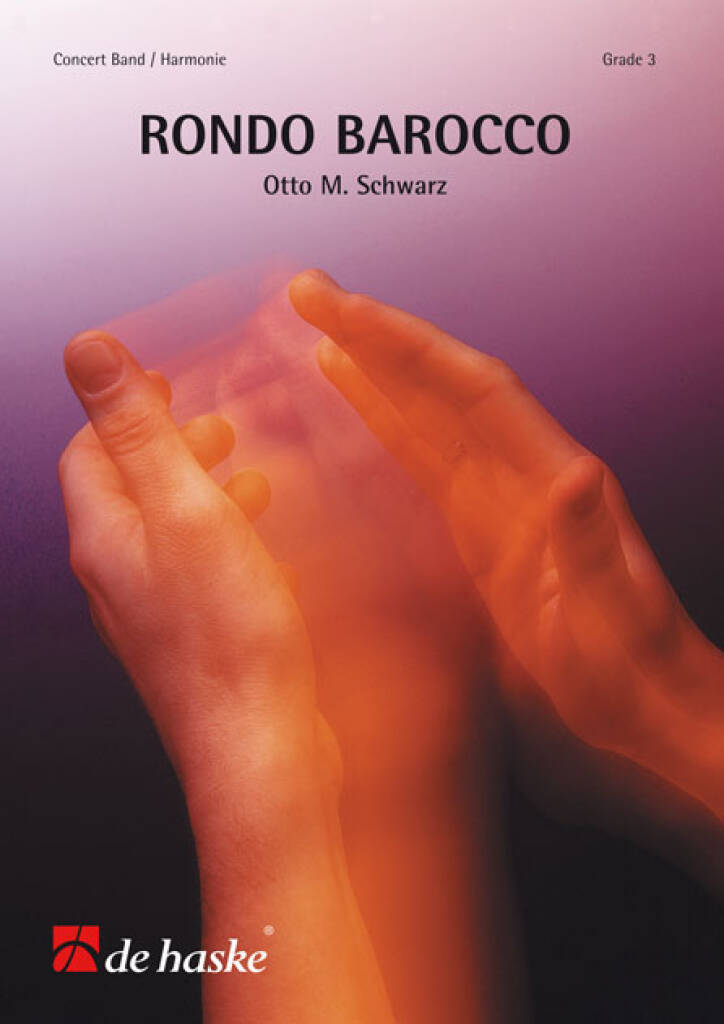 £84.99
Rondo Barocco - Otto M. Schwarz
The Baroque is a period of frills and ornaments, wether in architecture, painting or music. An easy melody passes through a variety of arrangements. From brass quintet and different tutti parts, all the sections are in action. Fortified by a drum set and an (optional) electric bass, the piece is given a modern touch and becomes more acceptable to the audience. A follow-up to "Rondo Romantica", this piece was composed in December 1997.
Estimated dispatch 7-14 working days
-
£134.99
Marche au Supplice - Hector Berlioz
Hector Berlioz (1803-1869) once remarked: "My life is a novel that greatly interests me." Experiences in his personal life had a great influence on his compositions. Symphonie Fantastique, written in 1830, is also autobiographical: he subtitled the work Episode in the Life of an Artist. The symphony echoes his feelings for an actress. The Marche au Supplice (march into torture) he described as: "The artist dreams he has killed his beloved, that he has been sentenced to death and is being led to the scaffold. The procession moves to the notes of a march that is now sombre and turbulent, now radiant and stately, and in which boisterous outbursts suddenly dissolve intothe heavy sound of marching feet."
Estimated dispatch 7-14 working days
-
£84.99
Sonare - Peter Riedemann
An airy, merry march in 6/8 time. It's easily recognisable melodious theme together with its harmonic and rhythmic simplicity makes it an ideal march for indoor or outdoor performance.
Estimated dispatch 7-14 working days
 View Music