
Results
-
 £42.50
Encore! - Goto Yo
Encore! was commissioned by Ishikawa Prefecture Band Association to celebrate its 50th anniversary in 2010. The commissioning request was that the piece be fun and appropriate as an encore. I made it simple and enjoyable for everyone.The only thing I added was an appealing introduction so each entering section might feel the importance of their instrument. That's why there is a specified appearance order involving standing. It goes from 1) clarinets, 2) piccolo, flute, horn, oboe and bassoon, 3) percussion, 4) euphonium, tuba and double bass, 5) trombone, 6) saxophone to 7) trumpet. Lastly, all sections stand up together and greet the audience. Technically, it's a medium grade level. There are substitutions for bands lacking oboe, bassoon or double bass.The title was selecting hoping for a fun, grand finale. It also means "more" and "again." My hope is for performers and audience to enjoy music, and for Ishikawa Prefecture Band Association to nourish its band movements and activities. I could not ask for more if people come to love music even more by experiencing this work.(Yo Goto)
Estimated dispatch 7-14 working days
-
 £199.99
Fanfare No. 1 - Wataru Hokoyama
Fanfare No. 1 (1995) In the summer of 1995 before his departure to the United States, a request from his high school band friends for a good concert opener sparked 19 year old Hokoyama to write his very first wind band composition.To capture the excitement of the rising curtain, the piece begins with magnificent brass ascending in 4th and 5th intervals. This is followed by the energetic entrance of the full ensemble like celebratory cannon fire. The following melody has many notes, yet is still simple. Do not overestimate it, just perform with driving momentum.In the slower middle section, utilize an instinctive vision of a scorching midsummer sun shimmering on the horizon. (Likely this shimmering sunset image was scored unconsciously, being composed in midsummer. A more applicable mood might be "Indian sunset". Perhaps this Indian style came from a capricious feeling of youthfulness.)The bright tempo and melody return for the last section. The climactic volley of musical display is like explosive fireworks as the last sounds echo throughout the concert hall.The composer wishes for performers to play from their hearts and not be limited by an analytic approach to the score-absolute accuracy is not required. Above all, the deepest pleasure for the composer is to know that teachers and students share the joy of music making with the intention of sharing it with others all over the world.With deepest gratitude, thank you for performing this work.
Estimated dispatch 7-14 working days
-
 £141.99
Jalan-Jalan - Shin'ya Takahashi
Jalan-jalan was inspired by the music of Bali, Indonesia based upon its unique melodies, modes and rhythms. As part of the independent archipelago "Ryukyu", Okinawa (southernmost Japan) had an active exchange with Bali that included cultural and musical influences. Jalan-jalan means "walkabout" or "walking journey" in Indonesian. It describes a walk in the so-called Isle of the Gods, encountering Bali's beautiful scenery and daily life. Its four themes include "Dawn," "Morning Market," "Beach in Early Afternoon" and "Kecak Dance (a form of Balinese dance and music drama, performed primarily by men) in Torchlight."An imposing pesante introduction will properly establish this song's mood. Boldly balance winds and percussion to the prominent timpani solo. At Allegro Vivo, observe the lighter abbreviated scoring and balance melody/countermelody at E. Melodies are elongated at the Grazioso, and tenor/bass rhythm figures need enough separation to be felt. The urgent-feeling Presto must initially be reserved except for the percussive "slaps"; same thing again at O. The daunting rhythmic figure at Q is actually a chattering effect-combine the two elements to teach continuity and placement. Don't "over blow" the ending, but continue to emphasize unique rhythmic elements.(Shin'ya Takahashi)
Estimated dispatch 7-14 working days
-
£244.99
Zenith of Maya - Satoshi Yagisawa
By 200 B.C. the Mayan civilization was expansive, from the Yucatan Peninsula well into Central America. Their highly advanced technology still amazes us today, including their discovery of an accurate calendar derived from detailed astronomical observations and the use of the "0" in sophisticated mathematics.I. Royal ceremony and sacrifice of renewalThe first movement describes Mayan civilization at its zenith. An initial theme heralds admiration for a great king. A graceful choral then captures the magnificent setting of the Mayan world. After a folk melody for the populace, the agitated scene of a sacrificial ceremony is portrayed. The regal theme appears again in the coda, concluding in brilliance. This great civilization vanished in 10 A.D., leaving only remnants of a remarkably prosperous world. Thousands of ruins large and small remain locked in a dense world of jungle, with huge crumbled cities having lain forgotten for eight centuries.II. Glorious ruins still ariseII characterizes this civilization from glory, to destruction, to the present with its buried ruins. To begin, stone cities wait silently cloaked in jungle, steadfastly eluding discovery. As time passes slowly, the music reflects back to the glory of the Maya. Though wishing to turn back the hands of time for this incredible civilization, its fate and the gravity of its loss are carried forward in the profound silence of eternal loss. Finally, in the present, we marvel at the thousands of elegant remains, with a choral of praise for those with remarkable wisdom and strength, in a spectacular conclusion.(Satoshi Yagisawa)
Estimated dispatch 7-14 working days
-
 £71.50
Echoes of Nostalgia - Matthew R. Putnam
Dedicated to the late John Kinyon, this new overture for band is an homage in all the best ways. Lush harmonies, beautiful melodies, and an accessible form are all on display. Teaching with this piece will be made easy, as Matthew R. Putnam knows how to make your band sound its best.
Estimated dispatch 7-14 working days
-
 £104.50
Radiant - Tyler Arcari
Inspired by the phrygian dominant scale's commonality in multiple dance styles, Radiant is an intense new concert work for advanced ensembles. Brisk melodic lines and embellishments are paired with an infectious dance rhythm that propels this work from beginning to end.
Estimated dispatch 7-14 working days
-
 £93.50
Wicklow - Laura Estes
Newcomer Laura Estes harkens us back to an earlier day with her original folk-sounding work, Wicklow. Packed with opportunities for historical study as well as historically-accurate instruments, Wicklow is an excellent choice for contest or festival performance.
Estimated dispatch 7-14 working days
-
 £179.99
Diagram - André Waignein
The story of the origin of Diagram for Symphonic Band is a curious one. Andr Waignein was enjoying a meal together with his great friend Jean-Marie Vivier - representative director of l'Oreal Belgilux and the same man who made the performance of the famous Cantate aux Etoiles, with 750 performers possible. Jean Plaquet, an appreciated associate of both gentlemen was also present.As an acknowledgement, Andr Waignein wanted to dedicate a composition to the band where Mr. Vivier has been chairman for 20 years. In connection with this, Andr Waignein was supposed to receive some extra information about the 120 years old history of this band, which has always been led by a memberof the Vivier family. In a flash this history was presented : using a diagram Mr. Vivier drew the power-lines of this more than 100 year old band.And of course, the title was found ! The only thing left to do, was for Andr Waignein to transform this diagram into music.
Estimated dispatch 7-14 working days
-
£144.99
Ukrainian Rhapsody - Franco Cesarini
Folk music plays an important role in the life of the Ukrainian people. Their country covers an area of over 600.000 square kilometres and has more than fifty million inhabitants. In the north there are vast woods, in the west one finds the picturesque Carpatian mountains and valleys, and in the centre and the south Ukraine has its famous steppes with fertile black soil. The river Dnjepr divides the country in two, forming a natural frontier between the western and eastern regions, which each have their own distinctively different musical folklore. This diversity forms the musical basis for Ukrainian Rhapsody. The work consists of three movements: the first one, in a moderatetempo, without a pause flows into a slow but very expressive middle movement, resulting in a powerful climax. The composition ends with the Gopak: a rousing dance.
Estimated dispatch 7-14 working days
-
 £104.99
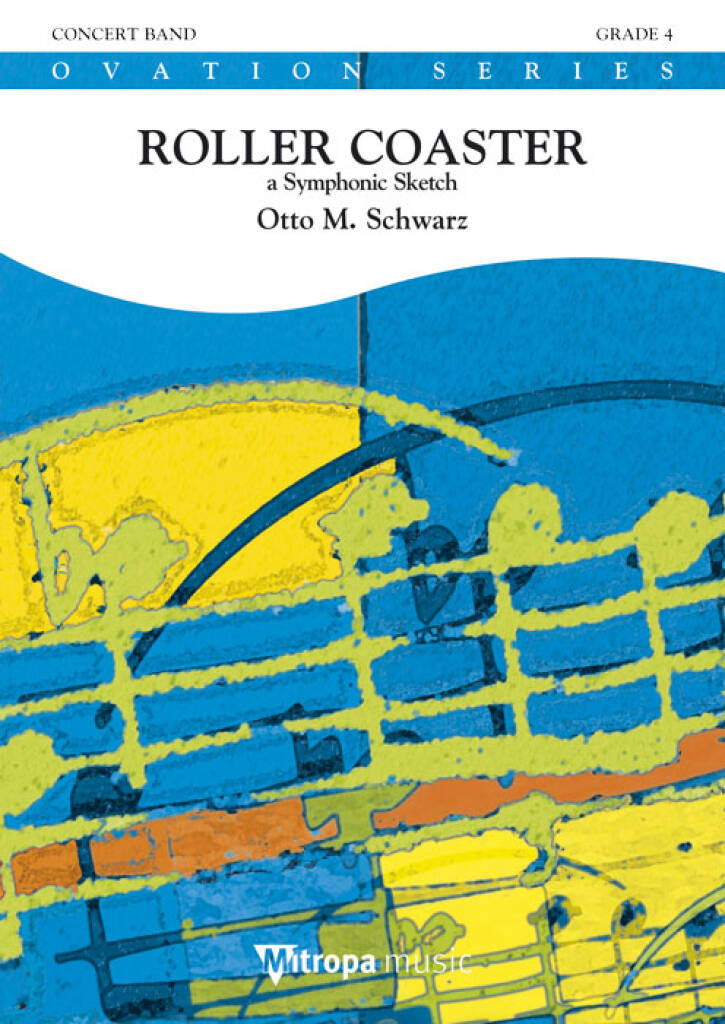
Roller Coaster - Otto M. Schwarz
In this piece, Otto M. Schwarz depicts a ride on a roller coaster. At the beginning, the cars are pulled up by a chain. High above the ground the ride suddenly begins the steep descent with the loop the loop being accompanied by the screams of the passengers. Towards the end of the piece the ride becomes faster and faster and then finally comes to an abrupt end. The musical sketch Roller Coaster is especially suitable as an encore for your concerts. Climb on and let the ride begin!
Estimated dispatch 7-14 working days
 View Music