
Results
-
 £79.95
Variations on 'Was Lebet' (Concert Band - Score and Parts) - Wainwright, Andrew
Variations on 'Was Lebet' is based on the German chorale of the same name, the first line of which translates as 'O worship the Lord in the beauty of holiness!' The opening fanfare figure in the Trumpets should be supported by bold, organ-like sostenuto chords in the lower band. Ensure that the fanfare in the Trumpets and Trombones from bars 25 to 28 is given equal articulation and volume in the antiphonal parts. After this majestic introductory section, the first of five contrasting variations is presented, although the tune is never realised in full form until the final variation, with fragments gradually being revealed as the piece progresses.Variation I is somewhat classical in approach, with its energy coming from a regular contrast between cantabile references to the theme, set against lively staccato figures. Ensuring a lightness of touch will be important here; the music should be poised and never sound frantic. As a result, careful attention should be paid to the tempo marking, being no quicker than 136 beats per minute. Snippets of the chorale come and go, with the last phrase of the hymn completing the movement. This final statement, at bar 95, should be an immediate change in tempo and a separate statement to the music that comes before.Variation II is plaintive in mood, giving the listener the chance to reflect on the following words, which form part of the second verse: 'Comfort thy sorrows and answer thy prayerfulness, Guiding thy steps as may best for thee be.' There is opportunity for rubato in this movement, at the discretion of the conductor.Variation III is somewhat quirky and volatile in nature, and takes its inspiration from the 3rd and 4th verses which describe the fearful times in life that we must entrust to the Lord. Driven by the Percussion section in particular, there are references here to Variation I with its chorale-like figures and hurtling scalic figures, and there is a feeling of a lack of resolution. A somewhat abrupt ending suggests that our sense of completeness in Christ is yet to be resolved. It is important that clarity and tempo are maintained in the bass line between sections L and M. Aim for consistency of line in the bass parts, particularly with the trade-offs between players here.There is a French romantic feel to the waltz in Variation IV, with the opportunity for various soloists to display their musicianship. A sense of ironic humour pervades throughout. The Clarinet and Bassoon duet from section U should be playful and display a lightness of touch, with that sense of style continued throughout the movement.Variation V is fugal in nature, with each section of the band being handed the theme at various points. Again it is important that a steady tempo is set at Y in order to maintain control. The sense of momentum gradually increases to a grandiose presentation of the full theme, beginning at section CC, affirming our completeness in the Lord, with the words of the first and last verses reiterated: O worship the Lord in the beauty of holiness! Bow down before him, his glory proclaim; With gold of obedience and incense of lowliness, Kneel and adore him, the Lord is his name.Duration: 11.45
Estimated dispatch 7-14 working days
-
 £15.95
Variations on 'Was Lebet' (Concert Band - Score only) - Wainwright, Andrew
Variations on 'Was Lebet' is based on the German chorale of the same name, the first line of which translates as 'O worship the Lord in the beauty of holiness!' The opening fanfare figure in the Trumpets should be supported by bold, organ-like sostenuto chords in the lower band. Ensure that the fanfare in the Trumpets and Trombones from bars 25 to 28 is given equal articulation and volume in the antiphonal parts. After this majestic introductory section, the first of five contrasting variations is presented, although the tune is never realised in full form until the final variation, with fragments gradually being revealed as the piece progresses.Variation I is somewhat classical in approach, with its energy coming from a regular contrast between cantabile references to the theme, set against lively staccato figures. Ensuring a lightness of touch will be important here; the music should be poised and never sound frantic. As a result, careful attention should be paid to the tempo marking, being no quicker than 136 beats per minute. Snippets of the chorale come and go, with the last phrase of the hymn completing the movement. This final statement, at bar 95, should be an immediate change in tempo and a separate statement to the music that comes before.Variation II is plaintive in mood, giving the listener the chance to reflect on the following words, which form part of the second verse: 'Comfort thy sorrows and answer thy prayerfulness, Guiding thy steps as may best for thee be.' There is opportunity for rubato in this movement, at the discretion of the conductor.Variation III is somewhat quirky and volatile in nature, and takes its inspiration from the 3rd and 4th verses which describe the fearful times in life that we must entrust to the Lord. Driven by the Percussion section in particular, there are references here to Variation I with its chorale-like figures and hurtling scalic figures, and there is a feeling of a lack of resolution. A somewhat abrupt ending suggests that our sense of completeness in Christ is yet to be resolved. It is important that clarity and tempo are maintained in the bass line between sections L and M. Aim for consistency of line in the bass parts, particularly with the trade-offs between players here.There is a French romantic feel to the waltz in Variation IV, with the opportunity for various soloists to display their musicianship. A sense of ironic humour pervades throughout. The Clarinet and Bassoon duet from section U should be playful and display a lightness of touch, with that sense of style continued throughout the movement.Variation V is fugal in nature, with each section of the band being handed the theme at various points. Again it is important that a steady tempo is set at Y in order to maintain control. The sense of momentum gradually increases to a grandiose presentation of the full theme, beginning at section CC, affirming our completeness in the Lord, with the words of the first and last verses reiterated: O worship the Lord in the beauty of holiness! Bow down before him, his glory proclaim; With gold of obedience and incense of lowliness, Kneel and adore him, the Lord is his name.Duration: 11.45
Estimated dispatch 7-14 working days
-
 £94.95
Fire in the Blood (Concert Band - Score and Parts) - Lovatt-Cooper, Paul
Fire in the Blood was commissioned by Dr Stephen Cobb for the 120th anniversary of the International Staff Band of the Salvation Army. The piece was composed for the celebration concert where the ISB were joined by several other staff bands from around the world to perform independently to a sell-out capacity crowd at Britain's most famous concert hall The Royal Albert Hall. Fire in the Blood received its world premier at the 'ISB 120' concert at the Royal Albert Hall on June 4th 2011.With this piece I wanted to acknowledge music that had an impact on me through my Salvation Army upbringing. When thinking of a title for this piece I had no hesitation than to reflect and re-word the Salvation Army's motto under their famous crest 'Blood and Fire'.When composing Fire in the Blood I wanted to use three songs of worship that have been prevalent in the Salvation Army's services over a number of years. Opening with Richard Phillips' setting of Psalm 95, 'Sing for Joy', the music is vibrant and full of energy, I wanted to capture the spirit of the well known words of Scripture. The music then moves into a more reflective section that includes Howard Davies' emotive song melody 'Lord, you know that we love you' and Laurie Klein's worship song 'I love you Lord'.A re-statement of the opening Psalm setting follows and this, in turn, leads into a dramatic and powerful finale that combines two pivotal statements drawn from the slower, reflective section: I love you lord, and I lift my voice to worship you, O my soul rejoice and Lord, you know that we love you with a final flourish from Psalm 95: Come let us sing joy to the Lord!- Paul Lovatt-CooperDuration: 10:00
Estimated dispatch 7-14 working days
-
 £225.00
Five Orchestral Meditations (Concert Band - Score and Parts) - Rutter, John - Noble, Paul
The Five Orchestral Meditations are all based on John Rutter's choral pieces, which he re-scored for orchestra, and on which these arrangements are based. They are offered as a suite, but the audio tracks have been separated to make it easier to hear each title. These lovely pieces will present a perfect exercise for band blending, balance, interpretation, intonation, and finesse, while offering your audience some of the typically gorgeous music for which John Rutter is so noted. They may be performed as a suite, or as independent pieces: 1. What Sweeter Music; 2. Blow, blow, thou winter wind; 3. Candlelight; 4. Lord, make me an instrument of thy peace; 5. The Lord bless you and keep you. John Rutter's compositions are in a class by themselves, and this adaptation is sure to find its way into the repertoire of outstanding bands around the world.
Estimated dispatch 7-14 working days
-
 £73.50
Folk Songs from the Southern Appalachians (Concert Band - Score and Parts) - Smith, Robert W.
There are a wide number of folk songs from the Appalachian region that are cherished by Americans. Smith selected a number of these tunes, including "The Dear Companion," "Pretty Saro," "Lisbon," "Green Bushes," "Lord Randall," "Lord Thomas." and "Fair Ellinor." Set in a more traditional concert band style, these more obscure folk songs have been scored at the concert band level in a Grainger-esque style by Robert W. Smith. Duration: 6.45
Estimated dispatch 7-14 working days
-
£137.99
Bilbo the Hobbit Wind Band Set (Score & Parts)
Originally written by the great English writer J.R.R. Tolkien (1892-1973), The Lord of the Rings has encountered new-found popularity recently with the release of three ?huge-hit? motion pictures. With Bilbo the Hobbit we enter the lands of Middle-earth during the Third Age, some decades before The Lord of the Rings trilogy. Fascinated by the works of the masters of film music, Maxime Aulio structured this work in their way. When the end credits roll, Maxime?s music displays all the basic characters and passages of the novel. From the landscapes of the Shire to Middle-earth, the Great Dragons to Gandalf the Wizard, Bilbo Baggins tells us his story through light and virtuoso arabesques in the solo part. Bilbo the Hobbit is a wonderful addition to the french horn repertoire and one to be a sure-fire hit with horn players everywhere.
Estimated dispatch 7-14 working days
-
 £29.95
Prelude on 'Lavenham' (Concert Band - Score and Parts) - Nobes, Geoffrey
Prelude on 'Lavenham' was written for the 130th anniversary, in 2014, of Lavenham Corps in Suffolk and was first performed at their anniversary concert in the village's beautiful Parish Church by Kettering Citadel Band. It's an arrangement of a tune the composer wrote to the words, 'Lord, there are times', a lovely hymn by the Reverend Nick Fawcett. The arrangement is dedicated to the memory of Bandmaster Derek Wilding of Lavenham Corps.The music is serene and free-flowing and was written with the rich and warm acoustics of the lovely medieval church very much in mind. It should be played cantabile throughout, with close attention to contrasts in dynamics.
Estimated dispatch 7-14 working days
-
£5.95
Prelude on 'Lavenham' (Concert Band - Score only) - Nobes, Geoffrey
Prelude on 'Lavenham' was written for the 130th anniversary, in 2014, of Lavenham Corps in Suffolk and was first performed at their anniversary concert in the village's beautiful Parish Church by Kettering Citadel Band. It's an arrangement of a tune the composer wrote to the words, 'Lord, there are times', a lovely hymn by the Reverend Nick Fawcett. The arrangement is dedicated to the memory of Bandmaster Derek Wilding of Lavenham Corps.The music is serene and free-flowing and was written with the rich and warm acoustics of the lovely medieval church very much in mind. It should be played cantabile throughout, with close attention to contrasts in dynamics.
Estimated dispatch 7-14 working days
-
 £82.95
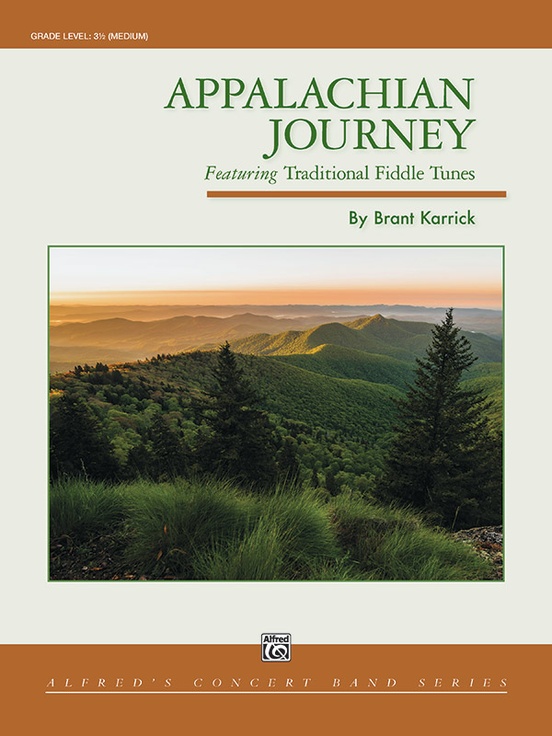
Appalachian Journey (Concert Band - Score and Parts) - Karrick, Brant
The Appalachians represented one of America's first frontiers, and frontier music became one of the first truly American forms of musical expression. Based on traditional fiddle tunes, Appalachian Journey combines four folk songs, providing players and the audience with a real toe-tapping treat! The melodies included are: "After the Battle of Aughrim" and "Lord Mayo I," both Irish in origin, and "Bonaparte Crossing the Rocky Mountains" along with "Whiskey Before Breakfast," adapted from the old-time fiddling tradition.Duration: 4.45
Estimated dispatch 7-14 working days
-
 £66.95
A Dashing Gallop (Concert Band - Score and Parts) - Pierpont, James Lord - Roszell, Patrick
Open your holiday concert or use it for a bold conclusion, A Dashing Gallop, by Patrick Roszell, imagines the age-old holiday classic Jingle Bells in a quasi-gallop/march style. Ring in the holiday season with this dynamic holiday arrangement!Duration: 2.00
Estimated dispatch 7-14 working days
 View Music