
Results
-
 £248.99
Odysseia (Concert Band - Score and Parts) - Aulio, Maxime
Washed up on the Phaeacian shore after a shipwreck, Odysseus is introduced to King Alcinous. As he sits in the palace, he tells the Phaeacians of his wanderings since leaving Troy. Odysseus and his men fi rst landed on the island of the Cicones where they sacked the city of Ismarus. From there, great storms swept them to the land of the hospitable Lotus Eaters. Then they sailed to the land of the Cyclopes. Odysseus and twelve of his men entered the cave of Polyphemus. After the single-eyed giant made handfuls of his men into meals, Odysseus fi nally defeated him. He got him drunk and once he had fallen asleep, he and his men stabbed a glowing spike into the Cyclop's single eye, completely blinding him. They escaped by clinging to the bellies of some sheep. Once aboard, Odysseus taunted the Cyclop by revealing him his true identity. Enraged, Polyphemus hurled rocks at the ship, trying to sink it. After leaving the Cyclopes' island, they arrived at the home of Aeolus, ruler of the winds. Aeolus off ered Odysseus a bag trapping all the strong winds within except one - the one which would take him straight back to Ithaca. As the ship came within sight of Ithaca, the crewmen, curious about the bag, decided to open it. The winds escaped and stirred up a storm. Odysseus and his crew came to the land of the cannibalistic Laestrygonians, who sank all but one of the ships. The survivors went next to Aeaea, the island of the witch-goddess Circe. Odysseus sent out a scouting party but Circe turned them into pigs. With the help of an antidote the god Hermes had given him, Odysseus managed to overpower the goddess and forced her to change his men back to human form. When it was time for Odysseus to leave, Circe told him to sail to the realm of the dead to speak with the spirit of the seer Tiresias. One day's sailing took them to the land of the Cimmerians. There, he performed sacrifi ces to attract the souls of the dead. Tiresias told him what would happen to him next. He then got to talk with his mother, Anticleia, and met the spirits of Agamemnon, Achilles, Patroclus, Antilochus, Ajax and others. He then saw the souls of the damned Tityos, Tantalus, and Sisyphus. Odysseus soon found himself mobbed by souls. He became frightened, ran back to his ship, and sailed away. While back at Aeaea, Circe told him about the dangers he would have to face on his way back home. She advised him to avoid hearing the song of the Sirens; but if he really felt he had to hear, then he should be tied to the mast of the ship, which he did. Odysseus then successfully steered his crew past Charybdis (a violent whirlpool) and Scylla (a multiple-headed monster), but Scylla managed to devour six of his men. Finally, Odysseus and his surviving crew approached the island where the Sun god kept sacred cattle. Odysseus wanted to sail past, but the crewmen persuaded him to let them rest there. Odysseus passed Circe's counsel on to his men. Once he had fallen asleep, his men impiously killed and ate some of the cattle. When the Sun god found out, he asked Zeus to punish them. Shortly after they set sail from the island, Zeus destroyed the ship and all the men died except for Odysseus. After ten days, Odysseus was washed up on the island of the nymph Calypso.
Estimated dispatch 7-14 working days
-
 £123.20
3 Letzte Motetten (Concert Band - Score and Parts) - Bruckner, Anton - Doss, Thomas
Anton Bruckner (b. 4.9.1824, Ansfelden, d. 11.10.1896, Vienna) didn't have it easy. Throughout his life, the Austrian composer was plagued by self-doubt. Anton Bruckner came from a simple, rural background. After the death of his father, he was accepted as a choirboy at the monastery of Sankt Florian in 1837. After several years as a school assistant and his own organ and piano studies, he first worked as organist in St. Florian, then from 1855 as cathedral organist in Linz. Introduced to music theory and instrumentation by Simon Sechter and Otto Kitzler, he discovered Richard Wagner as an artistic role model, whom he admired throughout his life and also visited several times in Bayreuth. In 1868 Anton Bruckner became professor of basso continuo, counterpoint and organ at the Vienna Conservatory; ten years later court organist; and in 1891 finally honorary doctor of the University of Vienna. He was considered an important organ virtuoso of his era, but had to wait a long time for recognition as a composer. It was not until Symphony No.7 in E major, composed between 1881 and 1883, with the famous Adagio written under the effects of Wagner's death, that he achieved the recognition he had hoped for, even if he was reluctant to accept it given his inclination towards scepticism and self-criticism. Anton Bruckner was a loner who did not want to follow a particular school or doctrine. He composed numerous sacred vocal works, such as his three masses, the Missa Solemnis in B flat minor (1854), the Te Deum (1881-84) and numerous motets. As a symphonic composer, he wrote a total of nine symphonies and many symphonic studies from 1863 onwards, tending to revise completed versions several times over. Bruckner's orchestral works were long considered unplayable, but in fact were merely exceptionally bold for the tonal language of their time, uniting traditions from Beethoven through Wagner to folk music, on the threshold between late Romanticism and Modernism. Anton Bruckner composed about 40 motets during his lifetime, the earliest a setting of Pange lingua around 1835, and the last, Vexilla regis, in 1892. Thomas Doss has compiled some of these motets in this volume for symphonic wind orchestra. These motets show many characteristics of personal expression, especially Bruckner's colourful harmony in the earlier works, which is in places aligned with Franz Schubert (changes between major and minor; and movements in thirds). Later works are characterised by many components which, in addition to the expanded stature of the movements, include above all a sense of the instrumentation as an outward phenomenon and the harmony as a compositional feature that works more internally. Some aspects of Bruckner's work are the result of his long period of study, which familiarised him not only with the tradition of his craft, but also gave him insights into the "modernity" of his time in such composers as Wagner, Liszt and Berlioz. From this developed his personal standpoint, which always pursues the connection between the old and the new.Duration: 14.00
Estimated dispatch 7-14 working days
-
 £256.00
14 Motetten (Concert Band - Score and Parts) - Bruckner, Anton - Doss, Thomas
Anton Bruckner (b. 4.9.1824, Ansfelden, d. 11.10.1896, Vienna) didn't have it easy. Throughout his life, the Austrian composer was plagued by self-doubt. Anton Bruckner came from a simple, rural background. After the death of his father, he was accepted as a choirboy at the monastery of Sankt Florian in 1837. After several years as a school assistant and his own organ and piano studies, he first worked as organist in St. Florian, then from 1855 as cathedral organist in Linz. Introduced to music theory and instrumentation by Simon Sechter and Otto Kitzler, he discovered Richard Wagner as an artistic role model, whom he admired throughout his life and also visited several times in Bayreuth. In 1868 Anton Bruckner became professor of basso continuo, counterpoint and organ at the Vienna Conservatory; ten years later court organist; and in 1891 finally honorary doctor of the University of Vienna. He was considered an important organ virtuoso of his era, but had to wait a long time for recognition as a composer. It was not until Symphony No.7 in E major, composed between 1881 and 1883, with the famous Adagio written under the effects of Wagner's death, that he achieved the recognition he had hoped for, even if he was reluctant to accept it given his inclination towards scepticism and self-criticism. Anton Bruckner was a loner who did not want to follow a particular school or doctrine. He composed numerous sacred vocal works, such as his three masses, the Missa Solemnis in B flat minor (1854), the Te Deum (1881-84) and numerous motets. As a symphonic composer, he wrote a total of nine symphonies and many symphonic studies from 1863 onwards, tending to revise completed versions several times over. Bruckner's orchestral works were long considered unplayable, but in fact were merely exceptionally bold for the tonal language of their time, uniting traditions from Beethoven through Wagner to folk music, on the threshold between late Romanticism and Modernism. Anton Bruckner composed about 40 motets during his lifetime, the earliest a setting of Pange lingua around 1835, and the last, Vexilla regis, in 1892. Thomas Doss has compiled some of these motets in this volume for symphonic wind orchestra. These motets show many characteristics of personal expression, especially Bruckner's colourful harmony in the earlier works, which is in places aligned with Franz Schubert (changes between major and minor; and movements in thirds). Later works are characterised by many components which, in addition to the expanded stature of the movements, include above all a sense of the instrumentation as an outward phenomenon and the harmony as a compositional feature that works more internally. Some aspects of Bruckner's work are the result of his long period of study, which familiarised him not only with the tradition of his craft, but also gave him insights into the modernity of his time in such composers as Wagner, Liszt and Berlioz. From this developed his personal standpoint, which always pursues the connection between the old and the new.Duration: 39.00
Estimated dispatch 7-14 working days
-
 £60.99
They are Coming Wind Band Set (Score & Parts)
There are people who are capable of planning well. They live their lives in a well-structured manner and know exactly what they have to do. On the other hand, there are also people who are the exact opposite: they want to do too many things at once and are often somewhat absent-minded, which occasionally results in frantic situations. The outcome of one such situation is 'They are coming'. John Emerson Blackstone had been working on a new composition for some time when he received a telephone call from his editor, who told him that the deadline was approaching rapidly, even worse, that it would expire at the end of that same day and that he would drop by in person to fetch the composition! Blackstone set to work in a frenzy and completed the last details. When his editor arrived, the piece was finished ..... and got its definitive title: 'They are coming'. 02:30
Estimated dispatch 7-14 working days
-
 £46.50
Secret Fairground & Blue Strut (Concert Band - Score and Parts) - Rae, James
James Rae is the man who put fun into woodwind and brass teaching. His many compositions, especially in the jazz and blues idioms, have often featured on examination syllabuses. Recent years have seen his publications of easy flexible ensembles for younger players and now he turns his attention to the wind band. In this series "The Concert Band Collection", he has written exciting new pieces for the standard concert band line up. Attention is given to each instrument so that the technical and musical requirements do not exceed UK Grade 2.5. An optional piano part will provide "stuffing" and moral support for the young players who will quickly enjoy James' catchy and imaginative music. Each volume contains two titles. This one includes the haunting and nostalgic waltz "Secret Fairground" and a dynamic masterpiece called "Blue Strut".
Estimated dispatch 7-14 working days
-
 £44.95
Big Screen Fanfare & Rockbuster (Concert Band - Score and Parts) - Rae, James
James Rae is the man who put fun into woodwind and brass teaching. His many compositions, especially in the jazz and blues idioms, have often featured on examination syllabuses. Recent years have seen his publications of easy flexible ensembles for younger players and now he turns his attention to the wind band. In this series "The Concert Band Collection", he has written exciting new pieces for the standard concert band line up. Attention is given to each instrument so that the technical and musical requirements do not exceed UK Grade 2.5. An optional piano part will provide "stuffing" and moral support for the young players who will quickly enjoy James' catchy and imaginative music. Each volume contains two titles. This one includes "Big Screen Fanfare", a fanfare in the style of a Hollywood movie theme and the cool "Rockbuster".
Estimated dispatch 7-14 working days
-
 £69.99
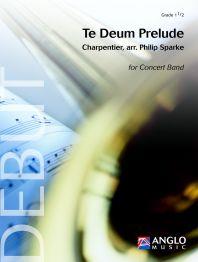
Te Deum Prelude (Concert Band - Score and Parts) - Charpentier, Marc-Antoine - Sparke, Philip
Who does not know the famous Te Deum Prelude by Marc-Antoine Charpentier (1634-1704)? This French composer studied both painting and composition in Italy. Returning to France, he took up the post of music master to the dauphin. He collaborated with Molire, working for the Thatre Francais until 1685. He then returned to court and was music director to the Princesse de Guise, composition teacher to the Duke d'Orleans and wrote music for the dauphin's chapel. His Te Deum, of which the Prelude has become well known (particularly in Europe, where it is used as the Eurovision signature tune) is one of many pieces he wrote for important state and religious occasions.Duration: 2:30
Estimated dispatch 7-14 working days
-
£109.99
Boreas Wind Band Set (Score & Parts)
In Greek mythology, Boreas is the God of the North Wind. When thinking of the north wind we particularly think of the bleak wind coming from the freezing cold north, but in Homers' work we see a more varied picture. As shown in the following two stories, Boreas often does play the role of a storm wind that blows forth heavy dark clouds while whipping up the dark waves of the tempestuous sea to mountainous heights. When the stake of the fallen Patroclos refuses to burn, Achilles begs for some wind. When Iris, the swift messenger of the Gods, asks the winds for assistance, they raise themselves up with tremendous roaring and rush to Troy. Upon their arrival they blow the divine fire of Patroclos' stake far up into the sky. When Troy was destroyed, the Greeks returned home. After many wanderings, Odysseus, however, ends up with the beautiful nymph, Calypso, who keeps him as a prisoner. As ordered by Zeus, Calypso frees him and sends him off on a handmade wooden raft. At sea, Odysseus is threatened by the aggressive sea god, Poseidon, who stirs up the winds and thrashes the waves with his trident. The goddess, Athena, stems the violence of all the winds except for the north wind, and thus it is Boreas, who sends Odysseus to the land of the hospitable Phaiakes. Jan Bosveld composed Boreas for OLTO, a music association in Loenen, The Netherlands, for which he had served as conductor for many years. Turbulent movement in both tempo and dynamics characterize this composition. The result is a whirling piece that races by in a positive manner. Boreas is in de Griekse mythologie de god van de noordenwind. Bij noordenwind denken wij vooral aan de gure wind uit het ijskoude noorden, bij Homerus echter zien we een meer gevari?erd beeld. Natuurlijk speelt Boreas, zoals uit de twee onderstaande verhalen blijkt, meestal de rol van de stormwind die de zware zwarte wolken voor zich uit blaast en de donkere golven van de onstuimige zee torenhoog opzwiept. 05:00
Estimated dispatch 7-14 working days
-
 £125.00
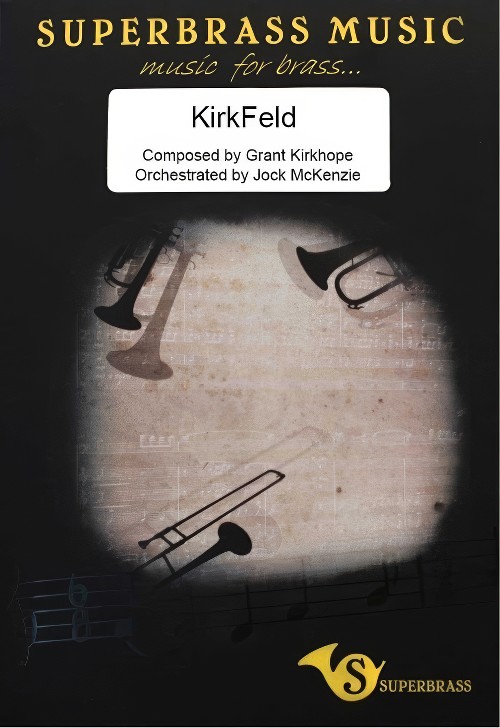
KirkFeld (Trombone Solo with Concert Band - Score and Parts) - Kirkhope, Grant - McKenzie, Jock
Written for Ian Bousfield and the International Trombone Festival 2017. Grant Kirkhope is a BAFTA nominated British composer who has created the soundtrack for video games that have sold in excess of 30 million copies. From "GoldenEye" to "Banjo-Kazooie", "Viva Pi?ata" to "Donkey Kong", "Kingdoms of Amalur: Reckoning" to "Civilization: Beyond Earth" and "Perfect Dark" to "Castle of Illusion starring Mickey Mouse". He has also recently scored the feature film "The King's Daughter" starring Pierce Brosnan and William Hurt and is currently working on "Yooka Laylee" and "Dropzone". Grant's score for "Viva Pi?ata" was nominated by BAFTA in the Original Score category in its 2007 awards. Grant is represented by the prestigious Gorfaine/Schwartz Agency by Cheryl Tiano and Kevin Korn. Grant has a degree in music from the Royal Northern College of Music, Manchester, where he majored in classical trumpet, is a green card holder and now lives in Agoura Hills, LA with his wife and two children. "Ian and I first met when we were around 15 years old. We both played in our county orchestra, the North Yorkshire Schools Symphony Orchestra (I was a trumpet player). I think we hit it off straight away, as we were definitely a couple of cheeky kids, if you know what I mean! We both ended up playing in Rowntree Mackintosh Brass Band for a while too which Ian's Dad, Trevor conducted. We bumped into each other again when we both went for the Shell/LSO Scholarship. I got to the area finals in Manchester so I was pretty pleased with myself but then I saw Ian and I knew it was all over! Of course Ian went on to win and the rest is history. I saw him again when I was attending the Royal Northern College of Music around 1983 by which time Ian had just got the principal chair at the Halle Orchestra. Then I guess 30 something years went by as we both went about our lives and lost touch. We re-kindled our friendship due to his wife really. She emailed me to say it was Ian's 50th birthday and she was collecting stories from all his friends over the years. After that we got back in touch and then one day on Facebook I got a message from him in typical dry Yorkshire fashion "now then Grant, I had a listen to your music and I think it's good, how about writing a piece for me ?" I was a little bit unsure at first but of course I loved Ian's playing and of course I said yes. Over a Skype call in 2016, he asked me what I thought I'd write. I said since I live in LA I'd like to write a "Hollywood" trombone piece. Imagine if John Williams had written a piece for solo trombone, that's what I'd like to write - well I'd certainly like to try" - Grant Kirkhope
Estimated dispatch 7-14 working days
-
£144.99
Andante & Rondo Wind Band Set (Score & Parts)
Antonio Capuzzi (August 1, 1755 - March 28, 1818) was an Italian violinist and composer who studied violin with Nazari and composition with Bertoni. In 1805 he moved to Bergamo, where he was professor of violin at the Instituto Musicale and leader of the orchestra at Teatro Riccardi. He was highly regarded there both as a teacher and a performer. Although popular in his day, most of his music is now forgotten; his most commonly performed piece today is the Concerto for Double Bass. All of Capuzzi's known compositions were written during his Venetian years. It was in Venice that Capuzzi became close friends with Domenico Dragonetti, Beethoven's virtuoso bassist. It is speculated that Capuzzi wrote his Concerto for Double Bass for Dragonetti. Gerald Oswald has made a fine arrangement of the second (Andante) and third (Rondo) movements of the concerto to feature either euphonium or tuba with concert band. The solo part is also available in an edition with piano accompaniment. 09:05
Estimated dispatch 7-14 working days
 View Music