
Results
-
 £87.99
David of the White Rock - Traditional
This is an ancient Welsh air that was first published in Relics of the Welsh Bards in 1794. Dafydd (David) Owain was a famous Welsh bard who lived on a farm called Gareg Wen (The White Rock) in Eifionydd, Carnarnvonshire, North Wales. Tradition has it that on his deathbed he called for his Harp and composed this lovely melody, requesting that it be played at his funeral. Accordingly, it was later played at the parish church of Ynys-Cynhaiarn. Lyrics were later added by Ceiriog Hughes, which describe the melody's inspiration. This version for Concert Band retains all the beauty and simplicity of the original.
Estimated dispatch 7-14 working days
-
£29.95
Share My Yoke - Score and Parts - Joy Webb
Program NotesMajor Joy Webb has a unique and special gift for writing songs that achieve massive popularity, both for the purity of their musical integrity and for the depth of their poetic and literal strength. One of the members of The Salvation Army's 1960s phenomenon "The Joystrings," Joy Webb has a string of popular songs to her name, several of which contributed to the charts successes of enjoyed by the group. In more recent years, many of her tunes have found their why into instrumental repertoire.A prime example of Joy's remarkable gifting is her beautiful Share My Yoke. Although the deeply spiritual words of Share My Yoke may be unfamiliar to some, the sheer beauty of the melody is without doubt. The chorus is reproduced here to offer an insight into the song's meaning:Your slightest movement I will feel and understand.Share my yoke, and come the way that I must go,In our togetherness my peace you'll know.The world beholding us will see it's so.Calling for real sensitivity both from soloist and accompanying group, this is an extremely rewarding piece to play - and a moving listening experience for the audience.The arranger, Ivor Bosanko, who lives in California following retirement from the post of Territorial Music Director in The Salvation Army's USA Western Territory, is himself a respected songwriter, composer and arranger. He has produced this wonderfully sensitive and evocative arrangement of the song for cornet soloist and band. Already widely used and recorded in its original brass band form, this arrangement for concert band will undoubtedly be a useful and valuable addition to repertoire.
Estimated dispatch 7-14 working days
-
£5.95
Share My Yoke - Score only - Joy Webb
Program NotesMajor Joy Webb has a unique and special gift for writing songs that achieve massive popularity, both for the purity of their musical integrity and for the depth of their poetic and literal strength. One of the members of The Salvation Army's 1960s phenomenon "The Joystrings," Joy Webb has a string of popular songs to her name, several of which contributed to the charts successes of enjoyed by the group. In more recent years, many of her tunes have found their why into instrumental repertoire.A prime example of Joy's remarkable gifting is her beautiful Share My Yoke. Although the deeply spiritual words of Share My Yoke may be unfamiliar to some, the sheer beauty of the melody is without doubt. The chorus is reproduced here to offer an insight into the song's meaning:Your slightest movement I will feel and understand.Share my yoke, and come the way that I must go,In our togetherness my peace you'll know.The world beholding us will see it's so.Calling for real sensitivity both from soloist and accompanying group, this is an extremely rewarding piece to play - and a moving listening experience for the audience.The arranger, Ivor Bosanko, who lives in California following retirement from the post of Territorial Music Director in The Salvation Army's USA Western Territory, is himself a respected songwriter, composer and arranger. He has produced this wonderfully sensitive and evocative arrangement of the song for cornet soloist and band. Already widely used and recorded in its original brass band form, this arrangement for concert band will undoubtedly be a useful and valuable addition to repertoire.
Estimated dispatch 7-14 working days
-
 £78.65
Freyja's Call - Andrew Duncan
According to Viking mythology, following a battle the bravest souls of the slain would be divided between two Gods, Odin and Freyja. Freyja was the Goddess of Love and War and before going into battle many Viking warriors would pray that they would die bravely so that Freyja would take their soul to join her personal army made up of the souls of the bravest of men.'Freyja's Call' describes one of these, a young Scottish soldier, going into battle as part of the Viking army who occupied parts of Scotland for four centuries. First, a slow theme is heard, Freyja's theme, which is the soldier praying to Freyja to keep a watch on him. Then the drums introduce a new rhythm which announces the beginning of the battle.A Celtic Jig is used to describe the progress of the battle with the jig played quietly at first then gradually louder with more percussion being added until a full ff section signifies the soldier fighting the enemy directly.Suddenly, the music drops back to the quiet Jig theme. The soldier has been slain, but will he be chosen by Frejya? After a short time, Freyja's theme is heard as the brave soldier is taken to Freyja's heavenly army of brave warriors, and the piece then ends in triumph.
In stock: Estimated delivery 1-3 days
-
 £78.00
Harlequin - Bruce Broughton
Harlequin is the most popular of the comic servant characters from the Italian commedia dell'arte who, although a slow thinker, was acrobatic and nimble - he would never perform a simple action when the addition of a cartwheel or backflip would spice up the movement! These characteristics are aptly portrayed musically in Bruce Broughton's mini concert overture. Originally published for brass band in 1984, this revised version for wind band coveys all the hustle, bustle, and agility of the character in a finely crafted musical structure. Ideal as a concert opener or encore it is sure to delight audiences and provide players with an exciting new addition to their repertory. Duration: 3 minutes USA Grade 4+
Estimated dispatch 7-14 working days
-
 £421.99
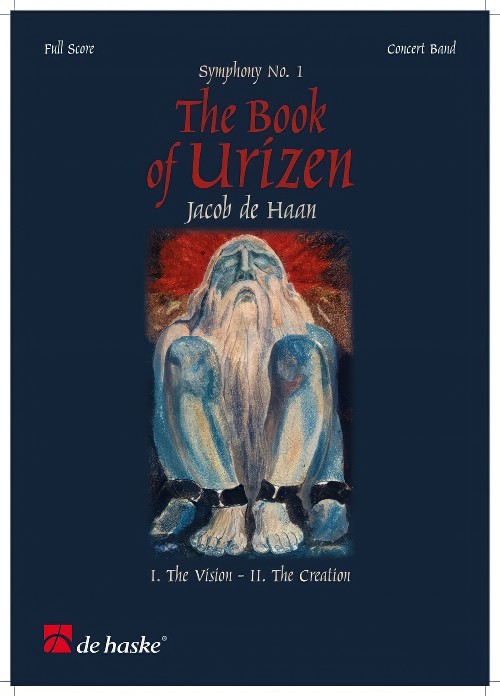
The Book of Urizen (Movements I: The Vision and II: The Creation) (Soprano, Narrator and Concert Band - Score and Parts) - De Haan, Jacob
The Book of Urizen is a work for concert band, solo soprano, and a male narrator in which sound collages of religious expressions are used. The piece is inspired by the compelling visionary poem of the same name (which the poet illustrated himself) by the Englishman William Blake (1757-1827), who occupies a unique position in western literature and the visual arts. He was not just a poet and a writer, but he was also a graphic artist, a painter, an illustrator, a spiritualist, a religious visionary, and a mystic philosopher. For the performance of this work, a professional sound system, including two microphones and a CD player, is needed. The three sound collages are three separate tracks on the enclosed CD and can be played easily at the right moment.The Book of Urizen bears resemblance to Genesis and Exodus, of which the contents form the basis of the Christian, Jewish, and Islamic faith. Blake adhered to the principle that all religions are in fact one, and that deities reside in human beings. In The Book of Urizen this is represented in "The Net of Religion," which is spanned over the earth by Urizen. The sound collages, compiled by Jacob de Haan in the studio, find their origin in Jerusalem, the Holy City, where the afore-mentioned faiths come together.In the first movement of this composition, The Vision, Urizen prepares his vision of the world, and he presents this to the "Eternals." His vision is rejected, and Urizen locks himself up in his own abstract world. When he does emerge again, he is confronted with rage by the gathered Eternals. Urizen flees the wrath of the Eternals, "the flames of eternal fury," and enwombs himself in his own world. When the Eternals see Urizen in his "stony sleep," they wonder if this is death. The blacksmith Los is torn by grief because of the isolation of Urizen. It brings him to rouse his fires, prepare his forge, and to give Urizen's world concrete form.In the second movement, The Creation, Urizen's world, but also man, woman, and child are created. Los is horrified with the appearance of Urizen's body. He mourns and pities Urizen, and from his blood a female form comes into being, with the name Enitharmon. The Eternals, fearful of the female form, decide to erect a tent to obstruct their view to eternity. Enitharmon and Los beget a son, called Orc. Los baptizes him as a child of the "fallen world." Orc is fed at Enitharmon's breast, which makes a girdle of jealousy restrict Los' chest. He takes the child to the top of the mountain and chains him down. The cries of Orc awaken Urizen, who explores his world creating instruments of scientific measurement to do so. Los encircles the face of Enitharmon from the sight of Urizen and Orc. She then populates the earth by giving birth to an enormous race.The Web, the third movement of The Book of Urizen, is available in a separate set.
Estimated dispatch 7-14 working days
-
 £210.80
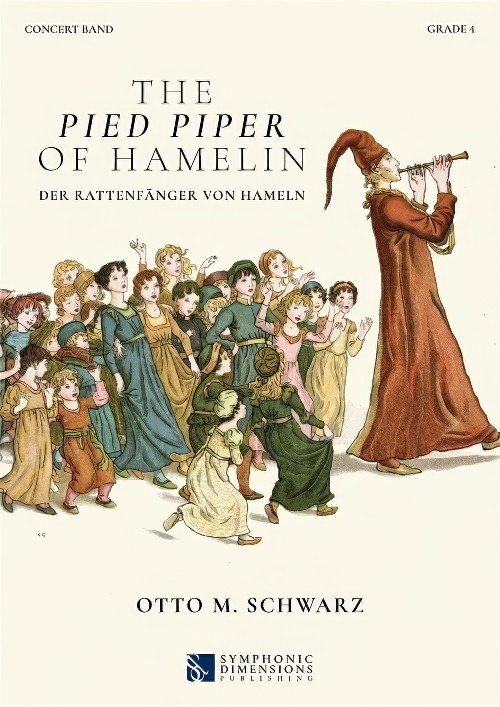
The Pied Piper of Hamelin (Concert Band - Score and Parts) - Schwarz, Otto M.
Stories, sagas and legends--who among us don't know them? Always delivered with a tinge of brutality, these cautionary tales are a legacy of moral education from times past: inquisitive children alone in the forest are generally eaten by a witch; the 'Soup-Kasper' of Hoffmann's Struwwelpeter dies from starvation rather than eating his soup; anyone letting in strangers usually gets devoured; anyone who plays with matches gets burned; and thumb-suckers get their thumbs cut off. The list of unfortunate demises is almost endless.In the tale of The Pied Piper of Hamelin, parents lose their children through greed, ridicule, scorn and a failure to appreciate art. There is still a street in the town of Hamelin in which neither drumming nor playing has not been allowed since 130 children disappeared into a mountain, never to be seen again. This composition by Otto M. Schwarz opens with exactly this scene, taking us back to the year 1284. As in many towns at the time, Hamelin in Germany suffered with hygiene problems--rats and mice began to multiply rapidly, and the town was overrun with the plague. There appeared a man dressed in colourful clothes who promised the locals to free them from this burden. They agreed and settled on a fee. Then the man pulled out a pipe and began to play. When the rats and mice heard this, they followed him. He led the animals into the Weser River, where they all drowned. Back in town, the people refused to pay him. They didn't recognise this man's skills and knowledge and were only prepared to pay for simple labour. A pact with the devil was made, which led to the Pied Piper leaving the town in a furious rage. One Sunday, when many people were at church, he returned, took out his flute and began to play. The town's children were so enchanted by his playing that they followed him. He led them out of the town and disappeared with them forever into a mountain forever. Of all the children, only two survived--however one was mute, and one was blind. In the street from which the children left Hamelin, music may no longer be played in memory of this event. The work may be performed in two different versions: 1. Purely instrumental (without narrator)--the GPs (pauses) must be kept short 2. With narrator--he speaks in the GPs but not during the music.Duration: 14.15
Estimated dispatch 7-14 working days
-
 £73.50
Memor Vita! (Concert Band - Score and Parts) - Karrick, Brant
There is nothing more precious on this Earth than human life, and every day we wake up to start a new day, we choose how to live our own. Memor Vita! is a musical celebration of life, particularly remembering the life of Zachary Joseph Heringer. Zach was diagnosed with cancer when he was 10 years old. He remained positive throughout the many months of treatments and had strong hopes of being cured. He was a vivacious boy who loved sports, the outdoors, and playing the trumpet in band. He was also an excellent student. He was looking forward to joining his high school band with his older sister, Beth, and his friends. However, the cancer continued to spread and at the age of 14, Zach passed away. He fought his cancer with faith, compassion, and an attitude to never give up, and his steadfast optimism left an indelible impression on all who knew him.Duration: 6.00
Estimated dispatch 7-14 working days
-
 £139.99
Pacific Dreams (Concert Band - Score and Parts) - De Haan, Jacob
Pacific Dreams describes the experience of Miguel, a traveling composer from Spain who, feeling somewhat alienated from his homeland, is wandering through an area of Sydney known as The Rocks. At a small outdoor market in a typical street of this old colonial neighbourhood, he discovers a print of William DeShazos painting Pacific Dreams. Portrayed in the painting is the surf of one of the exotic islands in the Pacific. Next, with the impressive Sydney Harbour Bridge looming over the narrow streets of The Rocks, he envisions sultry Pacific beaches. Suddenly a theme he once composed about the lakes in Japan comes to him. Is it the Asian influences present in cosmopolitan Sydney that bring this theme to mind? Or perhaps the waters around Sydney, over which he could sail to Tahiti? He is uncertain. Could this same theme be used to create a new composition about his feelings for the metropolis Sydney? How then to work his Pacific Dreams into the mix? Miguel is certainly no fan of Hawaiian music. Maybe he could use the vocabularies of islands like Hawaii and Tahiti, their beautiful vowel combinations being sung ad libitum by a mixed choir.With these ideas and his newly purchased print of Pacific Dreams, he boards the Metro at Circular Quay. He has a final glimpse of the harbour and the Sydney Opera House as the train races into the ground. On to the hotel! To work! He must compose!Maestoso: Miguel is impressed as he gazes upon the Sydney Harbour Bridge. And yet, he wants to go away from this city. Away, to an exotic island in the Pacific.Steady Rock : In the Rocks, musicians are playing at a square. Miguel basks in the atmosphere but at the same time he is fantasising about Hawaii and Tahiti.Andante Lamentoso: In his hotel room, Miguel is feeling sad and lonely in this big city. He takes comfort in his Pacific Dreams.Allegro: Miguel boards the boat that takes him from Darling Harbour to Circular Quay. In his mind he is travelling on to Hawaii. Or is it home, where the bolero is playing? He is pulled back to reality by the skyline of Sydney.Duration: 9:15
Estimated dispatch 7-14 working days
-
 £149.99
Heaven and Earth Wind Band Set (Score & Parts)
An Astrological Composition. Astrology is based on the principle that each sort of time has its own quality. In order to determine the quality of a particular moment, an astrologer looks at the position of the planets in the solar sustem at that moment. Each planet has specific types of energies and its location provides unique information for a certain moment on Earth. Thus: its position in the sky tells something about what happens on Earth. In this composition the types of energies of four planets are musically translated. The four planet were not randomly chosen. There are two pairs, whose influence and energy are opposite. Venus and Mars. Venus represents the feminine principle: harmony, beauty, art, and the ability to make relationships and to keep the peace. Venus connects, and communicates in order to maintain the balance. Mars represent the masculine principle: winning, impulsiveness, enthusiasm, and sexual energy for procreation. He creates war enabling the strongest to triumph. Mars is musically depicted in a stirring march in which enthusiasm characterises the masculine character. Saturn and Jupiter. Saturn represents concentration and withdrawal: the strong notion of responsibility, seriousness, self-discipline and melancholy. Saturn is the hermit who will conquer his fears and worries in minimal conditions and by self-chastisement. This contemplative character is depicted in the music as if it is almost standing still, which also reflects the given character of this planet. Jupiter represents growth and expansion: the positive, self-confidence, the good Samaritan, the healer. Jupiter is the philosopher who will make the world a better place, sees future possibilities, and searches for eternal values. He is the prophet who sometimes rants and raves his doctrine and proclamations, resulting musically in a whirling and upbeat finale. not looking back at what has been but searching for new challenges. "Heaven and Earth" was commisioned by the Music Lending and Information Centre (MUI), a department of the library for the province of Gelderland in Arnhem, The Netherlands.Een astrologische compositie. Astrologie is gebaseerd op het principe dat elke tijd zijn eigen kwaliteit heeft. ""Tijd voor koffie"" of ""het was je tijd nog niet"" als bijvoorbeeld een baan aan je neus voorbij is gegaan. Om de kwaliteit van een moment te lezen kijkt de astroloog naar de stand van de planeten in ons zonnestelsel op dat tijdstip. Elke planeet heeft specifieke energie?n en de plaats aan de hemel geeft unieke informatie over een bepaald moment op aarde. Oftewel: de stand aan de hemel (Ouranos) vertelt iets over wat er op aarde (Gaia) gebeurt. In deze compositie worden de energie?n van vier planeten muzikaal vertaald. De vier planeten zijn niet lukraak gekozen. Het zijn twee paren, die qua invloed en energie tegenovergesteld zijn. Venus en Mars. Venus vertegenwoordigt het vrouwelijke principe: harmonieus, schoonheid, de kunst, het vermogen om verbindingen aan te gaan en de vrede te bewaren. Venus geeft door en verbindt om de balans te bewaren. Mars vertegenwoordigt het mannelijke principe: winnen, anderen aftroeven, impulsief en enthousiast, seksuele energie voor de voortplanting. Mars cre?ert oorlog om de sterkste te laten zegevieren. Venus staat tot Mars als vrede staat tot oorlog, als verbinden staat tot verbreken, als harmonie staat tot competitie. Jupiter en Saturnus. Jupiter vertegenwoordigt groei en expansie: het positieve zelfvertrouwen, de weldoener, de genezer. Jupiter is de filosoof die de wereld wil verbeteren, vooruitkijkend en zoekend naar eeuwige waarden, de profeet die soms al te bombastisch zijn leer verkondigt. Saturnus vertegenwoordigt concentratie en inkrimping: het sterke verantwoordelijkheidsbesef, soberheid, zelfdiscipline en melancholie. Saturnus is de kluizenaar die onder minimale voorwaarden en zelfkastijding zijn angsten wil overwinnen. De harde, serieuze werker die volgens vaste regels stug doorgaat om aan zijn hoge eisen te voldoen. Jupiter staat tot Saturnus als uitbreiding staat tot inkrimping, als zelfvertrouwen staat tot faalangst, als vrijheid staat tot structuur. 11:00
Estimated dispatch 7-14 working days
 View Music