
Results
-
 £52.70
Swedish Rhapsody - Alfven-Faith
Hugo Alfven was a Swedish violinist (pupil of Csar Thomson in Brussels), conductor and composer who was musical director at the Uppsala University for thirty years. He composed five symphonies, choral works and three Swedish Rhapsodies of which the first 'Midsommarvarka' (Midsummer's watch) from 1904 is the most famous. Alfvn was a great conductor and conducted in 1954 the first Swedish stereo recording session which also included his famous Swedish Rhapsody, the popular version of the main theme of his first Swedish Rhapsody.
Estimated dispatch 7-14 working days
-
 £90.30
Glenn Meets Wolfgang - Wolfgang Amadeus Mozart
JEF PENDERS (Hoensbroek 1928) is also a very popular Dutch wind band music composer who also does a great job as conductor, arranger and recording supervisor. In his novelty Glenn meets Wolfgang (1969) he arranged the tune of Mozart's 'Sonate Facile' into the Glenn Miller style. It proved to be a successful formula as this piece was followed by 'Glenn beats the Battle of Jericho', 'Glenn plays after the Ball' and, more recently, 'Glenn mucks about with the clarinet'. (All published by Molenaar Edition).
Estimated dispatch 7-14 working days
-
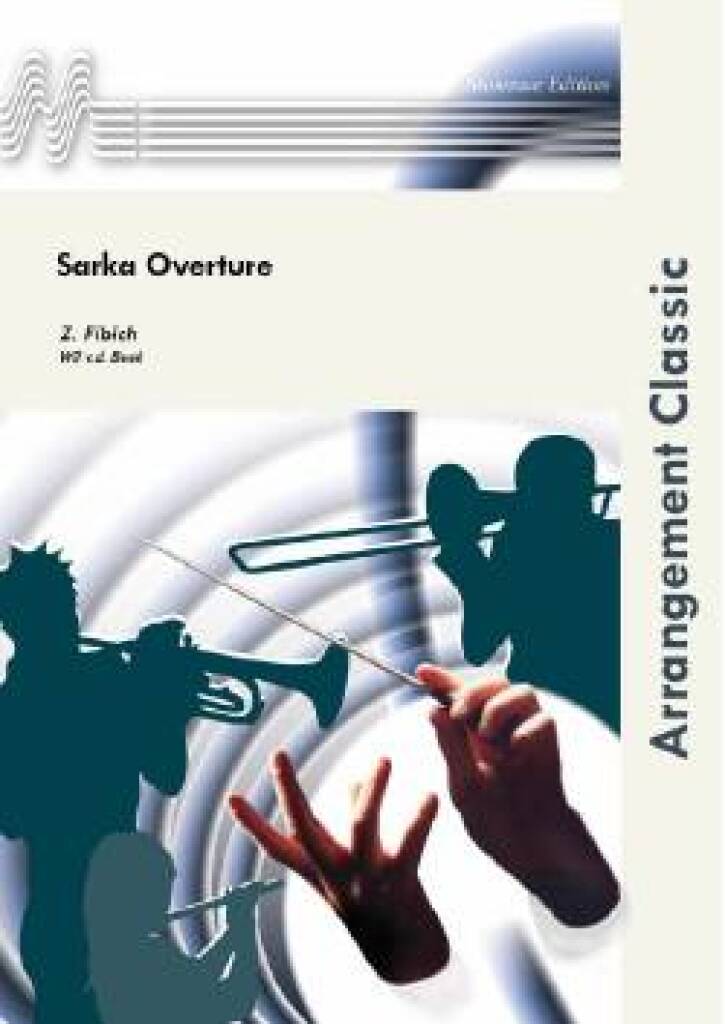 £140.80
Sarka Overture - Zdenek Fibich
This overture introducing Fibich's opera 'Sarka', was composed between 1896 and 1897 and is based on a famous Bohemian legend. Several Czech composers, such as Bedrich Smetana and Leos Janacek, have used this popular national story in opera's and symphonic poems. The relevant legend deals with Vlasta, the courageous Amazone Queen who has a quarrel with the Bohemian knights. After several battles she thinks of a cunning to conquer the knights. She leaves her ally, the beautiful Sarka, tied up to a tree in the middle of the forest. The knight Ctirad finds her, frees her and takes her back to his camp. In the evening he organizes a kind of victory celebration with his friends. At night, while the knights sleep it off, Sarka calls the Amazones. The latter have no difficulties to conquer the sleeping knights. Fibich does not keep strictly to the original legend and made quite some changes, especially at the end of the story.
Estimated dispatch 7-14 working days
-
Each Life Converges - Peter Meechan
Each Life Converges was written to celebrate the retirement of my dear friend Terry Austin.Writing a piece to celebrate someone you know so well is such an honour - and as I reflected on his wonderful career as a musician, teacher, and administrator I couldn't help but think of the lives that are richer because of Terry Austin. Whether that is students who have gone on to become teachers and inspired their own generations of musicians (who will no doubt go on to inspire further generations), or people who have got to know him through music and maybe taken other paths through life, but are forever enriched by all he gave and continues to give.Just as Terry inspired others, he was himself inspired and shaped by his mentors, colleagues, and - perhaps most importantly - friends. In Each Life Converges I try to show this through an initial simple melody from which, on each repetition, new countermelodies and musical lines grow, always enriching the main melody.No words about Terry would ever be complete without mentioning his dearly missed friend, Dennis Zeisler - someone who, like Terry, enriched the lives of all those who were fortunate enough to encounter him. Each Life Converges is written in memory of Dennis and dedicated to my friends Terry and his wife Tracia on the occasion of Terry's retirement.Each Life Converges was commissioned by Tiffany Hitz and Matthew McCutchen, and was premiered by the Virginia Commonwealth University Alumni Band, conducted by Duane Coston, June 11 2022.Peter Meechan 2022
Estimated dispatch 5-14 working days
-
Dreams Unseen - Peter Meechan
A number of traumatic global events over the past year have tested humanity. The global pandemic, racism, human rights issues, the discovery of thousands of unmarked Canadian Indigenous children's graves and climate change are testing humans' willingness to listen, hope and seek change. This three-movement work is a journey through silence, resistance and hope.Dreams Unseen begs the question, "Are we listening?"As people around the world endure and cope with significant loss, isolation, uncertainty and fear, Dreams Unseen contemplates the journey through uncertain times and is fraught with the complexities of today. As we continue to endure loss and uncertainty, we must have faith in resilience, goodwill and hope for a brighter future.Jacquie Dawson, August 2021Note from the composerWhen composing Dreams Unseen I was faced with a variety of decisions and complexities. Initially commissioned with the idea of conveying joy and hope as we emerged, or hoped to emerge, from a pandemic, too much happened around us in the world - locally, globally, and personally - that made the initial goal of the piece something that didn't represent so much that I saw.This made the selection of texts particularly difficult.As time passed, the texts originally selected became less and less appropriate to what I wanted to say, and, as the unmarked graves of murdered Indigenous children were uncovered throughout Canada on a daily basis, I felt compelled to move away from joy and the promise of hope to instead write about listening, to put hope in a more fragile, truthful context, to be grateful for those who never gave up, those who stood up in the face of all that was happening - the scientists, the leaders, people we've never met, people we know. It felt that the only way I could say all that I wanted to say as a composer was to write my own words.The first movement, In Silence, I ask us not to just hear, but to listen. It is only once we understand the truth that we can truly begin the process of reconciliation. The second movement, In Resistance, is my amazement at those who stood up in these times of adversity - specifically the scientists who saved our lives and those who continue to fight for what it right in the face of a seemingly impossible situation. I continue to believe that, because of those people, love will win, and lyrically I wanted to pay homage to that; The Beatles "In My Life" and Dr. King's "I Have A Dream" speech are both referenced.The final movement, In Hope, also takes existing words as an inspiration. The Rodgers and Hammerstein song "You'll Never Walk Alone" has been a song so close to my heart throughout my life, in the good times and difficult times alike. None of these times have been more difficult than losing a friend during the pandemic. His fight with cancer was driven by hope. A wonderful musician and human, he would also turn to "You'll Never Walk Alone" - so I chose this final movement to pay homage to the song, to my dearly missed friend, and to the idea that hope - for a better future, for a win against an almost unstoppable disease, for those whose voice is so often not heard to be listened to, and that Dr. King's words will come true - is everything.Pete Meechan, August 2021With funds from:Desautels Faculty of Music at the University of Manitoba - Jacquie Dawson, Director of BandsUniversity of Kansas - Paul Popiel, Director of BandsAnd the following commissioning partners:Arizona State University - Jason Caslor, Director of BandsGeorgia State University - Robert Ambrose, Director of BandsMarietta College - Nils Landsberg, Director of BandsNew Mexico State University - Michael Mapp, Director of BandsOregon State University - Erik Leung, Director of BandsThe Desert Winds - Charles Maguire, Artistic DirectorUniversity of Colorado Boulder - Donald McKinney, Director of BandsUniversity of Missouri - Brian Silvey, Director of Bands, and Amy Knopps, Associate Director of BandsUniversity of North Florida - Erin Bodnar, Director of BandsUniversity of Texas - Jerry Junkin, Director of BandsUniversity of Toronto - Gillian Mackay, Director of Winds ConductingValdosta State University - Ben Harper, Director of BandsWright State University - Shelley Jagow, Director of Bands
Estimated dispatch 5-14 working days
-
The Legend of King Arthur - Peter Meechan
King Arthur is the subject of many tales, stories, myths and legends - from his ascension to the throne by pulling the sword from the stone, his courageous battles with his fellow Knights of the Round Table, to his ultimately tragic love for Guinevere.The Legend of King Arthur is a musical portrayal of some of the most important moments in the legend.The opening of the work - a rock inspired overture - is a reference to Arthur's final resting place (at least, so some legends have it!), the modern day Glastonbury (Avalon in the legend), and it is in this opening that we hear for Arthur's theme.This high octane opening gives way to a mysterious section - as Merlin (the mystical wizard) places in a stone a sword, upon which was inscribed "Whoso pulleth out this sword of this stone is the rightwise born king of all England". The music describes the mystical surroundings as each of the contenders for the throne take their turn - to no avail - and with a return to the original theme, we hear Arthur pull the sword from the stone, to become King of England.Next we hear a depiction of Arthur's greatest victory in battle - The Battle of Mount Badon. He finally defeated the Saxon invaders of Britain - over 900 Saxons perished - and the victory brought about an extended period of peace. Arthur is portrayed as brave, bold and confident as he and his Knights end years of invasion.The penultimate section of the work tells the tale of Arthur's tragic love for Guinevere - his traitorous wife, who through her infidelity with Sir Lancelot (Arthur's most trusted Knight), ultimately leads Arthur in to his final battle with his nephew, Mordred.We hear the final bitter battle, which eventually ends with only Arthur and Mordred fighting. Arthur is wounded, fatally, by his nephew -at which point we hear with a sudden and dramatic sounding of Arthur's theme - and is taken to Avalon to die.
Estimated dispatch 5-14 working days
-
Letters For Home - Peter Meechan
Letters for Home is a three movement work, commissioned by East Lancashire Concert Band with support from Arts Council England, to commemorate the start of the First World War, and the role played in the war by the 'Accrington Pals'. Before each movement a reading should be made - these may be a letter sent from The Front, WW1 poetry, thoughts and reflections recorded elsewhere, or new words, written by local poets, school children or others.Whilst specifically concerned with the First World War, each of the work's movements broadly outlines emotions that would form part of any soldiers lives during any war - and as such, performances of this work can easily be adapted to reflect other wars both modern and historical, and locally sourced words for the readings is highly encouraged.The first movement, "The Bittersweet Love Song" is the story of a soldier saying goodbye to his loved one before leaving for war. The opening passages are of the soldier, perhaps putting to the back of his mind the danger he is facing, singing a love song to his wife or girlfriend. In the following passages we hear his loved one singing "I love you", played by the flute section.We again hear the soldier singing - this time with more of a sense of what lies ahead for him, but now the response is further away as they gradually move more distant from each other. The movement ends without conclusion, but with chords for the soldier's song played hauntingly over the percussion.The second movement, "The Trench", is more self-explanatory. It combines bravado in the percussion opening with the whole band coming together as one - as a unit, before again we hear fear and trepidation in the brass, once more failing to reach a resolution. Perhaps the thoughts of the soldier are interrupted as the percussion once more calls the men to arms. The movement ends with gun shots in the percussion.The final movement, "In Memory", opens with a repetition of the love song from the opening movement, before a slow lament, again never resolving, is heard. It keeps finding a new key, a new place, intending to represent the cyclical nature of war, and again without resolution, suggesting that war is also often that way.Letters for Home is dedicated to Ian McGuinness, whose support, enthusiasm, and sheer hard work led to this work being commissioned and performed, and to the East Lancashire Concert Band, who gave the premiere on 27 September 2014, at the Town Hall, Accrington, home of the Accrington Pals, with the final revision of the work being completed in November of the same year.
Estimated dispatch 5-14 working days
-
£29.95
Share My Yoke - Score and Parts - Joy Webb
Program NotesMajor Joy Webb has a unique and special gift for writing songs that achieve massive popularity, both for the purity of their musical integrity and for the depth of their poetic and literal strength. One of the members of The Salvation Army's 1960s phenomenon "The Joystrings," Joy Webb has a string of popular songs to her name, several of which contributed to the charts successes of enjoyed by the group. In more recent years, many of her tunes have found their why into instrumental repertoire.A prime example of Joy's remarkable gifting is her beautiful Share My Yoke. Although the deeply spiritual words of Share My Yoke may be unfamiliar to some, the sheer beauty of the melody is without doubt. The chorus is reproduced here to offer an insight into the song's meaning:Your slightest movement I will feel and understand.Share my yoke, and come the way that I must go,In our togetherness my peace you'll know.The world beholding us will see it's so.Calling for real sensitivity both from soloist and accompanying group, this is an extremely rewarding piece to play - and a moving listening experience for the audience.The arranger, Ivor Bosanko, who lives in California following retirement from the post of Territorial Music Director in The Salvation Army's USA Western Territory, is himself a respected songwriter, composer and arranger. He has produced this wonderfully sensitive and evocative arrangement of the song for cornet soloist and band. Already widely used and recorded in its original brass band form, this arrangement for concert band will undoubtedly be a useful and valuable addition to repertoire.
Estimated dispatch 7-14 working days
-
£5.95
Share My Yoke - Score only - Joy Webb
Program NotesMajor Joy Webb has a unique and special gift for writing songs that achieve massive popularity, both for the purity of their musical integrity and for the depth of their poetic and literal strength. One of the members of The Salvation Army's 1960s phenomenon "The Joystrings," Joy Webb has a string of popular songs to her name, several of which contributed to the charts successes of enjoyed by the group. In more recent years, many of her tunes have found their why into instrumental repertoire.A prime example of Joy's remarkable gifting is her beautiful Share My Yoke. Although the deeply spiritual words of Share My Yoke may be unfamiliar to some, the sheer beauty of the melody is without doubt. The chorus is reproduced here to offer an insight into the song's meaning:Your slightest movement I will feel and understand.Share my yoke, and come the way that I must go,In our togetherness my peace you'll know.The world beholding us will see it's so.Calling for real sensitivity both from soloist and accompanying group, this is an extremely rewarding piece to play - and a moving listening experience for the audience.The arranger, Ivor Bosanko, who lives in California following retirement from the post of Territorial Music Director in The Salvation Army's USA Western Territory, is himself a respected songwriter, composer and arranger. He has produced this wonderfully sensitive and evocative arrangement of the song for cornet soloist and band. Already widely used and recorded in its original brass band form, this arrangement for concert band will undoubtedly be a useful and valuable addition to repertoire.
Estimated dispatch 7-14 working days
-
 £65.00
Freyja's Call - Andrew Duncan
According to Viking mythology, following a battle the bravest souls of the slain would be divided between two Gods, Odin and Freyja. Freyja was the Goddess of Love and War and before going into battle many Viking warriors would pray that they would die bravely so that Freyja would take their soul to join her personal army made up of the souls of the bravest of men.'Freyja's Call' describes one of these, a young Scottish soldier, going into battle as part of the Viking army who occupied parts of Scotland for four centuries. First, a slow theme is heard, Freyja's theme, which is the soldier praying to Freyja to keep a watch on him. Then the drums introduce a new rhythm which announces the beginning of the battle.A Celtic Jig is used to describe the progress of the battle with the jig played quietly at first then gradually louder with more percussion being added until a full ff section signifies the soldier fighting the enemy directly.Suddenly, the music drops back to the quiet Jig theme. The soldier has been slain, but will he be chosen by Frejya? After a short time, Freyja's theme is heard as the brave soldier is taken to Freyja's heavenly army of brave warriors, and the piece then ends in triumph.
In stock: Estimated delivery 1-3 days
 View Music