
Results
-
 £159.99
Guardian Angels - Kevin Houben
Guardian Angels gives a musical expression to the legend of Reverend Louis Henri Bhler referring to the use of Psalm 34.North-west Veluwe and in particular Oldebroek (The Netherlands) has a very rich religious tradition which is demonstrated by its monumental churches. They tell the story of a stirring history in which Reverend Bhler played a crucial role. Inspired by his arrival as a pastor in 1870 in the neighbouring Oosterwolde, two big religious communities came into existence with their characteristic churches but this rivalry also resulted in great social unrest.This composition reflects on this striking personality and in particular on the story of the Angel Guard.'One evening Reverend Bhler has given a sermon in Oldebroek and he walks over the Church path through the pastures to Oosterwolde. On this dark and stormy evening Bhler's opponents are waiting for the pastor in ambush. They want to drown him in a watercourse near the Church path but abandon their plan because Bhler is accompanied by two men. The next day it comes to an encounter between Bhler and his opponents. They repent their, fortunately unexecuted , plan. Bhler firmly believes that on the previous night he walked alone over the Church path, and was not accompanied by two men. It was concluded that it must have been the angels who had protected Bhler.'Psalm 34 is central to this composition and this because of its powerful melody but also because the lyrics of verse 4 of the rhymed version fit in well with the special legend of Reverend Bhler:The Lord's angel gathered round himAn invincible heavenly guard,Who tries God's will, around himSo he's well guard(ed)A second melodious and harmonic cell is a musical transformation of the name 'Bhler'. This cell is varied in major and minor third chords and sometimes used as the main idea or apotheosis, but also serves as an accompanying cell or as a bridge between other melodic and rhythmic constructions.The composition was made possible by contributions of: Mr Evert van de Poll, owner of the Van Gelder Groep, Het Prins Bernhard Cultuurfonds Gelderland en Het Feteris Oosterbaan Fonds.
Estimated dispatch 7-14 working days
-
 £149.40
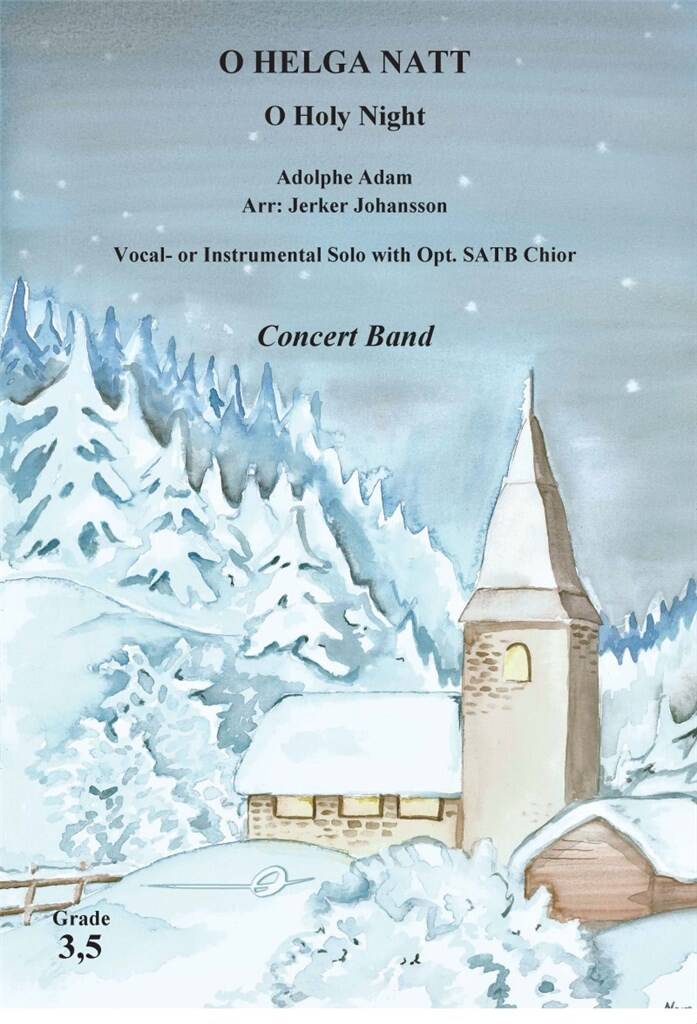
O Helga natt - Adolphe Charles Adam
O Holy Night is a very well-known Christmas carol. The origin of the carol is French beginning with the words: "Minuit! Chrtiens, c'est l'heure solennelle". It is about the birth of Jesus and was written in 1843 by a wine merchant and poet by the name of Placide Cappeau (1808 77). He turned to the composer Adolphe Adam (1803 56) and asked him to write a suitable melody. The result was brilliant and the carol was premiered in Cappeau's home town Roquemaure in 1847 by the opera singer Emily Laurey. Based on Cappeau's French text, the English version was written in 1855 by an American Unitarian (Calvinist) minister by the name of John Sullivan Dwight (1813 93). Adolphe Adamwas the son of the pianist and composer Louis Adam (1758 1848), who did not want his son to follow in his foot-steps as a musician. However, Adolphe wanted otherwise, and already at the age of 17 he was accepted to study at the music conservatoire in Paris. He was a student under Franois Adrien Bo eldieu and composed several comical operas that became successful. After the July-revolution 1830 Adam moved to London. He worked for a couple of years before returning to Paris, where he founded a new opera house in 1847, the Th tre national. After the revolution in 1848 it had to close and Adam was ruined, why he had to go back to composing. In 1856 he concluded the ballet Le Corsaire, which together with the ballet Giselle are his most performed works today.
Estimated dispatch 7-14 working days
-
 £435.40
Goldberg 2012 - Svein H. Giske
The first time I heard Bach's Goldberg Variations was in the movie Silence of the lambs, in the early 1990s. I noticed the beautiful background music in one of the scenes, but at that time I didn't know what it was. A few years later, when I was studiying at the Grieg Academy, I got to know the entire piece. For me, this is a piece of music which I can listen to countless times. I think it sounds as fresh today as it did more than 15 years ago and it never ceases to inspire me. Both Bach's composition and Glenn Gould's famous 1955 recording (which was the first one I heard) still makes a great impression on me. Before Gould recorded it at age 22, it wasn't a highly ranked piece amongst pianists and Bach was by many viewed as a bit old-fashioned. The young Canadian turned all this around. He managed to portray Bach in a reformed way, producing fine nuances in phrasing and making the many layers in Bach's music more transparent than anyone before him. Thus he plunged both himself and Bach (back) onto the international music scene. When The Norwegian Band Federation (NMF) asked me to write the test piece for NM in 2012, it was only natural for me to use the Goldberg Variations as a starting point and inspiration for my work. Since I was a teenager at NMF's summer courses in the mid eighties I've always listened to many different styles of music. Growing up in Sunnmre with the Brazz Brothers as teachers and mentors, jazz-, pop/rock- and folk music were early on a natural part of my musical background. I also have my classical education from the Grieg Academy on trumpet. As the title of my piece implies, I've wanted to bring Bach to the present and put his music into various modern musical landscapes. I think you can bring about a special kind of energy when music from different genres are mixed and I've tried to do this by mixing Bach with artists and musical styles from the present. In Goldberg 2012, the music is often constructed by several layers, which in a way are living parallel musical lives. They are seemingly moving or floating freely, almost unaware of each other, but bound together by the same basic pulse. The rythms, however, are often notated on a different rythmic subdivision level than the usual 8th- or 16th note levels. By doing this, I hope to achieve transparent sounds that rythmically are perceived as more free and detached from each other. In large sections of the piece, pop/jazz is fusioned with elements from Bach. I guess you could have this little scene as a synopsis for the piece: picture a group of musicians meeting: some are classical performers, some are jazz. They start to improvise together, each in their own voice or musical dialect and I'm sort of in the middle, trying to write down what they are playing. This is what I feel much of Goldberg 2012 is about. The foundation of the piece, in addition to Bach and references from pop/jazz music, lies also in my own material. This material, basically two chords, is heard in it's purest form in the 1st movement. I use these chords to create scales, new chords and different motifs which contribute to blend together the different moods of the piece. It has not been my intention to copy Bach's form (theme and 30 variations), but rather to use the bits and pieces that I like the most as an inspiration for my own variations. The 1st movement, Aria 2, is for my 3rd son, Olav, who was born on the 21st of April 2011, and the 5th movement, From long ago, is dedicated to the memory of my father, Svein J. Giske, who passed away on the 6th of June 2011. -Svein H. Giske, January 2012-
Estimated dispatch 7-14 working days
-
 £123.20
3 Letzte Motetten - Anton Bruckner
Anton Bruckner (b. 4.9.1824, Ansfelden, d. 11.10.1896, Vienna) didn't have it easy. Throughout his life, the Austrian composer was plagued by self-doubt. Anton Bruckner came from a simple, rural background. After the death of his father, he was accepted as a choirboy at the monastery of Sankt Florian in 1837. After several years as a school assistant and his own organ and piano studies, he first worked as organist in St. Florian, then from 1855 as cathedral organist in Linz. Introduced to music theory and instrumentation by Simon Sechter and Otto Kitzler, he discovered Richard Wagner as an artistic role model, whom he admired throughout his life and also visited several times in Bayreuth.In 1868 Anton Bruckner became professor of basso continuo, counterpoint and organ at the Vienna Conservatory; ten years later court organist; and in 1891 finally honorary doctor of the University of Vienna. He was considered an important organ virtuoso of his era, but had to wait a long time for recognition as a composer. It was not until Symphony No.7 in E major, composed between 1881 and 1883, with the famous Adagio written under the effects of Wagner's death, that he achieved the recognition he had hoped for, even if he was reluctant to accept it given his inclination towards scepticism and self-criticism.Anton Bruckner was a loner who did not want to follow a particular school or doctrine. He composed numerous sacred vocal works, such as his three masses, the Missa Solemnis in B flat minor (1854), the Te Deum (1881-84) and numerous motets. As a symphonic composer, he wrote a total of nine symphonies and many symphonic studies from 1863 onwards, tending to revise completed versions several times over. Bruckner's orchestral works were long considered unplayable, but in fact were merely exceptionally bold for the tonal language of their time, uniting traditions from Beethoven through Wagner to folk music, on the threshold between late Romanticism and Modernism.Anton Bruckner composed about 40 motets during his lifetime, the earliest a setting of Pange lingua around 1835, and the last, Vexilla regis, in 1892.Thomas Doss has compiled some of these motets in this volume for symphonic wind orchestra.These motets show many characteristics of personal expression, especially Bruckner's colourful harmony in the earlier works, which is in places aligned with Franz Schubert (changes between major and minor; and movements in thirds). Later works are characterised by many components which, in addition to the expanded stature of the movements, include above all a sense of the instrumentation as an outward phenomenon and the harmony as a compositional feature that works more internally. Some aspects of Bruckner's work are the result of his long period of study, which familiarised him not only with the tradition of his craft, but also gave him insights into the "modernity" of his time in such composers as Wagner, Liszt and Berlioz.From this developed his personal standpoint, which always pursues the connection between the old and the new.
Estimated dispatch 7-14 working days
-
 £256.00
14 Motetten - Anton Bruckner
Anton Bruckner (b. 4.9.1824, Ansfelden, d. 11.10.1896, Vienna) didn't have it easy. Throughout his life, the Austrian composer was plagued by self-doubt. Anton Bruckner came from a simple, rural background. After the death of his father, he was accepted as a choirboy at the monastery of Sankt Florian in 1837. After several years as a school assistant and his own organ and piano studies, he first worked as organist in St. Florian, then from 1855 as cathedral organist in Linz. Introduced to music theory and instrumentation by Simon Sechter and Otto Kitzler, he discovered Richard Wagner as an artistic role model, whom he admired throughout his life and also visited several times in Bayreuth.In 1868 Anton Bruckner became professor of basso continuo, counterpoint and organ at the Vienna Conservatory; ten years later court organist; and in 1891 finally honorary doctor of the University of Vienna. He was considered an important organ virtuoso of his era, but had to wait a long time for recognition as a composer. It was not until Symphony No.7 in E major, composed between 1881 and 1883, with the famous Adagio written under the effects of Wagner's death, that he achieved the recognition he had hoped for, even if he was reluctant to accept it given his inclination towards scepticism and self-criticism.Anton Bruckner was a loner who did not want to follow a particular school or doctrine. He composed numerous sacred vocal works, such as his three masses, the Missa Solemnis in B flat minor (1854), the Te Deum (1881-84) and numerous motets. As a symphonic composer, he wrote a total of nine symphonies and many symphonic studies from 1863 onwards, tending to revise completed versions several times over. Bruckner's orchestral works were long considered unplayable, but in fact were merely exceptionally bold for the tonal language of their time, uniting traditions from Beethoven through Wagner to folk music, on the threshold between late Romanticism and Modernism.Anton Bruckner composed about 40 motets during his lifetime, the earliest a setting of Pange lingua around 1835, and the last, Vexilla regis, in 1892.Thomas Doss has compiled some of these motets in this volume for symphonic wind orchestra.These motets show many characteristics of personal expression, especially Bruckner's colourful harmony in the earlier works, which is in places aligned with Franz Schubert (changes between major and minor; and movements in thirds). Later works are characterised by many components which, in addition to the expanded stature of the movements, include above all a sense of the instrumentation as an outward phenomenon and the harmony as a compositional feature that works more internally. Some aspects of Bruckner's work are the result of his long period of study, which familiarised him not only with the tradition of his craft, but also gave him insights into the "modernity" of his time in such composers as Wagner, Liszt and Berlioz.From this developed his personal standpoint, which always pursues the connection between the old and the new.
Estimated dispatch 7-14 working days
-
 £105.80
Magellano - Andrea Moncalvo
This composition was written on the occasion of the 500th anniversary of the death of Ferdinand Magellan, a Portuguese explorer (1480 - 1521), who embarked on what would have become the first circumnavigation of the globe. Unfortunately, he did not complete it because, in 1521, he was killed in the region that is today the Philippines. This adventure triggered various images in the author's mind; evocations that the composer elaborated in this piece, which is in a tripartite form (A B A) and is introduced and concluded by a solemn fanfare evoking the departure of the expedition, consisting of 5 ships with a total of 234 crewmen. The first part (Allegro) presents a main theme with a cantabile character that describes the fleet that, intrepid, plows the ocean. This initial melody is then contrasted by a more rhythmic and syncopated theme in a minor key, which instead refers to the indigenous peoples they have encountered during the journey. The central section (Adagio) is an oasis of reflection because, as in other great adventures, this too has tragic aspects: mutinies, shipwrecks, clashes with indigenous peoples, up to the disappearance of those who had desired and planned this enterprise. The last part proposes the themes of the first section but in reverse order, to describe the return to the homeland. The solemn fanfare welcomes the arrival of the Victoria, the only surviving ship with only 18 men on board, which returns to the port of departure after completing the circumnavigation of the earth in 2 years, 11 months, and 17 days.
Estimated dispatch 7-14 working days
-
 £53.95
Buffalo Rock - A Royal Portrait - James Rae
James Rae is the man who put fun into woodwind and brass teaching. His many compositions, especially in the jazz and blues idioms, have often featured on examination syllabuses. Recent years have seen his publications of easy flexible ensembles for younger players and now he turns his attention to the wind band. In his series The Concert Band Collection, he has written exciting new pieces for the standard concert band line up. Attention is given to each instrument so that the technical and musical requirements do not exceed UK Grade 2. An optional piano part will provide "stuffing" and moral support for the young players who will quickly enjoy James' catchy and imaginative music. Each volume contains two titles. Buffalo RockThis piece has been specifically composed for bands in their early stages of development. All instrumental parts have been written in comfortable keys and ranges with all clarinet parts staying entirely in the low register. After a short, powerful introduction, the music immediately kicks in to a driving rock mode, setting the scene for the remainder of the piece. Strong rhythmic playing is required from all sections of the band in order to achieve a solid performance. A Royal PortraitThis piece is very regal in style and portrays all the pomp and circumstance that surrounds a high-profile state occasion. It is to be performed with a full, warm sound and players must resist the temptation to overblow as this could have a detrimental effect on tone quality and intonation. As with Buffalo Rock, the instrumental parts have been written in comfortable keys and ranges with all clarinet parts staying entirely in the low register.
Estimated dispatch 7-14 working days
-
 £82.50
Romp! - Darren W. Jenkins
Romp! was inspired by and dedicated to the composers very cute tabby who decided that his computer table (where he composes) was his spot to be... also when coming up with ideas for this piece, it seemed to fit him very well. The piece represents how he tends to wake up instantly and spring into action... running and darting here and there. The solo breaks and legato section represents how he can shift gears, stopping quickly, then springing right back to his romping around. There is optional "cat meowing" at the end that can be done by one person, if your group has someone who does a good cat meow, or electronically if you have the equipment. Or you can leave it out, though it does add a nice touch.
Estimated dispatch 7-14 working days
-
 £53.95
Big Screen Fanfare ? Rockbuster - James Rae
James Rae is the man who put fun into woodwind and brass teaching. His many compositions, especially in the jazz and blues idioms, have often featured on examination syllabuses. Recent years have seen his publications of easy flexible ensembles for younger players and now he turns his attention to the wind band. In his new series "The Concert Band Collection", he has written exciting new pieces for the standard concert band line up. Attention is given to each instrument so that the technical and musical requirements do not exceed UK Grade 2.5. An optional piano part will provide "stuffing" and moral support for the young players who will quickly enjoy James' catchy and imaginative music. Each volume contains two titles.Each volume features two titles. This one includes "Big Screen Fanfare", a fanfare in the style of a Hollywood movie theme and the cool "Rockbuster". A score of this edition (without the parts) is available with the number UE21792.
Estimated dispatch 7-14 working days
-
 £53.95
Secret Fairground ? Blue Strut - James Rae
James Rae is the man who put fun into woodwind and brass teaching. His many compositions, especially in the jazz and blues idioms, have often featured on examination syllabuses. Recent years have seen his publications of easy flexible ensembles for younger players and now he turns his attention to the wind band. In his new series "The Concert Band Collection", he has written exciting new pieces for the standard concert band line up. Attention is given to each instrument so that the technical and musical requirements do not exceed UK Grade 2.5. An optional piano part will provide "stuffing" and moral support for the young players who will quickly enjoy James' catchy and imaginative music. Each volume contains two titles.Each volume features two titles. This one includes the haunting and nostalgic waltz "Secret Fairground" and a dynamic masterpiece called "Blue Strut". A score of this edition (without the parts) is available with the number UE21793.
Estimated dispatch 7-14 working days
 View Music