
Results
-
£233.99
Transfiguration - James Curnow
James Curnow explores many domains of sound with this wonderful piece. Four extensive variations, based on the melody of the hymn All Praise to You, Oh Lord, together form a beautiful piece of music for use in church services. The composer has a fresh view of the theme in the various fragments of the melody, from ethereal reflections to passionate joy. The last variation starts softly but energetically, and keeps developing using the last phrase of the melody - until the majestic highlight of this glorious hymn begins.
Estimated dispatch 7-14 working days
-
£67.50
Space Probe - James L. Hosay
Now your band can boldly go where no band has gone before, and bring the "final frontier" to your concert band stage! Here's James L. Hosay's imaginative new tone poem SPACE PROBE. Since the 1970's, NASA has been launching long-range, solar-powered probes into space. Over the past 30 years, the Voyager, Pioneer, and Galileo series' probes have sent back incredible photographs. The data sent to Earth by these probes, along with recent photos and information gathered by the orbital telescope, Hubble, has helped astronomers chart the ever-expanding universe all the way back to its origins. This composition provides excellent opportunities for cross-curriculum teaching withscience. A scintillating musical spacescape ushers in the bold thematic statement in the Trumpets and Alto Saxophones. French Horns join in thrilling variation. A boundless contrasting espressivo theme soars through to the reprise of the initial ideas. Explore SPACE PROBE with your band this year. Inspiring!
Estimated dispatch 7-14 working days
-
£54.99
Don't Fall off the Housetop! - Timothy Johnson
This light and fanciful arrangement will bring a sparkle to your holiday performance! The skillful use of variation and counterpoint will surely catch your students' imagination as they practice their parts and prepare for the performance.Considerations such as staccato playing and dynamic contrasts make this a great teaching tool as well as an enjoyable and entertaining excursion up to the rooftop. Every section has something fun to play so the students, as well as their parents and friends, will love it.Imaginative!
Estimated dispatch 7-14 working days
-
£94.99
Operatica - James L. Hosay
If you seek truly dramatic music, look to opera. Opera has been enormously influential on Classical, Popular, and Film and Television music over the years. James L. Hosay's new intermediate level piece, OPERATICA, incorporates the important elements of Opera and Classical music to bring exhilarating drama to the concert band stage. Style and technical considerations make this a rich learning experience for the band. Add in the dimension of music history by studying Opera and Classical music, and you have a wonderful teaching tool! The grand theme explores a multitude of colors as it twists and turns its way through opera-style development and variation. Whether for formal, festival,or spring concert use, you will find this to be a thrilling addition to your library.Opulent!
Estimated dispatch 7-14 working days
-
 £116.40
Little Studies on a Folk Song - Henk van Lijnschooten
These variations on a popular Dutch children's song about a 'Count from The Hague' are infact studies in orchestral playing. Aspects dealing with playing in tune; overall sound; ensemble playing; rhythm; articulation and dynamics are paid attention to.The scoring is stricktly limited to four-part-harmony, which makes this work suitable for incomplete orchestras or other windgroups and youth orchestras.When performing with a full band it is recommended to vary the scoring according to the character of each respective variation. In this way the conductor can have a creative share in the overall performance of this music.
Estimated dispatch 7-14 working days
-
 £61.00
Day You Sang This Song
A beautiful variation on Beethoven's fifth pianoconcerto. This work may be performed with mixed choir (S.A.T.B.) or male choir (T.T.B.B.) or just windband (HaFaBra).
Estimated dispatch 7-14 working days
-
£116.40
Paganini Variations - Niccolò Paganini
A lot of composers, such as Brahms, Rachmaninov, Lutoslavski and many others used the Caprice nr.24 for violin solo by Paganini, to write a series of variations. This time that favourite theme has been used to write a series of variations for band. This work, commissioned by SAMO Nederland lasts about 9 minutes.The theme is followed by eight variations and a coda. Two quick variations alternate twice with a slower variation, whereas the final is written in a waltz tempo leading to a magestic coda as conlusion. All variations are played without interruption.
Estimated dispatch 7-14 working days
-
 £61.00
Choral Prelude - Willy Hautvast
Choral Prelude starts with an impressionistic introduction, which leads to the mainstay of the composition, the actual choral tune played by the horns and basses.This theme is repeated several times under different aspects and in different orchestral settings. There is much variation in the dynamics and the work ends with a solemn and imposing final. Here is an ideal work to ge a good tone balance with the band.
Estimated dispatch 7-14 working days
-
 £286.40
Fifth Symphony - Alfred Reed
This work was commissioned by the Senzoku Gakuen College of Music in Tokyo in celebration of its 70th anniversary in 1994. However, in view of the invitation by WASBE (World Association of Symphonic Bands and Ensembles) for its Wind Orchestra to perform at the 7th annual convention of this association, to be held in Hamamatsu, Japan, in the summer of 1995, it was decided to premiere the music at that time instead of the anniversary year itself. The symphony is in three movements, with an introduction marked 'Moderately and sustained' leading to the first movement proper, a driving 'Allegro assai' whose main thematic material is first heard in the timpani and mallet percussion. The second movement, from which the symphony drives its sub-title, is an extended treatment of one of the oldest and most beloved Japanese folk songs 'Sakura' ('Cherry Blossoms'), a long-breathed elegiac melody taken as the basis for a free variation development through all the individual sections of the orchestra. The third movement is a brilliant rondo form (Allegro Molto, con fuoco) in which some elements of the preceding two movements are incorporated to bring the entire work to a breath-taking conclusion in a final burst of virtuoso performance from every instrument in the ensemble. The 'Fifth Symphony (Sakura)' was first performed on July 26th 1995, by the Senzoku Gakuen Symphonic Wind Orchestra under the direction of the composer, at the 7th WASBE Conference in Hamamatsu, Japan.
Estimated dispatch 7-14 working days
-
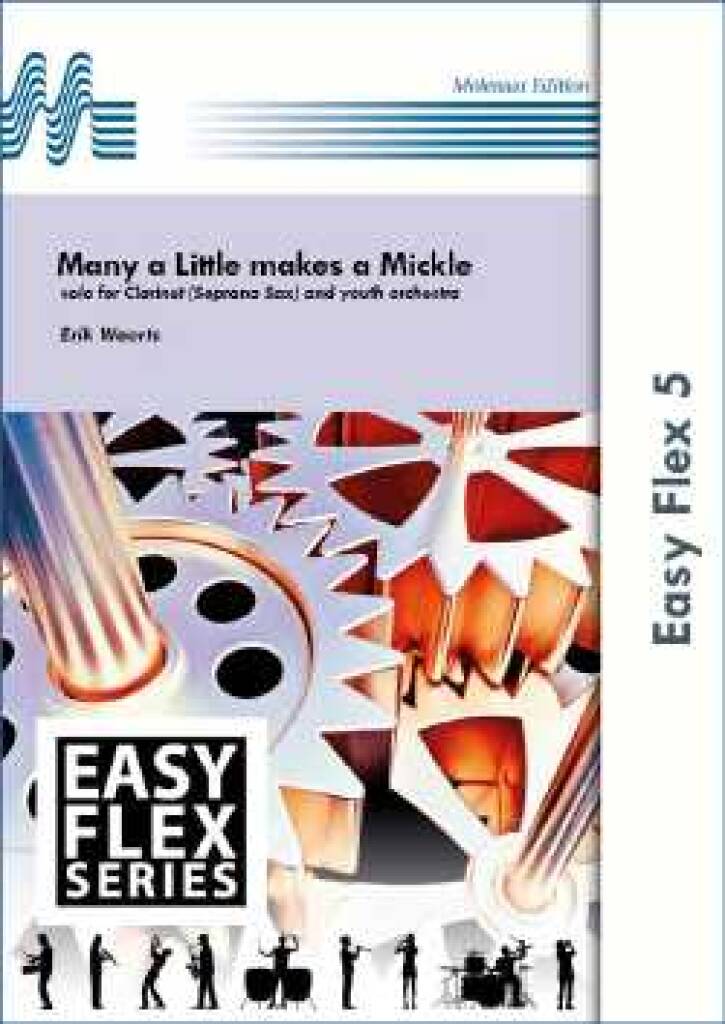 £60.90
Many a Little makes a Mickle - Erik Waerts
Look for some variation in the concert program of your youth wind band and put your best clarinettists to the fore. In 'Many a little makes a mickle' they can prove that the 'little ones' have more strings to their bow.
Estimated dispatch 7-14 working days
 View Music